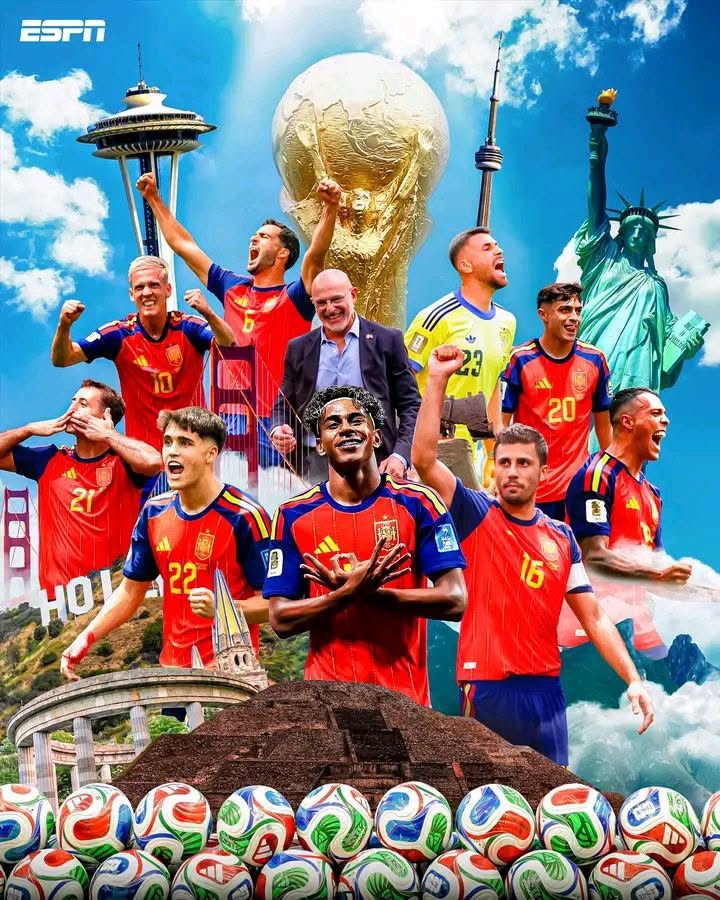
The 2026 FIFA World Cup ended in a grand style on Sunday, July 19, at the MetLife Stadium, New York New Jersey, with Spain lifting the coveted Cup with 1-0 against Argentina, the defending champions. Winner: Ferran Torres 106′ – substitute came on and fired it in after a Nico Williams header.
How Spain did it was spectacular. Torres, subbed on for Oyarzabal, scored in extra time. He became just the 5th substitute ever to score in a World Cup final and the 2nd Barcelona player after Iniesta 2010.
Argentina down to 10: Enzo Fernandez sent off for 2 yellows in 93′. Argentina had 0 shots on target in 120 minutes. Spain dominated and had 12 shots to Argentina’s 1. Outshot them 20-3 overall.
This is the 2nd World Cup title for Spain – first since 2010. Most clean sheets: 7; least goals conceded: 1 goal all tournament; longest unbeaten run: 38 games, breaking Italy’s 37; oldest manager to win: Luis de la Fuente at 65 years; 29 days; first nation to hold both men’s and women’s World Cup at same time – women won 2023.
For Messi 39, it was likely his last World Cup. Argentina couldn’t become first repeat champions since Brazil 1962. Spain got $50m prize money and had 1.8 million people welcome them in Madrid.
Records were set in the 2026 World Cup. It was the first with 48 teams, 104-games; World Cup co-hosted by USA, Canada, Mexico. So a lot of firsts got broken. Longest unbeaten run: 38 competitive men’s matches, broke Italy’s 37. Argentina: Equaled Brazil’s record of 11 red cards in World Cup history after Enzo Fernandez sent off. Argentina had 0 shots on target in 120 minutes. Spain had 12. Spain’s golden generation: won Nations League, Euros, and now World Cup under De la Fuente
The 2026 World Cup tournament is different in many respects. It is a unique World Cup that has no comparison with any other in the past. World Cup 2026 was ambitious, but “bigger with more problems”. With 48 teams and three host countries bracing the summer heat, FIFA was dealing with complex challenges it never faced before. The challenges were largely man-made arising from the geography, politics of soccer introduced by FIFA.
By joining three countries to co-host the tournament was novel with new challenges. Some of the host countries, particularly, the United State have standing travel restrictions against some countries. Coming at a time when the United States is cracking down on illegal immigration presents special problems for the game.
The distance between the host countries, namely USA, Canada and Mexico covers some 9.8 million km². That’s bigger than all of Europe. Concerning the teams, a group could play from Vancouver to Mexico City to Miami, which is some 12,000km round trip, 3 time zones, jet lag. Players will land, play 72hrs later, fly again.
As for the fans, a Nigerian fan following Eagles through group stage might spend $8k on flights, hotels just for 3 games. Domestic US flights are expensive plus delays. The carbon footprint should not be ignored. FIFA promised “carbon neutral” but 104 matches plus fan travel makes that almost impossible. Colombia 1986 gave up hosting because of costs. FIFA’s betting airlines with NFL stadiums can handle it.
There is also the issue of weather, kickoff times, and heat versus TV money. Between June-July in USA/Mexico, temperatures soar to 35°C-45°C in Houston, Dallas, Mexico City, and Guadalajara. Qatar solved it with winter and air conditioned stadiums. North America can’t. There was heatstroke risk. FIFA needed more water breaks and night games, but US TV networks Fox/Telemundo wanted 12pm/3pm ET for maximum viewers but 9am coincided with Pacific heat.
On the stadiums, only 6 of 16 stadiums have domed/retractable roof. The rest are open NFL stadiums. So MetLife, Dallas, Houston were like ovens. Quality of pitch after concerts/football in same week wa a worry. 1994 World Cup had terrible pitches.
Dealing with security, visas for 3 countries, 3 systems was onerous. Dealing with some 5 million fans, 48 fan bases, post-2024 US election tension. US visa wait times are 1-2 years in some African countries. Nigeria’s wait time was about 400 days in 2024. FIFA and the US government promised “fan visa” fast-track, which had not been tested before.
On border crossings: Fans wanting Canada, USA, Mexico games needed 3 visas/ETAs. One denial means trip ruined. Mass shooting risk: USA has stricter gun laws debate. Stadiums are “gun-free” but parking lots, fan fests are not. Security budget was reportedly more than $1bn.
Format chaos: 104 games, 3rd place teams. New format sounds fair, but created mess. With 2 teams and 8 best 3rd place going through, last group game could have teams playing for “lose by less than 2 goals” to qualify. There was match-fixing risk. Schedule imbalance: Some teams played 3 games in 11 days, others got 5 days rest. FIFA’s computer had to balance travel. Knockout round of 32: That’s 16 extra knockout games, which meant more extra time plus penalties causing player fatigue for final.
Who pays the money for infrastructure? FIFA reportedly makes $11bn, but cities pay the bill. Most are NFL stadiums. Cities like Los Angeles, New York didn’t build new, but smaller cities like Kansas City, Vancouver had to upgrade locker rooms, media centers at some $300m. FIFA reportedly needed 48 team base camps plus 16 “team hotels and training fields” per city. Rural cities didn’t have more 50 quality pitches .Affordability: 1994 tickets were $25-$349. 2026 tickets will be $60-$2000. There is risk for stadiums half-empty except final, like Brazil 2014.
Coming to Africa/Asia team challenges, 9 African slots is great, but travel from Africa takes 10-16hr flight plus 6-9hr time difference to USA/Canada. Jet lag kills performance. African teams in 1994/2002 struggled with this .Climate shock: Nigeria/Senegal players used to humidity, but dry Arizona/Utah heat plus altitude in Mexico City 2240m presented new challenge. Most African fans live in Europe, not USA. Cheaper to fly to Europe than to the USA. So “home advantage” went to USA/Mexico/Canada fans.
How FIFA is trying to fix it: Regional groups: Put groups mostly in one zone – West, Central, East. Only cross zones for knockout. Night games: 70% of games in hot cities were late evening local time. Teams arrived early to acclimatize. Truth is that the FIFA 2026 was the most logistically complex World Cup ever. it changed football forever. .
It is pertinent to ask if the USA is caused problems through entry restrictions. Actually, US entry rules are the primary headache for World Cup 2026. But “causing problems on purpose” vs “bureaucracy plus security” is the debate. FIFA and all 3 hosts signed a contract promising “easy entry for teams, officials, fans, and media”. USA struggled to deliver that promise.
FIFA President Infantino met US State Department in March 2026. Deal: “World Cup Visa” will use ticket and fan ID instead of full interview. That still needed Congress approval. Canada/Mexico easier: Canada eTA is 5minutes online, $7. Mexico visa is faster than US. So many fans were based in Toronto/Vancouver plus do day trips to USA border cities like Seattle. Team exemptions: Players, coaches, FIFA officials got “P-1 visa” fast-track. No problem for Eagles/Super Falcons. Problem was for fans/media. There was diaspora advantage: 1.2M Nigerians reportedly live in the USA. They don’t need visas. So US-based fans filedl stadiums more than African-based fans. USA isn’t trying to “sabotage” World Cup. The US immigration system was built for business/tourism, not for 48-team, 5-million-fan mega event. The visa bottleneck was real and FIFA was in crisis talks with Washington.
FIFA Somalia referee wasn’t allowed into the USA. It happened. Somali referee Omar Abdulkadi Artan was denied entry into the USA for World Cup 2026, even with a valid visa and diplomatic passport.He was set to make history as the first Somali referee ever at a World Cup.
According to reports of what happened at Miami Airport – June 2026, Artan, 34, landed at Miami International Airport on June 6 from Istanbul to join FIFA’s 52-referee training camp. But US Customs and Border Protection (CBP) held him for 11 hours of questioning. CBP said he was “determined to be inadmissible due to vetting concerns”. The Trump administration later claimed CBP found “derogatory information, including association with suspected members of terror organizations”. White House World Cup chief Andrew Giuliani said he was “talking to some very bad people right as he was coming to the United States”.
Artan denied any link to Al-Shabaab. “I had the right papers and everything… I’m just simply a referee who’s trying to live his dream”. He called it “unfortunate” and said “They have a problem with my country”.He was put on a flight back to Istanbul, then to Mogadishu. FIFA confirmed he “will be unable to train and officiate at the FIFA World Cup 2026 after he was denied entry”.
The question is why the referee had valid visa but still denied: Somalia was on Trump’s 2025 travel ban list with “full restrictions”. Artan’s denial fits a pattern – fans from Haiti, Senegal, Morocco, Iran/Iraq staff also faced US visa/entry issues. FIFA said it “is not involved in host country immigration processes”. But they paid Artan his full tournament fee anyway so he wouldn’t lose money. He rejected it: “I don’t want compensation. I wanted to referee at the World Cup”.
This became the first big proof that US entry restrictions are affecting officials, not just fans. Somalia’s sports ministry said “Denying him entry… undermines football’s commitment to fairness, merit, and the spirit of fair play. Ironically, UEFA then appointed him to referee the UEFA Super Cup PSG vs Aston Villa in August 2026, so his career isn’t over.
This is exactly the “entry restrictions causing problems” we talked about earlier. If FIFA officials with vetted visas can be turned back, fan visas look even riskier.
Dr. Onyekakeyah, a former member of The Guardian Editorial Board, is a public affairs commentator and a Daily Query columnist.