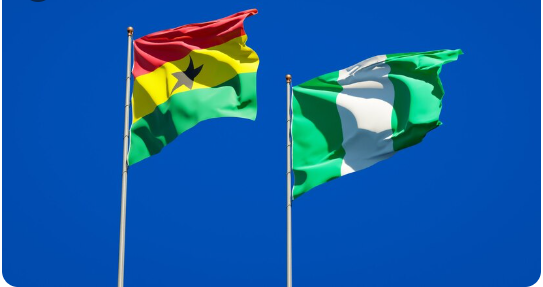
Reports of a rising wave of crackdown on Nigerians in Ghana are troubling and should be addressed. It portends a historic turn of events for both Nigeria and Ghana. The development underscores the philosophical axiom that nothing is absolute. Things change, sometimes very fast. What the future unfolds to a person, family or nation may depend on how the one plans it. Sometimes it goes beyond human capacity.
That Ghana, which in the 70s and 80s flooded Nigeria following a crushing economic hardship in that country is today waxing strong while Nigeria, hitherto, seen as the pearl of Africa is bastardised, can’t be imagined. But that underscores the reality of change. The obvious turn of events has given rise to perceived hostility and antagonism against Nigerians in Ghana.
First is the purported Igbo king in Ghana, referring to one Eze Dr. Chukwudi Jude Ihenetu, a Nigerian of Igbo extraction. His news has gone viral on the Internet and has created the false impression that a Nigerian wants to create an Igbo kingdom in Ghana, thereby undermining the country’s sovereignty. The reported installation of Eze Ihenetu sparked off a huge controversy among Ghanaians who seemed hell bent to resist the Nigerian’s intrusion in their country. But in his reaction, Eze Ihenetu maintains that his Ezeship is purely cultural and symbolic without any political or territorial intent.
It needs to be pointed out that of recent, Igbo leaders in the Diaspora have rightly or wrongly applied the little “Eze” to themselves, certainly, without any ulterior motives against their lost communities. Thus, there is “Ezeigbo” in virtually every country where there is Igbo community. Here in Nigeria, there is “Ezeigbo in Lagos, Ibadan, Kano, Kaduna, e.t.c. Across Europe, there are several Ezeigbo figures in Europe, particularly, in the U.K. and Ireland. The same Ezeigbo Ghana reportedly has connections with the U.K. and Ireland Ezes. There is Ezeigbo Japan Eze Dr. Chris Umeh. And on the side of Ghana, there is the Asante Queen U.K. and Ireland.
All these are symbol of unity and cultural identity and nothing more. The Ezes serve as a bridge between their people at home and abroad. There has been no reported case where Ezeigbo had turned to claim territorial powers in Diaspora.
The other day, I came across on the Internet Igbo compound in Virginia, USA. The facility, located in Staunton, Virginia, showcases traditional Igbo architecture and heritage. It features Igbo farm village, cooking shelters with great cultural significance for hosting cultural events. The facility serves as a great tourist attraction.
Interestingly, it is not only the Igbo that have organised communities or institutions for cultural identity in Diaspora, other country nationals also do. There are Lebanese and Indian communities in Lagos and other cities. There are Lebanese and Indian schools in Lagos. There are also British schools in Nigeria.
Against this backdrop, it is not clear why Ghana profiled Ezeigbo Ghana to the extent of staging a national protest against him. The demonstrations sparked off the “Nigeria Must Go” mass discontent, thereby reenacting the 1969 mass deportation of Nigerians from Ghana. Government’s decisive action against undocumented Nigerians and what it called “foreign-styled” chieftaincies has raised eyebrows. History is repeating itself. This move, together with rising economic hardship in Ghana, coupled with anti-immigration sentiments have crystallized into massive crackdown on Nigerians. Add these to a long standing historical grievances against Nigeria.
At the root of all this is the mass deportation of undocumented Ghanaians from Nigeria in 1983 under the popular “Ghana Must Go.” This appeared to be a retaliatory measure for a similar action by Nigeria. In 1969, under its alien compliance order, many Nigerians were deported from Ghana at the peak of the civil war in Nigeria. Consequently, a tit-for-tat game appears to be playing out. First was Ghana in 1969, followed by Nigeria in 1983 and now Ghana wants to reenact the 2025 episode. How does that promote good diplomatic relationship?
Historically, Nigeria and Ghana have rich cultural, economic and political relationship. The two countries are seen as twine sisters in the West Africa sub-region based on deep semblances. For instance, before the advent of European colonists, both countries had strong empires and kingdoms that waxed strong. There was the Benin kingdom, Yoruba and Hausa empires in Nigeria. These kingdoms and empires related well with the Akan and Dagomba kingdoms in Ghana. The relationships lasted till the colonial times during which the same European power- Britain colonised both countries.
By having the same colonial experience, the two countries shared the same language, educational and administrative experience. The two countries’ system looked alike even to the behavioral attitude of their peoples. Prior to independence, both countries had developed vibrant trade and economic cooperation. Many Nigerians migrated to Ghana to work in its cocoa plantations while others worked at the gold mines. Ghana’s economy boomed with labour force drawn mainly from Nigeria and other West African countries.
At the regional level, both Ghana and Nigeria are members of the Economic Community of West African States (ECOWAS) and the African Union (AU). The two countries use these platforms collaboratively to promote regional development. Without doubt, these historical ties have enhanced cooperation and interaction between the two countries.
Nevertheless, despite what appears to be a cordial relationship between the two countries, there is festering animosity and tension that keep rearing its ugly head. The tension often comes from Ghana against Nigerians.
Under the ECOWAS protocol, citizens of member states are allowed to move freely within the region without visas or residence permits. Banking on this provision, Nigerians trooped to Ghana in search of jobs or businesses. This is exacerbated by the battared state of the Nigerian economy. The result is that a large number of Nigerians are migrating to Ghana with some doing legitimate business while others are involved in dubious activities. The few bad eggs are the reason why Ghanaians profile Nigerians and lump everyone one as a criminal.
At this juncture, what is needed is diplomacy. The Federal Government should engage the Ghanaian authorities to respect Nigerians in their country. The Nigerian authorities have not been proactive on this issue. Not all Nigerians are dubious, fraudulent or criminal minded. The Nigerians in Diaspora Commission (NIDCOM), should do its job. Its functions should not end in attracting investment from Nigerians abroad, but should provide support and advocacy for Diaspora Nigerians with regards to their rights and welfare. Effort should be made to stop the indiscriminate profiling of Nigerians even when they are innocent.
Dr. Onyekakeyah, former member of The Guardian Editorial Board is a Public Affairs Commentator and a Daily Query columnist.
Follow us on all social media platforms @dailyquery for news and analyses around the globe.