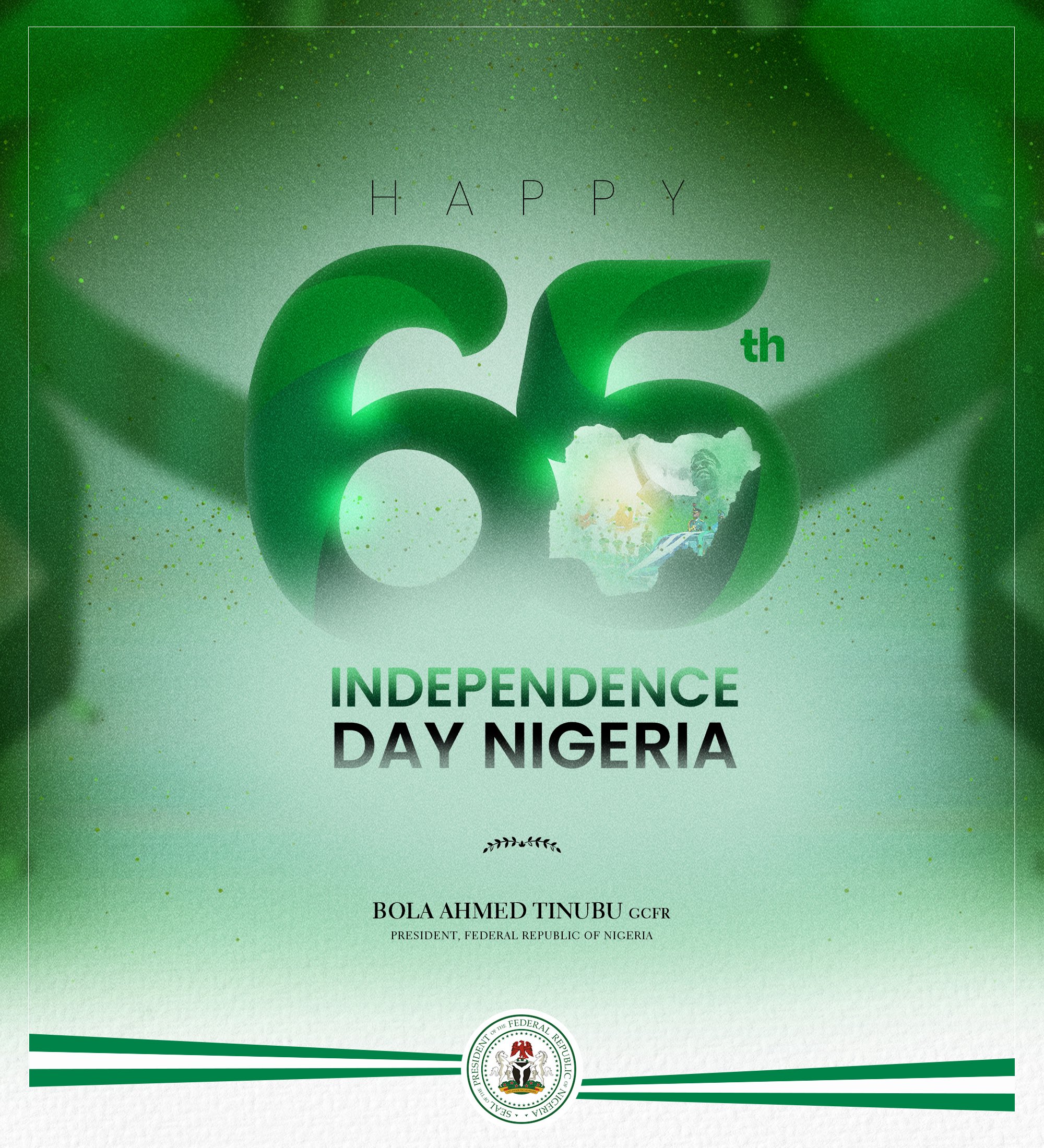
The activities marking Nigeria’s 65th independence anniversary kicked off on September 25 with inter-denominational church services held in various Christian churches across Nigeria. Earlier on Friday September 26, special Juma’at prayers were held by Muslims to commemorate Nigeria’s independence anniversary.
At the National Ecumenical Centre Abuja, the church service was attended by top government officials, including the Senate President Godswill Akpabio, Secretary to the Government of the Federation Gorge Akume, service chiefs including Chief of Defense Staff General Christopher Musa, among others. The services were aimed at promoting unity, peace and progress in Nigeria, reflecting on the country’s achievements and challenges over the past 65 years.
The theme for Nigeria’s 65th independence anniversary is, “Nigeria @ 65: All Hands on Deck for Greater Nation”. The theme emphasizes the importance of unity, collaboration and patriotism among government institutions, the private sector, civil society and citizens to advance national peace, prosperity and progress. It reflects Nigeria’s resilience since independence and highlights the need to build on past achievements while pursuing new national goals to leverage suffering Nigerians.
The anniversary celebration aims to promote a sense of national unity and collective responsibility, with the government urging citizens to set aside their differences and work towards building a stronger, united and prosperous country, a country to be reckoned with in the comity of nations.
Nigeria’s independence on October 1, 1960 was very remarkable. It was elaborately celebrated by men, women and school children with feasts and dances. Nigerians saw independence as a historic landmark, a day of freedom from colonial bondage.
The Prime Minister, Sir Abubakar Tafawa Belewa, in his Independence Day speech, called it the day Nigerians have been “eagerly” looking forward, our great day, “a wonderful day”. There was nothing in the wildest imagination of anyone that Nigeria was not going to record great strides in different fields of human endeavour and also take her rightful place on the global arena. Being endowed with abundant human and natural resources, with a great deal of wealth, a thunderous leap forward was anticipated. Nigeria was ahead of countries like Brazil, Malaysia, Singapore and South Korea in the early 60s. The expectations were very high. The country’s founding fathers had great vision. A potential giant was born.
But those great expectations were short-lived. The great dreams were quickly aborted with the outbreak of political crises, which led to the first military coup on January 14, 1966. Many of the county’s prominent leaders were killed in the putsch. That set the stage for military coups and counters coups.
Altogether, Nigerians have witnessed seven coups and counter coups from January 1966 to November, 1983. All through this period, the country was in the throes of military detectorship that more than anything set the stage for the present woes. During those dark years of military rule, there was more of plundering and looting than development.
Thus, for a period of thirty-three years, Nigeria remained stagnant with the foundation led by the colonial masters destroyed. Whatever progress Nigeria recorded in the more than sixty years of independence is minuscule when compared with the huge amount of money that accrued to the country during the period. The economy was basterdized; it took a plunge for the worst.
Agriculture which formed the backbone of the economy at independence was abandoned in preference to oil diseconomy. The political situation remained unstable. Socially, majority of Nigerians were emasculated. The over six decade’s period of independence saw Nigeria being overtaken by countries she had hitherto superseded. Today, Nigeria is nowhere near Brazil and the Asian Tigers. Nigeria is left crawling from far behind her peers.
After the long years of the locust, following a fierce pro-democracy agitation, a new political dispensation was birthed in 1999 when the military handed over power to a supposedly civilian democratic government.
Like what happened at independence, Nigerians heaved a sigh of relief, hoping to see a new beginning. Unfortunately, the hope seems to be dashed, as the Nigerian situation went from bad to worse on a daily basis. The new crop of political elites appears not to reckon with the stark backwardness of the country that needs urgent redemption.
Twenty-five years into democratic governance, there is lethargy in the land. The economy has taken nose-dive with ravaging mass poverty and unemployment. Pervasive corruption has overwhelmed the polity. There is frightening insecurity. The safety of lives and properties is not guaranteed, even as kidnapping, and armed banditry are commonplace across the country. There is systemic failure occasioned by poor leadership. The country seems to be drifting to nowhere.
On October 1, 2025, Nigeria marked 65years as an independent country. I have deliberately chosen not to use the word “nation” to avoid giving a wrong impression of what a nation is not in the strictest sense of the word. This is because at 65, Nigeria is still struggling to attend nationhood. That is one of the greatest failures as the country marks 65 years. It is sad to note that Nigeria was much better 65 years ago than it is today. There is mass dissatisfaction over economic hardship. Nigerians are a beleaguered people.
The occasion of the 65th independence anniversary presents another opportunity for the country’s leaders to take stock of the past, make evaluation for the present and chart a way forward. At 65, it is either that the country has done well in different spheres of human endeavour, or has wasted time.
Nevertheless, like the prodigal son, who wasted his youth and fortune chasing frivolities and shadow, but still had his life intact, perhaps, the only thing to celebrate is the fact that Nigeria is still intact under one government. Like the prodigal son who came back to his senses, and decided to return to his father, in order to start a new life. Nigeria has the opportunity to renounce the vindictive and divisive tendencies of the past with its failures and return to the path of progress, peace and development.