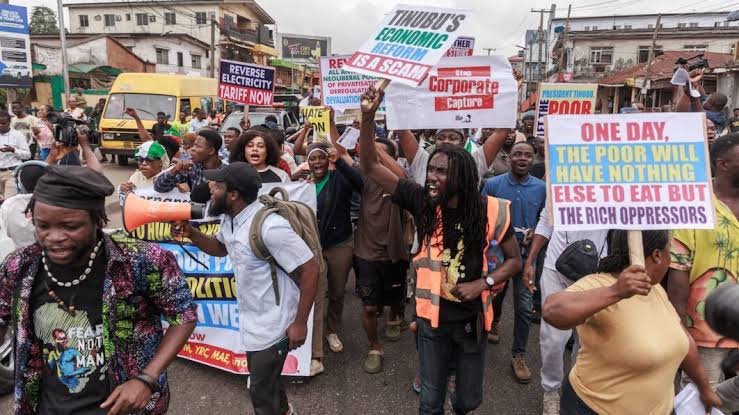
Without doubt, unemployment is a significant contributor to insecurity in Nigeria. When young people lack access to economic opportunity, they become vulnerable to recruitment by extremist groups or engage in criminal activities out of desperation. This can lead to increased violence, kidnapping other security threats.
In Nigeria, the lack of jobs and economic opportunities has been linked to the rise of Boko Haram, banditry, and other security challenges. The International Labour Organization (ILO) has noted that unemployment and under employment can lead to social exclusion, poverty, and increased vulnerability to radicalization.
Addressing unemployment is crucial to reducing insecurity in Nigeria. By providing economic opportunities, skills training, and promoting entrepreneurship, the government can help reduce the pool of potential recruits for extremist groups and create a more stable and secured environment.
In today’s Nigeria, where the rate of unemployment has reached high heavens, getting a job is an uphill task. Millions of youths are facing daunting challenges of their lives. Unconfirmed reports say each year, about six hundred thousand youths graduate from the country’s tertiary institutions, out of which a meager two hundred thousand manage to get job, while the remaining four hundred thousand roam about the streets.
If the statistics is anything to go by, it means that since 2000, about 15 million youths have graduated from the country’s tertiary institutions, out of which less than 5 million or 33 per cent got one form of employment or the other, while the remaining 67 per cent are unemployed. It is not uncommon to see young people who graduated for upwards of five years staying without job. Many in this category can’t even go back to school to further their education.
The situation is so frightening and alarming. Government should appreciate the gravity of this problem and do something about it. Self employment may be the way out. There are thousands of youths out there who are genuinely interested in self employment but could not start something due to lack of startup capital. A carefully planned program to empower the youths financially will go a long way to reduce the crisis in the over-crowded job market and by extension insecurity.
When the large number is added to those graduating from secondary schools and allied institutions, like computer colleges, the number will be more. It is not everybody who graduates from school at all levels forms part of the labor force
For the purpose of this discourse, I shall be concerned with those in the active labor force; that is, those who are able bodied and are looking for work. According to available statistics, Nigeria’s current unemployment rate is 4/3% as of second quarter of 2024 according to the National Bureau of Statistics (NBS). Using the 2009 labor force estimates of 44.33 million, it means that about 9.5 million people are employed while the larger 37.8 million are unemployed.
These provide insights into the magnitude of the problem. The crux of the matter is that millions of youths are out there on the street chasing too few jobs in a shrinking economy. The situation gets worse daily as the few remaining banks that had taken a large chunk of the youths keep retrenching staff. Reports say more than 1,8 million retrenched people have recently joined the labor market.
Some, especially, in official quarters may argue that the economy is not shrinking given the huge budget outlay proposed annually. But what else can one say of an economy that is recording negative indices in virtually every sector, with the exception of perhaps, crude oil output and its accruing revenue? Leading developed nations like the United States and United Kingdom have acknowledged that their economies are shrinking, especially, since the 2008 global recession. My aim is not to dabble into the analysis of Nigeria’s economic misfortunes. My concern is to take a closer look at youth unemployment and how to tackle it.
Faced with a worrisome unemployment situation, what will the youths do? Are they going to sit back and keep hoping that the situation will change? Changing the situation depends on how serious governments at all levels take the matter. If change will eventually come, how soon will that be? These are some of the issues that should bother anyone interested in this matter. Nigeria doesn’t have a leadership that could champion such a cause to its logical conclusion without something happening somewhere along the line to thwart it. Even if the leadership is committed, corrupt government officials whose duty it is to supplant government programs will frustrate it. Funds made available for such a purpose would be stolen.
In view of the foregoing, would it not be better for one to brave all odds and seek personal solution to the unemployment problem? Bearing in mind that what pushed the country into the present economic woe is planlessness, compounded by virulent corruption. Dealing with the unemployment situation would take some time. Everybody seems to be looking at the federal government to solve the entire problem while the states and local councils do nothing. The absence of vision in the management of the economy means that the mistakes that brought us to this point are not being corrected. The leadership still appears unwilling to take drastic measures that would redress the mounting problems. The half-hearted measures that are being applied here and there could hardly make any difference.
It is time for the unemployed youths to look inwards and decide on what to do. The time to do it is now. There is no need wasting precious time. Necessity, they say, is the mother of invention. All the inventions known to humanity came as a result of pressing need. All inventions came because man lacked something and needed “something” to close the gap, something to solve the problem. If there were no problems, there wouldn’t have been inventions in the first place.
What would the youths do in the face of crushing unemployment situation? To start with, a number of youths who graduated from university, for instance, could think of going back to school for further studies. Going back to school is one easy option. There is job for those with advanced qualifications. The over 130 universities in the country need doctorate degree holders. The more educated one is the better for job prospects. There is no need staying at the low level where the masses belong hoping to excel from there. It is difficult now. You need to climb to a higher level on the ladder
Virtually all the youths I have counseled in this manner reacted with dismay. How can I go back to school when there is no money they asked? They cited poverty, lack of money and family expectations that they should get job on graduation and help train their younger siblings. I agree with that position but with a caveat; to get a job on graduation was what obtained in the past, when the economy was buoyant. But we are in an abnormal situation. Things have changed. The economy is sick, very sick, which means, people should adjust their choices and expectations.
My position is that poverty is a common problem in our traditional families. There are few families that are able to meet their basic needs. My logic is that any family that is able to train a person for years in the university would be able to support that person for just another one year to obtain a masters degree, which in turn would provide a higher pedestal for a doctorate degree. Most Nigerian universities accept new lecturers who hold a masters degree with doctorate in view. This is one way out.
But anyone who sticks to the old thinking that once you graduate, you get job and start helping the family, could stay for years without getting a job. Any youth or family still holding such straight thinking would be making grievous mistake. I think it would serve many families better to henceforth, plan for post-graduate studies for their children in order not to be disappointed with the prevailing ugly situation.
The only problem is that going to university in Nigeria nowadays is no longer a straight course because of incessant strikes. The culture of strikes has truncated academic calendar of the public institutions and also lengthened the time it takes for one to graduate. It takes up to five to six years to complete a normal four-year degree program in most public universities in Nigeria due to incessant strikes. Therefore, it would be naïve for anyone to think that once he or she gets into the university, he would graduate at the expected time. The graduation time has become open-ended. That, unfortunately, is the reality.
Also, it would be naïve for any youth to be expecting to get paid job after graduation. The wise thing to do is to start early to think of what to do on your own. If one is not going back for higher degrees, the person should prepare the mind in advance to create job for one self and others. Government should have a policy to empower this category of youths financially to stand on their own. Failure to do that would lead to youth restiveness, militancy, armed robbery, kidnapping, insecurity and a host of other anti-social behaviors that torment Nigerians.
Onyekakeyah, former member of The Guardian Editorial Board, is a public affairs commentator and a Daily Query columnist..