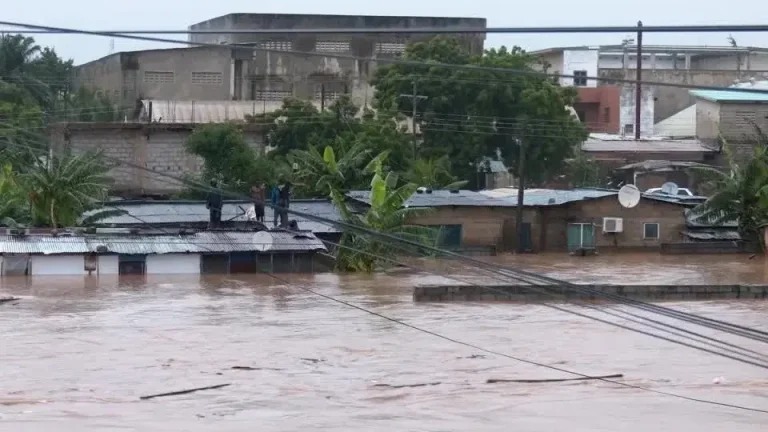
At least three people have been confirmed dead after torrential rains triggered widespread flooding across Accra on Monday, leaving several communities submerged, forcing rescue operations and renewing concerns over the impact of climate change and rapid urbanisation in the West African nation.
Authorities and local media reported that the heavy downpour inundated large sections of the Ghanaian capital, disrupting transportation, damaging homes and businesses, and trapping residents in floodwaters as emergency responders raced to rescue those stranded.
The flooding, which followed hours of intense rainfall, once again exposed the city’s vulnerability to seasonal storms and highlighted the growing challenges posed by inadequate drainage systems and uncontrolled urban development.
According to Ghanaian authorities, approximately 140 millimetres of rainfall fell on Accra within a single day, making it the heaviest rainfall recorded in several years.
President John Mahama described the rainfall as nearly three times higher than the highest level recorded during a comparable period last year, attributing part of the disaster to changing climatic conditions.
In a statement shared on X, the Ghanaian leader said the intensity of the rainfall reflected the increasing effects of climate change, which has contributed to more frequent and severe weather events across many parts of the world.
“That aspect of the problem is beyond our control because it is driven by changing climatic conditions,” Mahama stated.
However, the president stressed that climate change alone could not explain the scale of the flooding, pointing instead to widespread human activities that have worsened the situation over the years.
He criticised the continued construction of buildings on waterways and drainage channels, saying such developments obstruct the natural flow of floodwaters and increase the risk of devastating floods.
Mahama noted that government efforts to remove illegal structures from waterways often encounter resistance from affected residents, despite the dangers posed by such developments.
“The issue of human behaviour,” he said, remains a major factor contributing to the recurring floods.
“Whenever government begins removing structures built in waterways, some people accuse us of being inhumane,” the president said. “Yet when disasters such as today’s flooding occur, the consequences affect everyone.”
Flooding has become a recurring challenge during Ghana’s rainy season, particularly in Accra, where rapid population growth and urban expansion have outpaced investments in drainage infrastructure.
Residents say the situation has deteriorated significantly in recent years as wetlands have been developed, drainage channels blocked and natural waterways encroached upon by residential and commercial buildings.
Urban planning experts have repeatedly warned that unless stricter development controls are enforced and drainage systems expanded, the city will continue to face increasingly severe flood disasters.
One of the worst-hit areas during Monday’s flooding was Tse Addo, where emergency response teams launched rescue operations after rising floodwaters overwhelmed homes and roads.
Emergency responders, supported by local volunteers, deployed boats to evacuate trapped residents after rainfall that began around 3:00 a.m. rapidly flooded the neighbourhood.
Among those rescued were at least 15 children and an infant, highlighting the dangers faced by families living in flood-prone communities.
Witnesses said several streets became impassable as vehicles were submerged and residents struggled to move through waist-deep water.
Businesses were forced to close temporarily, while commuters experienced significant delays as major roads across parts of the capital became flooded.
Authorities are continuing to assess the extent of the damage, while emergency agencies remain on alert in case additional rainfall worsens the situation.
The flooding has once again reignited public debate over urban planning, environmental management and the need for stronger climate adaptation measures in Ghana.
Environmental experts have consistently called for improved drainage infrastructure, stricter enforcement of building regulations and greater public awareness to reduce the risks associated with flooding.
They argue that while extreme weather linked to climate change may be unavoidable, better urban planning and responsible land use can significantly reduce the impact of such disasters.
The latest flooding also serves as another reminder of the increasing vulnerability of many African cities to extreme weather events, as changing climate patterns combine with rapid urban growth to create greater risks for millions of residents.
As rescue and recovery efforts continue in Accra, authorities are urging residents to avoid flood-prone areas, comply with safety advisories and support government efforts to keep drainage channels and waterways free from obstruction in order to minimise the impact of future flooding.