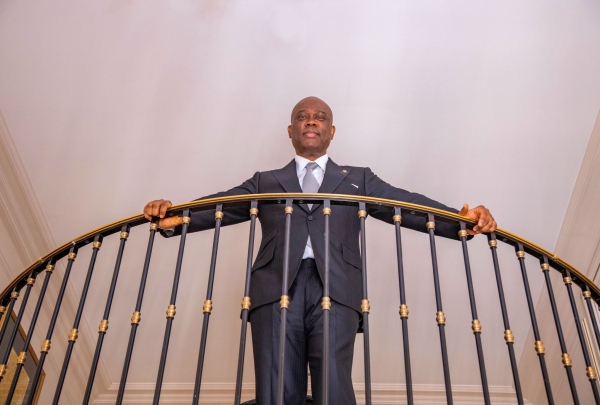
By Onovo-Agbo David
The dead cannot speak. But numbers can. And the numbers surrounding the late Herbert Wigwe, former Group CEO of Access Holdings Plc, are speaking with a thunder that no amount of posthumous hagiography can silence.
A bombshell investigation by The Londoner, the British publication, has linked Wigwe to 106 properties in London, one of the most expensive real estate markets on earth. Based on newly released data compiled by Tax Policy Associates’ Dan Neidle, and made possible by a 2022 UK law compelling overseas entities to declare their beneficial owners, the report places Wigwe seventh among London’s biggest overseas property owners. He ranks above royals, industrialists, and foreign oligarchs.
One Nigerian banker.
One hundred and six London properties.
Let that settle.
These properties were not held in Wigwe’s name. They were registered through shell companies — entities incorporated in secrecy jurisdictions like Jersey, Guernsey, and the British Virgin Islands. Many of the beneficial owners are listed as unnamed. Unnamed persons. This is not an accident of paperwork. This is architecture. The deliberate construction of financial opacity so that the true owner, or the true beneficiary, need never surface. In Nigeria’s political economy, ‘unnamed persons’ is a phrase that does the heaviest lifting.
UK company records had already linked Wigwe to an address on The Bishops Avenue in north London, one of the city’s most storied billionaire streets, where he was listed in 2012 as a director of Carmel Gate Ltd. But 106 properties dwarfs that single address. The Londoner’s investigation exposes the full iceberg, not just the tip.
When Wigwe died in a helicopter crash near the California-Nevada border on February 9, 2024, alongside his wife Chizoba, his son Chizi, and NGX Group former chairman Abimbola Ogunbanjo, Nigeria mourned. Dirges played. Tributes poured. The man was celebrated as a titan who turned Access Bank into West Africa’s largest financial institution. But there is a question that the elegies refused to ask: where did the money come from? And more crucially, where did it go?
Wigwe held 2.59 billion shares in Access Holdings, worth ₦65.3 billion at the time of his death. He held 1.26 billion of those shares indirectly through Coronation Trustees Tengen Mauritius, an entity domiciled in Mauritius, another African tax haven. Tengen Family Office, based in Ikoyi, Lagos, managed his wealth alongside that of his long-time partner Aigboje Aig-Imoukhuede. The money flowed, but it flowed outward. Into shell companies. Into offshore accounts. Into 106 houses in London.
I had raised concerns, at the time of his death, about Nigeria’s forex round-trippers and market manipulators who were making life unbearable for ordinary Nigerians. The revelations now unfolding suggest that the rot went far deeper than currency speculation. Properties held in trust for unnamed persons smells, unmistakably, of wealth laundried on behalf of Nigerian public officeholders; the ones who cannot appear on any register but still need their London addresses.
In December 2023, barely six weeks before his death, Wigwe moved into his sprawling ₦15 billion mansion. He died on February 9, 2024. He never fully unpacked. This is not poetic irony; it is a blunt reminder that the accumulation game, no matter how well-played, always terminates at the same address.
The family battles that erupted after his death are equally telling. His father, Pastor Shyngle Wigwe, and his cousin Christian Wigwe filed legal challenges against his children, disputing the estate the late banker left behind. A Lagos High Court granted his eldest daughter Tochi guardianship of her minor siblings, only for the grandfather to appeal. The siblings accused Aig-Imoukhuede of withholding financial details. Courts have been summoned. PwC and KPMG auditors have been deployed. The empire is now a battlefield.
The charity schools, the Wigwe University built in his hometown of Isiokpo, the donations and civic gestures — these are not now erased. But neither do they erase the questions. A man who moves ₦65 billion in shares through Mauritius entities and holds 106 houses in London through British Virgin Islands shell companies is not simply a ‘successful banker.’ He is a man who understood, deeply, how to move money across jurisdictions so that it leaves no fingerprints.
Wigwe is gone. He cannot be prosecuted, cross-examined, or compelled to answer. But the structures he built remain: and the unnamed beneficiaries of those 106 London properties are, presumably, still very much alive, still very much in Nigeria, and still very much in office.
The reckoning does not always come in a courtroom. Sometimes it comes quietly: in a British newspaper, in a dataset, in a 2022 law that simply required people to say who they really are.
Everyone who has made life further unbearable for Nigerians in one way or another will face their date with truth. In the end, no one leaves this earth with a single pin.