The ghost at the Nigerian economic banquet is no longer a phantom. It has assumed the concrete shape of a ledger entry, inked in trillions of Naira and stamped with the seal of consecutive administrations that promised fiscal redemption but delivered a deepening paradox.
When raw numbers are flung across political pulpits,the roughly ₦87 trillion accumulated in public debt during Muhammadu Buhari’s eight years, set against a debt stock that has since surged beyond ₦150 trillion under Bola Tinubu,the public space is transformed into an arena of profound cognitive dissonance. The numbers are frightening, but the real question is more complicated than the arithmetic suggests.
This is not merely a statistical contest. It is a moral and structural crisis that cuts straight to the core of Nigeria’s social contract, exposing the raw nerves of a populace caught between relentless economic pressure and the grand abstractions of macroeconomic policy.
When opposition figures such as Atiku Abubakar deploy the subsidy question as a political counterweight, they are not merely engaging in routine partisan shadowboxing. They are seizing upon one of the most agonising contradictions of contemporary Nigerian governance. If the removal of the petroleum subsidy and the liberalisation of the foreign exchange market were supposed to halt the bleeding, reduce fiscal distortions and create enormous fiscal space, why does the national debt ledger still look so alarming? Where did the fiscal relief go? Why does the ordinary citizen feel so little of it?
Those are not questions that can be answered with slogans.
The first mistake is to treat the headline Naira debt figure as though it represents a simple accumulation of fresh borrowing. It does not. Nigeria’s debt stock has been affected not only by new borrowing but also by the revaluation of existing foreign currency obligations after the Naira’s sharp depreciation and by the formal recognition and restructuring of historical Ways and Means advances.
That distinction matters.
A Dollar-denominated debt does not need a new Dollar of borrowing to become substantially more expensive in Naira terms. When the currency weakens, the domestic currency value of an existing external obligation rises automatically. The liability has not necessarily become larger in Dollar terms; the Naira required to service it has.
The same accounting reality applies to the historical Ways and Means obligations accumulated through the Central Bank. What had previously operated as monetary financing of government deficits was subsequently converted into formal public debt. The debt ledger therefore became more transparent, but transparency itself made the headline number considerably larger.
This is why the spectacle of a debt stock racing beyond ₦150 trillion cannot, by itself, establish that the Tinubu administration borrowed an equivalent amount of fresh money.
But that clarification does not absolve the government.
In fact, it creates a more uncomfortable question.
If the headline debt figure is partly inflated by currency revaluation and the formalisation of historical obligations, then what happened to the genuine fiscal space created by the reforms?
That is where the government’s own numbers become politically consequential.
The Federal Government now estimates that the removal of fuel and foreign exchange subsidies generated about ₦15.8 trillion in savings between June 2023 and December 2025. But those savings were distributed across the federation rather than retained by Abuja alone. The Federal Government’s share was estimated at ₦5.43 trillion, while States received about ₦6.52 trillion and local governments about ₦3.88 trillion.
The government also says the Federal Government’s incremental resources including its share of subsidy savings, additional revenues and incremental borrowing amounted to about ₦20.4 trillion, against additional expenditure pressures of roughly ₦30.64 trillion.
That is the real fiscal story.
The money did not simply disappear into a secret account. Nor did the removal of the subsidy create a giant pool of cash that could automatically be converted into roads, hospitals, jobs and cheaper food. The fiscal space was immediately confronted by a State carrying enormous existing obligations, higher borrowing costs, increased wage commitments, exchange rate-related debt service pressures and demands for additional social and infrastructure spending.
The government’s own accounting identifies external debt service costs arising from the exchange rate effect at roughly ₦9.37 trillion over the period.
And yet this is precisely where the political argument becomes unavoidable.
Because citizens were not asked to endure extraordinary pain merely so that government balance sheets could become technically cleaner.
They were told that sacrifice would produce a stronger economy.
They were told that the subsidy regime was fiscally unsustainable and that removing it would release resources for productive investment. They were told that exchange rate reform would eliminate distortions, attract investment and place the economy on a more sustainable footing.
There may be a compelling macroeconomic case for those reforms. The IMF itself has acknowledged that ending fuel subsidies and deficit monetisation, tightening monetary policy and liberalising the exchange rate have strengthened macroeconomic stability and reduced fiscal vulnerabilities.
But macroeconomic stabilisation and household prosperity are not the same thing.
That distinction is where the government’s political vulnerability resides.
A government can win an argument with the IMF and still lose an argument with a market woman.
It can point to stronger reserves, improved foreign exchange functioning, greater investor confidence and a more credible fiscal framework. It can explain why an inherited foreign currency liability costs more in Naira after devaluation. It can demonstrate that historical monetary financing was finally recognised on the public balance sheet.
All of that can be true.
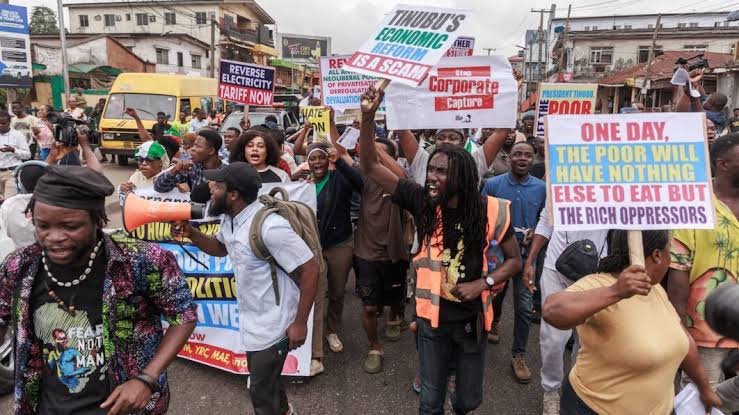
And yet a family that now spends a vastly larger share of its income on food, transport and energy is entitled to ask a much simpler question: when does the reform begin to improve our lives?
That question cannot be answered by telling citizens that debt to GDP ratio remains within a technically sustainable range.
People do not experience debt sustainability as a ratio.
They experience it as the price of rice, the cost of transport, the rent they cannot afford, the wages that disappear before the month ends and the shrinking purchasing power of money earned through honest work.
This is the deeper failure of the government’s communication. It has allowed a technically defensible fiscal narrative to collide with an emotionally undeniable social reality.
The administration is correct that the debt ledger requires context. The opposition is correct that the public deserves an account of what the reforms have actually delivered. Neither proposition cancels the other.
The real scandal would be to pretend that one does.
The subsidy savings were not a mythical pot of money waiting to be stolen. They were part of a broader fiscal adjustment that occurred while Nigeria was simultaneously dealing with inherited debt, currency depreciation, expensive borrowing, higher personnel costs and enormous development needs.
But that explanation creates an obligation, not an escape route.
If the government says the savings have been absorbed by debt service, wages, infrastructure and other obligations, then Nigerians have every right to demand a transparent account of those expenditures. They should be able to see not merely aggregate figures but the measurable public value generated by the sacrifice imposed upon them.
If the savings have been absorbed by debt service, infrastructure and other government obligations, Nigerians deserve to see what those expenditures have actually produced. They deserve to see better roads, functioning hospitals, properly equipped schools, reliable infrastructure and investments that create jobs and make it easier for businesses to survive and grow. They deserve to see where the sacrifice is showing up in the real economy, not just in government accounts.
The most dangerous mistake the government could make is to believe that explaining the arithmetic is the same thing as demonstrating success.
It is not.
The arithmetic may explain why the debt number looks worse than the underlying borrowing story. It may explain why subsidy savings have not accumulated as a neat surplus. It may explain why the State has been forced to spend heavily simply to keep its existing obligations from overwhelming it.
But none of those explanations, by themselves, answer the question that ultimately matters in a democracy: has the sacrifice produced a better country for the people who were asked to bear it?
That is the question the opposition will continue to weaponise, because hunger requires no economic theory and disillusionment requires no statistical model.
The government therefore has a choice. It can continue to defend the reforms primarily through technical indicators and inherited liabilities, or it can open the books widely enough for Nigerians to see precisely what was saved, what was distributed, what was borrowed, what was spent and what tangible assets or improvements were created in return.
That is the ledger that ultimately matters.
Not merely the debt ledger.
The social ledger.
Because a government cannot permanently ask citizens to endure the present on the promise of a better future while treating the evidence of that future as an accounting abstraction. Fiscal reform is not an end in itself. Debt sustainability is not prosperity. Macroeconomic stability is not a substitute for household security.
And if the government wants Nigerians to believe that today’s suffering is the price of tomorrow’s prosperity, then tomorrow must eventually arrive.
Until it does, the question of where the money went will remain more than an opposition talking point. It will remain the defining test of whether Nigeria’s latest economic sacrifice was the beginning of transformation or simply another chapter in the country’s long history of asking its citizens to pay for promises they are never allowed to audit.
As long as our leaders choose to hide behind the ghosts of previous administrations rather than confront the structural contradictions of their own fiscal choices, the question of where the money went will remain the definitive indictment of our democratic journey.
Shaakaa can be reached on: sahaakaastephanie@yahoo.com