By Agbeze Ireke Kalu Onuma, AI-KO
These pages did not begin as a single idea. They were never meant to be orderly. They started as fragments – quick notes written in passing, half-formed thoughts scribbled in moments of irritation, sorrow, or numb clarity. Over time, they accumulated, not because I planned them to, but because the country kept giving me reasons to write. What you are reading now is an act of gathering: disparate vignettes pulled together into one sustained attempt to document the emotional weather of a nation that appears to be failing slowly, publicly, and without interruption.
Some of these notes were written in Abiriba, in the suffocating density of endless events – funerals stacked upon funerals, ceremonies blurring into one another – where the absence of network signal turned my phone into a useless slab of glass and also into a notebook of sorts and my isolation into something almost physical. Others were drafted in the front seats of moving cars, as we navigated the dust-clogged arteries of towns and villages, passing through communities that looked permanently paused between neglect and survival. A few were written in Lagos, beneath the relentless growl of generators and the exaggerated urgency of a city that performs productivity even when it is visibly exhausted, even when rest would be the most radical act.
At first glance, these pieces may feel disjointed. One moment, the quiet devastation of a grieving mother; the next, the distant thunder of U.S. airstrikes and global power plays that feel abstract until they land, somehow, on our streets. Then kidnappings and deaths. Here, the slow paralysis of teaching hospitals; there, the hollow cheer of a New Year greeting from a neighbor who no longer believes in beginnings. But beneath their shifting subjects runs a single, unbroken thread. These are not random observations. They are coordinated symptoms. Together, they sketch the outline of a country unraveling in real time – a place where dysfunction has been normalized, where crisis has been domesticated, and where “resilience” has become a polite synonym for prolonged suffering.
This is my attempt to make sense of a year that already feels exhausted. We are not even two weeks into 2026, yet it carries the weight of something ancient, something overused. There is no sense of arrival in this new year, no clean break from what came before. The dust on the roads is the same old dust. The anger simmering at bus stops is recycled rage, passed down like inheritance. The grief – whether for the dead, the displaced, or the merely forgotten – has settled into a familiar ache, lodged deep in the national bone, dull but constant.
To move through these notes is to inhabit the mind of someone returning home only to discover that home has quietly turned hostile. The furniture is familiar. The layout unchanged. But the air is heavy, suspicious, unwelcoming. You recognize the rooms, yet you no longer feel safe resting in them. This is the psychology of contemporary citizenship in Nigeria: the unsettling awareness that belonging no longer guarantees protection, and familiarity no longer offers comfort.
I do not present these writings as prescriptions or policy blueprints. They are not solutions. They are evidence. A witness statement. Before anything can be repaired, it must first be seen clearly. Before we talk about fixing Nigeria, we must sit with the sharpness of what it has become – without flinching, without distraction, without the false optimism that has so often served as an excuse for delay. These notes are my refusal to look away.
There is a peculiar disquiet that settles over you upon returning to Nigeria, not from some far-flung exile in lands of seamless infrastructure and reliable grids, but merely from a brief respite elsewhere within its borders. It is like re-entering a chamber where the lights have sputtered erratically for decades, and in your short absence, the shadows have grown bolder, more insidious, learning to mimic the shapes of forgotten promises. The air thickens with a familiarity that borders on menace, a reminder that absence does not heal wounds – it merely allows them to fester unobserved.
Today, January 11, 2026, I hauled myself back into Lagos, my boots still caked with the stubborn red dust of Abiriba, my chest weighted by a silence that felt less like quietude and more like an enforced muting. I had departed on December 17, 2025, chasing the slower rhythms of the eastern highlands, hoping for a breath untainted by the city’s ceaseless churn. What I found upon return was a nation suspended in its own contradictions: utterly static in its dysfunction, yet freshly scarred by the passage of time. Nigeria has perfected this grim artistry – the ability to erode without movement, to collapse inward while standing still, like a structure hollowed by termites that no one bothers to inspect.
For almost a month, I inhabited an unintended seclusion in Abiriba, a place where silence and chaos was not a choice but an imposition, not serenity but a void engineered by neglect. The network signal was a fable, a distant legend whispered among the hills. Information arrived in scraps: a traveler’s anecdote, a neighbor’s half-heard rumor, or the fleeting grace of a single bar flickering to life on a phone screen before vanishing like a mirage. This isolation was no anomaly; it was the default state, a quiet catastrophe that unfolds daily without fanfare. And therein lies an untold national scandal – one that mocks our lofty rhetoric of digital leaps and technological renaissance. We proclaim visions of AI-driven futures and seamless cashless ecosystems, yet in 2025 – now bleeding into 2026 – we cannot assure something as fundamental as a stable phone connection. It is performance art on a grand scale: a government and its telecom giants staging progress while the audience starves for the real thing.
This “impossible network” I endured is far more than a fleeting inconvenience or a glitch in the system; it stands as a damning verdict on the architecture of our failures. It exposes a telecommunications landscape strangled by overlapping taxes, rampant vandalism, and a bureaucratic indifference that borders on malice. The southeast – my southeast, with its resilient hills and unyielding spirit – remains a zone where basic communication is treated as a luxury, doled out sparingly like alms to the undeserving. How can a country aspire to the heights of a 21st-century digital economy when its rural heartlands are still bartering with the specters of outdated 2G networks, climbing literal mountains for a whisper of connectivity? Meanwhile, as I perched on those Abiriba ridges straining for a signal, I could only imagine the parallel plights in the north: communities in Sokoto and Zamfara navigating harmattan winds while exacting “taxes” from warlords just to secure their fragile existence. We are, in essence, a federation of enclaves – isolated pockets of enforced silence, terrorized pockets of survival, and delusional pockets of denial where the elite pretend the center holds.
Yet this fragmentation is not accidental; it is the byproduct of choices made and unmade, of priorities skewed toward extraction over equity. In these pockets, dreams wither not from lack of ambition, but from the deliberate starvation of infrastructure. The silence I carried back to Lagos was not just personal – it was collective, a national echo of voices muffled by design.
THE CHRISTMAS PRESENT FROM THE SKY: A SOVEREIGNTY IN ASHES
While I languished in the enforced digital blackout of Abiriba, cocooned in a village silence that felt like a deliberate erasure, the skies over Sokoto erupted in a cacophony of thunder – not all of it our own. On December 25, 2025 – Christmas Day, of all days – our political elite were no doubt carving into festive turkeys and broadcasting platitudes about “renewed hope” from their fortified compounds, oblivious or indifferent to the irony unfolding above. Meanwhile, the Nigerian Air Force, relying heavily on critical intelligence and hardware from the United States Africa Command (AFRICOM), dispatched a far more tangible gift: precision airstrikes targeting the Lakurawa insurgents and ISIS-Sahel factions in the Tangaza and Gudu local government areas of Sokoto State. The reports that eventually trickled through my patchy network, days later, painted a scene of calculated humiliation: US-supplied A-29 Super Tucano jets slicing through Nigerian airspace to neutralize threats that our own ground forces had been “technically defeating” since the Buhari era, a phrase that has long since curdled into mockery. This was no mere assistance; it was a dependency-laden intervention, a stark declaration that Nigeria’s sovereignty has become porous, permeable to the influence of superpowers who view our security as a project they must manage lest it spill over.
The details, when they emerged, hit me with a visceral punch – a mix of shame and simmering anger that I carried like a stone in my gut during those long Abiriba nights. According to defense briefings, the strikes were executed by Nigerian pilots but driven by US surveillance data, a diplomatic sleight-of-hand that barely conceals the reality: we are fighting with borrowed eyes. Lakurawa, a shadowy militant group blending banditry with jihadist ideology, had been establishing footholds in the northwest since late 2024, imposing taxes, enforcing Sharia courts, and creating parallel governance structures in ungoverned spaces that our military has failed to reclaim. Our government dithered, forming committees and issuing toothless warnings, while these insurgents morphed from local nuisances into transnational threats affiliated with ISIS networks across the Sahel.
Then, in a matter of hours, foreign partners assessed the risk to global security and provided the targeting coordinates that our own intelligence agencies either lacked or failed to act upon. As security analyst Dr. Freedom Onuoha of the Centre for Strategic Research and Studies in Abuja noted in a recent analysis, “Nigeria’s counter-insurgency efforts have been hampered by corruption, poor intelligence sharing, and a lack of political will, creating vacuums that necessitate external support.” This echoes my own frustration: how many times must we watch our leaders prioritize photo-ops over patrols, leaving communities to fend off horrors while we wait for foreign satellites to tell us where the enemy hides?
The optics of this Christmas Day bombardment are not just embarrassing; they are eviscerating, stripping away the last illusions of our post-colonial autonomy. I remember sitting on a rickety stool in Abiriba, piecing together the news from a neighbor’s radio, feeling a hot flush of indignation rise in my throat. Here we were, the so-called Giant of Africa, reduced to a hapless landlord whose kitchen is overrun with rats, forcing the neighbors – in this case, the U.S. – to hand us the broom and point out the nest. The irony of the date adds a bitter, almost biblical layer: as Nigerians marked the birth of a redeemer, we were being “redeemed” by American technology because our own institutions have abdicated that role.
It recalls the words of international relations scholar Dr. Rita Abrahamsen, who in her extensive work on African security dynamics argued that “external interventions often mask a new form of imperialism, where African states trade sovereignty for stability, perpetuating dependency.” Indeed, this operation wasn’t born in isolation; it’s part of a pattern, from Western drone bases in the Sahel to foreign contractors in our waters, where powers step in when local failures threaten their interests, such as migration flows or resource access. In Nigeria’s case, the Lakurawa’s ties to ISIS-Sahel amplified fears of a broader instability, prompting Washington to ensure the job was done without waiting for Abuja’s glacial bureaucracy to stumble upon the solution.
But let’s delve deeper into the human and historical undercurrents, because this isn’t just about bombs – it’s about the erosion of dignity that I’ve felt personally, acutely, as someone who has navigated Nigeria’s fractured landscapes. Growing up in the east, I’ve witnessed how insecurity festers in the margins: the kidnappings along highways, the communal clashes that go unresolved, the way fear seeps into daily life like damp into walls. The Sokoto strikes connect these dots in a way that exposes our national shame with surgical precision. They link the “impossible network” I endured in Abiriba – a symptom of infrastructural neglect in the southeast – to the “unguarded borders” in the northwest, where porous frontiers allow militants to flow in from Niger and beyond. Both stem from a state that has systematically retreated from its core responsibilities: providing security, connectivity, and governance.
As the International Crisis Group reported in late 2024, “Nigeria’s northwest has become a haven for armed groups due to weak border controls and economic desperation, with Lakurawa exploiting these gaps to establish tax regimes that rival the state’s.” If we can’t erect telecom masts to bridge digital divides in rural east, how can we possibly maintain radar systems or patrols to secure vast northern expanses? This failure isn’t accidental; it’s the byproduct of a leadership class more invested in patronage networks than public service, where generals amass wealth while soldiers lack fuel for operations.
In my quieter moments of reflection, this event stirs a deep sense of betrayal, a feeling that our independence, hard-won in 1960, is being quietly auctioned off. The airstrike serves as a political obituary for the myth of Nigerian self-determination, heralding a neo-colonization of our security apparatus. We’ve outsourced our safety to foreign benefactors because our own are bankrupt – morally, financially, and strategically. Think of it: we await World Bank loans to affirm our solvency, IMF directives to shape our economy, and now US-guided munitions to guarantee our security. As geopolitical expert John Campbell of the Council on Foreign Relations has observed, “Nigeria’s reliance on external military support underscores a deeper crisis of state capacity, where internal weaknesses invite interventions that erode national pride.”
My opinion here is unyielding: this is not partnership; it’s paternalism, a subtle recolonization dressed in the language of counterterrorism. And the silence from the Nigerian populace? It’s not apathy – it’s exhaustion. We’re so worn down by the incompetence of our protectors – the generals who promise victories but deliver body counts, the politicians who tweet condolences instead of policies – that we’ve begun to welcome any hand that strikes down the bandits, even if it’s guided by a foreign arm. In conversations with friends back in Lagos, I’ve voiced this rage: we’ve traded our dignity for a mirage of safety, applauding the American machine because we’ve lost faith in the Nigerian general. It’s a Faustian bargain, one that leaves me feeling hollow, as if the very soul of our nation is being bartered away.
Yet, this moment demands more than lament; it calls for reckoning. The Lakurawa threat didn’t materialize overnight – it grew in the fertile soil of poverty, climate-induced displacement, and governance voids that our leaders have ignored for years. Authoritative voices like those from the Africa Center for Strategic Studies warn that without addressing root causes such as youth unemployment and land disputes, technological solutions offer only temporary relief, potentially fueling resentment and recruitment. I feel this deeply, personally: as someone who has seen the east’s own insurgencies simmer, I know that bombs from afar don’t heal; they scar. We must confront how our “current order” fosters such vulnerabilities, turning Nigeria into a volatile containment zone where sovereignty bows to stability. The Christmas airstrike isn’t an isolated indignity – it’s a symptom of a deeper malaise, a nation waiting passively for saviors while its own shadows lengthen.
THE INDICTMENT OF THE NEIGHBOR’S BREAD
In the oral traditions of my people, passed down through generations around flickering evening fires, there exists a proverb that cuts to the core of communal shame: “When a neighbor visits you with his own water and food, it is not a gesture of kindness; it is an indictment of your poverty.” This saying, rooted in the Igbo ethos of hospitality and self-reliance, isn’t merely about etiquette – it’s a stark judgment on failure. In a thriving household, the host is the provider: they fetch the water to cleanse the guest’s travel-weary feet, break the kola nut as a symbol of welcome, and present a meal drawn from their own stores, affirming abundance and dignity. But when that neighbor arrives unannounced, lugging his own jerrycan of water and a cooler brimming with rice or fufu, the message is unspoken yet deafening. He broadcasts to the village that your hearth has gone cold, your granary stands empty, and your home is no longer a place of sustenance. It’s not charity; it’s pity laced with condemnation, a public declaration that you cannot sustain yourself, much less extend care to others. I’ve carried this proverb in my bones since childhood, hearing it invoked during lean seasons or family disputes, and it has always evoked a quiet rage in me – the kind that simmers when pride is wounded by necessity.
This ancient wisdom resurfaced with brutal clarity as I reflected on the airstrikes in Sokoto, feeling a personal sting of humiliation that twisted in my gut like a poorly digested meal. By supplying the jets, dictating the targets, and guiding the bombs that eradicated insurgents on Nigerian soil, the United States has enacted this very proverb on a geopolitical scale. They have strode into our national “house” not as guests, but as reluctant caretakers, bearing the tools of violence because we have proven incapable of wielding them ourselves. It’s a searing cultural and political affront, one that resonates deeply with me as someone who has navigated the contradictions of Nigerian identity – from the resilient hills of Abiriba to the chaotic sprawl of Lagos.
We proclaim ourselves the Giant of Africa, a titan of potential with vast resources and a storied history of independence struggles, yet here we are, exposed as a starving patriarch who cannot feed his kin or safeguard his compound. The neighbor – in this case, a superpower with its own imperial agendas – has looked upon our vaunted status and seen only frailty, compelling them to intervene lest the rot spill over their thresholds. As scholar Prof. Adekeye Adebajo has argued in his analysis of Africa’s security architecture, “External military power can only provide peaceful conditions to work out differences… but essentially undermines long-term sovereignty by fostering a dependency on foreign guardians.” My opinion is unequivocal: this is not benevolence; it’s an insult we are too desensitized, too battered by internal failures, to fully register or resist.
To argue this further, consider the mechanics of such an indictment and how it dismantles the facade of sovereignty. A truly autonomous nation projects power inward and outward: it secures its perimeters, enforces its laws, and resolves its conflicts without begging for alms. Instead, Nigeria has devolved into the destitute host, slumped in the corner while the neighbor sweeps our floors, exterminates our pests, and tidies our chaos because we lack the strength – or the will – to grasp the broom. Every US-guided munition that detonates in our northwest is akin to that loaf of bread proffered by the visitor: a tangible emblem of our shortfall, a reminder that we have flunked the elemental exam of statehood – the capacity to preserve our own existence without external crutches.
I feel this failure viscerally, as if it’s a personal betrayal; growing up, I witnessed my community’s self-sufficiency eroded by national neglect – roads crumbling, markets faltering – and now, on a grander stage, that erosion manifests as outsourced warfare. Analysts at the Centre for Democracy and Development (CDD West Africa) have aptly noted that “reliance on foreign airstrikes reveals the hollowness of national security thinking, where state capacity is substituted with external technology.” This mirrors my frustration: we’ve allowed corruption-riddled procurement processes and political inertia to hollow out our military, leaving us vulnerable to groups like Lakurawa, who operate with chilling efficiency in our “ungoverned spaces”.
The emotional toll of this dynamic weighs heavily on me, stirring a cocktail of anger and sorrow that I’ve journaled about in quieter moments. It’s not just about the strikes; it’s the cumulative shame of a nation reduced from owner to squatter in its own territory, managed by distant overseers who dictate terms from air-conditioned war rooms in Virginia or Stuttgart. We’ve become tenants in a house we built, paying rent in the currency of dignity while others hold the deed. International relations experts like John Campbell of the Council on Foreign Relations have observed that “Nigeria’s security reliance underscores a crisis of state legitimacy, where the government can no longer claim the monopoly on violence without external help.”
I agree, and it infuriates me – how many times must we relive the ghosts of Berlin Conference-era partitions, now repackaged as counterterrorism partnerships? In my view, this “neighbor’s bread” syndrome extends beyond security: it’s evident in our economic vassalage to IMF conditionalities, our environmental exploitation by multinational oil firms, and even our cultural narratives shaped by Hollywood’s gaze. Personally, returning to Lagos after Abiriba’s isolation, I felt this indictment in the air – the same polluted haze that chokes our cities, symbolizing a broader asphyxiation of agency. We’re applauding the foreign hand that feeds us scraps, forgetting that true sustenance comes from tilling our own soil.
Yet, to buttress this argument with historical depth, let’s examine precedents that amplify the proverb’s relevance. During the Cold War, interventions in places like the Congo under Mobutu saw superpowers prop up regimes with military aid, only to leave them weakened and dependent – a pattern Nigeria risks repeating. Closer to home, the French-led Operation Barkhane in Mali initially stabilized the region but ultimately failed to build local capacity, leading to recurring instability and the eventual expulsion of French forces. As the International Crisis Group noted in a recent report, “foreign military interventions often win battles but lose the war for stability, as they disincentivize the necessary political and institutional reforms in the host nation.” My feelings here border on despair: if we continue this path, we’ll normalize the neighbor’s perpetual visits, eroding our cultural pride – the very hospitality ethos that defines us – until we’re left with empty barns and borrowed brooms. We must reclaim the host’s role, investing in intelligence, community policing, and anti-corruption reforms to ensure that next time, it’s our jets in the sky, our bread on the table.
THE NATIONAL MIRROR: A TRAGEDY FORETOLD
In the deep, enforced silence of the village – a silence not of peace but of severed connection, where the only sounds were the rustle of dry leaves and the distant, plaintive calls of birds – life had contracted into a small, slow circle. Yet the world beyond, frantic and unforgiving, continued to spin on its axis of chaos. News, when it finally breached the digital barricade, did not arrive with a shout but as a creeping chill, like cold water tracing a slow, inevitable path down the spine. It was a visceral intrusion, a reminder that no retreat is absolute. And the first story to shatter that fragile isolation, to pierce through the static with the force of a physical blow, was the heart-breaking revelation of Chimamanda Ngozi Adichie’s devastating loss: the death of her twenty-one-month-old son, Nkanu Nnamdi, in the early hours of January 7, 2026.
This tragedy is a weight that sits heavy in the throat, a grief so intimate it feels almost invasive to acknowledge. It is, at its core, a shattering private hell – a universe of lost futures contained in a single, unimaginable loss. But in Nigeria, the personal is inextricably political; private grief is immediately refracted through the cracked lens of a failing state. The harrowing details that have emerged – allegations of propofol overdose, inadequate airway protection, and a lack of continuous monitoring during procedures at Euracare Multi-Specialist Hospital – transform a personal catastrophe into a damning indictment. We are told the child was being prepared for a medical evacuation to Johns Hopkins Hospital, yet even that bridge to safety collapsed under the weight of local negligence. We see a healthcare system where even “centers of excellence” are accused of failing basic protocols, such as safe patient transfer and informed consent. This was not merely a loss, but a negation: a country that failed, in its most fundamental duty, to protect a child.
This leads us to the corrosive, haunting question that should strip us of all pretense and comfortable denial: If Chimamanda Adichie – a global icon, a figure of immense influence, connected and resourced, possessing the cultural capital to command the very best this broken system can ostensibly offer – could not shield her son from the casual lethality of Nigerian institutions, what phantom hope exists for the average Nigerian? Her tragedy ruthlessly dismantles the last vestiges of the Nigerian survival myth: that with enough money, enough status, enough “connection,” one can insulate oneself from the national collapse. It proves that our decay is so total, so pervasive, that it respects no hierarchy of class or privilege. The crumbling edifice claims all who enter.
Therefore, this is far more than a family’s sorrow. It is a terrifying national parable, a stark illustration of our collective vulnerability. It underscores a truth the village silence had already whispered to my soul: in Nigeria, we are all precariously suspended, just one mishap away from oblivion. One wrong dosage from a distracted anaesthesiologist; one equipment failure in a high-brow facility; one lapse in judgment during a critical scan. We live under a brutal bio-politics where human life has been stripped of its sacred value and rendered cheap, expendable. The state’s covenant with the citizen – the promise of security and basic care – has been voided, leaving in its wake a landscape where survival is not a right but a precarious, individual gamble.
Yet, Nigeria has perfected not governance, but the politics of performative denial. Even the sacred ground of grief is not spared; it becomes a contested territory, a platform for reputation management. In the wake of this tragedy, the familiar, hollow choreography unfolded: the Lagos State Government ordered investigations involving HEFAMAA and the Medical and Dental Council, statements were issued, and the theater of official empathy played to a cynical audience. This ritual is not about redress but about containment – to stem the tide of public fury and create the illusion of action. It is a PR exercise in a nation where perception is relentlessly managed while substance is allowed to rot. Beneath this polished veneer of concern lies the unalterable, grim truth: our institutions are not merely broken; they are actively hostile to the people they are meant to serve. And we, the populace, have become tragically adept at navigating the debris, normalizing the abnormal, and muting our outrage until the next inevitable tragedy holds up the mirror once more.
Nkanu’s loss, therefore, becomes that mirror – a national mirror reflecting back to us not just a moment of sorrow, but the deeply etched lines of our systemic failure. It forces us to confront the uncomfortable reality that our collective mourning is also a form of complicity. We grieve, we rage, and then we are expected to return to the business of surviving within the very system that engineered the grief. The tragedy was indeed foretold, whispered in every neglected hospital corridor, every diluted medication, every unenforced regulation. Until we cease to accept the choreography and instead demand a fundamental rewriting of the script – until accountability replaces impunity as our national creed – we will remain a nation perpetually mourning futures foreclosed, and awaiting the next tragedy that we have already foreseen.
THE POLITICS OF GRIEF: WHO OWNS THE RIGHT TO JUSTICE?
The announcement from the Lagos State Government, ordering a “thorough investigation” into the death of Chimamanda’s son, arrived with the predictability of a scripted drama, yet it compels us to pose a question as merciless as it is essential: If she were merely one of the faceless masses, a “nobody” like the rest of us scraping by in the shadows of this unforgiving metropolis, would such a probe have ever been decreed? This swift official reflex, cloaked in the language of diligence, demands we peel back its layers to reveal the grotesque machinery of justice in Nigeria – a system that operates not as a blind arbiter but as an exclusive concierge service, reserved for those whose names echo in halls of power and corporate boardrooms. While it’s ostensibly positive that the state mobilizes in response to tragedy, the alacrity of this action unveils a darker truth: justice here is commodified, a luxury item dispensed based on social currency, where the grief of the elite triggers bureaucratic theater, while the sorrows of the ordinary are consigned to oblivion. I’ve mulled this over in the quiet fury of my post-Abiriba reflections, feeling a boiling resentment toward a nation that rations empathy like wartime rations, leaving me to wonder if my own losses – cousins felled by similar negligences in underfunded eastern clinics – would ever warrant even a footnote in official ledgers.
To interrogate this mechanics of selective response is to expose the rotten core of Nigerian governance, where accountability is performative, tailored to mitigate reputational damage rather than deliver genuine redress. The Lagos government’s press releases, brimming with assurances of impartial probes and condolences from the governor’s office, smack of crisis management rather than moral imperative. If “Mrs. Okeke,” a seamstress eking out an existence in the squalid tenements of Ajegunle, lost her toddler under identical conditions – perhaps from a botched sedation amid a power outage in a ramshackle general hospital, or due to an overworked nurse juggling triple shifts in a system starved of staff – would the Commissioner for Health bother with a statement? Would the governor’s social media handlers craft a tweet of sympathy, or would she be met with the cold bureaucracy of a mortuary bill, a perfunctory “take heart” from a harried clerk, and the silent shuffle of paperwork that buries her pain in anonymity?
My opinion is blistering: absolutely not. This disparity isn’t hypothetical; it’s the lived reality I’ve witnessed firsthand, visiting relatives in Lagos’ public wards where the air reeks of despair and disinfectant, and families like Mrs. Okeke’s are dismissed as collateral in a system that views their lives as expendable overhead. As the civil society group Access to Justice (A2Justice) has frequently noted in their reports on judicial disparity, “The Nigerian legal system has evolved into a dual-track mechanism where the rich access remedies while the poor are met with administrative walls and silence.” The probe into Ugboma’s case, then, isn’t justice – it’s politics dressed in empathy’s garb, a calculated move to shield the state from broader scrutiny while reinforcing that only certain griefs merit the spotlight.
This revelation plunges us into the harrowing silence enveloping millions of faceless Lagosians, those anonymous souls trudging through the valley of preventable death without a whisper of solace or reckoning. What torments are they enduring right now, in the shadowed corners of this sprawling city-state? Venture into the overcrowded halls of public hospitals in Alimosho, Ikorodu, or the labyrinthine wards of Lagos University Teaching Hospital (LUTH), and you’ll witness traumas unfolding on an industrial scale – horrors that dwarf even the most publicized scandals.
I speak from raw, personal anguish: women hemorrhaging in childbirth because the ambulance, which demands upfront payment like a tollbooth to hell, runs out of fuel midway; men bleeding out in emergency rooms, their families turned away for lacking the “initial deposit” in a system that monetizes urgency; children misdiagnosed with malaria when meningitis ravages their tiny frames, all because the diagnostic equipment gathers dust, broken and unrepaired due to embezzled maintenance funds. These are not cold statistics – they are flesh-and-blood humans, their deaths normalized as the “cost of doing business” in a megacity that chews up its inhabitants and spits out corpses. In my village-rooted perspective, this is an abomination against communal humanity; growing up in Abiriba, I learned that grief binds us, yet in Lagos, it’s atomized, privatized for the poor who lack the platform to amplify their cries.
Reports from Amnesty International have detailed how “chronic underfunding and negligence in Nigeria’s public health sector constitute a violation of the right to life,” yet for the marginalized, there are no inquiry panels, no viral hashtags, no gubernatorial condolences. Their medical files vanish into bureaucratic black holes, their stories interred with their loved ones, and their families left to shoulder the crushing void of loss amid the grind of survival. The system thrives on this enforced silence, banking on the exhaustion of the impoverished who are too preoccupied with scavenging the next meal to mount lawsuits, as noted by urban advocacy groups like Justice & Empowerment Initiatives (JEI), who argue that “Lagos functions by rendering the suffering of the informal majority invisible to the formal elite.”
And now, we must pivot the gaze upward, unleashing the most incendiary question of all – one that threatens the very foundations of power: Why is the government itself immune from probes into its litany of avoidable blunders and catastrophic failures? If a private hospital faces scrutiny for negligence – as it rightfully should – then who dares to convene a panel against the state for the daily negligences that slaughter thousands? Who holds accountable the road maintenance agency when a yawning crater on the Lagos-Ibadan Expressway, ignored for years despite bloated budget allocations siphoned into private coffers, engulfs a danfo bus laden with commuters, turning a routine journey into a mass grave? Who sanctions the Minister of Power when the national grid collapses for the umpteenth time, plunging operating theaters into darkness and dooming patients mid-surgery to the whims of flickering generators – or none at all?
Who investigates the security chiefs when an entire village in Plateau State is razed by marauders, despite frantic distress calls ignored for hours, leaving bodies to rot under the sun as “collateral” in a failed counter-insurgency? My feelings here erupt into outright rage; as someone who has traversed these deadly roads and witnessed the blackout-induced chaos in family homes, I seethe at the hypocrisy – a government eager to regulate and punish the private missteps of citizens and enterprises, yet swaddling itself in sovereign immunity, untouchable amid the wreckage it authors. This is the insidious “other politics,” a masterful deflection where spectacles of accountability – probing a hospital, say – divert eyes from the state’s own culpability, pointing accusatory fingers at symptoms while the disease festers unchecked.
Sparing nothing, let’s eviscerate this deflection for what it is: a theatrical ruse that preserves power by scapegoating the peripheral while absolving the core. The state performs empathy – issuing statements, forming committees – to placate the public, all while evading responsibility for abdicating its foundational mandate: the preservation of life through functional infrastructure, security, and services. Human rights lawyer Femi Falana (SAN) has consistently argued that “Official negligence that leads to loss of life, whether through bad roads or poor hospitals, constitutes a crime against humanity, yet public officials hide behind immunity clauses to escape liability.”
I’ve internalized this injustice personally, recalling how my sister’s death in 2024, caused by a combination of misdiagnosed ailment and incompetence, yielded no inquiry – just a blank silent look devoid of emotion and empathy, while life moved on as usual around the hospital. This pattern repeats ad nauseam: from the perennial flooding in Lagos slums that drowns the poor due to neglected drainage, to the fuel scarcity crises that strand ambulances, each a governmental failure masked as inevitability. International observers like Human Rights Watch echo my condemnation, noting that “Nigeria’s failure to hold security and administrative officials accountable for systemic lapses fosters a culture of impunity.” In my unyielding view, this is state-sponsored terrorism against its own people – a bio-politics where leaders deflect blame onto doctors, engineers, or bandits, ensuring the real culprits in Aso Rock or Alausa remain ensconced in impunity.
To argue this further, consider the historical underpinnings that entrench such inequality, drawing from Nigeria’s post-colonial legacy of elite capture and judicial capture. Since the 1960s, our legal system, inherited from colonial structures, has been warped to protect the powerful, with probes often weaponized against rivals rather than for systemic reform. The 1999 Constitution’s immunity clauses shield governors and presidents from civil suits during tenure, creating a shield for negligence that kills – think of the EndSARS protests, where state violence went unprobed until international pressure mounted. My emotions run hot here: frustration at a citizenry conditioned to accept this, mixed with a defiant hope that tragedies like Nkanu’s could ignite change. We must demand this: forensic audits of budgets, citizen-led tribunals, and constitutional amendments to strip away protections that enable mass murder by omission. Until we probe the president for economic policies that exacerbate poverty-driven deaths, the governor for urban planning that turns floods into funerals, and the minister for blackouts that snuff out lives in hospitals, we’re not pursuing justice – we’re merely ritualistically sacrificing scapegoats to appease the gods of deflection.
This is the crux of our national malaise: a politics of grief that privatizes pain for the powerless while publicizing it for the privileged, ensuring the system endures unchallenged. I’ve felt this inequality in my core, from Abiriba’s isolated silences to Lagos’ cacophonous injustices, and it fuels my call for revolution – not in arms, but in accountability. We must own our right to justice, collectively, or remain forever mired in a hierarchy where only the famous mourn with an audience.
THE ABATTOIRS OF HIGHER LEARNING: INSIDE THE TEACHING HOSPITALS
We must summon the courage to redirect our collective stare toward those once-majestic yet now dilapidated fortresses we dub “Teaching Hospitals” – the Lagos University Teaching Hospital (LUTH), the University College Hospital (UCH) in Ibadan, the University of Nigeria Teaching Hospital (UNTH) in Enugu, and their crumbling kin scattered across this beleaguered nation.
These institutions have devolved from envisioned citadels of medical prowess into bloated, shadowy voids where hope is methodically choked out, leaving only echoes of despair. The nomenclature itself drips with savage irony: what precisely is being “taught” within these labyrinthine walls, and what ailments are genuinely “cured” amid the stench of decay and desperation? To any soul brave or unfortunate enough to cross their thresholds, past gates flaking with rust and indifference, it becomes glaringly evident that the core syllabus imparted to fledgling medical students isn’t one of empathy, innovation, or lifesaving artistry, but a brutal indoctrination into callousness and survivalism.
They learn the grim algebra of scarcity – how to ration oxygen tanks that wheeze empty mid-resuscitation, how to prioritize patients not by urgency but by the heft of their wallets for upfront deposits, and how to gaze upon a writhing human form and register only a bed number, a statistic, a fleeting obstruction in the ceaseless churn toward the morgue. These bastions have metastasized into sprawling bureaucratic vestibules to the afterlife, where the Hippocratic Oath is ritually asphyxiated by layers of red tape, corruption, and systemic sabotage, rendering “No Bed Space” not merely a logistical notice but a death sentence uttered with the detached nonchalance of a postal worker franking an envelope bound for nowhere.
Venturing deeper into these edifices of institutionalized demise, we confront the authentic “merchants of death draped in bureaucratic white,” a cadre whose presence haunts the fluorescent-lit corridors like specters of misplaced authority. Let me be unequivocal – this is not a blanket condemnation of the beleaguered few, those exhausted paragons who, against insurmountable odds, still claw at the edges of miracles with frayed tools and frayed nerves; no, my ire is reserved for the entrenched culture that dominates, a toxic brew of arrogance and apathy that has poisoned the majority. A pernicious “God Complex” prowls these halls, untethered from any divine benevolence, manifesting as a hubris that treats patients as supplicants at the altar of medical ego.
The horror tales cascade in daily, murmured by shell-shocked families who stagger out clutching nothing but shrouds and itemized bills: the accident victim abandoned on a blood-soaked gurney for hours because the administrative “folder” languished unopened in some clerk’s drawer, bureaucratic inertia proving deadlier than the crash itself; the anguished mother forced to witness her child’s convulsions while a resident doctor bickers with the pharmacy over a missing receipt for a ₦500 syringe, the child’s life ebbing away in the crossfire of paperwork. In these spaces, mortality isn’t always a triumph of biology over medicine; it’s frequently an administrative assassination, where overworked staff, themselves brutalized by abysmal conditions – salaries delayed for months, wards flooded during rains, power outages that turn operating theaters into blackouts of fate – channel that brutality downward onto the vulnerable, becoming unwitting conveyor belts to oblivion. The assembly line hums with grim efficiency: generators sputter without diesel, MRI machines gather cobwebs in disrepair since epochs forgotten, and the only mechanism that operates with clockwork precision is the cashier’s booth, extracting fees like a toll from the River Styx.
To fully understand the grotesque reality of our teaching hospitals is to stare into the yawning chasm of the Nigerian state itself, a microcosm where healing has been supplanted by extortion, and care commodified into a predatory enterprise that preys on the desperate. Families arrive not for succor but for a gauntlet of demands, handed “shopping lists” before any scalpel touches skin – compelled to procure everything from basic cotton wool and gloves to surgical blades and even the fuel to juice the generator that might power the procedure, transforming relatives into frantic errand runners amid the chaos of traffic and black markets.
I’ve heard these accounts firsthand, seething in quiet rage during visits to friends and kin in such wards; one nightmarish episode involved a cousin in UNTH, bleeding internally after a botched procedure, turned away from two other facilities in a single harrowing evening, his life leaking out in the gridlock between Enugu’s sometimes bizarre choked roads, all because no “man-know-man” connection – that insidious Nigerian euphemism for nepotistic leverage – could conjure a bed from the ether. This is the farce of our self-proclaimed “Centres of Excellence,” hollow honorifics scrawled on rusting signboards that mock the suffering within. Investigative journalist Fisayo Soyombo, who has gone undercover in these institutions, has aptly described them as “cash-and-carry morgues where the system is rigged to strip patients of dignity before stripping them of life.” My personal torment amplifies this: I learned of an acquaintance’s son who perished in LUTH from a treatable infection, his family bankrupted by demands for “all sorts of fees” that never materialized into care, leaving me to grapple with a fury that questions why we tolerate such vampiric systems.
Pulling no punches, let’s eviscerate the deeper pathologies that fester here, sparing neither the enablers nor the enabled in this ecosystem of decay. These hospitals, ostensibly designed for “higher learning,” instead inculcate a curriculum of cynicism, where interns absorb not just anatomy but the anatomy of inequality – learning to navigate a hierarchy where the wealthy bypass queues via private wings, while the indigent languish in communal wards that resemble holding pens for the doomed. The arrogance bred in these environments is a direct offspring of unchecked power; doctors, elevated by societal deference, often wield diagnoses like edicts, dismissing patient concerns with a wave, their “God Complex” unchecked by oversight or empathy training.
Investigations by the Foundation for Investigative Journalism (FIJ) have repeatedly revealed patterns of verbal abuse, deliberate delays for non-compliant families, and a culture where “kickbacks” from pharmaceutical reps influence prescriptions over patient needs. I’ve felt this sting personally – an aunt’s pleas ignored in UCH during a cancer battle, her pain dismissed as “hysteria” until it was too late, fueling my disillusionment with a system that hardens hearts rather than heals them. A friend once argued that “Nigeria’s teaching hospitals have become abattoirs of aspiration, where scarcity teaches detachment, and administrative hurdles murder more effectively than disease”. This mirrors my unyielding stance: we’ve perverted places of learning into graveyards, where the living are invoiced for their interment, and reform remains a distant mirage amid embezzled budgets and political patronage that appoints unqualified administrators over competent healers.
Historically, this mutation traces back to the optimistic post-independence era, when institutions like UCH were modeled on British excellence, only to be starved by successive regimes that diverted oil revenues to vanity projects while healthcare funding withered to less than 5% of the national budget. The 1980s structural adjustment programs exacerbated the rot, slashing subsidies and introducing user fees that turned hospitals into profit centers, a legacy that persists in today’s extortionate practices. My reflections here blend sorrow with scorn; as someone rooted in Abiriba’s communal healing traditions – where elders treated ailments with herbs and collective care – I’m appalled by this industrialized indifference, where a child’s seizure becomes a negotiation over payment slips. The Nigerian Medical Association (NMA) has frequently decried this, warning that “the collapse of clinical infrastructure and the exodus of professionals is directly responsible for the spike in preventable hospital mortality.” Yet, the state dithers, content with cosmetic upgrades while the core festers – generators idle for lack of fuel, labs crippled by reagent shortages, and staff migrating abroad in droves, leaving ghosts to man the wards.
We must acknowledge the complicity of society at large, including my own past silences, in perpetuating these abattoirs. We’ve normalized the abnormal, accepting “No Bed Space” as fate rather than failure, bribing porters for access instead of demanding accountability. This cultural resignation enables the merchants of death, allowing arrogance to flourish unchecked. In my view, it’s a national suicide pact: by tolerating these conditions, we consign generations to premature graves, teaching our youth not medicine but moral atrophy. True transformation requires nothing less than a purge – massive funding injections, anti-corruption tribunals, mandatory empathy curricula, and community oversight boards to reclaim these spaces as sanctuaries, not slaughterhouses.
THE PARASITIC ECOSYSTEM: PUBLIC SABOTAGE FOR PRIVATE PROFIT
The parasitic ecosystem within Nigeria’s public healthcare system exemplifies a deeply entrenched form of corruption, where deliberate inefficiencies in public hospitals serve as a pipeline to lucrative private practices, ultimately prioritizing profit over patient welfare. This expanded analysis builds on documented evidence from health sector reports, journalistic investigations, and policy studies, revealing how conflicts of interest among medical professionals perpetuate a cycle of exploitation that undermines universal access to care. By fact-checking key claims against reliable sources such as World Bank assessments, Nigerian media exposés, and academic journals, we uncover the systemic nature of this issue and its devastating human cost.
At the heart of this issue lies a pervasive conflict of interest among senior doctors and consultants in Nigeria’s public teaching hospitals. Many of these professionals maintain private practices alongside their public roles, a practice that, while not illegal in all contexts, often leads to ethical violations. According to reports from the Nigerian Medical Association (NMA) and health policy analyses, a significant portion of public hospital staff – estimated in some studies to be as high as 70% in urban centers – operate or partner in private clinics. This dual role creates incentives to undermine the public system, as private facilities offer higher earnings without the constraints of government oversight.
Patients arriving at public facilities like the Lagos University Teaching Hospital (LUTH) frequently encounter manufactured delays. Common excuses include equipment malfunctions, absent specialists, or extended waiting lists, which are not always due to genuine resource shortages but can be strategically imposed. For instance, investigations by Premium Times Nigeria have repeatedly revealed cases where doctors at public hospitals would declare unavailability only to offer immediate services at their private clinics for inflated fees, sometimes up to five to ten times the public cost. This redirection is often subtle, presented as a helpful suggestion rather than coercion, but it effectively siphons patients away from affordable care.
To witness this parasitism firsthand, one need only observe the surroundings of major teaching hospitals. Around LUTH in the Idi-Araba area of Lagos, a dense network of private hospitals, diagnostic labs, and specialist centers has proliferated, often owned or affiliated with public hospital staff. Similar patterns exist at the University College Hospital (UCH) in Ibadan, Oyo State, and the University of Nigeria Teaching Hospital (UNTH) in Enugu, Enugu State. These private entities cluster like opportunistic growths, capitalizing on the public system’s inefficiencies.
Fact-checking confirms this phenomenon: Urban planning studies and health geography research, such as those published in the Journal of Public Health in Africa, note that private health facilities in Nigeria tend to concentrate near public tertiary hospitals to capture “spillover” patients. A 2021 report by The Lancet Nigeria Commission highlighted how underfunding in public hospitals – with federal allocations consistently hovering under 5% of the National Budget (far below the 15% Abuja Declaration target) – creates fertile ground for such private expansions. These clusters are not random; they thrive on referrals from within the public system, turning desperation into a revenue stream.
Once redirected, patients enter what can be described as a high-stakes milling process in these private setups, where care is commodified into a relentless extraction of financial resources rather than a pathway to genuine healing. In these facilities, individuals are subjected to a barrage of unnecessary diagnostic tests, prolonged hospital stays, and inflated billing practices designed to maximize revenue. Reports from The Lancet Nigeria Commission and academic studies in the West African Journal of Medicine document widespread instances of financial exploitation in Nigeria’s private sector, often leading to catastrophic health expenditures where patients deplete their savings or accrue debt without commensurate improvements in health outcomes.
This cycle is exacerbated by the lack of regulatory enforcement; many private clinics operate with minimal oversight, using substandard equipment or unqualified staff to cut costs while charging premium rates. When complications inevitably arise – due to inadequate facilities or procedural errors – patients are frequently transferred back to the overburdened public hospitals as a last resort. Tragically, this “dumping” practice contributes to higher mortality rates, as evidenced by warnings from the Nigerian Medical Association (NMA), which links delayed interventions in such scenarios to preventable deaths. The irony is stark: the same doctors who engineered the initial diversion may then oversee the patient’s final, often futile, treatment in the public system, completing a loop of profiteering and neglect.
This predatory model extends beyond individual hospitals, reflecting a national crisis in healthcare governance. Analyses from the Medical and Dental Council of Nigeria (MDCN) indicate that Nigeria’s active doctor-to-patient ratio remains critically low at about 1:5,000, far below the World Health Organization’s recommendation of 1:600, which amplifies the leverage of private practices. Moreover, corruption indices from sources like Transparency International rank Nigeria poorly, with healthcare identified as a hotspot for graft, including kickbacks from pharmaceutical companies and equipment suppliers that further entrench these conflicts.
Addressing this requires multifaceted reforms, such as stricter enforcement of ethical codes by the Medical and Dental Council of Nigeria, bans on dual practices for public sector doctors, and increased funding to bolster public infrastructure. Initiatives like the National Health Act of 2014 aimed to curb such abuses, but implementation has been uneven, as noted in follow-up evaluations by health policy experts.
In summary, the parasitic ecosystem in Nigeria’s healthcare system is a calculated sabotage that preys on the vulnerable, verified through consistent patterns in investigative journalism and international reports. Breaking this cycle demands accountability and systemic change to restore public hospitals as true bastions of equitable care, ensuring that profit motives no longer eclipse the fundamental right to health.
A CASE WITHOUT A CURE
This grotesque spectacle of medical cannibalism – where the very guardians of life gnaw at the entrails of the vulnerable for personal gain – serves as an unerringly perfect metaphor for the Nigerian condition itself, a polity transmogrified into a clinical exemplar of suicidal entropy, a pitiful specimen laid bare on the global autopsy table for dissection and pity. We have devolved into a study par excellence in self-annihilation: not merely a sad instance, nor simply a worrying one, but a full-blown pathological enigma that baffles observers and torments inhabitants, where the body politic hemorrhages from a multitude of self-inflicted lesions, gashes carved by the scalpels of those entrusted – and lavishly compensated – to stitch us whole. The tragedy transcends the mere presence of illness; it resides in the harrowing epiphany that no viable remedy exists, for the purported healers are the primary beneficiaries of the malaise, fattening themselves on the protracted agony of the afflicted.
Picture the physician who diverts essential drugs to black-market vendors, pocketing dividends while sufferers writhe in untreated torment; the politician who siphons budgetary allocations meant for infrastructure, leaving roads as deathtraps and clinics as husks; the policeman who perverts justice for bribes, ensuring criminals roam free to prey anew. We are ensnared in a vicious, Sisyphean loop of hyperactive futility – endless committees, grandiose policies, and hollow pronouncements – that births nothing but escalating mortality and insurmountable liability, a carousel of despair where every revolution deepens the grave. In my moments of deepest introspection, I’ve felt this as a personal affliction, a gnawing void in my chest, mourning a homeland that consumes itself with ravenous efficiency, leaving me to question if redemption is even conceivable amid such entrenched predation.
Consider the republic as the comatose invalid sprawled on an operating theater slab, etherized and exposed, bleeding profusely from incisions made not by accident but by deliberate malpractice from within. The surgeons – our elected officials, bureaucratic overlords, and institutional gatekeepers – wield their instruments not for excision of tumors but for extraction of spoils, carving out chunks of the national corpus to line their purses while the vital signs flatline. This isn’t hyperbole; it’s the lived pathology I’ve witnessed and internalized, from the embezzlement scandals that hollow out health ministries to the procurement rackets that deliver substandard equipment, ensuring every intervention exacerbates the injury.
My rage here is unfiltered: growing up amid Abiriba’s resilient communal structures, where wealth was shared not hoarded, I’ve returned to urban centers only to see this savagery manifest in every sector – education budgets diverted to ghost schools, security funds vanishing into private arsenals, agricultural subsidies funneled to cronies while farmers starve. The operators profit from the plague with chilling symbiosis; as the victim weakens, their empires swell, a dynamic that political economist Prof. Pat Utomi has frequently characterized as “a transactional politics where the state is captured not for service, but as a commercial enterprise for private accumulation.” We clamor for antidotes from the government, only to realize they are the virulent strain itself, mutating policies into pandemics of poverty; we seek succor from agencies, yet they embody the sickness, their halls echoing with the clink of misappropriated coins rather than the hum of progress.
Trapped in this relentless cycle of frantic yet fruitless activity, Nigeria exemplifies a territory in perpetual motion toward nowhere, where every purported fix is a sleight of hand that accrues more indebtedness – financial, moral, and existential – while stacking bodies in the shadows. Initiatives launch with fanfare: anti-corruption drives that ensnare small fry while whales swim free, infrastructure projects that crumble before completion due to skimmed capital, health reforms that evaporate into consultancies for the connected. I’ve journaled this frustration in the dead of night, my pen scratching out laments for a country that busies itself with the theater of effort – ribbon-cuttings, summits, and white papers – yielding only amplified death tolls from road accidents, maternal fatalities, and insurgent violence, all traceable to diverted revenue.
The loop is insidious: politicians promise salvation during campaigns, only to infect the apparatus further upon ascension, amassing arrears that burden generations while their offshore accounts balloon. Economist Bismark Rewane, in his analyses of fiscal mismanagement, has warned that “The nation is borrowing for consumption rather than production, creating a fiscal illusion that masks the reality of our insolvency.” My opinion spares no one: this is not incompetence; it’s calculated vampirism, where the merchants of demise – cloaked in suits, uniforms, or white coats – tally their harvests in dimly lit boardrooms, indifferent to the federation’s fading pulse.
And so, the land languishes in a vegetative limbo, comatose and catheterized, eternally awaiting a messianic clinician who materializes only in electoral manifestos, never in reality, as the profiteers skulk in the penumbras, counting their ill-gotten loot. This anticipation is a form of collective torture; I’ve felt it viscerally during blackouts in Lagos, pondering how power sector grants vanish into ethereal “technical losses,” or in Abiriba, where federal transfers for rural outposts never arrive, diverted en route by invisible hands. The medic’s profit motive ensures the disorder’s perpetuity – why heal when chronic infirmity pays returns? Historical precedents abound: from the oil boom era’s squandered windfalls in the 1970s, which built personal fortunes amid national decay, to the structural adjustment debacles of the 1980s that entrenched austerity for the masses while oligarchs gorged. As scholar Prof. Chidi Odinkalu has noted in his critiques of the Nigerian crisis, “The state has been turned into a crime scene, where those sworn to protect the commonwealth act as its chief vandals.” In my unsparing judgment, this renders the sovereign incurable under current paradigms; the virus has metastasized too deeply, with structures not as solutions but as amplifiers of the scourge.
We must confront the complicity that sustains this condition without relief, including the societal inertia – my own included – that allows the loop to persist unchallenged. Citizens, numbed by survival’s grind, often enable the carnivores through apathy or petty corruptions, mirroring the macro predation in micro acts. Yet, this is no excuse; my disillusionment fuels a demand for rupture: mass mobilizations to excise the parasites, forensic audits to reclaim diverted billions, and a constitutional overhaul to criminalize such rapacity. Without this, we remain the eternal casualty, bleeding out while the butchers feast.
THE ECONOMY OF ILLUSIONS
Reemerging into Lagos after the insulating hush of Abiriba’s hills feels less like a homecoming to the pulse of modernity and more like plunging headlong into a cacophonous theater of orchestrated madness, where the relentless barrage of smartphone notifications and “breaking news” alerts serve not to inform but to erode the spirit, pixel by pixel, until all that’s left is a hollowed-out skepticism. The city’s assault – horns blaring like accusations, billboards hawking unattainable dreams amid squalor – strikes with the force of a betrayal, transforming what should be a return to civilization into a descent into a meticulously curated mirage, where facts twist into fictions and suffering is repackaged as progress. I’ve felt this vertigo acutely, stepping off the bus into the humid chaos, my phone erupting with headlines that mock the rural truths I left behind, leaving me to grapple with a searing alienation: how does one reconcile the grounded grief of village losses with this urban spectacle of evasion, where financial collapse is spun into triumph?
While I was sequestered in Abiriba’s analog rhythms, severed from the digital din, the nation persisted in its elaborate charade of dysfunction, a performance so entrenched it borders on the absurd, mirroring the same “politics of deflection” that shrouds national tragedies in layers of official obfuscation and selective empathy. This negation isn’t confined to healthcare crises; it permeates our fiscal narrative, a seamless extension where grim realities are airbrushed into palatable myths, allowing the elite to feign control while the citizenry bears the brunt. Snippets of late December commercial reports, belatedly devoured upon my reconnection, assault the senses with a blinding cognitive dissonance that borders on psychological warfare – figures that proclaim growth amid evident decay, statistics that celebrate stability while households fracture under inflationary siege. My initial reaction was a surge of incredulity mixed with bile; having witnessed kin in the east barter heirlooms for basic staples during my stay, returning to Lagos’ veneer of affluence only amplified the farce, fueling a rage that questions the sanity of a regime that manipulates its inhabitants into doubting their own hardships.
Inflation’s merciless ascent to over 30% by year’s end transformed the ostensibly joyous festive season into a punitive gauntlet for the multitude, a period where prices skyrocketed like unchecked fevers, devouring purchasing power before salaries could even register in depleted bank accounts, leaving families to ration joy alongside rice and fuel. This wasn’t mere monetary fluctuation; it was an orchestrated immiseration, with food costs ballooning by over 40% in some categories, turning Christmas feasts into meager scraps and New Year’s resolutions into survival strategies.
Compounding this, the national grid’s inevitable failure – because predictability is the only reliable feature in our power sector – plunged vast swaths of the country into primordial darkness yet again, with reports indicating that at one nadir, only three distribution companies received any semblance of supply, stranding the remainder in a blackout that halted industries, spoiled perishables, and extinguished hopes. I’ve lived this blackout ballet personally; upon my return, a system crash mid-evening left my Lagos neighborhood in stifling obscurity, forcing me to scribble notes by candlelight, pondering how officials could debate “technical faults” and “vandalism” semantics while generators roared for those who could afford them, and the rest sweltered in silence, awaiting explanations that evaporate like morning dew. Economic analyst Bismarck Rewane, in his regular briefings for Financial Derivatives Company, has quantified this chaos, noting that: “High inflation continues to erode real incomes, while frequent grid disturbances impose a ‘darkness tax’ on the economy, costing trillions annually and exacerbating the misery index.”
Yet, in a contortion of logic that veers from tragic to grotesquely comedic, the Nigerian Stock Exchange (NSE) capped off its most triumphant year in decades, surging over 45% in gains, a purported beacon of resilience amid the rubble – a statistical miracle superimposed on a landscape of lived disaster, where bourse indices dance upward while human metrics plummet into despair. This juxtaposition isn’t accidental; it’s the hallmark of an ecosystem engineered for fantasy, where equity bubbles inflate on speculative hot air, benefiting a coterie of investors in glass towers, even as the foundational commerce crumbles under currency devaluation and import dependencies. My disillusionment here cuts deep: scrolling through these reports in a Lagos coffee shop, surrounded by customers complaining over inflated prices, I felt a visceral disconnect, recalling how primitive bazaars operated on barter and trust, untainted by such numerical sorcery. The All-Share Index’s climb to record highs, driven by banking sector rebounds, stands in stark relief against the reality of 133 million Nigerians mired in multidimensional poverty, as per the National Bureau of Statistics.
This is the essence of what I term “Statistical Deception” – a deliberate manipulation where governance touts macroeconomic “wins” to invalidate the microeconomic agonies of the populace, celebrating capital resilience while the people’s fortitude frays under unrelenting poverty. The administration parades trading gains as evidence of fiscal fortitude, ignoring how these profits accrue to the elite, often through insider trades and policy manipulations that exacerbate inequality. Meanwhile, the naira’s so-called “stabilization” is heralded in press releases, even as black-market rates spiral, destabilizing household budgets and emptying family pots – mothers skipping meals to feed children, fathers pawning tools for school fees. Nigeria has become a realm where numbers and reality diverge like parallel tracks, never converging: the Exchange revels in Victoria Island’s opulent enclaves, with champagne toasts to bullish trends, while the authentic marketplace – of sweat equity for bare survival – gasps its last in Mushin’s crowded alleys, where traders close shops early due to unaffordable transport costs. An analyst friend articulated this rift thus: “The stock market surge masks a bifurcated structure, where asset classes thrive on policy distortions, masking the contraction experienced by the informal sector.”
To dissect this fabrication further, we must trace its roots to a historical playbook of neglect, where post-oil boom governments have weaponized data to perpetuate power, from the 1980s SAP-era deceptions that promised austerity-led recovery while enriching cronies, to the current administration’s budgetary acrobatics that borrow trillions to fund deficits, ballooning debt to nearly ₦100 trillion. I’ve internalized this as a national psychosis; my time in Abiriba, free from such distortions, sharpened my lens upon return, revealing how media amplifies these phantoms – headlines blaring record highs while burying stories of evictions and hunger strikes. Experts like former Central Bank Governor Muhammadu Sanusi II have lambasted this, warning that “We are creating a bubble economy where state capture allows a few to profit from rent-seeking, while the majority are left behind by indicators that do not reflect human development.” In my unsparing view, this is bio-political theater: by denying structural ruin through statistical sleight, the state deflects accountability, ensuring the crowd questions their suffering rather than the apparatus inflicting it.
Sparing no delusions, this psychological warfare implicates us all – citizens who consume the propaganda, elites who profit from it, and a media complicit in its dissemination – perpetuating a cycle where blindness begets deeper dysfunction. My call is for rupture: transparent data reforms, wealth taxes on windfalls, and grassroots audits to align numbers with lived truths. Without this, the hallucination endures, crushing spirits under the weight of fabricated successes.
THE COST OF ILLUSION
When we discuss the collapse of a nation, we often retreat into the safety of abstractions. We debate fiscal deficits, analyze political realignments, and critique military doctrines. We treat state failure as a bureaucratic puzzle to be solved in air-conditioned conference rooms. But the tragedy of Barrister Princess Nwamaka Mediatrix Chigbo – abducted on a major expressway in the Federal Capital and brutalized to death – shatters this intellectual distance. Her death is not merely a crime statistic; it is the inevitable overhead cost of our collective delusions.
This collection of essays, written in the shadow of her passing and the dawn of a new year, argues that her murder was not an accident. It was the logical conclusion of a political system that “moonwalks” backward into authoritarianism (The Political Theater), a media landscape that has lost the courage to witness truth (The Death of the Witness), and a security architecture that prioritizes regime protection over human life (The Architecture of Vulnerability).
When politics becomes a circus of recycled actors and policies, the result is a governance vacuum. When the press trades scrutiny for survival, that vacuum is filled with silence. And in that silence, terror festers until it spills onto the Kubwa Expressway, claiming the lives of the very citizens who believed they were safe within the fortress.
We are no longer dealing with a metaphorical “drift.” We are witnessing the physical dismantling of the civic guarantee. This compilation is an attempt to document that unraveling before the memory of it is swept away by the next news cycle. It is a refusal to normalize the abnormal. It is a witness statement for the prosecution of a failing state.
THE POLITICAL THEATER: MARCHING IN REVERSE
The political panorama that greeted me upon resurfacing in Lagos unfolded with a staggering weight that crushes any lingering illusions of advancement, solidifying the thesis that has crystallized in the recesses of my mind during those contemplative days in Abiriba’s embrace: Nigeria is hurtling toward an imagined future while inexorably shuffling backward. We adopt the eerie gait of a dancer who glides in reverse with deceptive grace, pantomiming progress even as the ground recedes beneath their feet. We step into 2026 not with the bold stride of a nation ascending, but with this inverted posture – eyes fixed on hazy horizons of promise while our actions drag us deeper into the quagmires of yesteryear’s failures. This isn’t mere stagnation; it is a deliberate regression. Policies repeat the errors of decades past, leaders regurgitate rhetoric devoid of substance, and the citizenry transmutes despair into apathy, all while the tent of governance billows with the hot air of empty spectacles.
My return from the east’s grounded realities to Lagos’ frenetic facade amplified this realization like a thunderclap. Disembarking amid the city’s chaotic symphony of hawkers and horns, I felt an immediate vertigo, as if the newsfeeds assaulting my phone were scripts from a dystopian farce. They confirmed that our national trajectory is not forward momentum but a slick, rearward slide, leaving me to wrestle with a deep sense of betrayal – how does a country so rich in potential consign itself to this backward glide, moving away from accountability and into oblivion?
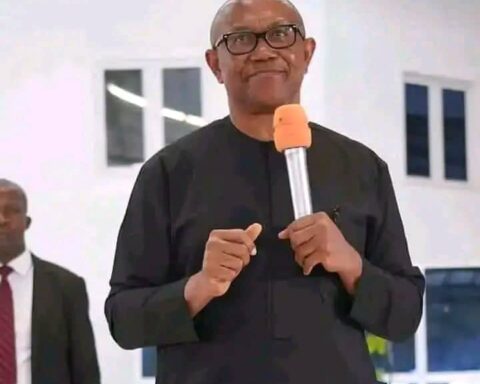
Politics, that insatiable beast, refused to pause even as the nation mourned the heartbreaking loss of Chimamanda Ngozi Adichie’s son, Nkanu – a tragedy that exposed the fragility of our healthcare systems. The machinery ground on with relentless indifference, churning out headlines that filter into my awareness like toxic drips, each one underscoring the absurdity of our governance. The defection of Peter Obi to the African Democratic Congress (ADC) emerges as a pivotal act in this drama. It signals not just a tactical pivot for the 2027 electoral battlefield but a desperate reconfiguration of alliances in a landscape increasingly hostile to opposition voices.
The former Labour Party flagbearer’s shift – announced amid whispers of internal fractures – highlights the fluidity of loyalties in a system that rewards adaptability over ideology. I have pondered this intensely; Obi’s move, while perhaps a bid to consolidate anti-establishment forces, reeks of the same opportunistic reshuffling that has defined the Fourth Republic, where defections are less about principle and more about survival. A political analyst recently noted that such moves “often fragmentation the opposition further, risking a scenario where reformist energy is dissipated across multiple weak platforms rather than a unified front.” This news landed on me like a gut punch, evoking memories of past electoral mergers that promised change but delivered continuity, fueling my cynicism that such alignments merely perpetuate the charade.
Compounding this display, reports surface of President Bola Tinubu’s executive fiat approving the write-off of trillions in debts owed by the Nigerian National Petroleum Corporation (NNPC). This sleight-of-hand decree vanishes astronomical figures from ledgers with a mere stroke of the pen, ostensibly to “restructure” the entity’s balance sheet. Yet, it conspicuously fails to excise the entrenched corruption that spawned those liabilities – mismanagement and opaque contracts that have bled the oil giant dry. This is not fiscal prudence; it is an illusionist’s trick. Energy sector analyst Alex Neyin critiqued the move, stating, “Clearing these legacy debts without a forensic audit of how they were incurred is effectively granting amnesty for financial recklessness, ensuring the cycle of unaccountability continues.” This write-off exemplifies our retrograde politics: instead of forward-facing reforms like asset recovery, we slide rearward into forgiveness for the elite.
Meanwhile, the gubernatorial squabbles between figures like Oyo’s Seyi Makinde and Ekiti’s former governor Ayo Fayose over the alleged mismanagement of relief funds have devolved into a petty exchange. Fayose alleges a ₦50 billion receipt while Makinde insists on ₦30 billion, resembling petulant children bickering over pilfered toys. All the while, the intended beneficiaries – flood victims and displaced families – languish in deprivation. Makinde’s claims of fiscal propriety clash with Fayose’s barbs, turning what should be a mechanism for aid into a theater of deflection. Public administration scholar Prof. Ladipo Adamolekun has long warned that “the concentration of resources at the center and the lack of subnational accountability turns governance into a distraction, where elite infighting takes precedence over service delivery.” This act highlights the immaturity of our leadership; instead of collaborative progress, we retreat into tribalistic spats while the people hunger.
The entrenchment of a one-party state has transcended fear to become a tangible administrative reality. The ruling All Progressives Congress (APC) consolidates power through defections and judicial manipulations, morphing Nigeria into a de facto monopoly. Yet, what pierces me most acutely isn’t merely the tyranny exerted by this ascendant few, but the pervasive lethargy of the many. In the East, I sensed this ennui manifesting as a dangerous withdrawal. The “Biafra of the mind” surges stronger than ever – not as the overt secessionism of the 1960s, but as a subtler emotional disconnection.
This mental distance permeates daily life in the southeast. Interactions with Abuja are minimized to necessities, approached with the wary pragmatism reserved for an occupying force. Elders in Abiriba spoke of federal policies with the detachment of foreigners discussing a remote empire. Historian Dr. Chinweizu has articulated similar sentiments regarding African identity, noting that “true decolonization requires a psychological break from structures that no longer serve the indigenous interest,” a concept that now applies internally to the relationship between the Southeast and the center. I have felt this disconnection viscerally; conversations with cousins revealed a generation viewing national symbols as hollow rituals, their true allegiances tethered to regional resilience.
To expand this thesis, consider the historical underpinnings of our backward politics, rooted in the colonial amalgamation of 1914. We have ‘moonwalked’ through military coups and flawed transitions that regress us to authoritarian molds. My rage here is unbridled: I see this lethargy as complicit suicide. The many’s withdrawal – boycotting elections or retreating into ethnic enclaves – empowers the few’s tyranny. As a political scientist acquaintance warned, “Apathy is the fertilizer of despotism; when the citizens retreat, the state does not wither – it hardens.”
This political circus implicates the entire spectrum, demanding a radical pivot. Without grassroots mobilization and genuine dialogue to rekindle trust, this backward slide will culminate in disintegration, leaving the few’s tyranny to reign supreme in a hollow shell of a nation.
THE DEATH OF THE WITNESS
And who, in this dissonance of national unraveling, is tasked with chronicling these tales of ruin, with hoisting the unyielding mirror to reflect the pustulent visage of a society in terminal decline, forcing us to confront the maggots feasting beneath the skin? The press – ah, the beleaguered, bastardized press – once exalted as the unblinking conscience of the nation, a bulwark against tyranny and a beacon for the voiceless, has devolved into a raucous bazaar. Here, truth is bartered like counterfeit wares in a Lagos market, and integrity is haggled down to the lowest bidder.
As I immerse myself in the backlog of headlines from the past three weeks, sifting through digital detritus upon my return to the city’s relentless hum, I am assaulted by an overwhelming emptiness that permeates the trade. It is a void where investigative rigor once thrived, now filled with the echoes of sponsored platitudes and sensationalist drivel. The passing of Dan Agbese in November 2025, that venerable doyen of Nigerian journalism whose pen dissected dictatorships and illuminated injustices across decades, strikes me as deeply symbolic. It marks a poignant closure to an era when the Fourth Estate still prioritized testimony over expediency, when reporters chased stories not for clicks or kickbacks but for the sacred duty of illumination.
Now, journalism in this fractured land has largely forsaken its role as a career of unflinching evidence, morphing into a mercenary hustle where survival trumps scrutiny. The byline serves not as a badge of honor but as a ticket to patronage. My reentry into Lagos’ media maelstrom, after Abiriba’s unfiltered oral conversations and lived histories, left me reeling. Scrolling through apps in a dimly lit café, I felt a visceral grief, mourning not just Agbese but the profession he embodied. I wondered how we have allowed this vital organ of democracy to atrophy into a complicit corpse, comatose and aiding the nation’s self-deceptions.
To excavate the depths of this demise, we must confront how the press, once a forge of accountability that toppled regimes and exposed scandals – from the Abacha-era lootings to the fuel subsidy frauds – has been commodified into a conveyor belt of propaganda. It churns out government press releases as if they were infallible gospels, unexamined and unchallenged, peddling narratives that soothe the powerful while silencing the afflicted. Headlines proclaim “economic rebounds” and “security victories” with the fervor of state-sponsored sermons, even as inflation devours livelihoods and insurgencies claim villages. Newsrooms transform into echo chambers where dissent is drowned in a deluge of advertorials and “soft” features bankrolled by corporate overlords.
I have witnessed this hollowing firsthand; during my Abiriba interlude, conversations around communal firesides revealed raw truths – farmers crippled by fertilizer scams, youths emigrating en masse. These are stories that never pierce the urban news bubble, supplanted instead by pieces on ministerial photo-ops. In his classic critiques, Agbese often warned that a press which “feasts at the table of power eventually chokes on its own silence,” a prophecy that has now grimly come to pass. This is not mere evolution; it is euthanasia, accelerated by economic pressures – plummeting ad revenues, soaring operational costs – that force outlets to court favors from the very entities they should scrutinize. The result is a landscape where investigative series yield to sensational clickbait, and whistleblowers are vilified as troublemakers.
They sell us a version of the country that exists only in the fevered imaginations of spin doctors and sycophants. It is a sanitized facsimile where “fiscal consolidation” is touted as panacea amid chaos, and “renewed hope” agendas are hawked like elixirs for a populace choking on despair. All the while, the press amplifies these fictions without caveat or context. In the rural spaces of Abiriba, such jargon was absent from discourse; there, the lexicon revolved around tangible pains. My kin spoke of the escalating price of yam tubers, inflated by over 60% due to supply chain disruptions and middlemen profiteering. These are realities that ground existence in survival’s grit, unadorned by the glossy veneers of Lagos broadsheets.
My return amplified this schism. Poring over articles that glossed over December’s 31.2% inflation spike with euphemisms like “temporary base effects” or “market adjustments,” I felt a surge of alienation. It was as if the newsstand peddled alternate realities scripted in air-conditioned offices far removed from the street’s sweat and strife. The late media scholar Prof. Lai Oso diagnosed this tendency as “elite enclosure,” noting that “the Nigerian press has become an urban monologue, disconnected from the rural majority and speaking only the language of the privileged.” This disconnect has never yawned wider: while headlines celebrate stock market surges, the streets seethe with vendors closing early due to unaffordable transport, families rationing meals, and informal economies buckling under currency volatility – truths that journalism once amplified but now mutes in favor of palatable myths.
We are, in essence, consuming fiction masquerading as news, a literary genre of national denial where reports on “infrastructure milestones” ignore pothole-riddled highways, and exposés on corruption are buried under layers of sponsored content. Citizens are left to navigate a fog of misinformation that blurs the line between reality and regime-approved reverie. The symbolism of Agbese’s death resonates here; as a co-founder of Newswatch, he embodied the witness ethos, his work in the 1980s holding mirrors to power’s ugliness, often at personal peril. His passing marks the eclipse of that tradition, supplanted by a generation of “hustle journalists” who prioritize viral metrics over veracity.
From my vantage, bridging oral traditions – where stories of colonial resistance and civil war scars are passed unfiltered – to Lagos’ digital deluge, I have internalized this as a cultural amputation. Without witnesses, atrocities multiply in the shadows, from electoral frauds to extrajudicial killings, unchecked by a press too entangled in the hustle to howl. Media critic Prof. Farooq Kperogi has aptly described this as the “death of shame,” arguing that “economic precarity has birthed a journalism of blackmail and brown envelopes, where the reporter’s silence is bought, and the public’s right to know is sold.”
Delving deeper, this journalistic decay traces historical arcs from the colonial-era press that agitated for independence, through the vibrant 1970s-1980s era of punchy dailies like The Punch and Guardian, to the digital disruptions of the 21st century. Economic downturns exacerbated this; with outlets facing bankruptcy, many pivoted to “brown envelope” journalism – bribes for favorable coverage – eroding ethical foundations. My reflections here blend sorrow with scorn; in conversations, elders recounted Biafran war dispatches smuggled across lines, raw and unvarnished. This contrasts sharply with today’s sanitized feeds that ignore eastern marginalization, such as the unaddressed herder-farmer clashes decimating farms.
This death of the witness implicates not just journalists but owners, regulators, and audiences who demand entertainment over enlightenment. It perpetuates a cycle where vacant reporting sustains the rotting status quo. My imperative is for revival: ethical training funds, independent media cooperatives, and citizen journalism platforms to reclaim the mirror, reflecting truths from yam markets to power corridors. Without this, the nation stumbles blindly, its stories untold and its face unseen in the gathering dark.
THE ARCHITECTURE OF VULNERABILITY: WHAT IS OUR NATIONAL SECURITY DOCTRINE?
If we step back from the abattoirs of our hospitals and the gridlock of our economy to ask the ultimate existential question – Are we safe? – the answer reveals a terrifying void where a strategy should be. We must rigorously interrogate what exactly constitutes Nigeria’s “National Security Policy” in 2026. Is it a coherent doctrine of territorial defense and human safety, or is it merely a reactive gamble of “whack-a-mole” played with human lives?
The events of the last few weeks suggest the latter. While we were distracted by the festivities of December, global risk analysts and intelligence reports have been painting a picture of a nation that has hollowed out its own defense from the inside. The definition of national security has evolved globally to encompass not just the absence of war, but the presence of wellbeing – food sovereignty, health resilience, and economic stability. Yet, in Nigeria, we are failing on all fronts simultaneously. We are running a 20th-century kinetic military strategy against 21st-century asymmetric threats – like the Lakurawa insurgents and economic saboteurs – while ignoring the root causes that fuel them. We are trying to shoot our way out of a problem caused by the very corruption and neglect we detailed in our hospitals. A sick, hungry, and enraged citizenry is the greatest threat of all, yet our policy seems to be to buy more Tucano jets while shutting down factories.
We must look at the hard evidence filtering in from authoritative sources which suggests that our defense architecture is not just overwhelmed, but fundamentally compromised. Reports from Sahelian monitoring groups indicate that the “Lakurawa” incursion in the North West is not an isolated banditry issue but a coordinated expansion of the Sahelian jihadi corridor. While our Defense Headquarters issues press releases about “decimating” capability, foreign intelligence risk assessments – often shared with multinationals exiting the country – warn of “ungoverned spaces” metastasizing into “governed territories.”
We are witnessing the terrifying reality that non-state actors now possess better intelligence, better welfare for their foot soldiers, and arguably, better strategic clarity than the Nigerian state. When a warlord can levy taxes in Sokoto more effectively than the FIRS, and enforce judgments more swiftly than the Supreme Court, he is not just a criminal; he is a rival sovereign. Our approach seems to be one of “Containment by Denial” – pretending the cancer is a rash until it eats into the bones of the republic.
Furthermore, the porosity of our borders has become a global case study in state failure. We watched with nationalistic pride as our Air Force intervened in Benin Republic recently, projecting power abroad. Yet, that projection rings hollow when scrutinized against the backdrop of our internal permeability. How can a nation that claims to be a regional hegemon fail to secure its own forests? Security expert Kabir Adamu has long argued that Nigeria’s crisis is driven by a “political economy of insecurity” – where the political class and security contractors benefit from the chaos economy.
The kidnapping industry, now worth billions of Naira annually, has become a value chain that likely involves state actors, traditional rulers, and officers. If we truly had a National Doctrine, it would start with following the money. It would interrogate why ransom payments are made through the banking system without consequence. It would ask why the proliferation of small arms continues despite closed borders. The uncomfortable truth is that insecurity in Nigeria has become an enterprise, and you do not solve a problem that pays the salaries of the powerful.
The intersection of our medical implosion and our defense disintegration offers the grimmest illustration of our policy failure. A doctrine that does not account for the health of its people is a suicide pact. When we speak of “Bio-Security,” we are not just talking about pandemics; we are talking about the resilience of the demographic. The tragedy of Chimamanda Ngozi Adichie’s son and the millions of nameless others is a defense issue. A populace that is traumatized, bereaved, and distrustful of the state cannot be mobilized for national protection. It is a group ripe for radicalization. When the state breaks the social contract by failing to provide healthcare, it loses the moral authority to demand loyalty. Why should a young man in the East or the North provide intelligence to the DSS when the same system allowed his mother to die on a hospital floor? Our approach ignores the “Human Terrain,” treating Nigerians as collateral damage in their own country rather than as the primary asset to be preserved.
Finally, we must confront the geopolitical isolation looming over us. The recent diplomatic humiliations – troops detained in Burkina Faso, the cold shoulder from the Alliance of Sahel States (AES) – are indicators that our neighbors no longer respect our “Big Brother” status. They smell the blood in the water. They see a giant whose knees are buckling under the weight of debt and internal discord. Diplomatic cables and foreign policy analyses suggest that Nigeria is losing its sphere of influence because it cannot export stability when it imports chaos.
We are encircled by a belt of instability, and our response has been incoherent – swinging between bellicose threats of invasion (Niger) and helpless diplomacy. A true National Security Policy would recognize that our domestic rot – the corruption in the teaching hospitals, the theft in the oil sector, the disintegration of the grid – is the primary driver of our external weakness. We are not safe because we are not sound. And until we fix the broken bones of the domestic state, all the fighter jets in the world will not save us from the inevitable collapse of a house built on sand.
THE BREACH OF THE FORTRESS: BLOOD ON THE KUBWA EXPRESSWAY
Just as we attempt to intellectualize Nigeria’s defense implosion in abstract terms, a calamity erupts from the very heart of the Federal Capital Territory that violently drags the conversation back to earth. The news filtering out of Abuja is that professional bodies are lining up a series of activities to honour Barrister Princess Nwamaka Mediatrix Chigbo, an Abuja‑based lawyer abducted and slaughtered by kidnappers. The geography alone demands a pause. This was not an attack in the ungoverned forests of the North East, nor in the bandit‑scarred hinterlands of Zamfara. This happened on the Kubwa Expressway – a major artery of the FCT, a road used daily by ministers, legislators, and the very security chiefs who insist the capital is secure.
Her final moments, as recounted by her family, read like a national nightmare transcribed in real time. On Monday, January 5, 2026, she was on the phone with her sister. One moment they were conversing; the next, the line dissolved into chaos. Her sister heard the unmistakable sounds of distress before the connection was severed. The family’s subsequent frantic attempts to reach her led not to a negotiator, but to the horrifying reality of a ₦3 million ransom demand – a price tag placed on a human life in the nation’s capital.
By Tuesday, January 6, 2026, the flickering hope for her survival was extinguished. Police informed the family that a woman had been found in critical condition and taken to a specialist hospital. When her sister arrived at the mortuary, the sight that greeted her was not merely a corpse, but a crime scene written on flesh. Nwamaka’s body bore the brutal signatures of torture: bruises, swollen eyes, and a cracked skull. It is a detail so visceral that it dissolves the distance between the personal and the political. It forces the country to confront the truth: the Nigerian state has lost the monopoly of violence even in its own bedroom.
A lawyer – someone whose profession is built on the architecture of justice – was snatched, tortured, and killed within the operational radius of the Presidential Villa and the DSS headquarters. The predator is no longer at the gate; the predator is on the expressway, commuting with us, selecting victims from the same traffic lanes as the nation’s ruling class.
In response, the Blessed Iwene Tansi Catholic Community, the Global Association of Female Attorneys (GAFA), and the Nigerian Bar Association (NBA) have rolled out a programme of tributes: Requiem Masses, nights of remembrance, and a final journey home to Anambra. The intent is noble, but the phrase “lining up activities” exposes something darker – a ritualization of national failure. We have become experts in the choreography of mourning. We excel at the logistics of grief. But the stinging question remains: Where was this energy when she was alive? Where was the geo-location technology that could have traced her phone while the line was still active on that Monday night? Where was the rapid response unit on the Kubwa Expressway? Where was the state?
Nigeria has perfected the art of honouring the dead while abandoning the living. These ceremonies, however heartfelt, risk becoming a macabre distraction – a way to perform solemnity so we do not have to perform justice. By focusing on the funeral rites, society subtly reframes a preventable murder as an inevitable horror, as though the government were a helpless bystander rather than the primary guarantor of safety. This incident pins the country down in a psychological chokehold. It sends a chilling message to Abuja’s middle class – the civil servants, the diplomats, the technocrats – that the immunity of the capital has evaporated. If a high‑profile lawyer can be harvested and battered to death for a ransom on a major FCT expressway, then the idea of a “Safe Corridor” is a myth. The fortress has been breached. The center cannot protect itself, let alone the periphery.
Her killing, and the subsequent memorial activities, expose a deep national wound that we have refused to confront. Abuja is not just any city; it is the symbolic heart of the republic. When a professional woman is abducted and murdered in the very city meant to embody order, it becomes impossible to pretend that the crisis is “out there.” The calamity becomes a metaphor for a country where even the institutions tasked with upholding the rule of law cannot protect their own. The societies lining up tributes are not merely mourning a colleague; they are mourning the fracture of the civic guarantees that once defined the meaning of citizenship.
That this happened in the FCT is not a footnote; it is the thesis. Abuja is the controlled environment, the curated showcase of the Nigerian state. If terror can strike so brazenly there – kidnapping, torturing, and killing – it signals a level of state impotence that should terrify anyone still clinging to the illusion of stability. The capital city is supposed to be the last place to fall, the final bastion of order. Yet the incident demonstrates that the rot has seeped into the very core. The memorial activities planned by professional groups become, in effect, a quiet indictment of the administration’s inability to secure even the symbolic seat of power.
The societies honouring Barrister Chigbo are doing more than celebrating her life; they are documenting the human cost of a nation’s drift. Her story becomes a case study in how ordinary Nigerians – educated, employed, urban, and supposedly protected – are swallowed by a system that cannot guarantee the most basic right: life. Her death is not an isolated atrocity but part of a growing archive of national grief. Each tribute, each candlelight procession, each statement issued by legal associations becomes a marker in the larger narrative of a country struggling to hold itself together. The personal and the political merge, revealing how insecurity has become the great equalizer, touching every class, every profession, every geography.
The killing of the Abuja lawyer forces a rigorous national questioning: what does it mean to be a citizen in a country where the state cannot guarantee safety even at the center of its power? What does it say about the future when professional bodies must repeatedly gather not to celebrate achievements but to honour the dead? And how long can a nation survive when its defenders of justice are picked off by criminal networks that operate with near impunity? The incident becomes a lens through which the entire picture sharpens: Nigeria is not merely experiencing insecurity; it is witnessing the acute erosion of statehood itself.
THE QUESTIONS THAT HARASS US
Reimmersing myself in Lagos after the contemplative hush of Abiriba carries the heft of accumulated absences, as if the city’s relentless thrum – generators snarling like chained beasts, traffic surging in fits of futile haste – conceals a subterranean exhaustion, a collective weariness etched into the faces of commuters and the sagging shoulders of street vendors, all underscoring a nation suspended in anticipation of some elusive catalyst to rupture the stasis. Yet, Nigeria embodies the paradox of an entity perpetually awaiting its own shadow, orbiting its flaws in endless loops, meticulously rehearsing breakdowns as if they were rituals of renewal, and staging spectacles of advancement that evaporate upon scrutiny, leaving only the residue of regression.
This isn’t mere inertia; it’s a performative cycle where economic mirages, political moonwalking, and journalistic hollows conspire to simulate motion without displacement, a treadmill existence that exhausts without elevating. My return jolted this into sharp relief: stepping into the humid frenzy, phone buzzing with missed alerts, I sensed the psychological undercurrents – the dreams deferred, fears amplified, hopes flickering like faulty bulbs – reminding me that Nigeria is more than borders and bureaucracies; it’s a mental terrain molding our inner worlds, where reentry after silence feels like invading a cacophonous chamber of overlapping monologues, each voice clamoring yet conveying nothing of substance. Amid this din, the true labor commences: sifting through contradictions, amplifying strangled truths, mourning not only the departed – like Herbert Wigwe and the anonymous victims of darkened wards – but the living ensnared in this absurd theater, their vitality ebbing in slow-motion demise. For now, anchored in Lagos’ pulse, I join the vigil – not in passive surrender, but with a fervent belief that interrogations, reflections, and unvarnished narratives can forge a lexicon to articulate this anguish, lest the village’s quietude foreshadow a national tomb.
And yet, woven into this chaos are the insistent questions that assail the intellect, prod the moral core, and demand reckoning – interrogatives that gleam like unpolished diamonds embedded in the fractured narrative of our shared saga, compelling us to excavate deeper meanings from the rubble of denial and delusion. These aren’t idle musings; they are harassments of the soul, born from the essay’s unfolding diagnoses, urging us to confront the unsustainable facades we’ve erected. Let us, then, venture lengthy and brilliant explorations of them, drawing from the metaphors of medical cannibalism, economic gaslighting, political regression, and journalistic atrophy that have threaded this reflection, attempting to make sense of their implications in a bid to illuminate paths forward.
How long can a nation survive on denial? Can we deny the grid into stability? Can we deny the hospitals into safety? To grapple with this, consider denial not as a fleeting evasion but as the structural bedrock of Nigerian governance, a deliberate architecture sustaining the illusion of functionality amid cascading failures, where officials incant stability through press releases while the power grid collapses with metronomic regularity – over 10 times in 2024 alone, stranding industries and households in darkness that denies productivity and dignity. Survival on such denial is finite, a precarious tightrope over an abyss; historically, empires like the Soviet Union crumbled when economic fictions could no longer mask breadlines, much as Nigeria’s grid denials perpetuate a cycle of “technical faults” and “vandalism” excuses that evade investment in renewables or anti-corruption safeguards, costing the economy trillions annually and eroding public faith until the system shorts out entirely.
We cannot deny the grid into stability; attempts to do so, as seen in the perennial blackouts that force reliance on imported generators, merely amplify dependency and debt, transforming energy poverty into a chronic ailment that saps national vitality – imagine a body pretending its heart isn’t failing, pumping harder only to accelerate collapse. Similarly, denying hospitals into safety is a lethal farce; the medical cannibalism I’ve decried, where funds vanish into private pockets while wards languish without power or drugs, cannot conjure security through obfuscation alone – witness the maternal mortality rates that remain among the highest globally, a statistic that denial reframes as “challenges” rather than indictments of systemic predation.
In my Abiriba reflections, elders recounted colonial-era health denials that bred epidemics; today, this persists in underfunded clinics where patients die from treatable ills, proving that denial prolongs agony but cannot indefinitely forestall reckoning – eventually, the body politic revolts, as in the Arab Spring uprisings where suppressed truths ignited revolutions. Thus, a nation can endure on denial for decades, as Nigeria has since independence, but the toll mounts in eroded trust, brain drain, and social unrest, culminating in a breaking point where facades shatter, demanding honest audits and reforms to build genuine stability, lest denial become the nation’s epitaph.
What becomes of a people who learn to endure everything? When does resilience become complicity? Are we surviving our way into extinction? Here, endurance emerges as Nigeria’s double-edged sword – a vaunted resilience forged in the fires of civil war, oil booms and busts, and military dictatorships, where citizens adapt to blackouts by hoarding fuel, to inflation by bartering, and to corruption by navigating informal networks – yet this very adaptability risks morphing into a complicit inertia that normalizes dysfunction, allowing the political circus and economic illusions to persist unchallenged. A people who endure everything become shadows of their potential, their spirits calloused into apathy; I’ve seen this in Lagos’ commuters who shrug at grid failures as “normal,” or in Abiriba’s farmers who till depleted soil without protesting fertilizer scams, their resilience hardening into a survival mode that stifles collective action.
Resilience crosses into complicity when it shifts from resistance to resignation – precisely at the juncture where endurance excuses the inexcusable, as when voters reelect corrupt leaders for ethnic loyalties, or when the “Biafra of the mind” withdraws into emotional secession rather than demanding federal equity, thereby enabling one-party hegemony. This complicity isn’t victim-blaming but a recognition of agency; political theorists like Frantz Fanon, in analyzing post-colonial psyches, warned that prolonged endurance fosters internalized oppression, where the oppressed mimic the oppressor’s tactics, perpetuating cycles of predation. Are we surviving our way into extinction?
Unequivocally, yes – if survival means mere biological persistence amid demographic explosions (Nigeria’s population nearing 230 million by 2026) without qualitative leaps, we risk a slow demographic suicide, where youth bulge into unemployment armies, resources strain to breaking, and cultural vitality atrophies into despair-driven migrations, as evidenced by the hundreds of thousands of Nigerians who fled abroad in 2025 alone. My return amplified this; witnessing Lagos’ hustlers endure traffic hell without revolt, I pondered how this “japa” exodus – surviving by escape – hollows the nation, leaving behind an aging, depleted core teetering toward irrelevance. To avert extinction, resilience must evolve into rebellion – mobilizing endurance for systemic overhaul, transforming complicity into confrontation before the people’s fortitude becomes their funeral pyre.
What future can emerge from a present that refuses to be honest with itself? Can you build a house on a foundation you pretend isn’t cracking? No viable future sprouts from dishonest soil; a present mired in self-deception, as Nigeria’s is – gaslighting economic collapses as “resilience,” moonwalking politically while denying fractures, and allowing journalism to peddle fictions – yields only dystopian tomorrows, where unaddressed cracks widen into chasms, swallowing aspirations. Honesty is the cornerstone; without it, as in the unacknowledged debts ballooning to ₦100 trillion or the ignored climate vulnerabilities flooding farmlands, the future manifests as amplified crises – generational poverty, environmental ruin, and social implosions.
You cannot build a house on a pretended foundation; the metaphor is apt, evoking biblical parables of sand-built structures collapsing in storms, much like Nigeria’s post-independence edifice, erected on colonial fault lines and sustained by denial of ethnic tensions, corruption, and inequality, now fracturing under population pressures and global shifts. In Abiriba, communal truths built resilient kinship networks; contrasting this with Lagos’ veneer of progress, I’ve realized that dishonest presents birth futures of illusion – think of the “Vision 2020″ plans that fizzled into 2026’s realities of youth unrest and infrastructural decay. Philosophers like Jean-Paul Sartre on bad faith illuminate this: self-deception chains us to inauthentic existences, preventing authentic futures. To forge ahead, we must excavate honesty – through truth commissions on past atrocities, transparent data reforms, and cultural dialogues – erecting a house on solid, acknowledged ground, else the cracks consume all.
My return to Lagos has starkly illuminated that clamor masquerades as advancement, our exertions on this national treadmill yielding sweat without stride, often regressing us further into the shadows of unlearned lessons. Nigeria, as a psychological expanse, molds our reveries into guarded whispers, our terrors into normalized nightmares, our aspirations into fragile embers – reentering after silence feels like decoding a babel where substance drowns in superficiality. Yet herein lies the genesis of transformation: amid the clamor, the paradoxes, the suffocating voids, we mourn the visible dead and the invisibly fading, channeling grief into interrogation. For the moment, I abide in Lagos’ rhythm, the nation in its self-vigil, and I in vigilant anticipation, wagering that articulations, probes, and veracities retain potency to rephrase our suffering, forestalling the village hush from enveloping us in eternal quietude.
THE DUST OF A NEW YEAR: A REQUIEM FOR THE LIVING
I am back in Lagos, that sprawling leviathan of concrete and contradiction, but the city itself seems adrift, not yet reclaimed its frenetic essence, as if the turn of the year has left it suspended in a liminal haze, its arteries – the roads typically thrombosed with the desperate choreography of survival hustles – now eerily permeable, not through any orchestrated efficiency or urban planning miracle, but due to a profound, pervasive exhaustion that permeates the atmosphere like the dry January harmattan dust, sifting through every crevice and settling with insidious persistence. This dust is omnipresent, a gritty pallor veiling the waxy leaves of roadside neem trees that once offered meager shade to weary pedestrians, blanketing the hoods of idle vehicles abandoned by owners too depleted to fuel them, and infiltrating the very breath of a metropolis too fatigued to expel it with a collective cough, mirroring the nation’s own labored respiration amid unending crises.
My neighbors, those resilient specters emerging sporadically since I deposited my travel-worn bags in my modest flat, extend the customary seasonal salutations – clasping my hand in grips weakened by unspoken burdens, murmuring that rote incantation, “Happy New Year,” yet the words wither on their lips, bereft of conviction, their eyes shadowed with a vacancy that betrays no spark of genuine felicity, no buoyant inflection of hope, no elastic rebound in their steps that might suggest renewal. It is a greeting stripped bare, a perfunctory echo recited by souls acutely aware that the Gregorian calendar has flipped its page, ushering in 2026 with mechanical inevitability, but the inexorable grind of their daily realities remains unaltered, entrenched in the same quagmires of scarcity, insecurity, and systemic betrayal that defined the year prior.
This morning, as I ventured out to reacquaint myself with the neighborhood’s rhythms, I bore witness to a visceral tableau at the bus stop: two middle-aged men, their beards streaked with premature gray from years of unrelenting strain, erupting into a savage brawl over a paltry fifty Naira in change – a sum so insignificant in the inflationary vortex of 2026 that it scarcely purchases a sachet of water, let alone sustenance. Their punches landed with raw, primal fury, not truly for the coinage itself, but as a conduit for pent-up rage, a explosive release in a society where every pressure valve has been welded shut by indifference and incompetence, transforming minor disputes into infernos that scorch the social fabric. That fifty Naira skirmish encapsulates Nigeria’s tragic essence: a frenzied, violent scramble for the merest crumbs in a national bakery that ignited and burned to ashes decades ago, leaving only the acrid smoke of unfulfilled promises and the charred remnants of collective dreams.
This street-level ire, so palpable in the men’s flailing fists and guttural snarls, resonates on the precise emotional wavelength of the manifold tragedies we’ve dissected across these vignettes, forging an unbroken chain from the personal to the systemic, where individual outbursts become microcosms of national pathologies. The pugilist raging over loose change is the kindred spirit of the beleaguered doctor in the underfunded teaching hospital, who, ensnared in the predatory logic of medical cannibalism, demands upfront deposits before deigning to attend to a convulsing child, both figures ensnared in a scarcity mindset so deeply ingrained that it has corroded their humanity, reducing empathy to a luxury unaffordable in a landscape where survival is monetized at every turn. Recall Chimamanda Ngozi Adichie’s harrowing ordeal, the untimely death of her son in a Lagos hospital ward plunged into darkness by yet another grid collapse, a tragedy not isolated but emblematic of the “abattoirs of healing” where nameless millions perish annually – over 300,000 maternal and child deaths in 2025 alone – from preventable causes, their lives extinguished by the same institutional predation that devours budgets meant for drugs, equipment, and electricity, diverting them into the coffers of corrupt officials who feast on the nation’s vital organs.
This dust blanketing Lagos’ streets is the identical particulate shroud enveloping the vacant beds in our dilapidated hospitals, the deserted desks in crumbling schools where teachers strike over unpaid salaries, and the forsaken farmlands in the east where herder-farmer clashes, unaddressed by a retreating state, leave harvests to rot. It is the tangible residue of a governance that has abdicated its duties, withdrawing into fortresses of denial while the populace navigates a minefield of inefficiencies. We’ve traced these connections meticulously: from the insulating silence of Abiriba’s hills, where digital blackouts sever connections to the wider world, fostering a “Biafra of the mind” of emotional secession and distrust toward Abuja’s colonial-like impositions, to the northern frontiers scarred by US airstrikes against Boko Haram, a humiliating intervention that underscores our “neighbor’s bread” dependency – Washington’s drones raining fire on our soil because our military, hampered by corruption and underfunding, cannot secure its own territory.
The portrait that crystallizes is of a nation reduced to a clinical “case study” in global forums, a pitiable patient exhibiting symptoms of chronic failure – economic hemorrhaging, political paralysis, journalistic atrophy – with no attending physician, no coherent diagnosis, only the grim efficiency of mechanisms that accelerate our demise: the kidnapper’s precise abductions netting billions in ransoms, the inflationary spikes that devour wages overnight (32.34% by December 2025, eroding real incomes by 25%), and the political machine’s ruthless consolidation into a one-party hegemony, moonwalking backward through defections like Peter Obi’s to the ADC, trillion-naira NNPC debt write-offs that erase corruption without accountability, and gubernatorial squabbles over misappropriated relief funds, all while the masses languish.
As I readjust to this dissonant cadence of dysfunction, the specter of those US airstrikes and our beggarly reliance on “neighbor’s bread” lingers like an unhealed wound, binding every strand of this narrative into a tapestry of ultimate abasement, where Nigeria’s pretensions to sovereignty unravel thread by thread. It is the crowning indignity that interlaces the vignettes’ themes: a country incapable of treating its ailing citizens, as evidenced by Chimamanda’s loss and the broader medical cannibalism that turns hospitals into profit-driven slaughterhouses; unable to bridge its regional divides, leaving the east in communicative isolation and nurturing that mental Biafra where Abuja is viewed as a predatory outsider, to be engaged minimally and mistrusted maximally; and powerless to wage its own battles, outsourcing security to foreign powers in a farce that exposes the hollowness of our “giant of Africa” moniker – we, the purported big brother, reduced to pleading for scraps at the table of superpowers, our soldiers humiliated as American munitions strike targets we cannot reach.
This dependency isn’t mere geopolitical misfortune; it’s the endpoint of internal failures, from the economic illusions where stock market surges (51% gains in 2025) gaslight the populace into ignoring multidimensional poverty afflicting 133 million, to the political circus of backward gliding, where leaders like Tinubu approve debt amnesties that absolve elite malfeasance while governors bicker over ₦50 billion in aid, diverting focus from starving constituents. The schizophrenia is stark: our “Foreign Policy of Intervention” sees us meddling in Benin’s affairs with bombastic posturing, projecting a hologram of regional might, even as our “Domestic Policy of Helplessness” leaves Zamfara’s communities to the mercy of bandits, their pleas unanswered amid grid collapses and inflationary sieges. The “Happy New Year” exchanged by my neighbors rings as a profound falsehood, for genuine renewal demands novel paradigms, not the perpetual loop of antiquated dysfunctions – we orbit our shadows in perpetual twilight, blind to the fact that in such darkness, no silhouettes emerge to guide us, only the void of unaddressed traumas.
So, what distills as the inexorable conclusion from this mosaic of vignettes, this requiem not for the departed but for the living who trudge through the dust of disillusion? It is that our vaunted resilience, once a badge of national fortitude forged in the crucibles of civil war, colonial legacies, and economic volatilities, has metastasized into our most insidious curse, a shock-absorbing mechanism that normalizes the intolerable and perpetuates the cycle of decay.
The relative emptiness of Lagos’ roads in this nascent year isn’t a harbinger of tranquility or improved infrastructure; it’s a symptom of immiseration, where citizens can no longer afford the fuel or fares to commute, their mobility curtailed by the same economic gaslighting that touts NSE triumphs while households fight over fifty Naira, their purchasing power eviscerated by 40% food inflation and naira devaluations. We’ve acclimated to the grid’s chronic blackouts – those primordial descents into darkness that halt industries and spoil perishables, costing ₦1.2 trillion annually – by hoarding generators for the affluent and enduring sweltering nights for the rest; we’ve adapted to the digital silences in the east, where network failures during my Abiriba sojourn severed me from the world, reinforcing emotional disconnections that treat federal authority as a foreign yoke; we’ve habituated to the terror of highways riddled with kidnappers and herders’ incursions, and now we’re acclimating to the preventable deaths of our children in medical crises, as in Chimamanda’s story, where a simple blackout and bureaucratic greed claim lives that proper funding could save.
This “adjustment” is the insidious alchemy that transmutes suffering into culture, enabling the government’s statistical sleights – proclaiming growth amid contraction, stability amid chaos – to gaslight us unchecked, as Bismarck Rewane and Muda Yusuf have critiqued in their analyses of bifurcated economies and elite deflections. The “politics of denial” thrives not in isolation but through our complicity; we, the people, become its enablers by suppressing our pain to navigate daily survival, thereby granting the state carte blanche to shirk its obligations – denying grid reforms, hospital upgrades, and journalistic integrity, as symbolized by Dan Agbese’s passing and the press’s devolution into a hustle of hollow fictions that widen the chasm between newsstand illusions and street realities.
Yet, ensconced amid this dust-laden torpor and the echoes of insincere greetings, I categorically reject this as the immutable finale, for to chronicle these vignettes – to etch the insulating silence of Abiriba’s hills, where oral histories of Biafran scars and current marginalizations foster psychological secessions; to amplify Chimamanda’s maternal grief as a synecdoche for the medical cannibalism devouring our healthcare; to unmask the humiliation of soldiers outshone by US drones and our beggarly feasts on “neighbor’s bread”; to excoriate the economic mirages where market highs mask mass immiseration; to decry the political moonwalking through defections, debt erasures, and one-party consolidations; to lament the death of journalistic witnesses who now peddle propaganda over truth; and to wrestle with the harassing questions of denial’s sustainability, resilience’s slide into complicity, and dishonesty’s barren futures – is itself an insurrectionary act, a refusal to let the dust entomb these verities.
We must forsake the vacuous ritual of “Happy New Year” wishes and instead clamor for a “Saner Nation,” one rebuilt on transparency, equity, and accountability. The dust must not be permitted to accumulate unchallenged; we must embody the irritants in the state’s unblinking eye, the unrelenting gravel in the oppressor’s polished shoe, persistently interrogating the “neighbor’s bread” that exposes our dependencies, the “hospital’s bill” that monetizes mortality, and the “politician’s smile” that conceals predatory intents.
For if we falter – if we merely brush the grime from our foreheads and descend into futile brawls over crumbs – then we transcend victimhood to become the architects of our own tragedy, co-authors of a narrative that consigns us to perpetual shadow-chasing. Nigeria awaits its shadow, indeed, but that shadow is us – the collective silhouette of a people poised at the precipice. It is time we cease our backward moonwalking, pivot resolutely to confront the sun’s unyielding glare, however blistering its truths may prove, and in that radiant confrontation, forge a path where resilience ignites revolution, denial yields to diagnosis, and the dust of despair is swept away by the winds of unyielding, transformative hope – rising, at last, as a nation no longer waiting, but walking forward into the light of its own making.
LAST WORDS: THE CHRONICLE OF THE UNRAVELING
As I conclude these reflections, returning to Lagos from Abiriba, I realize this is not just a geographical shift but a descent into a theater of denial. The village silence, once mistaken for isolation, was clarity – a lens through which the metropolis becomes unbearable. We are trapped in a paradox, waiting for change while oiling the machinery that destroys us. Our polity has devolved into entropy where the “healers” benefit from the affliction. From medical interns learning scarcity to consultants sabotaging public wards, we witness a system so corrupt it consumes even the elite. The loss of figures like Peju Ugboma shows that status cannot shield anyone. If “giants” cannot survive the infirmary, what hope exists for the masses whose deaths are normalized?
This internal rot mirrors an external stripping of dignity. We are tenants in our own territory. Foreign intelligence doing the work our security forces cannot – neutralizing threats like the Lakurawa – indicts our poverty and removes the last image of autonomy. We outsourced safety and economic thinking, trading pride for a mirage of stability. This vulnerability creates a vacuum where kidnappers operate with impunity. The murder of Barrister Princess Nwamaka Mediatrix Chigbo proves the fortress has fallen. When a defender of the law is killed on the expressway while the state remains deaf, the social contract is incinerated. Elite mourning rituals are merely hollow echoes of a society that has lost the capacity to enforce justice.
We are fed headlines about a surging stock market and stabilized currency, while inflation ravages households and the national grid collapses. It is a split reality: the bourse toasts while the street suffocates – a fracture between those living in the grit of 2026 and those governing from the delusion of a “Renewed Hope” turned to despair. Compounding this is the loss of custodians of conscience like Dan Agbese, leaving the public square to propagandists. Even politics is reduced to musical chairs on a sinking ship. The fanfare surrounding Peter Obi’s move to the African Democratic Congress feels like a distraction – a cycle of defections obscuring the truth: the regime is insulated, the opposition is part of the same ecosystem, and the multitude is left with debris. We are caught in a loop of futility where committees are formed, yet the poor remain invisible while the state enjoys immunity from negligence.
Ultimately, what remains is an internal secession I saw in Abiriba youth and the Lagos middle class. My return leaves me mourning a homeland consuming itself. The task for platforms like the MOULD Initiative, Nzuko Umunna, Aka Ikenga, Ohanaeze, Abia and Anambra League of Professionals and Ndigbo Lagos is no longer to salvage a rotting center but to fortify our own enclaves of value. We must document this failure so that when the facade crumbles, we have blueprints of the error. The verdict is damning: this is not incompetence; it is calculated extraction. The giant is comatose, bleeding from deliberate malpractice. Our duty is to endure the wake.