A Travelogue
By Agbeze Ireke Kalu Onuma, AI-KO
The decision to travel home is never simple in Nigeria. It comes weighted – with calculation, with a kind of chest-heaviness that has nothing to do with sentiment and everything to do with the specific intelligence that moving between Nigerian cities by road demands of a person. You think about the distance first, then the time, then the dozen variables between departure and arrival that no schedule accounts for. Then you leave anyway, because home is home, and some pulls are stronger than any arithmetic.
We left Lagos on a Sunday morning, three of us – Kenny, a Yoruba man from Kwara who drove the entire journey with a steadiness that made the long miles shorter, myself on the river seat beside him, and my wife settled into the back with the composed patience she brings to everything. The city had not yet gathered itself into its weekday fury. The roads still carried the memory of the night before, the air thinner, the overhead bridges briefly bearable. There is always a small optimism in early departure. Lagos in the first light of a Sunday has an almost confessional quality – quiet, briefly honest, the streets emptied of the performance that crowds make necessary. We drove through it with the particular alertness of those who have learned that this quiet does not last, who have learned…
We left at 5:30 in the morning. Not because we are people who rise at five o’clock for pleasure, but because the road between Lagos and Abiriba – approximately 630 kilometres by the route we were taking, through eight states, across the Niger and the Imo River, through the Benin bypass, the Anambra interior, the Imo hills and the new Abia tarmac – demands that you begin before the city has fully assembled its objections to your departure. I set the stopwatch on my phone at the moment we pulled out of the compound.
Not from habit or obsession, but from the writer’s instinct for evidence: the desire to have something beyond impression, something numerical and irrefutable, to set against whatever the road was going to say to us. Twelve hours and twenty-five minutes later, we drove into the compound in Abiriba. The stopwatch read 12:25:36. I looked at it for a long moment before I turned it off. Twelve hours and twenty-five minutes. For 630 kilometres. On roads that, in a country whose infrastructure matched its ambition, should have delivered us home in six.
The stopwatch had four laps, each one a precise accounting of what a specific corridor cost us. Not in money – though the roadblock economy extracted that too, stop by stop, all the way – but in the one thing that cannot be recovered, replenished, or returned: time. Lap One: six hours, thirty-five minutes, and nine seconds. Lagos to Asaba – the full length of the journey from our house through Lagos, through Ogun, through Ondo, across Edo State and its punishing bypass, and on through Delta to the bank of the Niger at Asaba. Six hours and thirty-five minutes. We arrived at the Niger at roughly noon, which meant the entire morning – the Lagos Sunday quiet, the Ijebu Ode roadside trade, the Ore craters, the Benin bypass, the Delta oil-palm corridor – had been consumed between 5:30am and midday.
In theory, Lagos to Asaba is a distance a well-maintained road should resolve in under four hours at ordinary speeds. The extra two and a half hours are not mysterious. They are itemised: the roadblocks, the bypass, the road surfaces, the pace that a broken corridor imposes on every vehicle that attempts it. Those two and a half hours are the daily tax on movement that this nation has been collecting from its people, without consent and without receipt, since long before any of us can remember.
Lap Two: two hours, forty-seven minutes, and twenty-seven seconds. Asaba to Owerri. This is the lap of the river crossing, the Anambra interior, Oba, Ozubulu, Okija, Ihiala, Uli, the Njaba descent, the Imo approaches. Two hours and forty-seven minutes for one of the most historically and visually layered stretches of the entire journey. It is a number that sits differently from Lap One – a body can absorb it without despair, it carries the feeling of motion rather than stagnation – but it is still not a number that reflects what these roads could be. The Niger Bridge itself was effortless; it was the kilometre beyond it where the wood and stones reappeared, where the police were waiting with their patient obstruction, where the time resumed being extracted in ways the tarmac was not. Still: this lap moved. And movement, after six and a half hours of the kind of road that seems designed to prevent it, is not a small thing.
Lap Three: one hour, twenty-five minutes, and forty-six seconds. Owerri to the Abia Tower at the Umuahia expressway entry. An hour and twenty-five minutes through Owerri – with its T-junction contortions, its makeshift bus loading at the Emmanuel College junction, its bottlenecks that are not traffic problems but planning failures wearing traffic’s clothes – and then out through the Mbaise road, through Obowo, down the long hill to the Imo River and across into Abia. By this point in the journey, the body has been in a car for over ten hours. The back has stopped sending polite signals and has moved on to formal complaints.
The legs have forgotten that other positions exist. The mind, which began the day with a certain crispness, has acquired the specific flatness of something that has been processing road, checkpoint, roadblock, bad surface, checkpoint, road, for the better part of a waking day. And yet: the Mbaise road through Obowo had its beauty. The Njaba valley offered its unrepeatable composition. Imo gave us its Sunday afternoon quiet. Even at hour ten, the road kept giving. This is what I mean when I say Nigeria rewards the traveller who refuses to reduce the journey to its worst moments. The rewards are real. They are simply delivered at considerable personal cost.
Lap Four: thirty-two minutes and thirty-five seconds. The Abia Tower to the compound gate in Abiriba. Thirty-two minutes. I want to write that number slowly: thirty. two. minutes. Because in the context of what preceded it – six and a half hours to Asaba, two hours forty-seven to Owerri, another hour twenty-five to the Tower – thirty-two minutes is not merely a lap time. It is a statement. It is what a good road says when it is finally allowed to speak. From the Tower, on the rebuilt Abia tarmac that Alex Otti’s administration has given back to these people, we moved at a pace that the preceding eleven hours had made us forget was available to us.
Thirty-two minutes that covered the same distance that, on the Lagos-Asaba lap, would have been forty, fifty, sixty minutes of crawl and negotiation and extraction. The ratio between Lap One and Lap Four is not arithmetic. It is moral. It is the distance between a state that has decided its people’s movement matters and a corridor that has been left to communicate the opposite through the daily, grinding evidence of its surfaces. Six hours thirty-five minutes versus thirty-two minutes. That is the gap between what Nigeria is and what it could be, measured in the only currency that is equal for everyone: time.
Now multiply these numbers by the people who are not driving home once but driving this corridor for a living. The commercial bus driver who completes this run three times a week and whose body absorbs twelve-hour Sundays not as a travelogue but as a working condition. The truck driver who has calibrated his entire existence – sleep, food, earnings, the phone calls home – around the time that Lap One reliably consumes, who has stopped being surprised by it and started being shaped by it, whose psychological portrait is drawn in the language of roads that never let you move freely and checkpoints that never let you pass cheaply. Think of what a Lap One corridor does to a person’s sense of possibility when it is not a journey but a life.
Think of the accumulated fatigue – not just physical, but existential – of a man who has driven six hours and thirty-five minutes to cover a distance that should take four, who has paid sixteen unofficial tolls, who will sleep tonight in a vehicle or a roadside room and do the return leg tomorrow morning, and who knows with the certainty of long experience that tomorrow will look exactly like today. What is the psychological portrait that road draws? It is not despair, exactly – despair requires a memory of something better, and these roads have been this way long enough that many of the men who drive them have no such memory to mourn.
It is something flatter than despair and more durable: a settled, load-bearing resignation to conditions that should be scandalous but have been normalised into the texture of a working life. The stopwatch gives you the numbers. The human cost is what those numbers add up to when you multiply them by every driver, every day, on every corridor like this one, across a country that has the resources to build Lap Four roads everywhere and has, for reasons that are entirely political, chosen not to.
The road south through Ogun State opens gradually. Ijebu Ode arrives before you expect it, a town with the easy confidence of a place that has always been on the way somewhere. Petrol sellers line the approaches. Roadside mechanics have their tools already laid out in optimistic rows. Akara and ogi at wooden stalls beside women in wrappers who have been awake since four. There is a texture to the morning trade on a Nigerian roadside that is worth pausing on – the commerce that begins before dawn, that does not wait for the world to warm up, that constitutes its own kind of national discipline, unrecognised and unhonoured, the informal economy breathing quietly in the background of all official narratives about Nigeria.
Then the road changes character. Between Ijebu Ode and Ore, the asphalt that had been merely rough becomes something else entirely – something that must be navigated the way one navigates a negotiation, lane by lane, reading it ahead, anticipating the craters, adjusting speed to the surface’s mood. Sections of road here have simply given up the pretence of continuity. What remains is not quite road and not quite ruins but something in between, and the trucks ahead pick their way through it with the weary expertise of beasts that have learned this terrain by the suffering of their axles. We followed their lines. It is one of the unwritten rules of Nigerian road travel: watch the truck ahead, and where he goes, you go.
The roadblocks begin almost immediately outside Lagos and do not stop until you have crossed more state lines than you care to count. They appear at intervals that feel precisely calibrated to maintain anxiety – too frequent to ignore, too numerous to fully budget for, too varied in their demands to reduce to any single strategy. Police in their black-on-black. Mobile police units in darker fatigues, these ones carrying the additional weight of a reputation for being less patient than their regular counterparts. Road Safety Corps officers in their distinctive Brown-and-black, a colour scheme that should signal caution and occasionally does, for reasons that have nothing to do with traffic management. Agbero, the motor park operatives who have colonised the spaces between the official agencies, collecting with a frank shamelessness that is almost easier to deal with than the official collections that require the performance of legitimacy.
At each stop, a choreography repeats itself with minor regional variations. The greeting first – “Happy Sunday, oga, we are here for you” – pitched at a frequency somewhere between warmth and menace. Then the outstretched hand, or the quiet delay, the documents examined at a pace chosen to communicate that time here belongs to the officer and not to you. The ask, when it comes, is rarely loud. It is a murmur, a sidelong thing, because everyone on this road knows what is happening and there is no need to announce it. I watched a truck driver two vehicles ahead of me dispense his N200 note with the economy of a man passing a baton – no eye contact, no pause, the note moving from hand to hand with the smoothness of a transaction so practised it no longer requires acknowledgement. It is the grammar of the road. Everyone is fluent.
I stopped being irritated somewhere around the fifth stop – Kenny at the wheel had long since adopted a philosophical silence, navigating the choreography with the composed focus of a man encountering something he knew about but had not before experienced at this frequency or intensity – and started, instead, watching. This is what long roads do if you let them – they strip away the first layer of response and leave you with something more patient, more inclined toward observation. The men at the roadblocks looked, most of them, the way exhaustion looks when it has been worn long enough to become an expression rather than a condition. Not cruel, particularly. Not the cartoonish villainy of men who had chosen this.
Something flatter than that, something that lived between resignation and necessity and had found a way to occupy that territory without drama. Several of them had the eyes of men for whom the morning had already been very long. The boots of one – a constable who flagged us down near Ore – needed resoling. His uniform had the slightly off-colour quality of fabric washed too many times in hard water. The gun on his shoulder was the only thing about him that looked maintained, and this detail, when it arrived in my mind, arrived with a particular chill. The man can decay; the weapon is kept functional. This is a statement of priorities.
And yet – and this is the thing the road insists on teaching you, if you are willing to be taught – the security situation, as real and as wounding as it is, does not consume the entire landscape. It does not fill every square metre of what there is to see and feel and know on these corridors. Between the roadblocks there is a country, and it is a country that rewards the traveller who refuses to reduce the journey to its worst moments. I am aware that one crossing does not constitute a survey, that a single Sunday passage through eight states – Lagos, Ogun, Ondo, Edo, Delta, Anambra, Imo, Abia – tells you only what one Sunday through eight states can tell you, which is not nothing but is also not everything, that the road on a different day, in different weather, with different fortune, would have given me a different set of experiences and a different set of conclusions.
I carry that awareness deliberately, as a corrective against the overconfidence that converts a single experience into a general truth. But I also carry what I saw. And what I saw, in the hours between leaving Lagos and reaching the Abia border, was a country doing what Nigeria has always done without adequate credit for it: sustaining itself, feeding itself, moving itself, trading with itself, maintaining the relationships and the commerce and the ordinary social fabric that make a nation a lived reality rather than a cartographic abstraction. The roadblocks are real. So is everything on either side of them.
What strikes me most, driving these corridors and driving them with deliberate attention, is how much of the living argument for Nigeria’s future is conducted not in Abuja or Lagos but on these roads and in the communities they pass through. The trader at Ijebu Ode who has been managing her stall since four in the morning is not waiting for a government programme to validate her enterprise. The mechanic in Benin with his tools laid out in the dust is not pausing his work pending a policy framework.
The boy selling groundnuts at Ore is not deferring his livelihood until the security situation resolves itself. They are already doing the thing. They are already present. And their presence on the road – their insistence on conducting their lives in full, against the headwinds of inadequate infrastructure and a state that under-serves them – is not merely admirable. It is instructive. It is the country showing you what it is capable of on the resources currently available to it, and inviting you to imagine what it becomes when those resources are multiplied by the kind of investment and attention it deserves but has not consistently received.
We need to travel these roads more. Not as tourists passing through on the way to somewhere else, not as reluctant transients making the minimum number of journeys that family obligation requires, but as people who have decided that knowing this country at its actual texture – at road speed, at close range, with the windows down and the attention engaged – is not optional for anyone who claims to care about it or want to contribute to its future. The distance between Lagos and Abiriba is not merely geographical. It is informational.
Every hour of that drive deposits things you could not have known without driving it: the specific character of the Ore road at this time of year, the mood of the Benin bypass on a Sunday, the way the Anambra interior feels different from the Delta interior feels different from the Imo interior – the granular, irreducible knowledge of a country that you can only acquire by being in it, moving through it, stopping in it, and talking to the people who inhabit it not as subjects of your concern but as people going about their lives who happen to have things to tell you if you are curious enough to receive them. Nigeria is a country that punishes the incurious traveller with its difficulties and rewards the curious one with itself. The reward, on this journey, was substantial.
Beyond Ore, the Edo State border is both invisible and unmistakable – invisible in the way of administrative lines that have no physical marker, unmistakable in the shift the road makes, in how it deteriorates further, and then briefly improves, and then deteriorates again, as though the road were staging its own argument about governance. The forest comes in closer here, pressing toward the road’s edges with a green insistence that reminds you how thin the asphalt intervention is, how recently the road was carved, how thoroughly the forest would have it back if the maintenance stopped. In places, it already has. Roots push up through tarmac. Vegetation leans into the carriageway with the casual confidence of something that knows the long game.
Benin City announces itself first in the traffic, then in the smell of roasting corn from a hundred roadside fires, then in the sudden density of commerce that makes you feel the city before you see its boundaries. Benin moves differently from Lagos – slower, more certain of itself, the ancient capital energy still faintly legible beneath the modernity, the old kingdom breathing quietly under the noise of the contemporary city in a way that Lagos, with its relentless presentness, never quite does. I do not stop to eat on the road – I travel with my flask, coffee or tea depending on the morning’s temper, and it has seen me through longer roads than this one – but we stopped in Benin nonetheless. Other reasons.
Brief. The kind of stop that is not about the place but about the necessity that a long journey occasionally imposes, and that Benin, in its unhurried way, accommodated without fuss. Around me while we paused: a mechanic working under a Toyota Corolla in the dust, a teenage boy pushing a wheelbarrow of yams toward the market, two women in church clothes picking their way around a crater in the road’s shoulder, holding hems. Life, in other words, in its most ordinary and most extraordinary forms, proceeding without annotation on the sides of a road that had no business being as broken as it was.
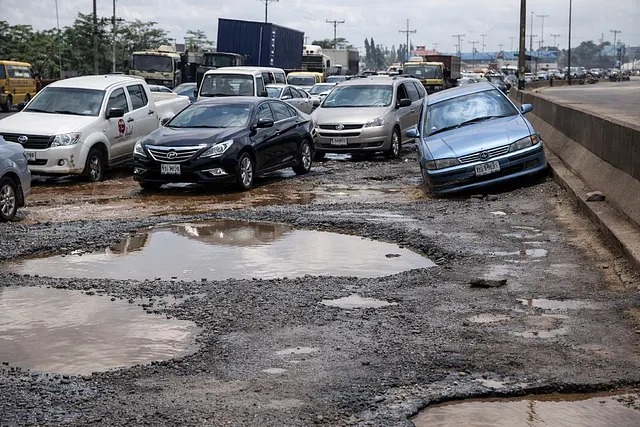
We did not pass through Benin City proper. We took the bypass – and I use that word in the strict administrative sense, because in every other sense the bypass is not a bypass at all but a punishment. A long, slow, grinding punishment visited upon every vehicle and every body that attempts it. The road on that bypass is bad in a way that requires qualification: not the ordinary bad of a Nigerian road in deferred maintenance, not the familiar bad of a surface that has simply been neglected, but something more aggressive than that, something that feels almost deliberate in its hostility. Craters deep enough to swallow a tyre to the axle. Stretches where the asphalt has not merely cracked but disappeared entirely, leaving behind a composition of gravel, mud, and compressed human suffering.
The kind of road that makes you instinctively lower your speed to something approaching a crawl and then lower it again, because whatever speed you have settled on feels, in the face of what the surface is doing, reckless. Trucks had gouged furrows in the softer sections; water had pooled in them and mixed with the red earth into a consistency that looked deceptively passable and was not. Other drivers picked their way through these sections with the slow, lateral care of men diffusing something. We joined them, Kenny reading the surface ahead with the calm concentration of a man who has decided that the road will not win, myself calling out the deeper craters from the river seat as they appeared in the headlights of the cars coming the other way, my wife maintaining behind us the dignified silence of a woman who has seen this road do worse. There was no other available philosophy.
At the far end of the bypass, where it eventually capitulates into what the signs and the maps and the official imagination of the Nigerian road network designate as the Benin-Asaba Expressway, I permitted myself a short, private laugh, and Kenny, who had been quiet for some time, made a sound that was not quite a laugh but was not quite not one either – the sound of a man from Kwara encountering the particular irony of the South’s road-naming conventions. Expressway. The word sat in the air of the car and refused to mean anything. To call that stretch of road an expressway is a dark joke at the expense of everyone who has driven it – a joke whose punchline is the pothole your wheel finds at exactly the moment you allowed yourself to relax, the lurch that reminds you that the name on the map and the surface under the tyres are not in the same conversation.
From the beginning of that bypass to its end, joining what the Federal Government calls an expressway, if you complete the passage in one hour you have driven better than any formula one driver on any circuit in the world – because formula one circuits are engineered to be driven fast, and this one is engineered, through its complete absence of engineering, to prevent it. We took longer than an hour. We were not ashamed of this. Nigeria shows its wounds on its roads and leaves the scars on its people, and the scar tissue on that bypass has been accumulating for long enough that it tells not just one government’s story but several of them, layered over each other in the way that bad roads are also a record of bad governance, each unrepaired section a dated entry in an unofficial ledger of neglect.
East of Benin, the road moves through Delta State with a changing mood. The oil-palm stands thicken on either side, their fronds catching the midday light at angles that make the roadside shimmer. Rivers appear with increasing frequency – brown, unhurried, sliding under bridges of varying degrees of confidence – and the towns become denser, more insistent, the roadside trade louder and more layered. Asaba arrives with the particular energy of a gateway city that knows exactly what it is: the last stop before the crossing, the final Delta exhale before the Niger swallows the distance between west and east.
We crossed the Niger at Asaba on the Second Niger Bridge, and the crossing was – unexpectedly, almost disorientingly – effortless. No queue. No patience-testing tributary of stationary vehicles stretching back toward the city. The bridge simply opened ahead and we drove onto it at speed, the way you enter a sentence that turns out to be shorter than you expected. This was a gift none of us had budgeted for, and we received it with the specific gratitude of the Nigerian road traveller, who has learned not to question good fortune but to take it quickly before it changes its mind. Kenny turned to look downstream as we crossed, something in the width of the water catching him in a way that the smaller rivers earlier in the day had not.
Below, the Niger was doing what the Niger always does: moving with an authority that makes everything on its banks feel contingent, temporary, provisional. Wide, brown, indifferent to the bridge above it and the traffic the bridge carried. We did not stop to contemplate it – there is no stopping on the bridge, and the momentum of unexpected freedom carries its own instruction – but I registered it in the way that things register at speed, as an impression that settles into something more considered only later. Empires have risen and fallen on these banks. Kingdoms have named themselves after this water. All of that history was down there, moving, as the current does not stop moving, as it has not changed direction in a thousand years, regardless of what the people above it are doing or failing to do.
The bridge deposited me not into Onitsha – that great, chaotic, irresistible market city whose gravitational pull I have felt on every previous crossing – but onto a bypass that swerved right and carried me away from it, toward Oba, cutting clean through Anambra without touching Onitsha’s hem. I will not pretend I did not feel a small pang. Onitsha is one of those Nigerian cities that rewards engagement even when the engagement is punishing – its noise and density are not obstacles to the place but the place itself, the way a river’s current is not an obstacle to the river. But this was not a day for Onitsha. This was a day for arriving, and Oba lay ahead, quiet and unhurried, a different kind of Anambra welcome.
And then, at the precise moment the bridge road straightened and the swerve eastward was complete – there they were. The police. Of course. The bridge had been so open, the crossing so clean, that some part of me had briefly allowed itself the fantasy that something was different this time, that the Second Niger Bridge’s newness had somehow sanitised its approaches. It had not. They were there at the exit with the full apparatus of obstruction: wood across the road, stones arranged with that particular Nigerian police aesthetic that communicates authority through inconvenience, officers standing in the carriageway with the unhurried posture of men who know you cannot go around them.
The crossing had been free. The freedom ended here, at the swerve, where the usual choreography resumed without apology or gap. We slowed, we stopped, we went through the ritual. Kenny handled it with a calm I have come to recognise as the particular composure of someone who has decided that equanimity is the only rational response to the irrational. The Niger behind us, Oba ahead, and the police between – as they always are, between everything.
Anambra beyond that checkpoint settled into itself with the quality the Igbo interior always produces in me: a sense of the land having opinions, of geography that is inhabited rather than merely occupied, of a civilisation that has been managing this particular terrain for longer than any road has existed and that wears that antiquity with the quiet confidence of something that does not need to announce itself. Oba came first – composed, self-contained, a town that moves at its own pace and makes no apology for it. The market at its edges was doing what Anambra markets do on a Sunday: conducting business in the informal register, the trade that does not require the formality of a weekday, that takes place between neighbours and acquaintances with the relaxed fluency of transactions repeated so many times they have become a form of conversation.
Then the road moved on through Ozubulu, a town that carries a specific reputation in Anambra – known for its ambitions, its diaspora wealth made visible in buildings that announce themselves from the road in styles that combine European aspiration with West African permanence, concrete and tile and gate and compound wall, each one a statement about distance travelled and resources returned. Ozubulu’s church of St Philip, long before the terrible violence that visited it in 2017, was one of the most distinctive buildings on this corridor: grand, locally significant, an institution around which a community organised its sense of itself. One passes through Ozubulu with the awareness of all of this, the awareness that every Nigerian town contains histories the road does not summarise adequately.
Orifite and Okija arrived in close succession, each with its own texture, each insisting on being noticed before the road moved past. Orifite carries the modesty of a town that knows what it is and has not been persuaded to be otherwise – the small commerce at the roadside, the women selling peppers in measured pyramids, the okada riders gathered at a junction with the patient idleness of men whose day is organised around the calls that come and the calls that don’t. Okija, by contrast, carries weight. The Okija shrine – or rather, the memory of it, the fact of it, the national conversation it once produced when its discoveries became a political event – gives Okija a gravity in the Nigerian imagination that its roadside appearance does not immediately suggest.
It is a town you pass through slightly differently from the ones before it, aware of depths beneath the surface that the road cannot show you. Then Ihiala, busier, with the slightly inflated energy of a town that serves as a commercial node for the communities around it – the mechanics, the building materials sellers, the provision stores stacked to the ceiling, all the infrastructure of the local economy spreading itself into the road’s approaches and shoulders with the unceremonious pragmatism of commerce that goes where the customers are.
Uli. The name comes with associations that are hard to suppress for anyone who carries the history in their body rather than merely their memory – Uli as the airstrip, the tenuous thread of supply that sustained the Biafran enclave in its final, contracted, desperate months, the runway on which relief flights landed at night and from which history was watched departing, box by box, life by life. The town itself does not wear this history on its face. It does what all towns in which enormous things have happened must eventually do: it continued, it rebuilt, it organised itself around the present rather than the past.
Children in school uniforms were walking home along the roadside. A group of men had pulled chairs under a tree and were making the kind of afternoon out of it that Nigerian men make under trees – the conversation flowing, the hours flexible, the urgency calibrated entirely to their own sense of what warranted it. We passed through with the slight solemnity that Uli always produces in me, the awareness that the road we were driving had once been the edge of a world, and that the world on the other side of that edge is still, all these decades on, in the process of being understood.
The road carried us across the Anambra-Imo border at Mgbidi, and the transition was announced not by signage but by the familiar diagnostic of the surface itself – a brief improvement on the Imo side, then a correction downward, as if Imo were clearing its throat before its proper introduction. There is, in Nigerian travel, a particular subspecies of knowledge: the ability to tell from the texture of the asphalt, from the frequency and depth of the craters, which state’s governance you are currently in the hands of. Anambra had given a surface imperfect but legible.
The Imo side offered a different contract, a story of deferred attention. But the country was beautiful regardless – the farms pressing close, the oil palms at the angles of long establishment, the air carrying scents of earth and woodsmoke from compounds set far enough back from the road to preserve their private life. Roadside stalls stood half-attended. A woman fanned a coal pot outside a gate. Two men in a yard mended something together in the easy silence of men who have done this many times before. These are the images that stay – not the potholes, not the barriers – but the human scenes enacted alongside the road, indifferent to strangers, complete in themselves.
Awommama came and went in the way of towns that the road passes through without ceremony – noticed, registered, and released. Then the road changed its grammar entirely: the descent. The long, gradual slope that drops toward the Njaba River is one of those stretches of Nigerian road that earns a different quality of attention than the flat miles before it. The land opens as you go down, the horizon lengthening, the river valley disclosing itself in increments. The Njaba itself arrived at the bottom of the hill with the unhurried authority of water that has been doing this particular thing – marking this particular boundary, receiving the road at this particular point – for long enough not to need to make a performance of it.
It is a smaller river than the Niger, more intimate, but it carries its own weight in the landscape, its own character in the light. We crossed it and the road climbed again immediately, the hill on the Imo side rising to meet us, the gear shifting down and the engine’s note deepening as the slope made its demand. Kenny’s hands settled differently on the wheel as the gradient changed – the quiet physical adjustment of a driver who has read a hill before it announces itself, who lets the car and the road negotiate without interference.
On the way up, the view back over the valley and the river offered one of those unrepeatable compositions that appear and are gone before you have fully registered them – the green of the valley floor, the brown of the water, the road descending toward it on the far side, the sky enormous above the whole thing. From the river seat, with no wheel to hold, I had the specific freedom of the non-driver: the ability to turn and look, to sit with the image a moment longer than the man responsible for what happened next could afford to. You carry it in incomplete form, which is perhaps the most honest way to carry anything seen at speed.
From the top of that hill, the road moved through communities whose names arrived and departed faster than the driving conditions allowed us to fully receive them – the Imo interior, in its Sunday afternoon incarnation, subdued and self-contained, the mid-afternoon light sitting on the compounds and the roadside vegetation with an equanimity that the road’s surface, fitful and unreliable beneath the tyres, was doing nothing to sustain. Then, gradually, the geometry of the road began to change, and the change announced something. The outskirts of Owerri were assembling themselves at the road’s edges: more commercial density, more motorcycles, more of the particular acoustic texture of a city that is always at a certain simmer regardless of what the clock says.
Ogbaku arrived with its own specific character – a town on Owerri’s western approach that has been absorbed into the city’s gravitational field without entirely losing its own personality, the way communities at the edges of expanding Nigerian cities tend to occupy a hybrid identity: neither fully their old selves nor fully the city they are becoming. And then Irete, closer still, the outskirts of Owerri now undeniable, the boulevard beginning to make its promise of the city proper, and the road, despite everything it had put us through, delivering us toward the next chapter of the journey.
Owerri receives you on its own terms. The boulevard that opens after Irete is the city’s formal introduction – the long, straight approach road that has always served as the overture to its self-presentation, culminating in the slow rise of Assumpta Cathedral against the sky. Home is Igbo. Everywhere on this road it has been Igbo: the compounds, the churches, the cadence of roadside commerce, the particular stubbornness of a people who build things even when the state declines to help.
But Owerri carries a different charge within that shared inheritance. It has always had the taste of a city where something is perpetually about to happen, or has just finished happening, and where the interval between those two states is barely long enough to notice. A university city, a transient city, a pleasure city in the specific West African sense – a city that has made enjoyment into its most distinctive industry and offers it to all comers with a generosity that lives somewhere productively between the innocent and the commercial.
Assumpta. The Metropolitan Cathedral of the Holy Trinity, its distinctive rotund dome visible from two, perhaps three kilometres out on that straight boulevard, has always been one of those built things that earns its place in a landscape rather than simply occupying it. It does not demand attention the way ostentatious architecture demands attention; it accrues it, slowly, as you approach, growing in the windscreen with the quiet confidence of a structure that has been doing this long enough not to need to try.
There is a specific aesthetic pleasure in that approach – the road’s straightness serving as an axis along which the cathedral gradually composes itself, the dome completing the horizon in a way that feels, if you are the kind of person who notices such things, like the right chord landing at the right moment in a piece of music you know well. It has been a permanent signature of this city, a visual claim on the sky that Owerri makes and that the sky, on that axis, accepts. It is the kind of thing a city keeps, not because it is the most impressive thing in the city, but because it is the most legible – the thing that says, without ambiguity: you have arrived somewhere that knows what it is.
Then Hope Uzodimma built a flyover. Right there. In front of it. The flyover rises directly on that approach axis, in front of the cathedral, covering a significant portion of the view that the boulevard’s long straight had always been building toward, inserting itself between the driver and the dome with the blunt confidence of infrastructure that has decided it does not need to consult aesthetics. I want to be fair about this, because fairness requires acknowledging what the flyover is trying to do.
The roundabout at that junction was, in truth, a congestion problem. Owerri’s traffic has grown in ways that the city’s road architecture was not designed to manage, and roundabouts that once processed traffic adequately have in many cases become choke points that the city’s commercial energy is slowly strangling. The flyover addresses that problem. It moves traffic. It works, in the narrow engineering sense of the word. But this is precisely where serious engineering should have married itself to serious town planning and serious aesthetic intelligence – where the question should not have been simply how do we move more vehicles through this junction, but how do we move more vehicles through this junction without erasing the most historically significant view on this approach to the city.
There were answers available. A partial underground solution, routing some of the traffic below grade, would have been more expensive, considerably more technically demanding, and would have preserved the sky above the cathedral and the approach view along the boulevard. It was the better answer. It was not taken. And so Assumpta stands where it has always stood, still beautiful, still doing what it does – but the flyover has placed itself between the city and its own monument, and the irritation this produces in the eye is not easily managed or forgotten.
Owerri has been losing pieces of its older self for some time, and the loss is made more visible by the absence of anything coherent replacing what goes. The facelifts that Rochas Okorocha embarked on during his tenure – the statues, the demolitions, the construction projects that announced themselves with characteristic Rochas maximalism and promised to remake the city into something the imagination struggled to fully visualise – have been largely left to rot where they stand or were abandoned before they could stand at all. Not all of those projects deserved saving; several of them, frankly, did not deserve starting.
But they are there now, unfinished and decaying, which is a different kind of insult to the city than not having built them would have been – because the incomplete is more demoralising than the absent, because it carries the additional weight of abandoned intention, of a promise that was made and then simply not kept. The roads around the Concorde Hotel area tell this story in asphalt and erosion: surfaces that once carried the investment of a government’s attention, now washed away, the red earth beneath exposed and gullied, erosion that has not merely damaged the road but consumed the edges of the properties beside it, carving into what were once advertised as desirable addresses the way water carves into everything that has been left unprotected long enough.
Since we were driving past rather than stopping to audit, these are the impressions of motion rather than the conclusions of residence – quick observations, registered at driving speed and held lightly as such. But even at driving speed, the T-junction by Emmanuel College announces itself as an unresolved problem that has been unresolved long enough to have become, effectively, a feature. The makeshift loading of vehicles – buses going to Aba, to Umuahia, to wherever the informal transport economy sends them – continues at the filling station by that junction with the relaxed permanence of an arrangement that everyone has accepted as the way things are.
It creates a bottleneck that expands into a proper traffic situation on the wrong day at the wrong hour, the kind of congestion that is not fundamentally a traffic problem but a planning problem – the consequence of a city that has grown its commercial and transport activity faster than its road and terminal infrastructure, and that has never found the political will to impose on that informal activity the spatial order that would prevent it from colonising the roads. One notes it. One passes it. One wonders, briefly, who exactly is responsible for it, and then the answer arrives with the familiar weariness of the Nigerian driver: no one, specifically; everyone, structurally.
. Whatever one thinks of Owerri – and there is a great deal to think, and most of it is affectionate – it comes speaking several languages simultaneously, all clamped upon each other in a density that is sometimes chaotic and sometimes creative and is most often both at once. But its loudest vernacular is boisterousness. A contagious, persistent, oddly nourishing boisterousness that the road carries away from the city with you, that sits in the car for the next twenty kilometres long after you have left, insisting that you remember it fondly even before you have finished leaving.
We left Owerri the way the city releases you – not cleanly, not all at once, but in stages, the urban density thinning gradually as the road finds its direction. From the Total filling station on Douglas Road, that busy, perpetually contested junction where the Emmanuel College traffic argument is at its most compressed, Kenny took the airport road. This is the Owerri-Aba Road, the main intercity artery that doubles as the corridor to Sam Mbakwe Airport, and which carries within a single stretch the freight of several different kinds of Nigerian journey: the businessman with a bag making his Monday morning flight, the market women with their goods heading to Aba, the commercial buses whose loading we had just observed, all of them funnelled into the same tarmac and pointed in the same direction. We followed the road as far as its swerve and then Kenny took us left, away from the airport, into the quieter corridor that leads through Enyiogugu and into Mbaise proper.
Mbaise is not one place. It is a constellation – a federation of communities that share a name and a geography and a reputation for producing, in disproportionate numbers, the kind of people who go out into the wider world and make themselves felt in it. The road through Mbaise passes through these communities in sequence, each one announcing itself in the particular way of Igbo interior towns: the market stalls at the junction, the church on the hill, the school whose name carries the ambitions of a generation, the compounds whose gates tell stories about where the family has been.
A freeway in the loose Nigerian sense of the word – a road that moves between communities rather than through them – carries you through the Mbaise villages with a rhythm that is different from the stop-start of the city: a rhythm of open space between settlements, of the road briefly becoming itself again before the next community claims it. The air changes. The green comes in. The body, which has been tensed against urban traffic for most of the last hour, begins – tentatively, not quite trusting it – to unclench.
This corridor is best understood through the names that locals use, not the labels that maps attempt. From Airport Junction, where the Sam Mbakwe road joins the main artery and fuel stations and transport stands cluster at the confluence, the road passes through the Ngor Okpala communities – small markets, schools in faded paint, churches of every denomination, the roadside commerce of communities that have organised their economic lives along the corridor with the pragmatic intelligence of people who know where the customers are.
Logara Junction appears, a known turning point that marks your position the way a familiar face marks it in a crowd. Then Umuowa, then Umuohiagu, the road widening and narrowing by turns, the churches outnumbering everything else by a ratio that suggests either extraordinary faith or the Nigerian entrepreneurial instinct that has identified the congregation as a reliable market for buildings and the ongoing business of salvation.
Then Ahiara. The name arrives on this road with a weight that the signage, wherever it exists, does not begin to capture. Ahiara is where, on the first of June 1969 – with the Biafran enclave contracted to a fragment of its original territory, with hunger advancing from every direction that the soldiers were not – Odumegwu Ojukwu stood and delivered what became known as the Ahiara Declaration. It was a speech about what Biafra was supposed to be at its most idealistic: not merely a secessionist state but a new model of African governance, a rejection of the inherited colonial structures that the independence generation had largely preserved, a vision of a society organised around the welfare of its people rather than the enrichment of its elite.
The speech was magnificent and doomed in approximately equal measure – delivered in the twilight of a cause that had less than a year to live, to a population already hollowed by blockade and starvation. But the ideas in it have refused to die with the cause that produced them, and Ahiara carries them still, in the way that places carry the weight of what happened in them without advertising it, without marking it adequately, the history alive in the ground beneath the road even as the road itself attends only to the present. We passed through it on a Sunday afternoon, Kenny steady at the wheel, none of us speaking for a moment, the name doing its quiet work on the air of the car.
Beyond Ahiara, the road descends into Obowo with a change in character that the body reads before the eye confirms it. The Ahiara corridor gives way to something quieter, more agricultural, the settlements smaller and more self-contained, the commerce less insistent. This is the deeper interior, the part of the journey where the road stops performing for the traveller and simply goes about its business of connecting one community to the next.
Aboh Mbaise begins where the road decides it is ready to receive you into a different register. The entry point is not marked with ceremony, but the body reads it: a shift in the density of settlement, the markets becoming more specifically local rather than transit-oriented, the palm trees thickening at the road’s edges as though the landscape is quietly reasserting the terms it had before the road arrived.
The Nkwogu and Lorji axis offers one of the longer straight stretches of this portion of the journey – that particular gift of a road that decides, briefly, to stop turning and simply go, the palms lining it on both sides in a way that converts the road into something closer to a corridor, or a nave, the light coming through the canopy in the way that light in old buildings comes through high windows: directed, particular, landing on the tarmac with a quality that feels, if you are in the right frame of mind, almost deliberate. Kenny drove this stretch with the quiet ease of a man who has found his rhythm after hours of urban complexity, and the car moved through the Mbaise interior with something close to contentment.
Obowo arrives with its own particular presence. The entry into Obowo LGA is announced by the roadside signboards that Nigerian local governments deploy with the enthusiasm of people who have been told that branding is governance – the welcome signs, the LGA name in bold letters, the occasional civic slogan that sounds hopeful in the abstract and means little in the specific. But behind the signboards is a community that has its own deep character, its own agricultural rhythms, its own relationship with the land that the road passes through without fully knowing. And then, past the community settlements and the small markets that serve them, comes Avutu. I did not see the monkeys – you do not see them from a moving car on a Sunday afternoon, and this road does not stop for sanctuaries.
But I know they are there: the Avutu Monkey Forest, one of the more quietly extraordinary things in this part of Imo State, a community that has maintained a relationship with a troop of mona monkeys across generations, the animals moving through the forest with the proprietary ease of residents who arrived before the humans and have never been convinced to leave. It is the kind of place that rewards the traveller who stops, and which therefore remains largely unknown to the kind of traveller who never does. I carry it as a debt to a future journey: the road I will drive more slowly, on a different day, and stop.
Seven and Half Junction – 7½ Junction, as it is known on every tongue along this corridor – is the kind of landmark that exists in Nigerian road geography as a pure local fact, comprehensible to everyone who uses this road and invisible to every map that has tried to render it. It is a T-junction, a major one, where the road makes its choice: left toward Obowo town and Umuahia, straight toward the Imo River and the Abia boundary beyond it.
The name carries the particular charm of the vernacular geography that Nigerians have always used to navigate spaces that official cartography has never adequately described – the Half Junction, the Under Bridge, the By-Pass, the names that accumulate on roads the way scar tissue accumulates on skin, marking not what the planners intended but what the users found. We went straight. The Imo River was ahead, and beyond it, Abia, and beyond that, home. At 7½ Junction, all of those things felt, for the first time since Lagos, genuinely close.
And then Abia. The road into Abia has a quality of arrival about it even before you have arrived anywhere – something in the vegetation, in the angle of the hills beginning to make themselves known, in the specific character of the light over the Abia interior that is different from anywhere else on this journey and that the body registers before the mind has caught up. The breadfruit trees. The tall palms leaning at the angles of long establishment. The compounds with their gates in family colours – ochre, cobalt, green, the occasional improbable magenta – and the sense that behind each of those gates a particular life is being lived, a particular history maintained, with or without the attention of the road and the world beyond it.
The Imo River at the bottom of that long descent from Obowo does not announce itself. It simply arrives – a change in the air, a change in the light, the kind of atmospheric shift that the body reads before the eye confirms it. We crossed that boundary with three different kinds of awareness: I with the quiet attentiveness of a man for whom each kilometre now carries a different weight; Kenny noting the shift in the vegetation with the genuine interest of someone new to this terrain, the Kwara man reading an Abia landscape for the first time; my wife in the back seat straightening slightly with the recognition that women carry when the road is finally, unmistakably, becoming the road to their own place.
And then – the road. I was not prepared for it, which is perhaps the only way to receive a genuine surprise. The Abia side of that crossing, which as recently as a few months ago was the kind of road that tests a driver’s faith in both his vehicle and his choices – potholed, broken at the shoulders, the sort of surface that demands negotiation rather than passage – had been transformed. Repurposed. Rebuilt. The word that kept arriving and insisting on itself was not “improved,” which is too modest, nor “fixed,” which is too clinical, but something closer to “given back.” A road given back to the people it was always supposed to serve.
It was smooth in the way that good roads are smooth – not the cosmetic smoothness of fresh tar laid over an unremedied base, but the deep, load-bearing smoothness of a road properly engineered from beneath, a road that does not apologise for itself or invite you to manage it carefully. Kenny let out a low sound from behind the wheel – not quite a word, the involuntary response of a driver who has just spent twelve hours reading broken surfaces and has suddenly, without warning, run out of broken surface to read – and I understood it completely.
We moved on it the way one moves on a road that does not demand your constant attention, which is to say we moved freely, and the ten minutes between the border and the tower were ten of the most uncomplicated minutes of the entire journey. Uninterrupted. Unhurried. Without the vigilance that every other stretch of the day had required. Ten minutes that lasted longer than they should have because the absence of difficulty has its own texture, and you notice it the way you notice the cessation of a noise you had stopped hearing.
There was an accident on the other side of the divider – a speeding car that had lost its grip and climbed the median, sitting there at an angle that told the whole story of a moment of misjudgement meeting a road too good for the speed being attempted on it. The irony was not lost on me: the road had been made so driveable that someone had driven it wrongly, which is a category of problem that Abia roads have not historically been able to generate. You cannot speed on a road you are busy surviving.
The accident was noted and passed, the way one notes and passes the evidence of other people’s emergencies on a moving journey, with a brief genuine wish for the occupants and then the forward motion that a road demands. From the tower to Abiriba, the hour unspooled in a way I have not experienced on this route in longer than I can precisely recall – smooth, cozy in the way of a road that holds the car rather than challenging it, the kilometres passing without incident or calculation. My wife, who has made this journey since 1999 and whose body carries twenty-five years of memory of what this road was, said nothing for a long time.
Then, quietly, almost to herself, the way things escape rather than announce themselves: “What Otti cannot do does not exist.” Seven words. They arrived with the weight of everything behind them – every broken spring, every detour, every journey that took twice as long as it should have, every arrival that felt more like survival than passage. Alex Otti has done something to Abia that goes beyond road construction. He has altered the emotional experience of returning home. And that is not a small thing. That is, in its quiet way, everything.
We arrived in Abiriba as the afternoon was beginning its slow lean toward evening, the light going amber over the hills, the sounds of a community’s Sunday reaching us through the open windows as Kenny cut the engine and sat for a moment with both hands still on the wheel, the way drivers do when a very long road has finally ended. Then he stepped out and stood looking at the hills and the compounds and the late light over all of it, the Kwara man taking in the Abia evening with the unhurried attention of someone who has arrived somewhere genuinely new to him. My wife did not stand looking. She walked straight toward the house, the way people walk toward places that know them. A generator somewhere, drums beating in the distance, children’s voices running and complex. The smell of rain on earth and of something cooking with crayfish. The specific quiet of a place that is not quiet at all but that your body recognises as rest.
The road had taken what it took. The hours, the money at the barriers, the toll on the back and the nerves and the patience. All of that was true and none of it was the whole story. The whole story included the boy selling groundnuts at the Ore junction who moved between the stationary cars with the grace of someone who has never questioned his right to be exactly where he was. It included the old man asleep in a plastic chair outside a provision store somewhere in Edo, his chin on his chest, entirely composed, indifferent to the traffic a metre from his feet. It included the woman who crossed the road at Oba with a basin on her head and a baby on her back and the absolute confidence of someone who has not got time for anxiety.
There is a conversation that needs to happen in this country, and it cannot happen entirely online or in conference rooms or in the opinion columns of Lagos newspapers. It needs to happen on the road – on the Benin bypass, at the Njaba crossing, in the market at Oba, in the shadow of Assumpta’s dome, on the rebuilt Abia tarmac that made my wife’s voice catch in her throat. The people who have the capacity to imagine better versions of these corridors, who have the education and the resources and the professional expertise and the political voice to demand them – too many of them have stopped making the journey.
They have found workarounds: the flight to Owerri, the charter to Enugu, the arrangements that remove the difficulty of the road from their lives and, in removing the difficulty, remove also the knowledge of it, the direct and unmediated experience of what the corridor actually is for the people who cannot choose otherwise. I understand the workaround. I have used versions of it myself. But the workaround has a cost that the flight ticket does not invoice. It costs us our presence in our own country. It costs us the specific authority that only comes from having been there – from having sat in the traffic at the Emmanuel College junction and understood, not from a report but from your own body’s patience, what that junction does to the time and energy of every person who passes through it daily.
The road, for all that it costs, gives something back that nothing else gives in quite the same way: it makes the country legible. It places you inside the argument rather than above it. When you drive from Lagos to Abiriba and you pass through eight states – each one a distinct political jurisdiction, a distinct set of governance choices, a distinct relationship between the people who live there and the roads they move on – and you see the variation – the differences in road quality, in commerce, in the visible evidence of governance’s presence or absence, in the mood of the checkpoints, in the condition of the markets, in the infrastructure at the boundaries between one political jurisdiction and the next – you acquire a form of comparative knowledge that is specific and personal and difficult to acquire any other way.
You see what Otti has done to Abia’s roads and you understand it not as a statistic but as a bodily experience, something your spine knows before your politics has processed it. You see what the Benin bypass has been allowed to become and you carry that knowledge not as data but as indignation, which is a more motivating form of the same information.
You see the Njaba River valley in the late afternoon light and you understand, in the way that beauty always produces understanding, why this country is worth the argument. All of this requires your presence on the road. It requires the willingness to be inconvenienced in the service of knowing. And knowing, for anyone who wants to be useful to this country rather than merely adjacent to it, is not optional.
Travel in Nigeria does not leave you unchanged, but it does not leave you empty either. It fills you with things you did not know you needed – not comfort, not ease, but something more stubborn than those, something that has to do with the persistence of ordinary human life against the considerable obstacles that have been arranged against it. You arrive home with the road still in your body, the potholes still in your joints, the faces of the men at the roadblocks still somewhere behind your eyes. And then your family opens the door, and someone puts pepper soup in your hands, and the road becomes – not memory, not yet – but the thing that made the arrival possible, the long proving ground between where you were and where you needed to be.
Nigeria does not make you comfortable. But it makes you arrive.
AI-KO writes from Lagos and Abiriba.
About the Author
Agbeze Ireke Kalu Onuma (AI-KO) is a Nigerian writer, essayist, and public intellectual whose work sits at the intersection of politics, culture, history, and lived experience. Writing from Lagos, he interrogates the gap between Nigeria’s democratic promise and its democratic reality – tracing the fault lines of governance, identity, and civic agency across the Fourth Republic.