By Charles Obiajulu Ugwu -PhD
In the basement of a federal ministry in Abuja, there is a file cabinet that has outlasted three military regimes, four democratic administrations, and several ministers. Its metal drawers stick in the humidity. When forced open, they release the scent of decaying paper and something else, something like the accumulated breath of transactions that were never meant to be remembered, only enacted.
This cabinet is Nigeria’s true parliament. Not the glass and steel National Assembly where senators debate padding billions with the casualness of market women haggling over yams, but this subterranean archive where the real business of governance occurs. Here is the slow, patient work of making theft look like procedure.
The file cabinet remembers what the headlines forget. It remembers the budget officer who, in 2021, inserted 257 duplicated projects worth N20.1 billion into the national appropriation, not as an act of individual greed, but as the culmination of a process so normalized that the duplicates were reviewed, approved, and signed off by multiple hands. It remembers the IPPIS syndicate, civil servants who manufactured ghost workers and fake employment letters, not through brute force, but through the elegant manipulation of payroll protocols that were designed to prevent exactly such fraud.
When we speak of corruption in Nigeria, we imagine the lone villain. The governor with suitcases of cash. The minister with offshore accounts. But the file cabinet suggests a different story. It suggests that corruption is not a violation of the system but its completion. The protocols were not circumvented. They were fulfilled. The signatures were not forged. They were obtained. The audits were not missed. They were conducted.
This is the first heresy we must embrace. Nigeria’s governance crisis is not a failure of institutions but their sophisticated functioning according to logics we refuse to name.
Consider the mushroom. Not the fruiting body that erupts overnight in the forest, but the underground network, the mycelium, that threads through soil connecting trees in silent commerce, shuttling nutrients, sharing warnings, maintaining the forest’s invisible economy. The mushroom is merely the visible tip of a vast, ancient collaboration.
Nigeria’s corruption operates similarly. We see the fruiting bodies. The senator suspended for exposing N3.7 trillion in budget padding. The president who dismisses the arithmetic of theft as misunderstanding. The senior senators who allegedly awarded themselves N500 million each while their colleagues received nothing. But these are merely the emergent phenomena of a subterranean network so pervasive that it includes the market woman who pays taxes to local government touts, the university lecturer who sells handouts to students who will later forge credentials to join the civil service, the Pentecostal pastor who blesses the governor’s empowerment programs that exist only on paper.
The 2023 UNODC survey found that 34% of Nigerians who interacted with public officials paid bribes, with prosecutors leading at 67% prevalence, followed by land registry officers at 58%. But these statistics miss the mycelial truth. The bribe is not an aberration but a translation fee, the cost of converting the illegible formal system into the legible informal one that actually functions.
The mycelium does not have a center. It has nodes of varying density. Some nodes, the principal officers of the National Assembly, the directors who control IPPIS access, the procurement officers who write specifications, are more connected. But remove one node, and the network routes around it. The 2024 budget padding scandal revealed not a conspiracy of individuals but a consensus of practice. “We are all culpable,” as Senator Jarigbe Agom-Jarigbe admitted before his microphone was cut. This was not confession but description, an acknowledgment that the system requires universal participation to maintain its plausible deniability.
The mycelial theory demands we abandon the search for the corrupt. Instead, we must map the nutrient flows, how value moves from public treasuries through bureaucratic tissue into private hands, not as theft but as metabolism. The civil servant who processes a padded voucher is not stealing. She is digesting. The contractor who delivers 30% of a road project is not cheating. He is excreting the surplus that feeds the network.
In quantum physics, entanglement describes particles that remain connected such that the state of one instantaneously influences the other, regardless of distance. Nigeria’s governance exhibits a similar entanglement, but across social class and moral self-conception.
The quantum state of the Nigerian citizen exists in superposition, simultaneously victim and accomplice. The same market woman who curses government corruption pays a mobilization fee to get her child into a federal school. The same youth who tweets resistance will, upon securing a civil service position, master the art of processing files for appreciation. The same community that demands accountability from the governor will shield him when anti-corruption agents come calling, because he is their son who brings development, meaning he sponsors weddings, buries the dead, and buys motorcycles for loyalists.
This entanglement collapses only when observed, and even then, into contradictory states. The 2023 UNODC data revealed a fascinating dissonance. 49% of Nigerians believe male and female officials are equally corrupt, yet male police officers engage in bribery at 46% prevalence compared to 28% for female officers. The perception and the reality exist in parallel, neither fully informing the other.
The quantum nature of complicity explains why anti-corruption campaigns fail. They attempt to measure the system, to observe it, without recognizing that the act of observation changes the state. When the EFCC investigates, the entangled citizens collapse into defensive solidarity. When the ICPC exposes ghost workers, the network simply shifts to consultancy fees and emergency procurements. The 2021 ICPC discovery of 257 duplicated projects did not end duplication. It merely evolved the practice, as evidenced by the 2024 N3.7 trillion padding scandal.
The quantum theorist must ask what maintains the entanglement. The answer lies in what we might call decoherence prevention, the constant, everyday acts that keep the superposition stable. The prayer offered for a corrupt official’s divine wisdom. The silence maintained when a colleague processes a file. The understanding that certain questions are not asked in staff meetings. These are not grand conspiracies but micro-interactions that preserve the system’s dual nature, simultaneously broken and functioning, simultaneously hated and inhabited.
We have been told that corruption persists because of weak oversight, inadequate technology, or insufficient political will. These explanations mistake the instrument for the ritual. Let us consider the paper trail not as a failed control mechanism but as a sacred text, a liturgy performed to sanctify extraction.
In the Nigerian bureaucracy, the file is not a record of decision but a performance of legitimacy. The irregularities that anti-corruption agencies discover are not oversights. They are decorative elements, like the gold leaf on a cathedral ceiling, expensive, unnecessary, but essential to the awe the structure commands.
Consider the budget padding that has become as regular as the budget itself. In 2016, the House Committee on Appropriation alleged N30 billion in padding by principal officers. In 2021, the budget grew from N13.08 trillion to N13.6 trillion after legislative review, a N500 billion increment. In 2024, the N3.7 trillion scandal erupted, with senators allegedly receiving differential allocations, some N120 billion, others N2 billion, many nothing. Each iteration follows the same liturgical structure: allegation, denial, suspension of the accuser, executive endorsement, public forgetting.
The anthropologist of Nigerian governance recognizes this as ritualized redistribution. The budget is not a plan for national development but a divination ceremony, the reading of entrails to determine who will feast this cycle. The constituency projects that legislators insert, often useless and frivolous empowerment initiatives with no location or specifics, are not failed governance but successful patronage. They exist to be claimed, not completed. The zonal intervention that favors certain regions over others is not discrimination but rotation of the feast.
The paper trail’s anthropology reveals the docility of the document. The file cabinet in the ministry basement holds thousands of completion certificates for projects that exist only in the fourth dimension of bureaucratic space. The engineer who signs them, the community leader who writes the letter of appreciation, the journalist who covers the commissioning, each is performing a role in a drama where the set is more real than the play.
The 2021 ICPC advisory to the Minister of Finance about duplicated projects was promptly actioned. But actioned does not mean prevented. It means the ritual was adjusted, the liturgy revised to maintain the sacred aura while permitting the same offerings to the same gods.
Research on Nigeria’s informal economy reveals a counterintuitive truth. Informal actors pay taxes, to non-state entities, to local touts, to ethnic associations, yet receive no services in return. This is not taxation as social contract but tribute to parallel sovereignties.
The formal Nigerian state is a shadow of the informal one. The shadow economy that constitutes 65% of GDP and 80% of employment is not the dark side of legitimacy. It is the substantive economy, while the formal sector is its theatrical representation. The civil service, in this inversion, becomes a specialized segment of the informal economy, formally registered, informally operated.
The implications for culpability are radical. The civil servant who demands a bribe is not corrupting the system but translating between economies. The ghost worker is not a fraud but a currency, a way of moving value across the formal-informal boundary. The budget padding is not theft but arbitrage, exploiting the price differential between official allocations and real costs.
The informal economy’s governance structures, ethnic associations, religious networks, professional cartels, are not social capital waiting to be mobilized for development. They are competing sovereignties that have captured the state from below. The senator who distributes empowerment funds through his foundation is not failing at governance. He is succeeding at the real governance that matters, maintaining the patronage networks that keep the mycelium fed.
Reports note that 98% of informal businesses pay taxes, albeit often to non-state entities. This is the key to understanding Nigeria’s culpability ring. The state has become merely the largest non-state entity, the most successful of the tribute-collecting networks. Its corruption is its competitive advantage in the informal economy of power.
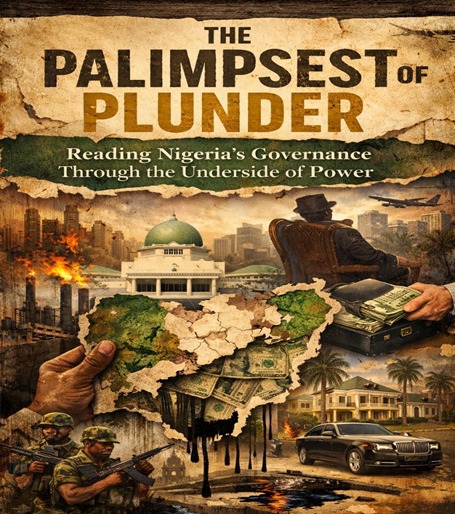
A palimpsest is a manuscript on which later writing has been superimposed on earlier writing, but the previous text remains partially visible. Nigeria’s governance is such a text, with layers of colonial extraction, military centralization, and democratic ritual written over each other, none fully erased.
The colonial layer taught that the state exists for extraction, not service. The military layer taught that power flows from the barrel and the bank account, not the ballot. The democratic layer added the performance of accountability, elections, audits, anti-corruption agencies, without the substance. Each layer is visible in the present. The ghost workers are the colonial porters, reincarnated. The budget padding is the military special allocations, democratized. The suspended whistleblower is the democratic citizen, disciplined.
The file cabinet in the ministry basement holds all these layers. The 2024 budget padding scandal is written in the same hand as the 2016 Jibrin affair, which echoes the 2000s oil windfall missing billions, which trace back to the 1970s cement armada contracts. The names change. The handwriting remains consistent.
The palimpsest theory suggests that reform is itself a layer, a writing over that preserves what it claims to erase. Each anti-corruption agency, the ICPC in 2000, the EFCC in 2003, the Code of Conduct Bureau perpetually, is a new inscription that leaves the underlying text legible. The 2021 ICPC Integrity Awards to two honest civil servants, Nelson Orji Okoronkwo and Muhammad Tukur Ahmad, were not evidence of institutional health but exceptions that prove the rule. They were the palimpsest’s margin notes, highlighting the main text’s corruption by their rarity.
To read Nigeria’s governance properly, we must hold the document to the light and see all layers simultaneously. The professional protocols that guide budgeting are the colonial district officer’s discretion, updated. The constituency projects are the native authority’s tribute system, computerized. The due process is the military administrator’s fiat, legislated.
If Nigeria’s governance is a palimpsest, a mycelium, a quantum entanglement, and an informal economy of legitimacy, then the standard prescriptions, political will, institutional reform, civil society engagement, are not merely inadequate but category errors. They assume a system that can be fixed, when the system is functioning exactly as its layered, entangled, mycelial nature demands.
What is required is an archaeology, not of artifacts but of practices. The archaeologist of Nigerian governance would excavate not the file cabinet’s contents but the conditions of possibility for the file’s existence. Why does the budget officer know how to duplicate projects? How did the IPPIS syndicate learn to manufacture ghost workers? What training, what mentorship, what socialization produces these competencies?
The archaeologist would discover that corruption is not learned in secret schools but in the open curriculum of everyday governance. The junior clerk who watches his director process a file learns more than procedure. He learns ontology, the nature of being in the bureaucracy. The citizen who pays a mobilization fee to get a passport learns not just expediency but epistemology, how knowledge of the system is acquired and validated. The senator who pads the budget learns ethics, not moral philosophy but the practical morality of distribution in a scarcity economy.
The archaeology reveals that accountability is not absent but buried, under layers of adaptive behavior, quantum entanglement, and informal legitimacy. To recover it requires not new institutions but new dig sites, points where the layers are thin, where the mycelium is sparse, where the quantum state is unstable.
These sites exist. They are found in the moments when the entanglement collapses unexpectedly, the civil servant who refuses the appreciation and is ostracized not by superiors but by colleagues who fear her integrity will expose their complicity. They are found in the informal economy’s own contradictions, the market association that successfully resists extortionate taxation, demonstrating that horizontal solidarity can challenge vertical extraction.
They are found in the palimpsest’s erasures, the spaces where earlier texts of communal accountability peek through, where the pre-colonial council of elders or the daughters’ assembly-maintained forms of accountability that were not about procedure but about presence and shame.
The file cabinet in the ministry basement will outlast the current administration. It will accumulate new files, new signatures, new completion certificates for projects that will never be. But it is not eternal. It is made of metal that rusts, paper that decays, and practices that can be disrupted.
The disruption begins not with the exposure of the N3.7 trillion padding, nor with the suspension of the senator who spoke, nor with the president’s dismissal of arithmetic. It begins with the recognition that the culpability ring includes not just the visible operators but the invisible maintainers, the ones who oil the drawers, who know the filing system, who ensure the cabinet remains locked but accessible to those with the right keys.
These invisible maintainers are not the few bad apples. They are the orchard itself, the soil, the roots, the mycelium that connects every tree in the forest. Until we are willing to uproot the orchard, to let the light into the subterranean networks, to collapse the quantum states and read the palimpsest with all its layers exposed, the file cabinet will remain Nigeria’s true parliament, and its metal drawers will continue to stick in the humidity, releasing the scent of decay and the breath of transactions that are never meant to be remembered, only enacted.
The culpability ring is wide because the ring is the system. And the system, finally, is us, written in layers, entangled in superposition, feeding the mycelium, paying tribute to shadows, and performing the liturgy of extraction with the devotion of the truly faithful.
The file cabinet waits. The question is not who will open it, but who will stop restocking it.
About the Author
Dr Charles Obiajulu Ugwu is a contrarian thinker writing from Lagos