By Agbeze Ireke Kalu Onuma, AI-KO
The call from my boss, came through on the 5th of January, a sharp, digital intrusion into the languid, saturated atmosphere of my prolonged homecoming. “Where are you?” The question, simple and administrative, struck me not as a reprimand but as a lifeline, a rope thrown from the world of order and obligation into the swirling, emotional quagmire where I had been treading water for weeks. It was an unexpected redemption. A wave of conscious, almost guilty elation washed over me. Here was a legitimate, external demand that could cut through the Gordian knot of my own indecision. By this date, the structure of my return had been amorphous, a vague cloud of “someday soon” that shifted with each new village announcement, each additional plate of food I felt compelled to consume, each evening where the generator’s roar once again postponed silence. I had been adrift in a sea of communal expectation, and Umahi’s call was a coordinate, a fixed point on the map back to my other life.
I had arrived on the 17th of December, a pilgrim in search of rest, in pursuit of the mythical “holy day,” yearning for quiet engagement—with myself, with the red earth of memory, with the community on terms I hoped to dictate. Instead, I was subsumed. Inundated. The very vitality I had admired from the road—the defiant lights, the kinetic energy—proved, upon immersion, to be a riptide. It pulled me under a schedule of performative mourning and compulsory celebration. I told my wife, in a voice that sought to convince us both, that we would be leaving in a few days. The statement hung in the air, devoid of a calendar date, a wish more than a plan. Across Abiriba, the calendar was still blotted with funerals; within the intimate circle of my own family, the burial of my uncle’s wife loomed. I was not merely an attendee; I was drafted deep into the logistical and emotional trenches—helping negotiate with the catechist, contributing to the opaque calculus of costs, sitting through long nights with the grieving children, whose plight was a stark tragedy magnified by the surrounding festivity. This immersion was the reason I gave Umahi, and it was true. The event itself was still two days hence, on the 7th, a final, weighty anchor holding me fast to this place.
But a profound and disorienting fatigue had set in, a counter-current to the social torrent. My mind, once longing for the slow tick of home, had become restless, itchy, seeking the sterile predictability of Lagos not for any emergency, but as an escape hatch, a sterile white room in which to reset a psyche overloaded with noise, obligation, and the dense, complicated love of home. The paradox was chilling: I was now desperate to flee the very place I had endured a seventeen-hour ordeal to reach. I wasn’t decided on a day, operating in the foggy “one step at a time” mentality that the village rhythm encourages. I cannot recall the precise cognitive shift, but a decision crystalized: we would leave on the 7th, immediately after the funeral service. We would drive to Aba, deposit the vehicle with a mechanic for some belated attention, and use that pause as a stepping-stone back to Lagos. These were plans, still fragile, written on water.
Then, on the morning of the 7th, as I left to run final errands, the vehicle—that faithful, suffering metal box that had carried us here—gave up its ghost with a final, pathetic shudder just by Erinma Hall. It was a mundane apocalypse, a mechanical veto. Yet, in its failure, it delivered a perverse clarity. Luckily, a local mechanic was summoned, a man who worked with the intuitive, percussive knowledge of his trade. He fixed the “bad leg,” patched the wound, and gave a tentative nod. In that moment, sitting in the disabled car, the decision was no longer mine to make. The vehicle had decided for me. I called my wife, the words feeling definitive: “We are leaving.” The plan to attend the funeral was aborted, a social debt left unpaid, a quiet guilt tucked into the luggage alongside our clothes. The tyranny of the mechanical had overruled the tyranny of the social, and in that, I felt a strange, unshackled relief.
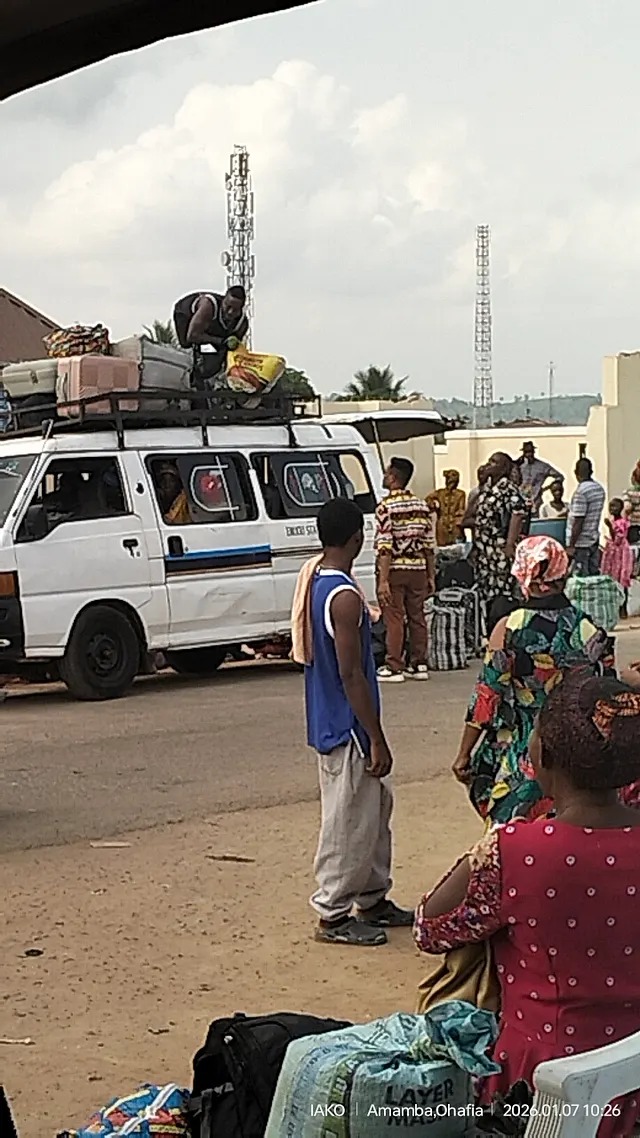
While I sat at the Abiriba motor park, waiting for the final verdict on the car, I entered a surreal and devastating spectacle. This was not the hopeful, chaotic exodus of December, but its grim, exhausted mirror image. “Chaos” is too loose a word, too romantic. This was a systemic unraveling. Men, women, and children flocked in a state of pressurized panic, shepherding mountains of luggage—loads that seemed, impossibly, thrice the volume of what they had arrived with barely two weeks prior for “Christmas.” Now, they were prisoners of return, and the jailers were scarcity and desperation. There were no vehicles, only rumors of them. Struggles erupted over bags, over space, over the mere possibility of a seat. The few available vehicles were subjected to grotesque transformations, overloaded to the point of deformity, with bags tied to roofs, bumpers, and windows in configurations that defied physics and mocked safety. One looked at them and could only imagine the worse: a burst tire, a sharp corner, a headline waiting to happen.
It was a spectacle that begged a brutal, existential analysis. Why? Why did they come with such loads in the first place? The absurdity reached its peak with the sight of people preparing to haul back full, unopened bags of the same rice they had ostensibly brought home as a offering or a display of prosperity. What was the performance for? Was the rice not for eating, but for showing? The entire ritual seemed locked in a vicious cycle of perception: arrive laden to demonstrate success, leave even more laden to prove the homeland’s bounty, carrying the evidence of a prosperity that the frantic struggle for transport actively belied. I wondered, watching a man sweat and swear as he tried to lash a crate of bottled water to an already sagging roof, what silent economies of sacrifice this represented. What joys had been denied, what bills postponed, what annual budgets warped around this one week of mad, competitive homecoming? I understood the visceral need to visit, to reconnect, to be seen. But I could not comprehend the self-harassing theater of the return, this collective, masochistic ballet where the performance of belonging became a physical and economic danger. This was not resilience; it was a pathology, a compulsive re-enactment of a script where the cost was never counted, only endured.
This was not merely a logistical failure; it was the physical manifestation of a profound psychic rupture, the visible symptom of our confused homecoming. For that hour, I became an ethnographer of our own dislocated yearnings, watching a scene that felt less like travel and more like a panicked evacuation from a dream that had curdled. The “home” they had rushed towards with such laden fervor just days before was now a site to be fled, but the frenzy of the departure suggested the sojourn had not solved the equation of belonging—it had only complicated it. Each person in that throng was a contested territory, a site where two competing geographies of the self were at war. One geography was Abiriba: a map etched with the coordinates of ancestry, unconditional identity, and a deep, visceral certainty of origin. The other was Lagos, Lome, Abuja, Europe, America: a map of possibility, of economic survival, of a modern self forged in the crucible of striving and anonymity. The homecoming is the annual, temporary attempt to force these two maps to align, to prove they can occupy the same space. But the motor park on the 7th of January was the glaring proof of their irreconcilability. The desperate struggle to leave was not a rejection of home, but the violent recoil from the unbearable pressure of holding these two worlds together in a single, overloaded psyche and atop a single, overloaded bus. The bags were not just luggage; they were the ballast of this failed merger—the unopened rice symbolizing a gift that could not be metabolized by the reality it was meant to impress, the new clothes now crumpled, the artifacts of “success” that felt hollow in the harsh morning light of departure.
Deconstructing this spectacle layer by layer reveals a pathology of performance that has entirely supplanted the substance of return. The sociologist Erving Goffman’s concept of “front stage” and “backstage” behavior is laid bare here with tragic clarity. For that one glittering week, the entire village becomes a “front stage.” Every returnee is an actor, their prosperity (or its convincing facsimile) is their costume, their laden SUV or their voluminous luggage are their props, their attendance at every wake and party is their scripted line. The “backstage”—the realities of debt, workplace stress, loneliness abroad, the quiet struggles of the life lived elsewhere—is meticulously hidden. But the motor park on departure day is the catastrophic collapse of that theater. It is the moment the curtain falls, the costumes are hastily stuffed into bags, the props become burdens, and the actors, stripped of their roles, revert to their raw, anxious, competing selves. The performative unity shatters into a Hobbesian scramble for scarce resources (seats, space). The communal “we” of the celebration atomizes into a desperate, every-family-for-itself “I.” The transition is so jarring because it is unmediated by ritual; there is no ceremony for leaving, only the crude economics of transport. Thus, the homecoming ends not with a blessing, but with a shove, exposing the whole elaborate production as a beautiful, stressful, and exhausting fiction.
Furthermore, the specific nature of the luggage offers a devastating commentary on a trust-less, transactional relationship with the homeland itself. Why bring a bag of rice from Lagos to Abiriba, only to take it back? On one level, it is a performative symbol, a proof of one’s capacity to provide, a trophy from the urban jungle to be displayed in the ancestral village. But on a deeper, more cynical level, it speaks to a fundamental lack of faith in the local economy, in the self-sufficiency of the homeland. It implies that the true, worthwhile goods must be imported, even if the import is a staple the land itself can produce. The return journey with the same unopened bag reveals the symbol’s emptiness: it was never meant for consumption, only for display. It becomes a sealed unit of unshared prosperity, a metaphor for the returnee’s own state: present, but not fully shared; seen, but not integrated. The luggage mountain, then, is a pyramid of sealed containers—of food, of gifts, of the self—that circulate but never open, never truly nourish or blend. This is the antithesis of communion; it is a ritual of closed circuits, where the bounty of migration cycles back to its point of origin, having changed nothing and fed no one, a perfect metaphor for an economy of signs that has replaced an economy of substance.
My bemusement curdled into a cold, analytical sorrow as I observed the generational transmission of this anxiety. Children, wide-eyed and irritable from disrupted sleep, were woven into this chaos not as bystanders but as conscripts. They watched their parents, the very figures of authority and comfort, transform into sharp-voiced negotiators, elbows-out competitors, figures of stress in a public square. What lesson is inscribed in a child’s mind in that hour? That home is a place you fight to get to, and then you fight to get away from. That community is a temporary alliance that dissolves under pressure. That belonging is a heavy, physical burden that cuts into your shoulders and strains your parents’ voices. They are learning the grammar of dislocation before they can even articulate the sentence of their own identities. For them, “Abiriba” will not be a seamless, holistic memory of Christmas; it will be a sensory collage of loud music, strange faces, overwhelming heat, and this final, confusing scene of panicked exodus. They are being acculturated into the rhythm of rupture, prepared for a lifetime of these bipolar migrations, where home is both magnet and repellant, and the journey between is a recurring trauma masked as tradition.
Ultimately, that hour at the park framed the entire “Long Road to Abia” not as a journey between two points, but as a frantic, circular oscillation within a trapped psyche. We are like charged particles bouncing between two plates: the positive pole of ancestral identity and the negative pole of contemporary survival. The homecoming is the violent, dazzling arc we create as we shoot toward the positive pole. The departure is the equal and opposite violent recoil. The spectacle I witnessed was the macroscopic view of this collective, psychic short-circuit. The physical struggle for space on a bus is the literal, crude manifestation of a metaphysical struggle for a coherent self that can reconcile where it is from with where it must live. We are not traveling to find rest; we are traveling to discharge an existential tension that builds up over the year abroad—the tension of being from one world and in another. The tragedy is that the discharge, in its current form, is so spectacularly inefficient and self-lacerating. It provides no sustainable charge, no resolution. It merely exhausts us, financially and spiritually, so we can return to the other pole and begin building the tension anew. The road, therefore, is not a path home; it is the visible spasm of our cultural and existential dilemma, and we are doomed to travel it—loaded down with our symbolic, unopened rice—until we find the courage to stop performing and start building a home that exists not just in memory or in one frantic week, but in a sustainable, livable present.
Sitting there, the analytical lens sharpened further, piercing the chaotic surface to reveal the grim financial tectonics grinding beneath. This spectacle was not merely emotional or performative; it was a stark economic audit. For a significant number in that seething crowd, the calculus was brutally simple: they had borrowed to come, and now they must borrow to leave. The entire pilgrimage was conducted on credit. The new clothes, the bags of rice, the crates of beer, the monetary contributions at funerals and for community projects—all were often funded by loans from cooperative societies, microfinance apps, or even more predatory lenders, the repayment of which would loom over the coming months like a shadow. And now, trapped in the park, faced with inflated “festival period” transport fares and the need to tip heavily to secure space, the debt was being compounded in real time. The frantic energy was not just about securing a seat; it was about securing a loan’s worth of performed belonging before the window of opportunity—the physical presence in the homeland—slammed shut for another year.
This, then, casts the absurdity of the unopened bags of rice and garri in a new, tragic light. It is not merely failed performance; it is a desperate strategy for survival. When they return to Lagos, Abuja, or Lome, they are not returning to a blank slate. They are returning to January—the most financially brutal month of the year. Rents fall due, school fees must be paid in a country where education is a crushing financial mountaintop, New Year levies and bills await. The cash has been spent on the homecoming. So, the physical bounty of the village—the rice, the garri, the yams, the palm oil—becomes a crucial stopgap. It is not status; it is sustenance. That bag of rice is a calculated economic buffer, a way to offset grocery bills for a month or two, to “manage” and stretch the depleted finances until the next paycheck or the next round of borrowing. The homecoming, therefore, creates its own paradoxical economy: it drains liquid cash in a spectacular, communal bonfire, and its only tangible return is a bulky, difficult-to-transport in-kind subsidy for the bleak weeks ahead. We are literally eating our homeland to survive the cities we left it for, carrying the red earth in sacks on buses because we cannot carry its prosperity in our bank accounts.
Expand this view from the Abiriba park to the major transit hubs across Igboland—the loading parks in Aba, Onitsha, Owerri—and the scale of the phenomenon becomes apocalyptic. Visiting the Aba park as vehicles load for Lagos or Abuja, you would be forgiven for thinking a city is being evacuated under duress. The atmosphere is not of journeying but of fleeing. The same mountains of luggage, the same taut faces, the same visceral struggle. It is the same from Nnewi to Awka, from Orlu to Umuahia. This is not an Abiriba quirk; it is the Igbo condition, a massive, seasonal transfer of people and their economic anxieties along crumbling arteries. What is being loaded onto those vehicles is not just people and goods, but the collective stress of a diaspora in a perpetual state of financial precarity, performing a rite that deepens that precarity even as it momentarily soothes the identity crisis that causes it. The parks become pressure valves for a people under immense psychic and economic strain, and the release is chaotic, dangerous, and deeply expensive.
Which forces the fundamental, haunting question: What has happened, what is happening to us, that we concentrate so much stress, so much financial peril, and so much emotional volatility into this narrow two-week window of a 365-day year? Why has this ritual become not a nourishing break but a systemically stressful, debt-inducing peak? The answer lies in the collision of an ancient, robust culture of kinship and obligation with the stark, unforgiving economics of modern Nigerian life. The culture dictates the depth of the return—you must be seen, you must contribute, you must feast. The economics of Nigeria—stagnant wages, rampant inflation, a scarcity of opportunity—make fulfilling those dictates a Herculean, often ruinous task. We are trying to lubricate a complex, ancient social machine with an economic oil we do not possess. So, we borrow against our futures to pay homage to our pasts, creating a present tense of immense anxiety. The two-week window is the only time the machine fully operates, the only time the village feels truly alive with its scattered children, and so we pour everything into it, creating a pressure cooker of expectation, expenditure, and exhaustion. We are trying to compress a year’s worth of belonging into a fortnight, and the psychological and financial compression is explosive.
Therefore, the spectacle I witnessed is more than a travel snarl; it is a profound cultural-economic feedback loop. The stress of the return is born from the economic pressures of urban life, and the return itself, in its current extravagant form, exacerbates those very pressures, ensuring the stress continues. We are running on a treadmill of our own making, fueled by a love for home that is manipulated by the unrelenting economics of survival. Until we collectively find the courage to redefine the terms of homecoming—to decouple it from competitive performance and crippling expenditure, to make it about presence rather than presents, about quiet communion rather than loud consumption—we will remain trapped in this annual cycle. We will continue to borrow to come, borrow to leave, and flee the village with sacks of food to face a January that our beautiful, punishing Christmas has made infinitely harder. The long road is not just to Abia; it is a closed loop, and we are, for now, its weary, devoted, and increasingly burdened prisoners.
We escaped to Aba, a city that felt, in contrast, like a metropolis of anonymity and calm. We went straight to a hotel, a neutral, transactional space, and collapsed into a bed that promised no history, no obligation, just the simple, sacred commodity of uninterrupted sleep. This, too, was still the Long Road to Abia. The journey was not a point-to-point line, but a state of being, a condition of transition that persisted even in stasis. The road had morphed from asphalt to experience, and we were still on it.
On the 8th, while waiting for the car to be fully repaired, an errand took me to Mgboko, in Obingwa LGA, to the State Psychiatric Hospital. It was a detour from the physical road, but a direct thoroughfare into the heart of a different, more profound national malaise. The facility, I was told, was built and commissioned by Governor Amadi Ikwegche, a fact that now felt like a cruel archaeological footnote. What I saw was an anatomy of promise and abandonment. The structures were there, well-built skeletons, but the spirit within had been eviscerated by neglect, incompetence, and a societal disdain so deep it was structural. The air of institutional despair was palpable—peeling paint, silent hallways, a garden overrun with defiant weeds. Speaking with the thinned-down, weathered staff was an exercise in controlled despair. They spoke of being utterly ignored by subsequent administrations—T. A. Orji’s, Ikpeazu’s. One staffer added with a bitterness that was both accusation and elegy: “This place isn’t far from the immediate past Governor’s place yet he never cared.” The present government, they said, had sent officials to tour, to review, to make notes. But notes, in Nigeria, are often the cemetery where intentions are buried. They “manage.”
“Manage.” That most Nigerian of verbs, a universe of despair concealed in two syllables. It is a word that means to persist in the face of systemic collapse, to improvise solutions where structure has failed, to become complicit in a shadow economy of survival. In this context, what did “manage” mean? Was it the exorbitant, unreceipted, unrecorded fees extracted from desperate families at the end of their rope, a final tax on broken minds? Was it the subtle, unspoken demands—for “fuel money,” for “mobilization”—that turned care into a series of petty, humiliating transactions? The hospital stood as a stark metaphor: a place designed to heal minds, itself a patient suffering from the national psychosis of neglect, a monument to our collective failure to tend to our most vulnerable interiors.
This led me to the deeper, cultural tumor: our attitude towards the very word “psychiatric.” Our cultural preclusions are not merely ignorance; they are an active, superstitious arcana. Mental illness is spiritualized, demonized, hidden in shame. It is seen as a curse, not a condition. Consequently, there is no political capital, no communal applause, in fixing a psychiatric hospital. A governor builds a market, and his name is etched on the plaque; he paves a road, and the praise singers gather. But who champions the renovation of a ward for schizophrenia? The benefits—a populace with treated trauma, reduced street vagrancy, families saved from silent, draining tragedy—are profound but diffuse, invisible to the metrics of political theater. The psychiatric hospital in Mgboko is thus a dual symbol: of the state’s abdication of its most humane duties, and of the society’s complicity in that abdication through stigma. Until we see mental health not as a private shame but as a public good, such places will remain our collective subconscious, rotting in plain sight.
The trip to Mgboko, to that crumbling psychiatric hospital in Obingwa, lingered in the mind far longer than the miles warranted. It was not a mere errand; it felt like a forced march into the heart of a silent, systemic collapse. What stood there was a precise physical metaphor for our national approach to the mind: a framework of promise utterly abandoned by the will to sustain it. The staff’s weary testimony—that the place had been “completely ignored” and survived only by “managing”—spoke of a rot that was both financial and moral. That word, “manage,” hung in the air, a chameleon term. In this context, it almost certainly concealed a shadow economy where desperate families paid unreceipted fees for scraps of care, a cruel, informal tax on despair that further victimized the vulnerable. The specific plight of this place, suffering under a state government notorious for salary arrears, meant a hospital for the mind was left without its most essential healers—psychiatrists. This was no accident of geography; it was the direct, predictable harvest of policy neglect, a catastrophic failure of political priority.
This institutional decay is scaffolded, and fiercely protected, by cultural preclusions that form our most formidable barrier. The reflection on our “primitive, superstitious and arcane” attitudes finds grim validation in reality. Studies in similar rural communities show a prevailing worldview where mental illness is attributed to spiritual attacks, ancestral curses, or divine anger. This belief, deeply embedded, performs a devastating alchemy: it transforms a health condition into a social stain and a spiritual failing, pathologizing not just the individual but their entire lineage. The resulting stigma creates a vicious, hidden cycle. Families, seeking to avoid shame, conceal illness until crisis erupts, often turning first to prayer camps or traditional centers where exploitation can thrive. This very secrecy then reinforces the fear of the formal system. For the politician, this cultural silence is a gift. It means there is no loud, concerted public applause for investing in a psychiatric hospital, no ribbon-cutting glory that compares to a new market or road. The community’s deep-seated misunderstanding becomes the state’s perfect excuse for inaction.
Yet, a crucial new context now exists that must frame any honest discussion: the National Mental Health Act 2021, signed into law in 2023. This Act, which finally buries the colonial-era “Lunacy Act,” represents a foundational shift on paper. It mandates the integration of mental health into primary care, protects the rights and dignity of persons with mental health conditions, and calls for a national prevention strategy. For a place like Mgboko, this law is a potential lifeline—a legal instrument to demand the Abia State government fulfill its responsibility. However, the Act’s critical flaw is that it still fails to fully integrate mental health into the National Health Insurance Scheme (NHIS), leaving the gnawing question of sustainable funding—the very core of Mgboko’s problem—dangerously open.
The dereliction at Mgboko is not an act of God; it is the accumulated sediment of political choices, a direct inheritance from previous administrations that treated human dignity as a discretionary budget line. The salary arrears demoralizing staff, the empty wards, the ghost of a working system—these are not sudden crises. They are the mature yield of a governance philosophy that valued visible, political trophies over invisible, humane necessities. This is the heavy ledger passed to the present government, a concrete manifestation of the “manage” that has meant managed decline. To see Mgboko is to see the physical outcome of a legacy where the mind and its ailments were relegated to the periphery of public concern, a neglect now solidified in cracked plaster and absent expertise.
Yet, within this inherited rot lies the clearest canvas for a transformative governance. The call, therefore, shifts from a generic demand of “the state” to a direct appeal to the conscience and legacy of the present administration. Governor Alex Otti, your tenure is defined by a striving for a new, pragmatic, and humane Abia. The rehabilitation of Mgboko Psychiatric Hospital represents a profound opportunity to extend that philosophy to its most logical and compassionate conclusion. This facility is a litmus test for a government that speaks of breaking from the past. It demands more than incremental repair; it requires a decisive intervention that signals a fundamental re-prioritization of what constitutes public welfare.
The path forward begins with an immediate, tangible rescue mission for Mgboko. We call on you, Governor Otti, to extend the long-needed hand. First, a special intervention to clear the historic salary arrears that shackle staff morale is not just an administrative act; it is a moral declaration that their work is valued. Concurrently, a directed recruitment drive for psychiatrists and clinical psychologists must be launched, transforming the hospital from a monument of neglect into a viable, functioning workplace. This must be coupled with the urgent development and public presentation of a Costed Abia State Mental Health Revitalization Plan, with Mgboko as its flagship. This plan must outline a defined budget, a timeline, and appoint a dedicated, empowered State Mental Health Focal Person with the mandate and resources to be accountable. This is the essential groundwork of credibility.
Furthermore, your administration must strategically leverage the new National Mental Health Act to secure support. The Federal Ministry of Health should be engaged not for charity, but for partnership, presenting Mgboko’s revitalization as a pilot for a conditional grant system—where verifiable state investment unlocks federal funds. This is the savvy, strategic governance Abia needs. The private sector and community groups, seeing genuine political will from the state, will find a credible partner in such a mission. Their capacity for investment, adoption of wards, and community mobilization awaits the spark of decisive state action.
Governor Otti, the challenge of Mgboko and facilities like it across Abia is the heavy inheritance of the past. Your response will be the definitive legacy of the present. To turn this particular site of systemic failure into a beacon of compassionate, competent governance would be a victory not just for public health, but for the very soul of the state. It would be a powerful statement that in the new Abia, no citizen, and no aspect of their humanity, is beyond the reach of a government that cares. The long road to Abia’s renewal must, necessarily, pass through the gates of Mgboko.
Second, the private sector must evolve from sporadic charity to structured investment. The model here is not mere donation, but blended finance and Public-Private Partnership (PPP). A consortium of Igbo businesses, with their famed entrepreneurial acumen, could partner with the state. The private sector could manage the non-clinical burdens that cripple public facilities: reliable solar power, facility upkeep, efficient pharmacy supply chains, and the introduction of telemedicine platforms to connect the hospital to specialists nationwide. Corporate social responsibility (CSR) funds could endow training fellowships or chairs specifically for psychiatric professionals at Mgboko, building the human capacity that is its greatest deficit.
Third, and perhaps most powerful, is citizen and community action. The inspiring initiative by groups like Umuada Igbo Nigeria and in Diaspora, which partnered with professionals abroad to donate essential medications to southeastern psychiatric hospitals, provides a stellar template. This model must be scaled and hyper-localized. Town unions, alumni associations, and local NGOs can “adopt-a-ward” at Mgboko, taking responsibility for its renovation and ongoing support. Crucially, community leaders—the clergy, traditional rulers, market heads—must champion a new narrative. They must translate the clinical language of the Mental Health Act into local dialogues and proverbs, reframing mental illness from a curse to a treatable health condition. The goal is to make Mgboko not an isolated fortress for the acutely ill, but a hub for community wellness, with outreach teams tackling prevention in schools and addressing the trauma of economic hardship and substance abuse.
The road that led to Mgboko is the same one that carried the overloaded buses away from Abiriba. One is a journey of frantic, performative escape, the other a journey into profound, neglected need. They are two sides of the same battered coin. We stress ourselves to breaking point in a two-week festival of belonging, yet lack the collective will to heal the breaking points within our own minds. The revitalization of that hospital, and the rethinking of what it represents, is not a medical project alone. It is a test of our ability to build something sustainable, to care for what is fragile, and to look squarely into a mirror we have long preferred to ignore. The crumbling walls of Mgboko do not just enclose patients; they reflect the state of our own humanity. We can continue to look away, or we can decide, finally, to build them anew.
We finally began the physical return on the morning of the 9th of January, our spirits patched up like the car’s suspension. We had made a wise, humane decision: no mad marathon. We would not replicate the single-day martyrdom of the inbound journey. This was to be an anodyne for our frayed nerves, a conscious pacing of our re-entry into the world of Lagos. We stopped in Benin City, and for two days, we existed in a pleasant, historical limbo. We were tourists in a city that was neither home nor the demanding homeland. We slept deeply, ate without obligation, and wandered without purpose. It was a restorative parenthesis, a buffer zone of silence between the overwhelming fullness of Abiriba and the demanding emptiness of Lagos.
The journey from Aba to Benin was undertaken under a novel and almost subversive principle: the abolition of urgency. Having severed ourselves from the tyranny of a single-day Lagos marathon, we granted ourselves the luxury of slowness. This was not the sluggish, frustrating pace of enforced gridlock, but a conscious deceleration, a deliberate opting out of the national race. The difference it wrought within the car was immediate and profound. The atmosphere shed its coiled-wire tension. Shoulders, previously hunched as if perpetually bracing for the next pothole, dropped. Conversations, no longer clipped logistical updates shouted over engine strain, unfurled into meandering threads—reminiscences of childhood trips, idle observations about the changing landscape, stretches of companionable silence that felt fertile, not empty. We were no longer hostages to the road; we had become its observers, and in that shift, the entire character of the journey transformed from an ordeal to be endured into an experience to be, however minimally, lived.
Freed from the desperate scan for bottlenecks and escape routes, our attention disengaged from its defensive perimeter and turned outward, its intricate gears shifting to a different mode of perception. We began to see. Not just the road, but the life pressed against its edges. We noticed the specific architecture of roadside commerce: not just a “shop,” but the meticulous pyramid of Coke bottles at a rickety kiosk, the rainbow array of plastic basins, the tailor under a stretched tarpaulin, his foot pumping the ancient Singer sewing machine in a rhythm as steady as a heartbeat. We saw the geography of laundry—bright fabrics draped over fences, spread on sun-bleached grass, flapping on lines strung between gnarled trees, a gallery of intimate textiles airing in public. We saw the schools, their playgrounds empty in the mid-morning, their walls flaked with maps of Africa painted in fading primary colours. These were not blurred background details; they were vivid, singular tableaux, each a complete story of adaptation and endurance we had always been traveling too fast to read.
The sensory appeals of the road, usually drowned out by the roar of our own impatience, now presented themselves with gentle clarity. The air that drifted through our half-open windows carried a narrative in scents: the sharp, green smell of freshly cut vegetation from a roadside farm; the dense, yeasty aroma of akara frying in giant pans over coal fires; the occasional, startlingly clean scent of wet clay from a recent, localized rain. The soundscape was no longer just engine noise and horns, but a layered composition—the chatter of market women at a bus stop, the distant call to prayer from a village mosque mingling with gospel music from a passing danfo, the rhythmic thwack of a carpenter unseen in his shed. Even the light felt different. The harsh, flat glare of a panic-driven noon was replaced by the long, golden afternoon angles that sculpted the landscape, casting deep shadows and turning the dust kicked up by passing trucks into clouds of suspended gold. We were engaging with Nigeria through our senses, not just our stress responses.
This unhurried drift allowed us to engage with the inevitable inconveniences not as crises, but as phenomena. The roadblocks—both the official police checkpoints and the unofficial “vignettes” of local boys—became not just toll points but brief, anthropological encounters. Without the seething pressure of a deadline, we could observe the practiced theatre of it: the weary authority of the officer, the performative negotiation of the bus driver ahead of us, the complex economy of N200 notes passed with a handshake. The frustration was replaced by a detached, almost melancholic curiosity. We saw the young men at these blocks not as predators, but as products of a system with no center, entrepreneurs of a hollowed-out authority, extracting their tiny tax from the river of motion because the river is all there is. The journey became a slow scroll through the intricate, informal governance of the Nigerian highway.
Within this slowness, we also encountered the profound, often ignored loss that our habitual hurry imposes. The loss is of context, of connection, of the human scale of the country. When we blast from Lagos to the East in a state of high-alert endurance, we are not traveling through Nigeria; we are tunneling through it, seeing only the obstacles. We miss the old man painstakingly repairing a bicycle tire under a tree, a portrait of patience. We miss the children waving gleefully at every vehicle, their joy a stark counterpoint to the grim faces inside. We miss the subtle changes in dialect shouted across the road, the shift in building styles from one community to the next. In our tireless dash, we reduce a nation of breathtaking depth and narrative to a mere obstacle course, and in doing so, we sever ourselves from its true texture. We arrive at our destinations knowing only the pain of the journey, not its story.
Conversely, the minute pleasures of the slow drift revealed themselves as a kind of national balm. The simple pleasure of stopping not because we had to, but because we wanted to—to buy something from a cheerful vendor, to stretch our legs on solid ground without anxiety, and to drink water or anything. These were not logistical pauses; they were small acts of participation, of choosing to be present within the journey rather than at war with it. The pleasure was in the lack of panic, in the rediscovery of our own autonomy over time. It was the quiet triumph of deciding that the space between point A and point B could contain value, not just cost.
Benin City, for us, was not a destination but an intermission—a deliberate pause in the grammar of our journey, written on Irhirhi Road at the Nirvana City Hotel. Its purpose was purely functional: a neutral zone for the body and mind to shed the accumulated weight of Abiriba before re-engaging with the metropolis of Lagos. My wife’s perception of the city as a place of “dusty, clampy roads and nothing to really see” is a verdict born of its presentation along the main thoroughfares, where it offers little to the hurried eye but transit and commerce. For me, it was almost the same, save for one critical distinction: as a halfway point, it offered the profound, underrated commodity of rest. It was a parenthesis of anonymity.
I am, by nature, drawn to exploration, to the quiet backstreets and hidden narratives that give a place its unique fingerprint. But here, the will to explore was subdued by a greater need. The sun hung too high and too hot, a blazing disc that turned the outside world into a furnace, making the cool, dark cave of the hotel room feel like a sanctuary. My only forays were two utilitarian missions to the Market Square supermarket for food from the fast-food joint—brief, sun-drenched sorties into a city that, in that moment, existed only as a provider of sustenance and air conditioning. In that limited exposure, Benin could have been anywhere in Nigeria—the same patterns of movement, the same styles of dress, the same vibrant, un-fanciful struggle of daily life.
And perhaps that was its secret gift. Its very anonymity, its lack of a demanding cultural or familial claim on us, was what made it perfect. It asked nothing. It expected no attendance at events, required no performance of belonging. It was simply a place to be still. In the grand, exhausting spectrum of the Long Road—from the demanding embrace of home to the demanding grind of Lagos—Benin was the vital, blank space in the middle. It was not “Benin, the historic kingdom”; it was simply “Benin, the halfway house,” and in that mundane neutrality, we found a small, essential peace. It was the calm eye at the center of our stormy migration, and for two days, that was everything we needed.
It is a profound sadness that millions of Nigerians ply the stretch from Aba to Benin to Lagos, week in, week out, and see nothing. They see only the taillights of the truck in front, the gap in the traffic, the next police checkpoint to dread. The road trip, which in other cultures can be a journey of discovery, has become for us a complex anecdote of our collective confusions: our hurriedness is not towards something, but away from something; our tireless dash feels increasingly like a sprint on a treadmill, propelling us with great energy toward a destination that never gets any closer. We confuse motion with progress, speed with efficiency, and in the process, we sacrifice the very experience of the land we are so desperately crossing.
Our slow journey from Aba to Benin was, therefore, a small act of reclamation. It was a refusal to let the road own us. It proved that buried beneath the layers of stress and haste, the Nigerian journey still holds moments of quiet beauty, human warmth, and poignant narrative—if only we have the courage to decelerate. To travel slowly is to pay attention, and to pay attention is, in its own small way, an act of love and respect for a country that demands so much of our endurance. It is to learn that sometimes, the only way to truly find your way is to stop trying so desperately to arrive.
The Long Unwinding: Benin to Lagos, January 11th
We pulled out from the Nirvana City Hotel on Irhirhi Road in the cool, grey-blue light of a Benin morning. The city was a patient creature, stirring slowly. The frantic, choking traffic of the previous days had evaporated, leaving the roads near-empty, a wide, quiet stage before the day’s drama. A few figures, already dressed in the crisp, bright fabrics of Sunday best, moved with purpose towards early church services. This sight, in the serene half-light, sparked a familiar, quiet ache within me. My wife, watching the same scene, murmured about the city’s dual nature. Benin, like every major Nigerian city, is a secular engine of commerce and survival, yet it is over-churched—a landscape where faith has been industrialised. Billboards for “Miracle Crusades,” “Prophetic Nights,” and new church branches eclipse advertisements for businesses, schools, or civic projects. It pains me deeply, this secularisation of the sacred, where churches compete not for the salvation of souls but for congregants as market share, for offerings as revenue. The city, filled with waywardness and ancient superstitions hiding beneath a veneer of piety, seems to treat the church as just another arena for transactional hustle, a place to bargain with God for prosperity rather than seek transformation. We moved in silence past these giant, smiling pastor faces, a kingdom of faith that too often feels like a real estate and media empire, leaving the dusty, clammy roads of the spirit unchanged.
Leaving the city centre, we entered the long, stretching ribbon of the Benin-Ore highway, passing through the Okada stretch. Here, the world was methodically waking. Communities dotted along the road, their lives pressed against the tarmac, were performing their morning rites. Young men were hauling tables and crates to the roadside, setting up the day’s commerce. Mounds of green plantains, arranged with careful geometry, waited for buyers. Hawkers were already at their posts, though their numbers were thin, their energy still gathering. The air was fresh, carrying the scent of dew on leaves and the faint, earthy smell of open drains. There was a peaceful, productive ordinariness to it, a stark contrast to the competitive spiritual theatre we had just left behind. We made good time, and as we approached the town of Okada itself, I felt my shoulders drop. This was the first checkpoint of psychological relief. On a normal, frantic journey, this stretch is a nightmare of logjams and impatient overtaking. Today, we sailed through without that familiar, gut-clenching congestion. I breathed a deep, conscious sigh, a physical release my wife noticed with a knowing smile. “See?” she said. “This is what happens when you’re not running from ghosts.” The car felt lighter, our conversation turning to idle observations rather than navigational anxieties.
This ease, however, is always provisional on a Nigerian road. The next task presented itself: navigating the transition at Ofosu, the bustling, amorphous border town that straddles Edo and Ondo states. Ofosu is not a town you visit; it is a condition you pass through—a fever dream of commerce born from transit. The highway bottlenecks, and the world explodes into a chaotic, makeshift market that has metastasized over decades. Here, the journey is forced to pause. People break for food, buy overpriced snacks, use the rough-hewn bathrooms. The economics of Ofosu are a study in captive-audience exploitation. Anything bought here—a bottle of water, a pack of biscuits, a meal—costs four or five times its normal price. The acceptance of this is a national pathology, borne from the relentless, persuasive persistence of the hawkers who swarm every vehicle, their hands tapping on windows, their voices a chorus of need and opportunity. We watched people guzzle plates of the standard fare—fresh fish, pounded yam or garri—as if this expensive, roadside version tasted uniquely of journey’s end. The food isn’t fantastic; it’s fuel, purchased at a premium because the road offers no alternative. It is a toll paid not to the government, but to the economy of desperation that lines its shoulders.
Past Ofosu, a new phase of the mental countdown begins. The body, now agitated from the stop-start chaos, begins to itch for specific comforts. You start yearning for the simple, clean pleasure of bananas and groundnuts, a snack that signifies you are in the Yoruba heartland, that Lagos is conceptually near. Your mind, tricked by the open road after Ore, starts making optimistic calculations. “By 2pm,” you tell yourself, “we should be beyond Ijebu Ode, skirting the Epe lagoon, the city’s outer breath on our faces.” This is the journey’s great, cruel trick. You enter a temporal warp. The vehicle’s speedometer shows the same numbers, your progress feels constant, but time itself undergoes a mysterious dilation. The two hours you budgeted stretch into a rubbery, unaccountable expanse. You lose count of your own countdown. The landscape, once a blur of forest and occasional villages, seems to repeat itself. You are moving, but not progressing. This is the numb heart of the long-distance drive in Nigeria—a sensation of being trapped in a mobile present, where the future (Lagos) recedes at the same rate you approach it. It’s a bizarre, existential confusion that feeds a quiet despair. What have we been doing, all this time, if not arriving?
Then, as if to punish your earlier optimism, the road itself revolts. About 20 to 30 kilometres to Ijebu Ode, the asphalt simply gives up. It flips on its head. What was a highway becomes an archaeological site of its own collapse. You are plunged into bad patches so severe they become the main event—craters that swallow tires, ridges that test the suspension to its limit. The smooth, forward momentum is replaced by a slow, careful, punishing crawl. The grand federal highway detours you, without ceremony, into silent, unmarked village paths. These are not scenic diversions; they are passages of dread. The paved road vanishes, replaced by laterite that coats the car in red powder. You pass compounds with watching eyes, unknown and unwelcoming. And then, the first true warning shot that Lagos, with all its aggressive hustle, is near: the area boys appear. Young men, not in uniform but in the uniform attitude of casual entitlement, have laid their own unofficial toll. A log, a rope, a pile of stones blocks the village detour they now control. You pay, not for a service, but for the indignity of passing through their domain, for the security of your vehicle’s windows. It is a raw, small-scale extraction, a microcosm of the national condition where every gap in authority is filled not with community, but with freelance taxation.
By the time you finally, wearily, rejoin something resembling a main road and see the signs for Ijebu Ode, the name feels like a cruel joke. All enthusiasm has been siphoned out. You are left not with the thrill of proximity, but with a deep, draining emptiness. The body is tired, but the spirit is fatigued. You look at the clock: it’s 2pm. A hollow laugh escapes. You have been actively travelling, negotiating, paying, and crawling for four hours since Ore, and the conceptual distance covered feels negligible. Ijebu Ode, which should be a landmark of near-arrival, instead feels like a taunt. This is the final, quiet tragedy of the road. It doesn’t just transport you; it processes you. It grinds down your anticipation, your energy, your sense of time and agency, so that you arrive at your destination not in triumph, but in surrender. You don’t enter Lagos; you escape the road. And as the first sprawling outskirts of the metropolis finally engulf you, the relief is tinged with a profound question, echoing in the silence left by the now-stilled engine: what, in the end, was all that movement for?
The stretch from Ijebu Ode onward is where the journey sheds its last pretence of being an adventure and becomes a pure, grim exercise in re-entry. The landscape begins its slow, inevitable morph from the lush, green blur of the hinterlands into the hard, grey sprawl of the megalopolis. The air thickens perceptibly, no longer carrying the vegetal scent of the villages but the complex, acrid cocktail of Lagos—a blend of diesel, open sewage, frying oil, and the metallic tang of too many people and machines in one place. My wife, who had been quietly resilient through the potholes and detours, grows visibly tense. Her body language shifts; she stops looking out at the passing scenery and instead focuses straight ahead, her posture that of someone bracing for impact. “The madness is about to start,” she says, not as a complaint, but as a factual forecast. This is the psychological border, far more definitive than the one at Ofosu. You are no longer going to Lagos; you are being absorbed by it. The roadside advertisements change, promoting not churches or local businesses, but betting companies, expensive phones, and reality TV shows—the totems of urban aspiration and distraction. The road itself, though still patchy, widens, a concrete artery preparing for the city’s immense, daily hemorrhage of traffic.
Then comes the Epe corridor, a study in contrasts that lays bare the city’s chaotic planning. One moment you are passing relatively orderly, new developments with hopeful names like “Peace Estate,” and the next, you are plunged into the anarchic, vibrant chaos of roadside markets that have spilled onto the highway, turning lanes into a pedestrian mall. Here, the “slow, unhurried” pace we cultivated becomes an enforced, frustrating crawl. Hawkers descend upon the car like a persistent swarm, offering everything from giant ceiling fans to live chickens, from intricately carved wooden stools to packs of socks. It is capitalism in its most raw and desperate form. My wife rolls up her window, a symbolic gesture against the onslaught. “They sell everything here except patience,” she remarks, and we share a weary smile. This is Lagos announcing itself not with a welcome, but with an immediate demand for your attention, your money, and your navigational skill. The traffic lights, when they appear, are treated as mere suggestions. The rules of the road dissolve into a complex, intuitive dance of aggression and concession. You must re-learn, in minutes, the brutal etiquette you had forgotten in the village—the strategic honk, the aggressive merge, the constant, 360-degree vigilance.
As we merge onto the Lekki-Epe Expressway proper, the final layer of the journey’s mental fatigue sets in: the paradox of the familiar unknown. We are on a road we have travelled countless times, past landmarks we recognize, yet it feels alien. The sun, now high and fierce, glares off the countless glass windows of new high-rises, buildings that seem to have sprouted like fungi in the weeks we were away. The city’s change is so rapid it feels like a time-lapse, and our absence, however brief, marks us as slightly out of sync. Conversations in the car dwindle to functional monosyllables: “Watch this guy.” “Which exit?” “There’s police.” The camaraderie of the shared, patient journey from Benin evaporates, replaced by the solitary focus required to pilot a vehicle through this kinetic chaos. The “eventfulness” of the road is no longer about observation; it is about reaction. Each swerve to avoid a pothole, each sudden brake for a darting okada, each negotiation with a danfo driver claiming his space by divine right, is a micro-transaction that spends a little more of our dwindling reserves of calm.
This final leg is where the true, unspoken loss of the long road is quantified. You have spent eight, ten, twelve hours in a state of heightened, yet monotonous, awareness. You have paid financial, physical, and psychological tolls. You have witnessed the nation’s beauty and its brutal neglect in equal measure. And for what? To arrive back at the very point of departure—the cramped apartment, the waiting job, the pile of bills—all of which have continued unchanged in your absence. The journey, for all its epic scale, concludes not with a crescendo, but with an anti-climax. You are not a hero returning from an odyssey; you are a worker who has completed a grueling commute. The profound reflections on home, community, and neglect that the road inspired now feel like ephemeral ghosts, chased away by the immediate need to find parking, unload the dust-coated luggage, and face the stale air of a closed-up home. The long road to Abia ends not on the red earth of the village, but on the faded concrete of a Lagos car park, with a silent, exhausted turning of the engine key.
Yet, in that exhaustion, there is a final, crucial revelation—the thing “many Nigerians don’t know” because they are too busy surviving the trip to contemplate it. The road trip is the nation’ most honest biography. The potholes are our unresolved history. The maddening delays are our institutional inertia. The vibrant, desperate roadside commerce is our bottomless ingenuity. The predatory checkpoints and tolls are our corrupted governance. And the sheer, stubborn will to complete the journey, at any cost, is our defining, tragic, magnificent national character. We are not travelling on the road; we are travelling inside a perfect metaphor for our condition. We endure the hardship because the alternative—to stop, to admit the journey is impossible—is unthinkable. So we press on, in a collective, tireless dash that feels, at times, like a dash to nowhere, because the act of moving, however painful, is the only proof we have that we are still aiming for a destination.
Pulling into our final street, the contrast is almost violent. The deafening, wide-frequency roar of the expressway narrows into the familiar, contained sounds of our neighborhood: a generator chugging next door, children playing in a compound, the distant call of a mai shayi. The journey collapses in on itself. The hundreds of kilometers, the seventeen-hour ordeal on the way down, the layered experiences of funerals and feasts, the silent psychiatric hospital, the chaotic motor park, the peaceful interlude in Benin—all of it contracts into a single point of arrival. You are home. But you are also irrevocably changed. You have seen the gears of the country turn, not from a newspaper or a policy paper, but from the driver’s seat. You have felt its vibrations in your spine. You carry the dust of its many paths on your skin. The long road does not simply connect two points; it imprints the distance between them upon your soul. You left Lagos to find home in Abia, and you return to Lagos having found that home is also the road itself—a long, painful, beautiful, and heartbreaking corridor of a people perpetually in search of themselves.
The final lesson, absorbed in the silent exhaustion of arrival, is this: the hurry is the enemy of understanding. Our national “tireless dash” is a flight from reflection. We speed past Ofosu, dread Ijebu Ode, and curse the Epe traffic because we are focused only on the terminus. But it is in the slow, unhurried acceptance of the journey—the watching of Benin wake up, the observation of the roadside economy, the very feeling of the time warp—that we see the truth of our condition. The road is not an interval to be minimized; it is the central experience to be deciphered. To travel slowly from Benin to Lagos is to choose, for once, to read the nation’s biography instead of merely enduring its plot. And in that reading, amidst the dust and chaos and numbing delays, lies the faint, stubborn outline of a hope not for a better destination, but for a better journey. For when we finally build roads that do not break our axles and our spirits, we will have begun to build a country worthy of the profound, wearying love its people so clearly have for it.
And so, the Long Road to Abia finally reveals its true, unsettling geography. It is not a line there and back, but a vast, looping circuit of paradox, a Möbius strip where every point of arrival instantly becomes a new point of departure, and every resolution births a deeper conundrum. It is the joyous arrival that mutates, hour by hour, into a cage of inescapable obligation. It is the ancestral home that replenishes your spirit with one hand—through the scent of udara on the air, the sight of the ancient hills at dusk, the unspoken grammar of belonging in a familiar glance—while depleting your very life force with the other, draining you through a thousand tiny siphons of expectation, performance, and noise. The community that embraces you with a ferocity that feels like love becomes the same entity that suffocates you with its needs, its dramas, its relentless, deafening calendar of spectacle. This is the central, throbbing contradiction: the very thing we cross hellscapes of asphalt to reach is the same thing we must, eventually, flee from in order to survive it.
This road is paved with jarring, crystalline moments of revelation that arrive in the unlikeliest of vehicles. It is in the violent jolt of the vehicle’s breakdown—that sudden, startling silence amidst the growl of stalled engines—that a fleeting clarity emerges, a pristine quiet where the mind can finally hear itself think, unobscured by the din of social obligation. That mechanical failure, that rupture in the journey’s relentless forward press, becomes a sacred pause, a window into the self that is immediately shuttered upon the engine’s restart. It is in the surreal, Sisyphean spectacle of people moving the same giant bags of rice from one celebration to the next, a sacrament not to any ancestral god, but to the modern deity of Perception. We are not nourishing bodies; we are manufacturing evidence—proof of our capacity for abundance, our adherence to a script of generosity, our place in a visible economy of regard where what is seen matters infinitely more than what is felt or what is sustainably shared.
This circuit runs parallel to other, more haunting roads. It detours past the crumbling edifice of the psychiatric hospital on the outskirts of Umuahia, its decrepit silence a screaming counterpoint to the manic, performative sanity of our festivals. That detour is not an accident of navigation; it is the necessary, shadowed companion to our journey. It forces the unaskable question: if this is how we celebrate, how then do we grieve? If this is our communal expression of vitality, what monstrous, unspoken pressures does it exert on the individual mind? The hospital’s ruin is the physical manifestation of the illness at the heart of our communal body—a collective refusal to tend to the private, fragile psyche, preferring instead to lose ourselves in the anesthetic roar of the crowd. We outsource our breakdowns to that crumbling facility while we orchestrate our public triumphs in the village square, never acknowledging they are two symptoms of the same disease.
The road winds through the forest of glossy posters, that gallery of rewritten lives. Here, the paradox deepens into a profound cultural vertigo. We are a people so adept at motion, so brilliant in our diasporic dispersal and triumphant returns, yet so terrified of the stillness required to truly look at a life—or a death—in its complex, unvarnished truth. We Photoshop our pain, we credentialize our souls for the afterlife, we trade memory for reference. The “Glorious Exit” is the ultimate triumph of the journey over the destination, of the spectacle over the substance. We endure the seventeen-hour odyssey not to arrive at a place of quiet communion, but to secure our starring role in a drama that will, in turn, be summarized on a vinyl banner. The road leads us home to perform our belonging, and the performance becomes the only belonging we can reliably access.
Thus, the conclusion of this long road trip is not an answer. It is a deeper, more resonant, and permanently unsettled set of questions that now live within me, as worn and familiar as the dust of Abiriba on my shoes. Is home a place you go to, or is it ultimately a place you must recover from? Is our famed Igbo resilience—that magnificent, stubborn capacity to endure traffic jams, broken infrastructure, and personal inconvenience—a virtue to be celebrated, or is it a subtle trap, a psychological adaptation that normalizes suffering and lets the architects of our hardship off the hook? Does authentic belonging require the periodic, willing sacrifice of our sanity on the altar of communal spectacle? Have we, in our desperate desire to hold a vanishing world together, created a social machine that consumes the very individuals it was meant to sustain?
The road offers no easy terminus. As I turned my own vehicle back toward Lagos, the physical journey reversing its course, the interior voyage only intensified. I carried not conclusions, but the crushing, beautiful weight of these interrogations. I carried the phantom vibrations of the potholed highway in my bones, the taste of dust and diesel, and the lingering sweetness of a perfectly ripe avocado pear eaten in a quiet moment stolen from the frenzy. I carried the echoing laughter of a genuine, unforced joke shared with an old friend, a sound that briefly cut through the cacophony. I carried the weary, knowing eyes of the soldiers back at their checkpoint, and the frantic energy of Akara junction at midnight.
And most hauntingly, I carried the indelible image of all those other overloaded vehicles—the buses sagging with luggage and fatigue, the cars packed with generations, all those faces etched with determination and weariness—lurching precariously toward their own versions of home. I saw us all, a mighty, weary caravan on a perpetual loop. Some were just arriving, their faces still alight with the anticipation of arrival, on the threshold of the exhausting embrace. Others, like me, were leaving, carrying the mixed cargo of fulfillment and depletion. But all of us, whether coming or going, were still on the long, long road. The road is the constant. It is the circuit of our longing, the stage for our resilience and our madness, the connective tissue between the vibrant, draining homeland and the isolating, demanding metropolis. It is the condition of our modern existence, a path we navigate not just with vehicles, but with our very souls, forever traveling between the deep need for rooted belonging and the necessary freedom of individual peace, forever seeking a balance that the road itself, in its present state, seems designed to forever unsettle. The journey does not end; it only pauses, waiting to begin again with the next irresistible, painful, essential call of home.
The journey is over. The car is parked, its engine ticking softly as it cools, a final echo of the thousands of revolutions that brought me here, back to the Lagos house where this pilgrimage began. The red dust of Abiriba still lines the wheel arches; a fine, laterite powder coats the dashboard, a tangible ghost of the road. The silence, after days of generator roar, prayer-house megaphones, and highway cacophony, is absolute and roaring in my ears. But the true voyage is only now beginning—the voyage inward, through the excavated layers of the self that this Long Road to Abia has exposed. To conclude is not to end, but to compartmentalise this dizzying spectrum of experience, to arrange the fragments of a shattered mirror into a coherent, if painful, mosaic of what it means to be a pilgrim in one’s own land.
The physical road, that brutal, buckling ribbon from Lagos to Abiriba and back, was the first and most literal layer. It was more than a path; it was a protagonist, an antagonistic force that shaped every thought and feeling. Its potholes were not mere inconveniences; they were somatic inscriptions of national neglect, each jolt a direct communication from a failing state to the citizen’s spine. The traffic was not just congestion; it was a rolling, desperate census of a people in perpetual, anxious motion. The highway at night, with its river of red taillights, was a collective nervous system firing in the dark, a testament to a resilience that borders on the masochistic. This road demanded a specific, eroded form of patience—not the peaceful patience of contemplation, but the gritted-teeth patience of the besieged. It taught that progress here is never linear, but a chaotic, stop-start negotiation with decay, where forward motion is a hard-won concession from a landscape of entropy. The road was the unspoken curriculum, and its primary lesson was endurance as the highest, and often only, virtue.
Then came the destination that was no sanctuary: Abiriba itself. The homecoming revealed itself as a magnificent, draining paradox. The vibrant, self-built “super city-states” I admired from the road at night became, upon immersion, the stage for a profound social dislocation. The wake-keep for my cousin’s wife was the epicentre of this revelation. Here, the formidable Igbo engine of communal collectivity—the same force that builds banks and town halls—had been perverted into a roaring machine of performative festivity. We had mastered the logistics of the crowd, the economics of the feast, but had utterly forsaken the grammar of grief and the architecture of genuine consolation. The ambulance parked by the generator was the perfect, unconscious hieroglyph: the vessel of quiet death physically tethered to the noise meant to annihilate its meaning. We commodified the soul, and the currency was a plate of jollof rice. The children, hollow-eyed with new loss, forced to dance under the banner of “tradition,” were not being initiated into culture; they were being taught that their authentic sorrow was an inconvenience to the social spectacle. This was not community; it was community’s ghost, a terrifying pantomime where attendance was a transaction and mourning was a logistical flaw.
This exhaustion birthed the “Feast of Fatigue,” the endless cycle of obligatory celebration that characterised the season. The homecoming transformed from a restorative retreat into a gruelling marathon of appearances. The psychology was laid bare: having endured the sacrificial ordeal of the road, we felt compelled to validate that suffering by cramming a year’s worth of networking, bonding, and social validation into two frantic weeks. We chased a phantom of fulfilment through loud music and overflowing plates, mistaking sensory overload for connection. The early morning visitors with their files were not mere seekers of help; they were poignant, time-sensitive traders in a narrow window of accessibility, turning the returnee into a walking ATM in a network of perpetual emotional debt. The stories of road suffering became badges of honour, a perverse rite of passage where the state’s infrastructural failure was woven into the mythology of our tribal grit. We were not resting at home; we were performing vitality for it, shouting our presence to prove we had not been erased by Lagos or Houston.
The spectacle of the return journey from Abiriba—the chaotic, desperate exodus at the motor park—was the grotesque climax of this confused homecoming. It was the physical manifestation of the psychic rupture. People who had arrived laden with unopened bags of rice as trophies were now fleeing with those same sacks, not as symbols of status, but as grim economic buffers for the lean January awaiting them in the city. This was the true, unsentimental economics of the pilgrimage: many borrowed lavishly to come, borrowed desperately to leave, and would return to face rents and school fees with only in-kind sustenance from the village to show for it. The park was not a travel hub; it was a pressure valve for a diaspora in financial precarity, performing a rite that deepened that precarity even as it momentarily soothed the identity crisis that caused it. The frantic loading of vehicles was the collapse of the “front stage” performance of prosperity, revealing the raw, Hobbesian “backstage” struggle for survival. It asked the haunting question: what has happened to us that we concentrate so much stress, debt, and emotional volatility into this narrow, punishing window of the year?
My detour to the Mgboko Psychiatric Hospital served as the chilling counter-narrative to this festival of the surface. If the village was obsessed with the visible, performative aspects of life and death, Mgboko was the kingdom of the invisible, the intentionally forgotten. The “well-built facility run down by neglect” was the ultimate metaphor. It represented a framework of promise utterly abandoned by the will to sustain, a direct reflection of our societal approach to the inner life. The staff’s survival by “managing” spoke of a rot both financial and moral, likely concealing a shadow economy that taxes despair. This neglect is scaffolded by cultural preclusions that are perhaps our most formidable barrier: the attribution of mental illness to spiritual curses, transforming health into stigma and a spiritual failing. This stigma provides the perfect alibi for political neglect; there are no votes in healing minds deemed bewitched. Mgboko is the screaming silence at the heart of our community, the repressed trauma we drown out with generator noise and gospel hype. Its crumbling walls are the physical manifestation of our collective refusal to look inward, to tend to the fractures within our own psyches that the very stress of our existence creates.
The conscious decision to break the journey in Benin City was a small, subversive act of reclaiming agency. It was the deliberate insertion of a pause, a “neutral zone” in the grammar of migration. Benin’s gift was its anonymity; it asked nothing, expected no performance. The slow, observant drive from Benin to Lagos the next morning, under a pale, hopeful sky, allowed for a different mode of perception. We saw the road not as an obstacle course but as a living tableau—the meticulous pyramids of soda bottles at a kiosk, the geography of laundry on grass, the slow, methodic wake-up of roadside communities. We engaged with inconveniences like the roadblock tolls at Ijebu Ode not with fury but as anthropological phenomena, observing the freelance taxation of a hollowed-out state. This slowness revealed the profound loss our habitual hurry imposes: the loss of context, of the human scale of the nation. We routinely miss the entire narrative of Nigeria, reducing it to a stress-filled tunnel between two points of pressure.
This brings me to the core, the unsaid heart of all these probings: the crisis of time and meaning in the Nigerian consciousness. The “time warp” experienced on the road—where you move constantly yet feel progress stall—is the central metaphor. Our national journey feels like a tireless dash on a treadmill, a furious expenditure of energy that leads nowhere. We confuse motion with progress, speed with efficiency, and festivity with fulfilment. The Long Road to Abia is this cycle in miniature. We rush home in a heroic ordeal, only to engage in a frantic, draining performance of belonging that leaves us more exhausted than the city we fled, so we rush back again, carrying the village’s food to subsidise the city’s bills, only to begin building the tension anew. It is a closed loop of trauma. We are charged particles oscillating wildly between the pole of ancestral identity and the pole of modern survival, and the journey is the painful, dazzling arc of our dislocation.
What, then, is to be done? The prescription must be as layered as the diagnosis. First, we must, individually and communally, reclaim the right to quiet. We must defund the spectacle. This means having the courage to miss a party for a quiet conversation, to prioritise depth of connection over breadth of attendance, to label a tragic death a tragedy and allow the atmosphere of sorrow to exist. It means protecting the grieving, not parading them. Second, we must renegotiate our relationship with the road and the homecoming. This requires communal courage to moderate the competitive extravagance that turns rites into ruinous displays. It means valuing the presence of kin at a hospital bedside over their crowd at a graveside. Third, and perhaps most critically, we must turn our formidable innovative energy inward. The same communal will that builds imposing town halls must be directed to building sustainable, accessible mental health infrastructure. We must dismantle the stigma that shackles places like Mgboko, using our cultural language of proverbs and kinship to reframe mental illness from a curse to a treatable condition. The revitalisation of that hospital would be a more powerful monument than any cathedral.
Finally, this journey has been an excavation of the self. I left as a son of Abiriba seeking rest. I return as a native-stranger, a product of its pride and resilience yet armed with the critical lens it also bred in me. I am the loyal child who loves the family but fears it is trading its legacy for short-term spectacle. This internal tension—the deep, cellular love for home versus the profound alarm at its direction—is the true terrain of the Long Road. The journey forces one to hold these two truths in perpetual, aching balance.
Therefore, the Long Road to Abia does not conclude. It simply arrives at a new beginning: the beginning of a more conscious, more questioning, and perhaps more painful form of love. It is the road that forces you to see that building a brighter future requires not just paving highways back to the village, but constructing intricate, compassionate pathways into the hearts of our neighbours and the uncharted territories of our own minds. The dust on the car is a sacrament. The fatigue is a testament. The unresolved questions are the compass. We have journeyed to the physical home and back, and discovered that the true destination—a home for our whole, unperformed, fragile humanity—remains ahead, waiting for us to stop running long enough to finally build it.