A CARNIVAL OF UNTRUTHS: THE BILLBOARD BEREAVEMENT
AN ANTHROPOLOGICAL INQUIRY INTO INFRASTRUCTURE, EGO, AND THE INDUSTRIALIZATION OF GRIEF IN IGBOLAND
“We have plastered over the silence of our dead with a deafening gallery of gloss, and in the quiet that follows the peeling of the vinyl, we are left with only the echo of our own avoidance.” – AI-KO
1.
Today is the 31st of December, 2025, and the date arrives already carrying a weight that does not belong to it alone but has been collectively agreed upon and rehearsed over years of repetition. It is the last day of the year, a day that culture has trained us to approach as a boundary, a hinge, a ceremonial full stop placed carefully at the end of a sentence that may not, in truth, be finished. It is meant to gather everything before it, compress it, summarize it, and offer the illusion of closure. This date expects reflection, resolution, reconciliation, and a certain quiet dignity, as though time itself has agreed to pause long enough for us to make sense of what we have survived. Yet I arrive here without that clarity. I arrive not with conclusions or clean endings, but with accumulation. I arrive heavy with residue, with impressions that have not settled, with days layered upon each other like sediment that has not yet hardened into rock. The calendar insists that something must end, but my interior life refuses to comply. Nothing feels complete. Nothing feels concluded. What stands before me is not an ending, but a dense bundle of sensations, conversations, sights, smells, obligations, and half-articulated thoughts that continue to move, shift, and press against one another. The year wants punctuation. I am still inside the sentence.
What follows emerges from that tension. These are notes and diary records drawn from the past eleven days, written without the benefit of distance or hindsight. They were composed in fragments, returned to again and again, not because they had reached completion, but because they resisted it. Each return revealed that something had been missed, something unsaid, something felt too quickly or not fully enough. They carry the texture of interruption. They were written between events, after events, sometimes during them, often when the body was already depleted but the mind refused to disengage. They include observations made in passing, comments overheard without invitation, conversations entered reluctantly and exited without ceremony, reflections that surfaced only after exhaustion had stripped away any remaining impulse to perform coherence. These entries do not aspire to neatness. They do not seek polish. They aim instead for honesty under pressure, the kind of honesty that appears when one no longer has the energy to curate an acceptable version of feeling. This is the writing that occurs when sleep is delayed, when the body is overstimulated, when the soul is crowded but still searching, stubbornly, for somewhere quiet to rest.
This stretch of days was meant to be a holiday. It was meant to be a pause, a soft interval carved out of routine, marked by rest, familiarity, and the reassurance of return. The expectation was ease. The promise was restoration. Instead, it unfolded as an endurance exercise, a sustained test of presence and politeness, a marathon of social obligation that left little room for withdrawal. One day folded into the next without ceremony, each demanding attendance, acknowledgment, participation. Time did not slow as promised. It thickened. It became viscous, heavy, resistant to the usual measurements. Hours dragged while days disappeared. The body continued to move from place to place, event to event, but the mind lagged behind, trying constantly to catch up with what it was being asked to absorb. The rituals arrived in rapid succession, loud and insistent: wakes, weddings, dedications, unveilings, and then further unveilings layered upon unveilings. Each demanded a different posture, a different emotional register, a different uniform of dress and expression. Each insisted on relevance. Each claimed significance.
I write from inside that exhaustion, not after it. These notes were not produced in the calm of retrospection but in conditions of overload. There was too much sound, too many bodies, too many repetitions of the same gestures performed with increasingly fragile conviction. Noise seemed to travel farther than it should have, spilling into spaces that once promised quiet. Smells lingered in the air long after their source had disappeared, clinging to clothes, to rooms, to memory. Even silence, when it appeared, felt temporary and borrowed, like a room occupied on loan, always at risk of being reclaimed by the next announcement or arrival. The air itself felt charged, saturated with expectation, as though every molecule was poised for the next performance, the next speech, the next reveal. Rest was postponed repeatedly, not by force, but by momentum.
These records are shaped by proximity. I was not observing from a distance, not standing apart with the safety of detachment. I was immersed, implicated, woven into the fabric of what was unfolding. Participation was not optional. Even withdrawal required explanation. The boundary between witness and subject collapsed early, leaving no clean separation between what was seen and what was felt. Each observation carried emotional weight. Each feeling altered perception. This entanglement remains unresolved in the writing because it was unresolved in experience. I did not arrive with the intention to document. I arrived to belong. Yet belonging revealed itself as complicated, heavy, and sometimes costly. It was not always comforting. It was not always generous. At times it felt like a mirror held too close to the face, revealing details one might prefer to blur or ignore.
There were moments of warmth, undeniably. Moments of genuine familiarity, flashes of connection that cut through the fatigue. But they rarely arrived alone. They came tangled in obligation, braided tightly with performance. Conversations drifted between sincerity and script, between what was truly meant and what was socially required. Laughter surfaced, sometimes freely and unexpectedly, sometimes precisely on cue. The body learned how to smile automatically while the mind quietly catalogued its own resistance. I found myself nodding along to stories I had heard many times before, applauding speeches that sounded like faint variations of last year’s speeches, embracing people whose names had escaped me but whose expectations pressed clearly and heavily against my chest. Recognition did not always require memory. Presence did not always require engagement.
The pressure of it all was not dramatic. No single event overwhelmed me. There was no singular breaking point. Instead, the strain accumulated slowly, almost politely. Meaning did not collapse; it eroded. It wore down gradually under the weight of repetition and excess. What should have felt significant became oddly light, stripped of gravity by overexposure. Meanwhile, minor details began to swell with importance. A gesture lingered longer than a ceremony. A smell carried more weight than a speech. A pause, unplanned and awkward, felt more truthful than a rehearsed declaration. A child’s offhand remark about how many billboards accompanied a funeral embedded itself in memory more firmly than the funeral itself. A moment of silence shattered by a ringtone felt more honest than the eulogy that followed it. These imbalances demanded attention. They suggested that something had shifted, that something sacred was being handled differently now, repackaged, amplified, circulated, and in the process slowly emptied of its original density.
What you encounter here is an attempt, necessarily imperfect, to retrieve meaning from that imbalance. Not to impose order where none naturally exists, but to trace confusion faithfully, to sit with it long enough to understand its shape. Writing functions here less as explanation than as containment. It becomes a vessel, a way of holding what might otherwise spill over into restlessness or quiet resentment. These pages do not seek to accuse, nor do they offer absolution. They do not render judgment on individuals or communities. They record strain: personal strain, communal strain, atmospheric strain. They capture a mind attempting to remain attentive while being pulled in multiple directions at once, many of them contradictory.
If coherence emerges anywhere, it does so slowly and indirectly, in the tension between expectation and experience. The holiday promised ease, but delivered exposure. What appeared insignificant revealed itself as heavy. What claimed significance often arrived disguised as routine. The rituals were not empty, but they were crowded, dense with ego, spectacle, and the machinery of grief that now hums steadily, fueled by diesel generators, vinyl banners, drone footage, and the unspoken competition of visibility. Grief did not disappear. It was industrialized, scaled up, given infrastructure.
These notes are offered without resolution. They remain unfinished because the experience that produced them remains unfinished. They are burdened because the days that shaped them were burdened. They stay close to the bone because distance has not yet been earned. They are not conclusions. They are openings. They are written at the threshold of a year’s end by someone still inside the question, still surrounded by noise, still attempting to understand what was seen, smelled, endured, and felt. Whether understanding itself is the correct ambition remains uncertain. If there is a truth present here, it is not clean or singular. It is carnival-shaped, bright and grotesque, excessive and disorienting, spinning too quickly to be grasped comfortably, demanding attention even as it resists containment.

2.
On the morning of the 31st, as the first pallid, dust-hazed light of the harmattan dawn bled through the louvers of my father’s house, something fundamental and long-strained inside of me finally gave way. It did not snap with the violent, theatrical report of a breaking bone or a severed cable, but rather with the quiet, definitive, almost elegant precision of a single thread – the last in a vast, overwoven tapestry of endurance – being pulled past its limit. This thread had been thinned by seventeen-hour journeys, by sleepless nights vibrating to the basslines of neighbouring compounds, by the relentless, smiling pressure of performed belonging, by the silent, accumulating weight of a thousand unmet expectations. It had frayed through days that were not days but contiguous blocks of mandated attendance, through conversations shouted into sonic voids, through meals eaten standing up while already late for the next obligation. Now, in the eerie, deceptive calm of that final morning, it simply parted. The decision, when it came, was not a product of deliberation but of pure somatic instinct – a deep, cellular imperative for survival that bypassed the tangled circuitry of guilt and duty entirely. Without ceremony, without the elaborate, time-consuming rituals of village farewells that could trap one for hours, I moved with a focused, quiet urgency. I packed my wife into the car, our movements synchronized in a kind of grim, wordless efficiency. We did not so much depart as flee. It felt less like travel and more like a strategic evacuation from a beautiful, beloved, but psychologically saturated warzone.
The noise – that omnipresent, shape-shifting creature I had spent weeks trying to clinically dissect and capture in prose – had long ceased to be an external phenomenon. It had completed its colonization. It was no longer something we heard; it was something we were. It clung to our skin like a gritty, inescapable second epidermis, a film of sonic residue mixed with red dust and generator smoke. It had seeped into our pores, a low-grade psychic toxin humming in our bloodstream. It had narrowed our perceptual world until space itself seemed to shrink and warp, collapsing into the immediate, oppressive dimensions of whatever plastic chair, church pew, or crowded veranda we happened to be trapped upon. Sanity, that fragile faculty of reflection and inner quiet, had not been challenged; it had been systematically eclipsed, rendered obsolete by the perpetual, swirling motion and the unceasing, aggressive sound. We realized, in a flash of cold clarity, that we were no longer living in the village; we were being lived by it. Our bodies had become transient, ambulatory nodes in its frenetic social network, our time and energy mere resources to be extracted and consumed by the great, churning engine of seasonal obligation. To stay another hour was to risk a more complete dissolution.
So we drove. The act of turning the key, of engaging the gear, of pointing the vehicle away from the familiar compounds and toward the open road, was an incantation of self-reclamation. And as the distance unspooled behind us, metre by precious metre, a miracle occurred: silence became possible again. Not the absolute, void-like silence of a vacuum, but the rich, restorative silence of profound relief – a palpable, enveloping quiet that felt heavy and substantial, like a cool, damp cloth pressed against a fevered brow. The steady, rhythmic hum of tyres on asphalt, a sound I normally associated with fatigue and logistical ordeal, was transformed. It became a balm, a single, continuous, predictable note of sanity. It was linear where the village noise had been chaotic; it was directional where our recent existence had been circular; it was a private cocoon where every prior space had been relentlessly public. This mechanical drone was infinitely preferable, infinitely more human, than the cacophony we were fleeing. It did not demand, or judge, or compete. It simply carried us away.
By the time we reached Umuahia, the capital’s outskirts greeting us with their own brand of chaotic bustle, a different, deeper species of fatigue had settled into the very marrow of our bones. It was no longer the acute exhaustion of a late night, but a chronic, systemic depletion, as if we had grown a second, leaden skeleton inside our own. Our minds were blurry, soft at the edges. We checked into Damgrete Hotel without the usual traveler’s conversation, without deliberation over amenities or view, without anything resembling conscious thought. The transaction was mute, functional. We were not guests; we were refugees seeking asylum from our own culture. We surrendered to the sterile, anonymous hotel room and to the bed – a vast, forgiving plane of undisturbed linen – and we slept. Not a gentle, drifting sleep, but a total, comatose plunge into oblivion, as if our bodies were forcibly shutting down every non-essential system to begin a desperate, internal process of repair.
When we finally surfaced, hours later, it was with the slow, tentative movements of deep-sea divers returning from a pressurized depth, wary of the bends. The world in the quiet room felt foreign, too still, almost suspicious in its peace. We moved through the rituals of reanimation: ordering room service food whose primary virtue was that it carried no social obligation, no embedded expectation of commentary or praise. I stepped out into the Umuahia evening, the air different here – less charged with ancestral memory, more simply urban – on a mission to buy fruits. This small, mundane act felt monumental, sacred. Selecting bananas, weighing oranges in my palm, feeling the cool skin of an apple, handing over crumpled naira notes to a disinterested vendor – each step was a tiny, powerful reclamation. It was the reassembly of a shattered self, piece by humble piece. Here, in this transactional simplicity, I was nobody’s son, nobody’s in-law, nobody’s “big man” from Lagos. I was just a man buying fruit. The glorious anonymity of it was a tonic.
Returning to the sanctuary of the room, I found the digital world, silent and conspiratorial for days in the network-dead zones of the village, suddenly reviving with a violent, electronic vengeance. My phone, now finding signal, began to shudder and chime incessantly. Messages poured in like a dammed-up river suddenly released – WhatsApp notifications, missed call alerts, SMS pings, Facebook tags. Each buzz and flash was a tiny tether pulling me back into the world of obligation, inquiry, and performance I had just escaped. They were the echoes of the carnival still raging behind us. But for the first time in weeks, I felt no urgency, no prickling anxiety to respond, to explain, to re-engage. I let the icons bloom into the dozens, then the hundreds. I placed the phone face down on the desk. I was not yet ready to re-enter that stream of communal consciousness. I needed to hover in this liminal, quiet space a while longer.
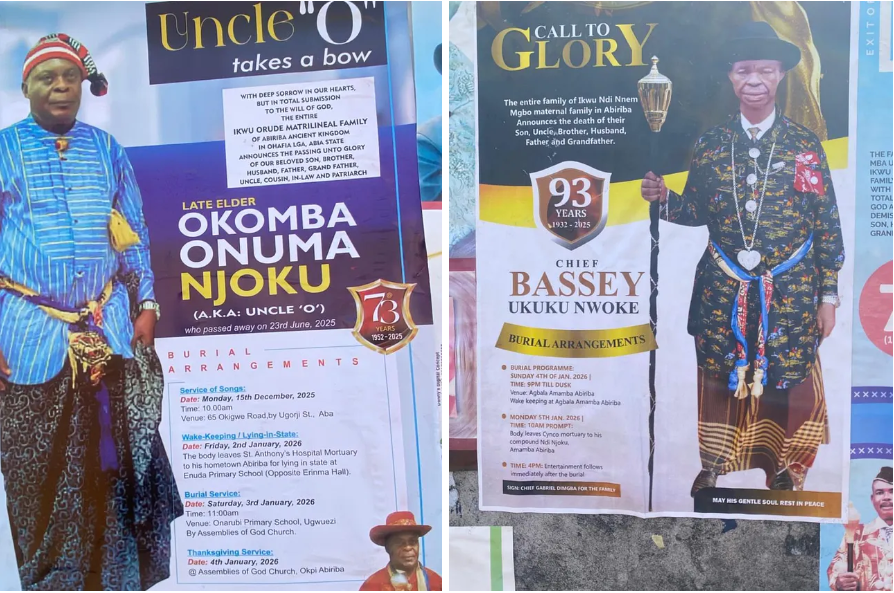
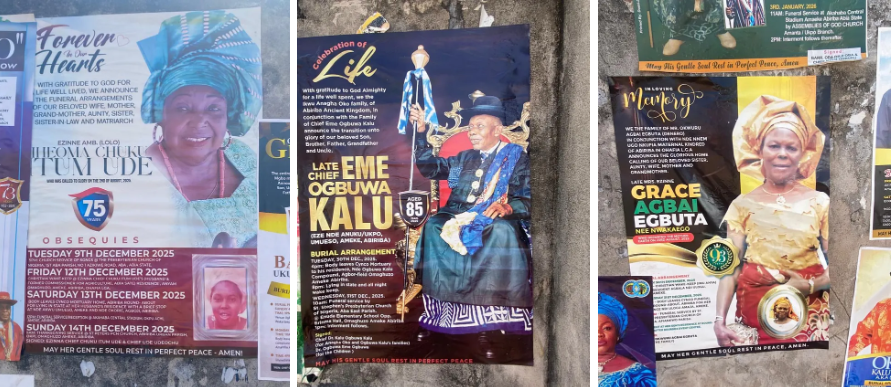
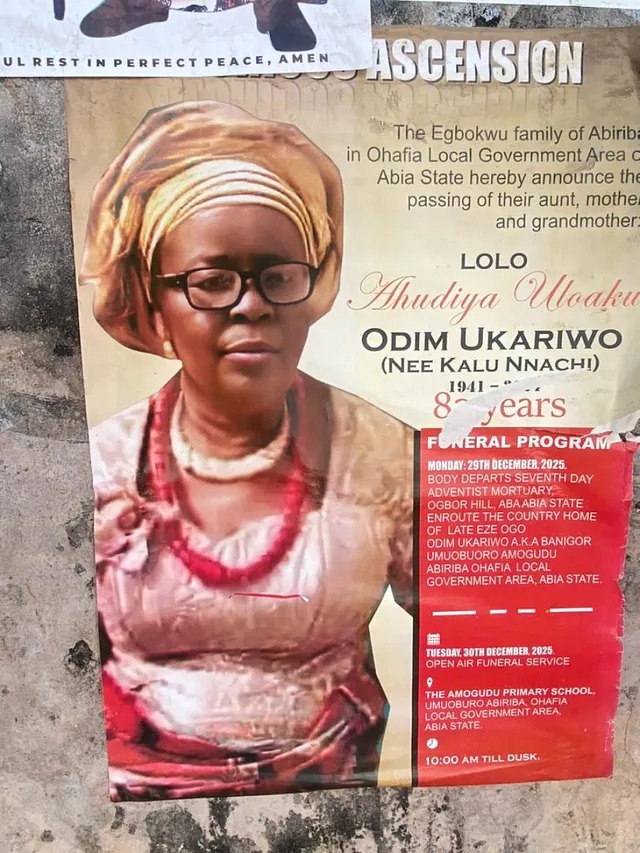
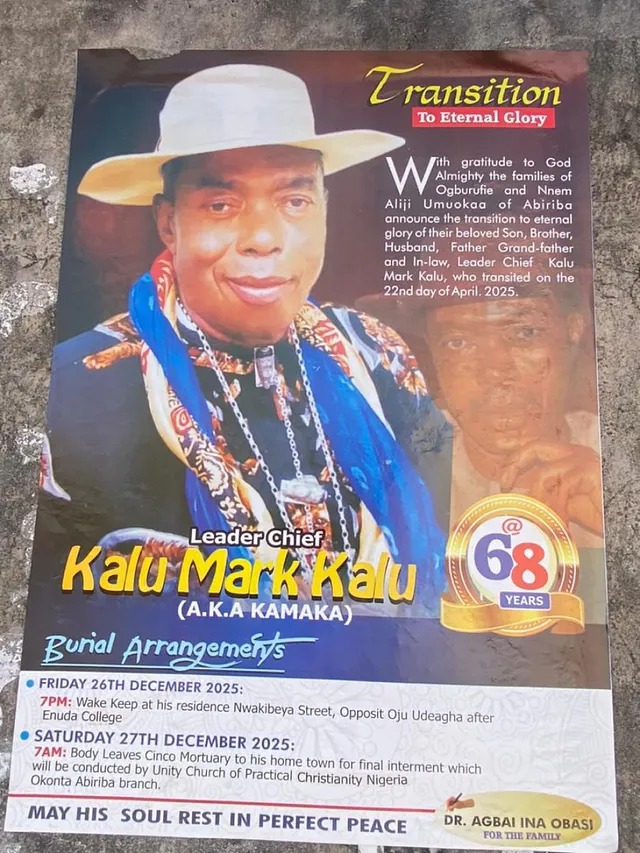
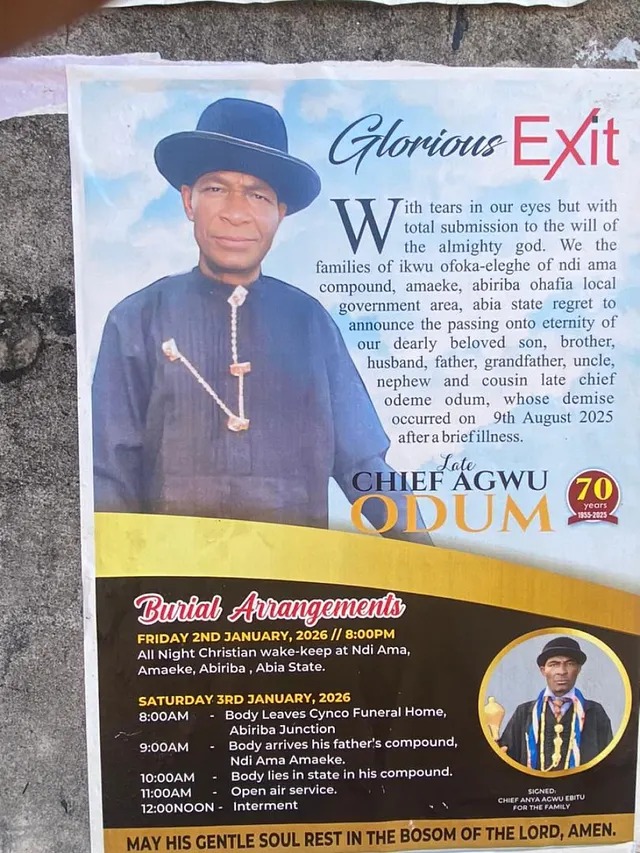
Instead, driven by a different, more reflective kind of pull, I opened the gallery on my phone. A few days prior, in a fleeting moment of anthropological curiosity or perhaps quiet rebellion against the overwhelming present, I had embarked on a solitary, documentary mission. I had walked, driven, and paused at various junctions, corners, and compounds across Abiriba, methodically photographing the posters, the vinyl flex banners, and the glossy obituary announcements that now form the ubiquitous visual text of our funerary landscape. I had done it not as a grieving relative or a passive observer, but as a field researcher – capturing the stark iconography of modern Igbo mourning: the pixelated, often decades-old portraits of the deceased; the bold, commanding fonts announcing “Celebration of Life” or “Grand Final Funeral Rites”; the elaborate lists of surviving family that stretched into genealogical minutiae; the sometimes jarringly triumphant slogans (“A Life of Impact!”, “A Glorious Exit!”); the sheer, overwhelming scale of the printed vinyl, flapping against fences and gates. I had documented the aesthetic of contemporary farewell, the way grief had been branded, formatted, and publicly displayed.
Now, scrolling through this digital archive in the dim, climate-controlled quiet of the hotel room, the images underwent a profound transformation. Isolated from their chaotic, real-world context of blaring music and milling crowds, they ceased to be mere records and began to speak. A chilling pattern emerged from the sequence. A disquieting narrative unfolded in the silent progression from one portrait to the next. The frozen smiles of the elderly, the stern visages of patriarchs, the kindly faces of matriarchs – all rendered in the cheap, high-contrast palette of mass digital printing – stared back at me, not as individuals, but as symbols in a vast, unspoken system. The banners were not just announcements; they were claims staked. The lists of survivors were not just tributes; they were maps of social capital and obligation. The grandiloquent titles were not just honours; they were performances of family stature. What I had captured was the visible infrastructure of a profound cultural shift – the industrialization of mourning, the transformation of intimate loss into a public, standardized, and fiercely competitive spectacle.
A deep, rolling discomfort, the precursor to revelation, stirred within me. This was the quiet truth screaming beneath the cacophony I had just escaped. The noise was not the cause; it was the symptom. The frantic gatherings were not the essence; they were the output. The exhaustion was not incidental; it was the designed product. The real machinery, the engine of this entire “Feast of Exhaustion,” was right here in these images – in this system that had learned to convert grief into social fuel, that had turned the sacred duty of remembrance into a high-stakes, seasonally-scheduled production. The clarity was sudden and merciless. It was the clarity that only comes when one has finally, physically escaped the epicenter of the quake, when the dust settles enough to see the altered landscape.
In that hushed hotel room, with the muted sounds of Umuahia traffic a distant whisper and my wife sleeping peacefully nearby, the shape of the next chapter of my understanding – this very inquiry you are now reading – coalesced with absolute certainty. It was born in that moment of hard-won distance. It was forged in the contrast between the silent, speaking images on my screen and the memory of the deafening realities they represented. It was a revelation pulled from the quiet after the storm, a diagnosis made possible only by the patient. What follows, the entirety of this meditation, is the unfolding of that revelation – an attempt to give voice to the patterns in those posters, to trace the logic of that industrial machinery, and to understand the profound human cost of the magnificent, draining, beautiful, and heartbreaking way we have learned to say goodbye.
3.
The first realization does not announce itself with drama or spectacle. It does not arrive the way revelation is supposed to arrive, with thunder or a clean shattering of illusion. It slips in quietly, almost apologetically, like a thought that does not want to disturb you but refuses to leave once it has settled. In the half-light of the hotel room, the city of Umuahia a distant hum beyond the window, the glow of my phone screen was the only world. It was a portal back into the village I had just fled, not to its noise or its crowds, but to its silent, visual subconscious – the gallery of funeral posters I had compulsively documented. The fatigue of the season was still a physical presence, a leaden weariness in my joints, but my mind, in this sudden oasis of quiet, was turning sharp, obsidian. I scrolled slowly, no longer seeing individual portraits but a pattern, a field of data. And then, without fanfare, it was simply there. The understanding. It did not descend; it assembled itself from the pixels on the screen. It tapped me lightly on the shoulder and said, without urgency but with absolute certainty: these posters are not announcements. They are not informational devices. They are not neutral conveyors of dates, names, and logistics. They are something else entirely.
The obvious purpose – the date, time, and venue of the funeral rites – was now exposed as mere pretext, the functional alibi for a far more ambitious and psychologically loaded operation. The logistics were the footnotes; the portrait and its attendant text were the main text, the thesis statement. They are proclamations. Each one was a declarative act, a statement issued to the public square, not of a death, but of a valuation. They are coronations masquerading as condolences. Beneath the veneer of communal sympathy pulsed the ancient, intricate machinery of social elevation, of status affirmation. The funeral was not just a send-off; it was an investiture. They are rituals of elevation performed in public space, using vinyl and ink as liturgical tools. The flex banner, strung across a busy junction or nailed to a compound wall, was our modern parchment; the digital printer our scribe; the list of sponsors and committee members our liturgical calendar. We had secularized sacrament and outsourced it to graphic designers in Aba.
And the ambition of this ritual was breathtaking in its scope and its denial. They attempt something audacious and deeply revealing: to lift a mortal life out of its contradictions, hesitations, mediocrities, and unfinished business, and suspend it at a height where nuance cannot breathe and complexity is treated as contamination. The project was one of alchemical purification. The raw, mixed material of a human life – the noble intentions and the petty resentments, the public successes and the private failures, the love given and the love withheld, the projects completed and the dreams abandoned – was to be processed, refined, and distilled into a single, flawless compound: Legacy. The poster was the crucible for this transformation. Ambiguity, the very essence of a lived life, was the impurity to be burned away. The messy, contradictory, beautifully human narrative was to be replaced by a clean, legible, socially endorsed hieroglyph.
What confronts me in these images is not remembrance as I once understood it. It is not memory in its fragile, fractured, unreliable human sense. True memory is sensory and subjective: the scent of a particular soup wafting from their kitchen, the sound of their laugh – a cackle, perhaps, or a low rumble – the specific way they mispronounced a word, the glint of mischief in their eye when telling a tall tale, the stubborn set of their jaw during a disagreement. Memory is granular, emotional, and often inconvenient. It does not conform to a narrative arc. It is canonization. This was a process of sainthood, stripped of its divine mandate but retaining all its formal rigor. It is the manufacture of sanctity. Sanctity was no longer a state of grace conferred by God or earned through martyrdom; it was a product, assembled posthumously from a kit of parts: a flattering photo, a list of titles, laudatory adjectives, and the correct ceremonial props. It is a graphic apotheosis, enacted not by priests or theologians but by designers, printers, sponsors, and committees of well-meaning relatives.
I saw it now with chilling clarity. A community, perhaps without fully realizing it, is rewriting its theology of worth, memory, and transcendence, using the grammar of advertising, the tools of corporate branding, and the aesthetics of aspirational success. Our ancestors spoke of the spirit joining the pantheon of the fathers, its worth judged by a lifetime of character, contribution, and alignment with omenala (tradition). Our new, unspoken theology was different. Worth was quantified, listed, bullet-pointed. Memory was not a spiritual continuum but a reputational asset to be managed. Transcendence was not a merging with the ancestral collective but a form of personal brand elevation into a glossy, permanent state of recognition. The afterlife, it seems, has acquired a marketing department. And its key performance indicators were printed in bold, embossed type.
One poster in particular does not merely catch my eye; it ambushes me. It stands with the confidence of something that knows resistance is futile. The face of Dr. Ike Onyike Oze filled the screen. He was not looking at the viewer so much as past them, into a middle distance of supreme satisfaction. He looks out from the banner with a serenity so complete it borders on smugness, the expression of a man who has not only accepted death but has solved it administratively. There was no trace of struggle, fear, or even curiosity. His countenance was that of a senior partner who has just reviewed the final terms of a complex merger and found them most acceptable. His face is calm, composed, almost managerial, as though he has just finalized an agreement with eternity and is waiting for confirmation email.
Yet it is not his expression that dominates the frame. It is the typography. His name, “Dr. Ike Onyike Oze,” was central, but it was besieged, fortified, and ultimately defined by the siege itself. The letters swarm his name like satellites around a privileged planet. To the left, to the right, stacked beneath in a column of formidable achievement, they orbited. DCR. BSc. MSc. MBA. Each acronym was a monument, a little pyramid of effort and validation. They were carefully spaced, meticulously aligned, presented not as information but as evidence. They had the visual weight of credentials on a boardroom door. And then, like the punchline of a joke that is not entirely sure it is a joke, the crescendo arrives: PhD, PhD, PhD. Three times. Not a single, hard-won doctorate, but a triplicate. Was it an error in the design file, duplicated in haste? Or was it a deliberate, emphatic repetition, a mantra? It felt liturgical. A trinity. A chant. A password repeated to ensure the gates open.
The message of the layout was unambiguous, aggressive in its clarity. The layout leaves no room for doubt. This is not a tribute; it is a defense. It was a fortification erected against any potential interpretation of this life as unremarkable. It pre-empted any whispered assessment that might begin with “He was just a…” It is not mourning; it is argumentation. The poster was engaged in a rhetorical exercise, marshaling its points with academic precision to prove a thesis: This was a Significant Life. The poster is not saying, “He lived.” It is saying, “He qualified.” Existence itself was not enough; it had to be certified, accredited, and framed within internationally recognized paradigms of achievement. The academic inventory is displayed with the seriousness of scripture, each acronym functioning as a talisman, a ward against the indignity of being remembered as merely human.
I find myself hovering between laughter and unease, caught in the strange realization that death, at least visually, has begun to resemble a LinkedIn update. The aesthetics were identical: the professional headshot, the bold-faced name, the strategic list of qualifications, the imperative to project competence and unassailable success. The funeral banner was simply the final, monumental profile update, a permanent change of status to “Formerly CEO of Life, Now Pursuing Other Opportunities in the Ancestral Realm.” I wonder, not rhetorically but genuinely, when the soul began to require bullet points to be taken seriously. When the sum of a life started to look suspiciously like a CV tailored for celestial review. At what point did we internalize the belief that the intangible essence of a person – their kindness, their courage, their humor, their resilience in the face of obscurity – was insufficient, illegible currency in the economy of remembrance? That it needed to be converted, without loss of value, into the hard currency of titles and degrees?
What I am witnessing is not vanity in its most obvious or shallow form. It is not simply an individual insisting on importance. This was not the lonely ego of the deceased projecting itself beyond the grave. The deceased, after all, was far past caring about font sizes. It feels collective, ritualistic, almost anxious. This was a social performance. The family committee that approved this design, the siblings who argued for the inclusion of every acronym, the designer who executed it – they were all actors in a communal play whose script everyone knew but no one had written down. There is a shared nervousness beneath the gloss, a communal fear that being “ordinary” in death is somehow unacceptable. To be buried without fanfare, without a banner listing your conquests, was seen not as humility but as poverty – a poverty of achievement, of social standing, of love from one’s kin. The simple dead appear to frighten us. An unadorned passing felt like an existential threat, a crack in the carefully maintained façade of collective progress and individual upward mobility. An unadorned life, presented without titles or embellishment, reads as a failure of imagination, perhaps even a failure of love. If you loved them, the logic whispered, you would prove it – by proving them. You would armor them against posthumous obscurity with the gleaming plate mail of documented accomplishment.
So the poster steps in to correct the record. It becomes a résumé for the afterlife, a curated transcript designed to speak eloquently on behalf of a body that can no longer speak at all. The silent, cold form was given a voice, but that voice was limited to a recitation of credentials. It was the voice of a public relations officer, not a husband, father, friend, or dreamer. The acronyms arrange themselves into a kind of metaphysical armor, protecting the deceased from the imagined scrutiny of both the living and the ancestral dead. We projected our own anxieties about judgement onto the cosmos. We imagined the ancestors as a stern review board, and we sent our loved ones to meet them armed with their best references.
The underlying assumption, once it reveals itself, is both chilling and absurd: that death is not an equalizer but an interview. The great democracy of the grave, where dust is dust, was being rejected in favor of a continuation of the hierarchy. The journey beyond was not a return to an undifferentiated source, but a processing center where stations were assigned based on submitted documentation. That the soul does not arrive naked and unknowable, but must present credentials. We had bureaucratized the afterlife. We imagined not a spiritual reckoning of the heart, but a clerical verification of paperwork. That somewhere beyond breath and blood, there is a waiting room, and someone is checking qualifications. The imagery was irresistibly bureaucratic: a celestial front desk, a harpless angel with a clipboard, a tick-box form. The fear is not annihilation; it is being told, politely, to wait outside. The ultimate social nightmare – exclusion, being found unworthy of entry – was mapped onto the afterlife. The poster was the pre-emptive VIP pass.
My gaze drifts, as it must, to another poster, and here the tone shifts from dry irony to something closer to opera. From the academic to the regal. The face of Chief Emman Kalu materialized. This was not the serene administrator; this was the sovereign. Chief Emman Kalu stands frozen in an attitude of authority that feels carefully rehearsed and digitally reinforced. Every line of his body communicated command. His shoulders were squared, his chin was level, his eyes held the camera with a gaze that tolerated no dissent. He grips a golden scepter with absolute confidence, the confidence of a man whose hands in life may never have held anything heavier than a television remote or a walking stick. The scepter was the star of the show. It gleamed with an unnatural, CGI-assisted brilliance, its surface untouched by the patina of age or use. The scepter gleams unnaturally, its metallic perfection announcing symbolism rather than history. It was not an heirloom; it was a prop, purchased or rented for the specific purpose of this photographic translation into royalty.
His expression communicates command. It says, “I ruled.” The statement was absolute. It admitted no qualification. What remains politely unaddressed is what exactly he ruled. The scope of his dominion was left gloriously vague. Was it a thriving business empire? A sprawling extended family? A village social club? Or was it, more likely, the respectful but bounded territory of his own household and immediate kin? A household. A meeting. A seating arrangement during Christmas gatherings. The specific, mundane realities of his authority dissolved in the universal solvent of the regal portrait. The ambiguity is irrelevant. Power, once represented visually, does not require jurisdiction. The image created its own truth. By holding the scepter and wearing the red cap with its eagle feather, he became a chief in the permanent record of the flex banner. The poster did not reflect reality; it authored it.
A few meters away, Princess Onyidiya repeats the grammar almost flawlessly. Swiping to the next image, the gender shifted but the syntax remained. The lighting is softer, the colors warmer, but the message is the same. She was bathed in a more forgiving, almost ethereal glow, but the trappings spoke the same language of elevated status. Regalia drapes her shoulders. A velvet cloak, trimmed with gold thread, sat upon her. A beaded crown, intricate and weighty, adorned her head. Symbols of royalty cluster around her like affirmations. She was not situated in her living room or her kitchen; she was placed against a generic, digitally rendered backdrop of drapes and soft light, a studio-made throne room. She is presented not as a woman who lived, but as an emblem of sovereignty.
These images are not memories. They are avatars. They were not attempts to capture the essence of a unique individual; they were the creation of a standardized character, plugged into a pre-existing cultural template. Constructed figures assembled from a shared visual vocabulary of monarchy and prestige. The library of stock images, the designer’s folder of “chieftaincy props,” the community’s agreed-upon visual shorthand for importance – these were the building blocks. The actual life of Chief Emman or Princess Onyidiya was the rough clay; the poster was the finished, kiln-fired statue, conforming to a familiar and reassuring shape. The props do the speaking. The individual recedes. The life dissolves. Behind the scepter, the crown, the cloak, the specific person – with their particular laugh, their favorite food, their secret fears – faded into a silhouette. They became a mannequin upon which the community hung its garments of collective aspiration.
What unsettles me most is not the ambition of these images, but their stillness. And here was the core of the dissonance. Life, in all its honesty, is rarely coherent. It is a kinetic, stumbling, glorious mess. It is a series of experiments, most of which fail. It is a conversation that meanders, doubles back, and is often interrupted. It is full of decisions made with poor information, kindnesses offered clumsily, triumphs that feel oddly empty, and failures that later reveal themselves as blessings. It is uneven, contradictory, full of awkward pauses and unflattering moments. The photo album of a real life contains bad haircuts, unflattering angles, moments of rage or tears, pictures where the subject is looking away, mid-sentence, or caught in a grimace. It resists narrative. It resists summary. Life cannot be captured in a thesis statement; it is the entire, messy, footnote-riddled dissertation.
Yet here, in death, we insist on coherence with almost desperate intensity. The chaotic, beautiful data set of a lifetime must be processed into a single, clean data point: LEGEND. We iron out the creases. The wrinkles of worry, the laugh lines of joy, the furrows of thought – all are smoothed by the airbrush tool into a placid, ageless plane. We remove the stumbles. The career missteps, the failed relationships, the public embarrassments, the private regrets – these are edited out of the final cut. We dress the departed in costumes of kings, scholars, and matriarchs, as though to shield them from the great democratic insult of dying. Death is the ultimate, humbling democratizer. The billionaire and the street sweeper, the professor and the illiterate farmer, all end in the same biological silence, reduced to the same organic matter. This raw, biological truth seems to offend our deep-seated social sensibilities. Everyone ends the same way, and this fact seems to offend us deeply. We find it intolerable. So we rebel. Nature erases hierarchy, so we rebuild it immediately, digitally, visually, ceremonially. In the face of nature’s indifferent equality, we reassert our human categories with renewed vigor. The funeral becomes not an acceptance of this equality, but a defiant, final assertion of difference. The bigger the banner, the longer the title, the more elaborate the regalia, the louder we scream our refusal to be dissolved into anonymous earth.
The result is a form of visual comedy that is entirely unintentional and therefore potent. The humor is not in the design itself, but in the vast, silent canyon between the image and the remembered reality. A man who spent decades arguing with NEPA officials over electricity bills, his voice rising in impotent fury in a dark living room, is now immortalized gripping a staff of authority meant to command nations. The baton he holds now could not turn on a single light bulb in his lifetime. A woman who never once wore a crown in life, who tied a simple headscarf to go to the farm or the market, now bears one so elaborate it threatens the structural integrity of her neck in the photo. The crown looks heavy, alien, a bizarre transplant from a different woman’s story. The humor is quiet, almost cruel, but it lingers because it exposes the gap between lived reality and posthumous aspiration. It’s the humor of profound cognitive dissonance. We are laughing, uneasily, at our own collective performance, at the sheer scale of the fiction we agree to uphold.
This signals a profound sociological shift. This was not just about individual families; it was a symptom of a community in rapid, disorienting transition. We are no longer remembering people; we are referencing icons. Memory is intimate and specific; referencing is formal and generic. We are moving from the anecdote to the archetype. The living, breathing individual – impatient, generous, petty, loving, inconsistent – is carefully removed from the frame. The complicated human being, whom you could have an argument with one day and share a drink with the next, is extracted. In their place stands a standardized digital hagiography. A saint’s life, scrubbed clean of temptation, doubt, and sin, leaving only virtue and miracle. Our version scrubbed clean of mediocrity, struggle, and ambiguity, leaving only triumph and honor. Every man becomes a Chief. Every woman becomes a Matriarch, a Princess, a Pillar. The titles are not descriptive; they are prescriptive. They are not what they were; they are what we need them to have been, for our own sense of order and lineage. Titles harden into identity. The fluid, multifaceted person solidifies into a single, monumental noun: The Patriarch. The Matriarch. The Scholar. Symbols glow with artificial clarity. The scepter, the crown, the scroll, the PhD – they burn with a symbolic intensity that real life, in its dull, material reality, could never sustain.
Ambiguity is not merely avoided; it is actively erased. The graphic designer’s “healing brush” tool is a metaphysical instrument here, wiping away not just blemishes but moral and narrative complexity. Even the imperceptible is exaggerated. A naturally dignified posture becomes a kingly bearing. A thoughtful gaze becomes prophetic wisdom. A lifetime of hard work becomes a legendary saga of triumph. Wrinkles disappear. The maps of experience, of laughter and worry etched on the skin, are flattened into a blank, youthful canvas. Eyes brighten. The tired, kind, sometimes sad eyes are replaced with the brilliantly white, sharply focused eyes of a visionary, digitally borrowed from a much younger face or generated from whole cloth. Skin is polished into a sheen that suggests the deceased spent their final years inside a skincare advertisement rather than a body subject to time. The mortal coil, with its sagging and spotting, is exchanged for the immortal vinyl, with its perfect, laminated gloss.
As the traffic loosens slightly and the car inches forward, these images refuse to stay behind. In the hotel room, there was no traffic, only the stalled rush of my own thoughts. But the metaphor held. The forward motion was intellectual, emotional. They climb into my consciousness like unwelcome passengers. I had invited them in through the lens of my camera, but now they had taken up residence, arguing with each other, with me, with my memories of the actual people they purported to represent. I carry them with me, replaying their faces, their fonts, their declarations. They became a slideshow projected on the back of my eyelids, a silent, persistent interrogation.
I begin to wonder what is lost in this translation from human to icon. What precious, fragile, human truths are sacrificed on the altar of this majestic, simplified fiction? The memory of their vulnerability, which made their strength meaningful. The recollection of their failures, which made their successes earned. The knowledge of their doubts, which made their faith a choice, not a default setting. The sound of their unguarded, ridiculous laughter, which no regal portrait could ever contain. What is sacrificed when memory becomes branding. Branding is about consistency, clarity, and positive association. Memory is about truth, in all its devastating, nourishing complexity. When we brand the dead, we trade truth for a manageable, marketable story. We exchange the nourishing, bitter bread of reality for the sweet, empty calories of legend.
Who benefits from this elevation, and who vanishes inside it. The family benefits, certainly – their social stock rises with the perceived stature of their departed. The community benefits, perhaps, gaining another “illustrious son” or “virtuous daughter” to cite in its narratives of self-worth. But the individual, the actual person, vanishes. They are buried twice: once in the earth, and once more under the laminated layers of symbolic expectation. The man who loved bad Nollywood films and hated gardening is gone, replaced by “The Patriarch.” The woman who was a ruthless businesswoman but sang off-key in the church choir is gone, replaced by “The Pillar.”
And, more troubling still, whether in our frantic effort to avoid being forgotten, we have quietly forgotten how to remember. The fear of oblivion is primal. But in our panic, have we adopted a method of remembrance that ensures the very thing we fear? By replacing the nuanced, specific, sensory person with a generic, symbolic icon, we create a memory that is impressive but empty, monumental but uninhabited. It is a tombstone, not a home. We remember the title, but forget the voice. We recall the achievement, but not the joke they told at the wedding. In striving to make them unforgettable, we have made them unrecognizable to anyone who truly knew them. We have forgotten that to remember is to engage with absence, not to fill it with noise and neon. It is to hold the space where they once were, with all its ache and its peculiar, quiet light.
By now, the physical gridlock barely matters. It fades into irrelevance. The real congestion has moved inward. The traffic jam was no longer outside on the Umuahia road; it was in the narrow corridors of my own mind, a logjam of conflicting thoughts, emotions, and recognitions. It sits somewhere behind my eyes and beneath my ribs. A tightness, a crowded feeling, as if the gallery of posters had been downloaded directly into my chest cavity.
The images have begun to argue with their own captions. The smiling face of “Princess” Onyidiya argued with the memory of her sharp, pragmatic tongue in a market negotiation. The serene, managerial gaze of Dr. Oze argued with the rumor of his legendary temper with lazy subordinates. The regal bearing of Chief Emman argued with the fond stories of him dancing drunkenly, hilariously off-beat, at a child’s birthday. They say more than they intend to say. They reveal more than they conceal. In their desperate attempt to show only glory, they revealed a deep anxiety about mediocrity. In their meticulous erasure of flaw, they confessed a terror of authentic humanity. They were not just pictures of the dead; they were stark, revealing portraits of the living – of our fears, our aspirations, our broken relationship with mortality and meaning.
I find myself listening not as a detached critic but as someone implicated. This was no longer anthropology. This was autobiography. Someone who has commissioned posters. I had sat on those family committees, nodding as an elder insisted we include every single title, had haggled with the printer over the cost of the metallic ink. Someone who has praised them. I had stood before these very banners, clucking my tongue in admiration at the “fine production,” telling the grieving children, “Oh, she looks so peaceful, like a queen.” Someone who has walked past them without objection, absorbing their logic, nodding along with their assumptions. I had been a carrier of the virus, a replicator of the code. I had accepted this visual language as the natural, proper way of things.
Until now. The two words hung in the silent room, final and heavy. The evacuation from Abiriba was not just an escape from noise; it was a granting of permission – permission to see what had always been there. The thread that snapped was not just my endurance; it was the thread that connected me, uncritically, to this script. In the quiet of the hotel, with the digital ghosts of my community staring back at me, the script had fallen apart. I was no longer nodding along. I was reading between the lines, and in that space between the gold embossment and the airbrushed skin, I found a silence more deafening than any generator’s roar, and a truth far more demanding than any social obligation.
4.
The most unsettling revelation, the one that crawled up my spine in the quiet of that Umuahia hotel room, did not spring from what these ubiquitous funeral posters overtly displayed, but from the vast, echoing silence of what they meticulously, systematically refused to show. This was not a matter of accidental omission or simple aesthetic preference; it was something far more deliberate, far more ingrained. The dissonance between the text – the screaming, embossed headlines – and the image – the serene, curated portrait – was not some minor glitch in the graphic design process. It was not an aesthetic misfire. It was, I realized with a slow-dawning chill, the entire point. It was a system, a fully operational protocol with its own internal logic, its own unspoken rules, its own profound and troubling psychology. It carried the unmistakable, heavy texture of a cultural pathology – a collective, unconscious decision to lie, not clumsily or maliciously, but beautifully, lavishly, and with the full force of our proverbial ingenuity and pride. We had become architects of magnificent, vinyl-clad fictions.
I found myself pausing, not physically this time but mentally and emotionally, arrested in the digital scroll, my breath catching before the poster of Late Elder Mercy Uke Akaronu. The headline did not simply announce; it assaulted. It hit the eye with the blunt, reverberating force of a brass gong struck in a silent hall: PAINFUL EXIT. The words were embossed in a faux gold leaf so aggressively shiny, so ostentatiously radiant, it seemed less suited for an obituary and more for a high-society wedding invitation or the opening credits of a Nollywood epic. The typography itself seemed to scream a narrative of anguish, of rupture, of catastrophic, untimely severance. Every serif shouted tragedy. The font weight implied a weight of sorrow too great to bear. It was a visual wail, a typographic sob etched in plastic.
But the image positioned commandingly beneath this verbal tsunami… it refused, point-blank, to cooperate. It engaged in a silent, stunning mutiny against the headline’s declared theme. What I saw instead, what dominated the frame, was something closer to a high-end fashion editorial masquerading as an announcement of grief. Elder Mercy Uke Akaronu appeared not merely peaceful, but radiant, almost celestial, as if lit from within by a soft, approving heavenly spotlight. She was wrapped, no, ensconced, in a breathtaking wrap of royal blue lace, a fabric so intricate and vibrant it seemed to glow with its own internal electricity, independent of the poor printing ink. Elaborate coral beads – the real, ancient, wealth-signifying kind – sat upon her neck and descended her chest with the severe, perfect precision of a museum installation, each bead a testament to lineage and status. Her gele was a masterpiece of architectural starch, a towering, flawless crest. Her posture was regal, chin slightly lifted, shoulders poised in a posture of dignified repose. Her gaze, directed just past the camera, was serene, contemplative, utterly untouched by the slightest shadow of struggle, pain, or the existential fear that must, by the headline’s own admission, have accompanied her final moments. She did not look like someone who had endured a “painful exit.” She looked, instead, like a sovereign who had gracefully, and on her own terms, negotiated a first-class upgrade on her journey out of mortality. If any pain was involved in her transition, it clearly had the impeccable manners not to disturb a single strand of her elaborate hairstyle, not to crease the magnificent lace, not to dim the regal assurance in her eyes.
The cognitive and emotional violence of this semiotic clash was so complete it bordered on the comic, were the subject matter not so fundamentally grave. The words, in their gilded, shrieking font, shouted one undeniable reality: PAIN. The image, in its polished, serene composition, whispered an entirely different, triumphant story: GLORY. The typography performed the ritual of mourning, of loss, of tragic interruption. The portrait performed the ritual of celebration, of apotheosis, of glorious continuity. It was a civil war waged on a two-foot by three-foot sheet of PVC flex. And in that stark, unresolved contradiction, in that cavernous gap between declared feeling and depicted reality, lies the great, pervasive mismessaging of our contemporary era. We have developed a cultural reflex that insists – loudly, theatrically, expensively, with all the gold foil and bold fonts we can muster – that an event was painful, traumatic, a terrible loss. Yet, simultaneously, we are culturally forbidden, as if by some unspoken but ironclad decree, from visually depicting any authentic trace of that pain itself. Agony may be declared in text, but it must never, ever be shown in the accompanying image. Suffering may be announced in the headline, but it must be meticulously airbrushed, filtered, and costumed out of existence in the portrait. The raw, human truth of decline must be verbally acknowledged, then immediately visually negated.
Sitting there, the phone’s glow illuminating my face in the dark room, I found myself asking the silent images a series of questions that grew more irritated, more pointed, with each scroll. Where is the honest messiness of a life concluding? Where is the visible fatigue of a long illness etched around the eyes? Where is the fear, that very human, very understandable terror of the unknown that tightens the lips and hollows the gaze? Where is the vulnerability, the unraveling, the sheer physicality of decline that accompanies real human dying – the weight loss, the changed posture, the look of someone who has been in a struggle? The answer hissed back from the glossy, smiling portraits: Nowhere. It has all been systematically erased. Not forgotten, but actively, deliberately deleted. It has been Photoshopped into oblivion, buried beneath layers of digital correction, replaced with the most flattering, most vibrant, most alive-looking photograph from decades prior, when the subject was in full health and vigour. The face of death, in our public visual discourse, is not allowed to be pale, thin, or weary; it must be rosy, full, and brimming with vitality. The setting of death is not a hospital bed or a quiet room; it is a professional studio backdrop of soft-focus clouds or a majestic, photoshopped throne.
This process represents something far beyond mere tribute. Grief, in this highly formalized context, has been utterly commercialized and aestheticized beyond all recognition. It has passed through the filters of social expectation and emerged as a product – a standardized, polished, and emotionally sanitized product. We have perfected, as a community, the intricate art of visual denial. We have built a sophisticated machinery for the production of agreeable fictions. What we create, in place of a complex, honest representation, is an Alternate Space – a digitally-sanitized, parallel-reality afterlife where death does not arrive as a thief or a conqueror, but as a respectful guest who knows to wait until the subject is perfectly dressed and coiffed. In this alternate space, a “painful exit” is visually indistinguishable from a serene, royal transition. The poster thus ceases to function as a record of a life that ended, with all its attendant truths. It becomes, instead, an escape hatch, a collective fantasy projection. It is a place where we, the living, flee when the truth of protracted illness, of medical neglect, of lonely suffering, of a healthcare system held together by prayer and Scotch tape, becomes too corrosive, too shameful, too indicting to confront directly. We escape into the glamour of lace and the reassurance of a smile.
And then there are the euphemisms – those slick, two-word linguistic incantations designed to erase entire sagas of suffering with the efficiency of a delete key. “Brief illness.” A phrase so elastic, so deliberately vague, it can stretch like a metaphysical rubber band to cover a spectrum that ranges from a twenty-four-hour fever to a five-year, bank-account-emptying, dignity-stripping battle with cancer or organ failure. I realized I could no longer read those words on a poster without my mind involuntarily constructing the hidden film reel behind them. I saw not the serene face on the flex, but my own cousin’s wife in a poorly lit hospital ward. I replayed the frantic, late-night drives to purchase black-market antibiotics, the humiliating negotiations with underpaid nurses for basic attention, the improvisation masquerading as treatment, the quiet, desperate conversations in hospital corridors where the real diagnosis was the crushing cost and the systemic absence of care. I saw the family’ exhaustion, the pawned jewelry, the quiet selling of land, the gradual dimming of hope. None of that brutal, chaotic, human reality survives the graphic designer’s treatment. It is all pushed mercilessly into the margins, buried beneath aesthetic filters and soft lighting, smoothed over and sanitized until it no longer poses a threat to our collective composure, our need for a neat, respectable narrative.
What emerges from this process of erasure and redesign is not truth, but a potent fantasy of control. It is a psychological compensation mechanism of staggering proportion. The implicit, heartbreaking logic is this: If we, as a family, a community, a people, cannot fix the broken healthcare system that failed the dying, if we cannot undo the years of silent suffering, if we cannot reclaim the time lost to pain, then we will exercise absolute, dictatorial control over the one thing we still can – the image of their departure. We will curate it, brand it, and present it to the world as we wish it had been. This is the unspoken, communal agreement we have all signed. We are a people deeply traumatized by the visceral fragility of life in a context where institutional support is often a cruel joke – and so, instead of raging against the failing systems, we collectively, quietly, rewrite the ending. Death thus becomes not a damning indictment of all that went wrong, but a glittering branding opportunity to loudly declare what we fervently wish had been true: that it was peaceful, glorious, and befitting of a king or queen. We swap the reality of systemic failure for the spectacle of individual triumph.
And so the transformations multiply across the visual landscape of our mourning, each one a small act of biographical revision. The perpetually grumpy, difficult uncle – the one who terrorized small children with his scowls, who picked arguments with neighbours over boundary lines, who could start a fight with a placid goat – is posthumously reborn on vinyl as a “Gentle Soul,” his familiar scowl replaced by a benign, slightly confused smile borrowed from a cousin’s wedding photo thirty years prior. The mother who suffered in quiet, heroic desperation, who labored without respite, who died exhausted and perhaps uncelebrated in the daily grind, is elevated not into a complex woman but into a monolithic “Heroine,” her lifelong pain repackaged and sold back to us as a singular, virtuous narrative of sacrifice, neatly severing the suffering from the social conditions that created it. The stern, unsmiling man who navigated life with a pragmatic severity, who never saw the utility in frivolous grinning, is suddenly beaming from the funeral poster as if he’s just received fantastic news in the afterlife, his unfamiliar smile digitally grafted, creating a stranger who is somehow meant to be him. The humble, practical woman who spent her life in simple, worn wrappers, who never owned or desired a piece of lace, is now digitally draped in enough elaborate, shining lace fabric to upholster the entire interior of a small village church, transformed into a royalty she never knew in life.
Complexity, it seems, is inconvenient for the purposes of public memorial. Contradiction is impolite at the funeral. The poster, as a format, demands a seamless, unified, coherent narrative – a single, easily digestible story. And if that coherence does not exist in the messy archive of the actual lived life, then it must be manufactured. It must be digitally and narratively stitched together from fragments of wishful thinking and social expectation.
This realization settled upon me in the hotel room with the weight of a genuine and disturbing epiphany: This is not remembrance. What I was witnessing in this gallery of glossy alternates was not the honouring of the dead as they actually were – flawed, beautiful, difficult, kind, stubborn, loving, real. This was revisionist history on a personal, familial scale. It was an attempt, driven by love, guilt, pride, and social anxiety, to retrofit a life that was lived unevenly, imperfectly, and uniquely, through the magic of graphic design and selective memory, into a standardized template of sainthood or royalty. We are not celebrating the person; we are editing them. We are airbrushing them into a more palatable, less challenging, more socially acceptable product for public consumption. And in this diligent act of biographical sanitization, we achieve a secondary, perhaps more urgent goal: we protect ourselves. We shield ourselves from the gnawing guilt of whether we did enough in their final days. We deflect the rising rage at the systems that failed them. We silence the harder, more dangerous questions about why, in our community and our nation, so many “exits” are so profoundly and unnecessarily “painful” in the first place. The gold-embossed lettering acts as a glittering tombstone, not just for the deceased, but for our own uncomfortable inquiries.
As I swiped to the final image in my gallery and let the screen go dark, the portraits did not disappear. They clung to the inside of my eyelids, to the quiet of the room, like a persistent, moral humidity – heavy, unresolved, insistently present. The silence was now full of their silent, smiling accusations. I was left, in that chilled anonymity of a hotel room, wrestling with a corrosive wondering: whether this entire, elaborate, expensive performance of posthumous beauty and honour is driven less by a pure, unadulterated love for the dead in their full, messy humanity, and driven more by a deep, unacknowledged fear among the living. Fear of looking suffering directly in its gaunt, unadorned face. Fear of admitting, publicly and collectively, how little power we truly have to prevent it. Fear of confronting the gaping voids in our social safety nets. Fear of a truth so stark and unyielding that no amount of gold foil, lace overlay, or flattering photo filter can ever truly, successfully bury it.
By this point in my solitary reflection, any pretense of cool, academic neutrality had evaporated. I was implicated. I was irritated. I was, unquestionably, complicit. I have not observed these rituals from a distance; I have slept through the all-night vigils, my body aching on plastic chairs. I have contributed my share of money to fund these very posters and the lavish events they announce. I have argued with uncles over the guest list at these funerals. I have eaten the rice and chicken served at them, the taste forever linked to a specific, complex blend of community and exhaustion. And I have, as proven by my very presence in this Umuahia hotel room, ultimately escaped from them when the sensory and emotional overload became untenable. What I am attempting to describe and dissect here is not rumor, hearsay, or a distant sociological critique. It is lived repetition. It is the accumulated sediment of experience. I know the particular, sweet-rotten smell of a crowded funeral compound after the rain. I know the specific, heavy taste of the funeral jollof rice, richer and oilier than everyday fare. I know the unique, hollowed-out fatigue that follows you home afterwards, a fatigue that is more spiritual than physical. And because I know these textures, these smells, these tastes, these feelings with such intimate, bone-deep familiarity, I can no longer, in good conscience, pretend they are harmless, benign traditions. What we are practicing, perfecting, and propagating is not the preservation of a sacred, ancient rite. It is something newer, colder, more efficient, and far, far less human. It is the industrialization of farewell, and I, like everyone I love, am both its product and its prisoner, yearning for a way back to something real.
5.
The hotel room’s artificial chill became the perfect climate for a colder kind of inquiry. The gallery of posters on my phone had shifted from a collection of images into an indictment of a process. But the images were just the product, the gleaming, laminated output. The real machinery lay behind them, in the days and nights they prescribed. Lying there in the sterile quiet, a question surfaced, one that bypassed the “what” and the “how” and went straight for the generative wound: The question that haunts me is deceptively simple: How did this carnival begin?
It was a question of origins, of patient, incremental mutation. Because carnivals do not simply appear. They are not natural phenomena, erupting like mushrooms after rain. They are cultural contraptions, immense and intricate. They are engineered. They are the product of countless small decisions, unconscious adaptations, and the slow, relentless pressure of changing economics and social anxieties. They are assembled piece by piece, ritual by ritual, until the spectacle becomes so familiar that no one remembers a time before it. The bizarre becomes normal through sheer repetition. The exhausting becomes traditional through the alibi of “that’s how it’s done.” What we now call “funeral tradition” did not erupt spontaneously from grief. To believe that was to believe the carnival was a natural outgrowth of the human heart, rather than a superstructure built upon it.
The realization was clear, and it reframed everything. It was constructed – slowly, methodically – through the commodification of the human soul and the conversion of mourning into a standardized, industrial-scale operation. This was the core of the shift. The soul, that ineffable essence, had been given a market value, calculated in cans of drinks, yards of lace, decibels of sound, and the number of plastic chairs filled. Mourning was no longer a private or communal emotion to be endured and shared; it was a public project to be managed, with inputs, outputs, budgets, and key performance indicators. What once emerged organically from loss – the gathering of kin, the simple sharing of food, the telling of stories in the hushed tones of night – had been reverse‑engineered into a template. The organic process had been studied, its components isolated, and then reassembled not for emotional efficacy, but for social scalability and visual impact. The template was rigid, allowing for only superficial customization (the photo, the font color, the choice of “Chief” or “Dr.”).
Today, every funeral poster doubles as a production schedule, and every death activates the same assembly line. The poster was not just an announcement; it was a Gantt chart for grief. It listed the sequence of events – Wake Keep, Funeral Service, Interment, Reception – with the cold precision of a factory shift log. And like a switch thrown in a control room, the announcement of a death triggered a pre-programmed sequence across the community. Caterers were called. Canopy and chair rentals were mobilized. Sound engineers checked their equipment. The community slipped into its pre-assigned roles on the assembly line: some as contributors of funds, some as cooks, some as crowd-fillers, some as officiants. The unique human being who had died was fed into one end of this standardized process; out the other end came a “successful funeral,” a product judged by metrics wholly separate from the depth of sorrow or the authenticity of remembrance.
Scrolling back through the images, I focused not on the faces but on the small print, the boilerplate text at the bottom. The burial itinerary printed on these banners is a chilling carbon copy, replicated with the precision of factory output. “Friday: Wake Keep at the Family Compound by 5pm.” “Saturday: Funeral Service at [Local Church or School Field] by 10am.” “Interment follows immediately.” “Reception at…” The phrasing was identical across different banners, as if copied from a master document. Names change. Faces change. The sequence does not. The idiosyncrasy of a life was forced into the uniformity of a program. A boisterous, life-loving adventurer and a quiet, scholarly recluse were both subjected to the same relentless, public timetable of farewell. It is an institutionalized blueprint for exhaustion, a script so familiar that no one questions its cruelty anymore. The cruelty lay in its one-size-fits-all nature, in its denial of the fact that grief has its own peculiar rhythm, its own need for pause or silence or privacy, which this industrial schedule bulldozed in the name of efficiency and spectacle. The choreography is so predictable that even children can recite it. They grew up knowing the steps: the night of noise, the morning of long speeches, the afternoon of rice and loud music. It has become our most consistent liturgy. More consistent than Sunday service, more faithfully observed than any ancestral rite, this was the true, unshakable liturgy of contemporary community life – a liturgy not of sanctity, but of social performance.
And the process begins, inevitably, with the Mandatory Wake‑Keep.
The words themselves now felt like a misnomer, a quaint holdover from a different time. The wake‑keep is advertised as a “Christian vigil,” but that description now feels like a polite lie. The original concept – a vigil, from the Latin vigilia, meaning watchfulness, a period of staying awake to keep watch, often in prayer – had been hollowed out and repurposed. In practice, it is a mandate for communal sleeplessness – a compulsory overnight performance staged not for the grieving family but for “Guests and Sympathizers,” a phrase that sounds suspiciously like a political rally. The banner’s invitation was never “Family will keep watch in prayer.” It was “Wake Keep: Guests and Sympathizers are invited.” The shift was profound. The purpose was no longer intimate watchfulness; it was public attendance. The metric was not depth of prayer, but breadth of crowd.
Attendance is less an act of compassion than a public signal. Your presence was a data point in the social ledger, a broadcast of your connection, your loyalty, your awareness of the event. Volume matters more than intimacy. A quiet, sparsely attended wake was a social catastrophe, a sign of a life poorly lived or a family without pull. Therefore, the volume had to be literal as well as figurative. Noise replaces prayer. The sonic landscape of the modern wake-keep was not one of hymns or quiet psalms; it was a curated playlist of highlife, gospel-infused pop, and motivational talk, blasted at levels that made conversation – let alone contemplation – impossible. The noise was a tool to manufacture the feeling of a “well-attended” event, to fill the emotional void with physical vibration.
I have lived this schedule too many times to romanticize it. This was not theory. My body held the memory. I remember nights when my eyes burned from fatigue, when grief should have found a quiet corner to breathe but was instead drowned in amplified music, forced cheer, and the relentless clatter of plates. The clatter was key – the sound of industrial-scale catering, of giant pots and serving spoons, a constant auditory reminder that this was, in part, a culinary audit. These nights are rarely about the dead. The deceased, whose name was on the banner, often felt like the least relevant person there. Their story was reduced to a caption beneath a photo, unheard over the din. They are loud, weary social clubs where the quality of jollof rice is debated with theological seriousness, where men argue about the coldness of beer with a passion that borders on spiritual warfare. I had witnessed these debates firsthand – heated discussions about the brand of stout, the presence or absence of pepper soup, the tenderness of the goat meat. The intensity of these conversations was a displacement activity, a way to engage in something tangible and judgeable because the amorphous, intimidating reality of death was too vast to confront. The extinguished life at the center of it all becomes abstract, almost theoretical. A concept, a name, a portrait on a banner. I have watched laughter peak while a corpse lay meters away, waiting patiently for morning. The laughter wasn’t callous; it was a release valve, a symptom of the absurdity of performing normality in the face of the ultimate abnormality. The vigil, stripped of reflection, becomes endurance theatre – a place where the living perform their stamina, not their sorrow. Who could stay the latest? Who could drink the most and still stand? The wake-keep tested your physical capacity to endure the schedule, not your emotional capacity to grapple with loss.
From there, the body enters what I can only describe as a transactional circuit. After the theatrical sleeplessness of the vigil, the following day saw the deceased mobilized. The deceased is no longer a person at rest but a passenger on a tightly coordinated route. The coffin was loaded into a hearse, and the hearse became a bus on a prescribed circuit. It makes brief, ceremonial stops at family compounds, each pause functioning as a ritual of territorial acknowledgment. This was the “lying in state” at various family houses. It was less about allowing different branches of the family a moment of farewell, and more a ritual of geographic claim-staking. It is less about farewell and more about recognition – an announcement that the dead once belonged here, too. The body was a relic, paraded to consecrate its connection to specific plots of land, specific compounds. The body is displayed, paused, moved along again, its stillness exploited to affirm social geography. The stillness of death was used as a tool to map and reinforce the living social network. Even in death, the deceased must complete the tour. There was no rest, even in a coffin. The schedule demanded movement.
The final stop is almost always the same: an open‑air funeral, usually on a primary school field. The choice of venue is telling. It was rarely the person’s local church, which might be too small. It was the largest, most public, most neutral (and often, most barren) space available: the community primary school field. These spaces, designed for children and learning, are temporarily converted into amphitheaters of mourning. The symbolism was jarring: a place of future potential transformed into a theater for finality. Canopies bloom like invasive species. White and green and blue tarpaulins spread across the red earth, creating a temporary, shabby metropolis. Plastic chairs spread in disciplined rows. A sea of identical, unforgiving plastic, a geometry of enforced seating. Loudspeakers claim the air with the entitlement of occupying armies. Their stands were tripods of sonic domination, ensuring no corner of the field was free from the programmed audio. What should be intimate becomes performative. A gathering that should have been for those who truly knew the person was now a public event for anyone with a connection, however tenuous, and a curiosity for spectacle. The crowd grows, and with it, the illusion that scale equals significance. We had conflated quantity with quality, attendance with affection. The funeral becomes a festival, and the dead become the least important participants. They were the reason for the festival, but not its focus. The focus was the festival itself – its success, its scale, its smooth execution.
At the heart of all this lies the most corrosive mechanism of all: the credit‑and‑debit system of obligation. This was the engine that powered the entire industrial complex. We have become, to borrow a phrase, hollow men and women. Our actions were not filled with the substance of genuine feeling, but were shells performed to maintain our social balance sheet. Attendance is no longer driven primarily by grief or affection but by bookkeeping. The first thought upon hearing of a death was often not “Oh, how sad,” but “Oh, I must attend. Their family came to ours.” Or, more darkly, “If I don’t go, they won’t come to mine.” Who came to mine? Did I show face at theirs? Who sat long enough to be seen? Who left too early? These were the calculations running in the background, the invisible spreadsheet governing movement and time allocation. This is not community; it is accounting. The warm, messy bonds of kinship and friendship had been reduced to a double-entry ledger. A ledger of appearances masquerading as solidarity. We traded the hard, vulnerable work of real solidarity – showing up in the quiet, difficult days after the funeral, providing practical help, listening to the raw grief – for the easy, public credit of a logged appearance at the main event.
In this economy, food and drinks are not acts of hospitality. They are transactional currency. This explained the intense scrutiny of the refreshments. They function as payment for occupied plastic chairs, compensation for borrowed time. The jollof rice and bottle of beer were not gifts; they were a quid pro quo. You gave your presence, your time, your contribution to the crowd-mass; in return, you were “paid” in food and drink. The transaction needed to feel fair. I have heard people complain – without irony – that the drinks were insufficient, that the meat finished too early, that the organizers “did not try.” The criticism was of a transaction that provided poor value. The emotional context was irrelevant. Once, standing less than ten feet from a coffin, I watched a man grumble that his beer was not cold enough. His irritation was genuine, almost moral. In his mind, a contract had been breached. The dead woman beside him might as well have been furniture. She was the backdrop against which this transaction was taking place, her profound absence less immediate than the palpable warmth of his lager.
This is the true face of the industrialization of the void. The “void” was the emptiness left by death, the profound absence. We had industrialized our response to it. Sorrow is no longer felt; it is processed. It was run through the machine of schedule, ritual, and social expectation, and emerged as a series of performed actions: crying on cue during a designated “mourning period,” wearing certain clothes, saying certain phrases. Grief is not shared; it is managed. Families hired MCs to manage the program, coordinators to manage the crowd, caterers to manage the food. The management of the event superseded the sharing of the emotion. Empathy has been outsourced to event planners, while families drown in logistics. The true labor of empathy – holding space, listening, sharing silence – was neglected because everyone was busy with the practical labor of the spectacle. Schedules are kept with military discipline, yet no space is reserved for silence. The itinerary was packed, minute-to-minute. There was no slot labelled “For Unstructured Grief.” No allowance is made for collapse. To break down, to be unable to host, to need to retreat, was seen as a failure to execute the schedule, a dereliction of duty. The bereaved are expected to perform gratitude, not grief. They were to move through the crowd thanking people for coming, ensuring the guests felt appreciated, their own inner turmoil secondary to the smooth running of the social transaction.
I have felt this machinery grind me down personally. This was the core of my exhaustion. I have stood as a relative, not a guest, forced to smile through exhaustion because the program demanded it. The mask of the gracious host had to be worn, even if the heart was shattered and the body was running on fumes. I have watched bereaved families morph into production managers, worrying about generators, seating, and protocol while their private grief went unattended. The mother, instead of being allowed to weep, was asked to approve the catering list. The son, instead of being allowed to be still, was running errands for more plastic cups. I have seen widows console visitors instead of being consoled themselves. The inversion was perverse and complete. The person at the epicenter of the loss was turned into a comfort-dispensing hostess to a room full of well-wishers whose primary need was to discharge their obligation. The inversion is complete. The mourners mourn the guests. The real grief of the closest family became a private, hidden thing, while their public energy was spent managing the emotional and logistical needs of the crowd.
What troubles me most is how normal this has become. The greatest success of the industrialization was its normalization. We no longer ask whether this system serves the living or honors the dead. Those fundamental questions had been silenced by the roar of the generator and the weight of expectation. We only ask whether it was “successful.” And success was measured externally. Was it well attended? (Crowd size). Was it talked about? (Social buzz). Did it meet expectations? (Fulfillment of the standard template). These are the metrics of an industry, not a culture of care. We were evaluating a product launch, not a sacred passage.
And so, the void – loss, absence, death – is no longer confronted. It is packaged, scheduled, amplified, and sold back to us as tradition. The terrifying, raw, existential reality of death was too much to bear. So we wrapped it in layers of activity – noise, food, movement, crowd – until it was hidden from view. We called this busy, elaborate wrapping “tradition,” sanctifying our avoidance strategy. In the process, we are slowly trained to feel less, to endure more, and to confuse participation with compassion. Our emotional muscles, those needed for deep, quiet, shared feeling, were atrophying from disuse. Our endurance muscles, for noise, fatigue, and social performance, were being overdeveloped. And we started to believe that showing up at the loud, crowded event was the ultimate act of compassion, rather than a precursor to the harder, quieter, more private acts that truly matter.
The tragedy is not only that the dead are gone. It is that, in managing their departure so efficiently, we are losing our capacity to mourn them honestly. We were building magnificent tombs of social activity, but inside, the chambers meant for genuine mourning were empty. We were creating a culture that was brilliant at managing death and terrible at experiencing loss. The industrial machine produced a convincing simulacrum of a funeral, but in its noise and haste, it was starving the very soul it pretended to honor.
By now, the questions refuse to stay polite. The clinical analysis was giving way to a deeper, more turbulent reckoning. They reach backward as much as they press forward, dragging memory, history, and inherited wisdom into the argument. To understand this industrialized present, I couldn’t just look at the posters and the schedules. I had to look back. I had to excavate. What had been here before the assembly line? What older, quieter ways had been paved over by this carnival? What I am seeing in these banners, wakes, and performances does not exist in isolation. It was not an inevitability. It was a choice, a turn taken. It is a rupture – one that becomes clearer when held against older ways of knowing, older disciplines of grief, and older understandings of what it meant to remember a human being. The dissonance I felt wasn’t just aesthetic fatigue; it was the tremor of that rupture, the ghost of an older path haunting the new, noisy highway. The unease deepens when I realize how far we have traveled, and how little we seem to notice the distance. We were speeding forward on this industrial track, congratulating ourselves on the efficiency of the journey, all while forgetting the landscape we had left behind – a landscape where sorrow had its own time, silence had its own dignity, and the dead were remembered not by the volume of their send-off, but by the quality of the silence they left in the hearts of those who truly knew them. The journey away from that landscape was the real story, and it was a story of a profound, and perhaps tragic, migration of the spirit.
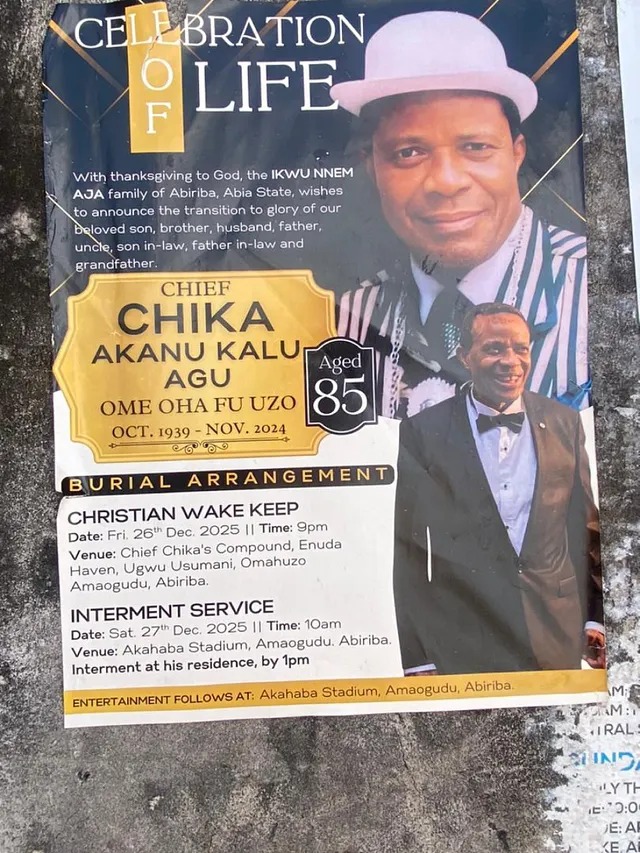
6.
The sterile silence of the hotel room had become an echo chamber for the reverberations of the past weeks. The physical escape from Abiriba had granted a perilous clarity. The analysis of the posters, the deconstruction of the industrial schedule – these were intellectual exercises, maps of a diseased landscape. But now, the emotional terrain of that landscape was rising up to meet me. The scrolling through the gallery of vinyl faces was no longer an anthropological survey; it felt like a procession of ghosts, each one whispering a question about the quality of the silence they had left behind. My earlier question – How did this carnival begin? – had led me to the machinery. Now, a deeper, more disquieting query emerged, one about the soul of the machine’s operators. When remembrance becomes shallow, loss loses its weight. The weightlessness of our current grief was the most terrifying symptom of all.
This sprawling forest of vinyl and flex banners is more than visual clutter. To dismiss it as mere visual pollution was to miss its profound semiotic function. It was a communal text, a collective subconscious projected onto PVC. It is a mirror, reflecting a terrifying evolution in our communal psychology. The banners weren’t just saying something; they were something. They were the visible manifestation of a profound internal shift – a move away from depth, contemplation, and the honest, ragged edges of human feeling, toward surface, performance, and the management of perception. The mirror showed not just what we thought of the dead, but what we had become in the face of their dying.
To understand the distortion in the mirror, I had to look at older, clearer glass. Long before the first banner was printed, societies across time and space understood that memory required discipline. This was a universal, human insight, not a nostalgic fantasy. Among ancient communities – Greek, Roman, Igbo, Hebrew, Egyptian – mourning was governed by restraint. It was framed by rituals that were, at their core, containers for an overwhelming and potentially destructive emotion. These were not celebrations of life, but carefully engineered channels for grief, designed to guide the living through the shock of loss without being consumed by it. Silence was structured. It wasn’t an absence, but a presence – a designated, sacred space within the ritual where the immensity of the loss could be felt, not shouted over. In many Igbo traditions, there were periods of communal quiet, days where normal activity ceased, not to host parties, but to stop and let the absence resonate.
Excess was discouraged. Lavish displays were often seen as vulgar, as a confusion of personal aggrandizement with genuine honor, or as an attempt to buy one’s way out of the humility that death imposed. Sumptuary laws in ancient Rome literally restricted funeral spending and display. In many pre-colonial African societies, while a great man was honored, the focus was on the rites of passage for his spirit and the consolidation of the lineage, not on a competitive social pageant for the living. In some traditions, even names were spoken sparingly after death, not to erase the departed, but to honor the gravity of their absence. To say the name was to invoke the presence, and that was a powerful, somber act, not to be done lightly or constantly. It reserved the memory for moments of true significance, preventing it from becoming cheapened by casual repetition. Memory was slow, deliberate, almost sacred. It was an act of interior labor, a careful curation of stories and impressions held in the heart and shared in intimate, appropriate settings. It had a weight, a specific gravity.
What we practice now is its inversion. We had systematically flipped this ancient understanding on its head. Where there was to be restraint, we practiced excess. Where silence was structured, we enforced noise. Where memory was slow and deliberate, we made it fast, public, and disposable. The funeral poster itself was the ultimate symbol of this: a mass-produced, brightly colored, quickly hung, and soon-faded object meant to announce a loss that, by its very nature, demanded slowness and depth. We had replaced the sacred discipline of memory with the profane logistics of publicity.
This inversion wasn’t random. It was, I began to see, a symptom of a deeper, collective trauma. The phenomenon before me speaks of a people numbed by the frequency of loss – loss that is often premature, often preventable, and often rooted in systemic neglect. Death in our context was not always the serene closing of a long, full life. Too often, it was the violent, abrupt, or degrading conclusion to a struggle against failing systems. Roads kill. The very journey home was a gauntlet, and many didn’t survive it. Hospitals fail. The stories of misdiagnosis, absent drugs, and “cash-and-carry” treatment were the grim folklore of our age. Poverty lingers. The stress, the poor nutrition, the lack of access to basic care – these were silent, chronic killers. We were a community bombarded by loss, much of it senseless and infused with injustice.
Yet instead of confronting these structural violences, we have erected a multi‑million‑naira distraction industry to soften the blow. The carnival wasn’t just a tradition; it was a coping mechanism, a collective anesthetic. We couldn’t fix the roads, reform the hospitals, or eradicate poverty overnight. The rage and helplessness those failures induced were too much to bear. So we built an alternative reality where we could exercise control: the reality of the funeral. The brighter the banner, the less visible the failure behind it. The dazzling gold foil was a distraction, a glittering curtain drawn over the grim backstage of a preventable death. The louder the music, the quieter the questions. The pounding bass from the giant speakers served a psychic function: to drown out the silent, screaming “Why?” that hung in the air. It muted the questions about why a simple appendix operation became fatal, why a diabetic couldn’t access insulin, why a promising youth died in a pothole-induced accident.
These defiant colors – electric blues, aggressive golds, imperial purples – are not aesthetic choices. The village graphic designer scrolling through color palettes wasn’t just picking what looked nice. He was, unconsciously, deploying a psychological arsenal. They are psychological defenses. They were shields. The electric blue was a jolt of artificial vitality against the pallor of death. The aggressive gold was an assertion of value and permanence against the terrifying transience of life. The imperial purple was a claim to dignity and sovereignty in the face of an undignified, system-induced end. They are attempts to paint over the gray reality of clinics without drugs, doctors without tools, and families without options. The vibrant vinyl was literal and figurative paint, a thick, glossy coat applied over the crumbling, grey concrete of a failed public health system. Each banner screaming “ICON” is a silent concession that something else went terribly wrong long before the funeral date was printed. To proclaim someone an “icon” in massive type was to desperately compensate for a narrative that felt stolen, for a life that might have been cut short not by fate, but by systemic failure. It was a posthumous promotion to legendary status, granted perhaps because the ordinary, decent life they should have been allowed to live was denied them.
The historical comparison became unavoidable, and the contrast was damning. I find myself thinking of ancient Rome, where funeral processions were somber affairs, tightly regulated. The pompa funebris had its pomp, but it was deeply ritualistic, focused on ancestral masks (imagines) and the validation of lineage, not on crowd size or entertainment value. Excessive display was often restricted by law, precisely because grief, when turned into spectacle, risked corrupting civic life. The Romans, in their pragmatic wisdom, understood that unbridled competitive mourning could distort social priorities, create crippling debts, and turn a sacred private passage into a vulgar public contest. The state intervened to keep the focus on the res publica, the public good. The dead were honored not by noise, but by measured remembrance.
Contrast that with what we have normalized: grief performed at stadium volume, sorrow replaced with choreography. Our processions were not measured; they were cacophonous convoys with hired DJ trucks. Our remembrance was not quiet storytelling; it was a choreographed sequence of speeches, song ministrations, and dramatic readings from a printed program. This is not evolution. It is erosion. We hadn’t advanced to a more sophisticated form of mourning; we had eroded the foundational soil of restraint and interiority, and what grew in its place was a brittle, showy weed.
The consequences of this erosion were being written on the hearts of the next generation. We are raising a generation for whom death will not register as a profound, personal rupture to be felt internally, but as an event management challenge to be executed efficiently. Children who grew up navigating this carnival were learning its implicit curriculum. They saw their parents and elders not weeping in quiet corners, but arguing over canopy sizes, coordinating aso-ebi, and troubleshooting generator failures. Children now learn, by observation, that the highest virtue in loss is flawless production. The lesson was: don’t feel it, manage it. The metric of love and respect was not the depth of your sorrow, but the smoothness of the program. Tears are awkward. To break down was to risk disrupting the schedule, to become a problem to be managed rather than a mourner to be comforted. Silence is suspicious. A quiet moment was a vacuum to be filled immediately with music or speech, lest it become uncomfortable, lest it allow the real feeling to surface. Emotional collapse is an embarrassment. It was a failure of the “strong face” that the spectacle demanded of its principal actors, the bereaved family.
This is how empathy dies – not dramatically, but administratively. Empathy, the capacity to feel with another, requires space, attunement, and vulnerability. Our funeral industrial complex killed it with paperwork, schedules, and logistics. There was no administrative slot for “empathy.” The time was allocated to “receiving guests,” “serving food,” and “thanksgiving speech.”
What replaces it is a hardened, hungry apathy, masked as resilience. We called it “strength.” We praised the widow who didn’t cry, the children who gave eloquent speeches without breaking down. We said, “They are strong.” But what we were often witnessing was not strength, but a kind of emotional anesthesia, a necessary detachment to survive the overwhelming administrative and performative demands of the event. We tell ourselves we are strong because we no longer cry, but strength without feeling is just numbness wearing good clothes. It was a suit of armor polished to a shine for the public, hiding the hollow, trembling figure within. This hardened apathy was “hungry” because it constantly needed new stimuli, new spectacles, new distractions to confirm its own existence, to prove that feeling wasn’t necessary.
We are moving away from remembering and toward merely referencing. This was the crucial, devastating shift in our cognitive and emotional architecture. The difference is subtle but devastating. Remembering requires time, stillness, and emotional risk. To remember someone is to reactivate the neural pathways where they lived in your mind. It is to sit with the ghost of their presence, to feel the pang of their absence, to recall the sensory details – the smell of their pomade, the texture of their handshake. It’s a vulnerable, time-consuming, internal act. Referencing requires only an object. The banner, the title, the slogan “A Life of Impact” – these were reference points. They were shortcuts. You didn’t need to do the internal labor of remembering Uncle Chike; you could just point to the banner and say, “He was a great man,” and the social transaction was complete.
We no longer sit in quiet corners recalling the specific cadence of a laugh, the rhythm of a person’s annoyance, the warmth or irritation they brought into a room. Those nuanced, subjective memories were the stuff of true remembrance. They were what made a person real, three-dimensional. We no longer argue lovingly about who they really were. The post-funeral debates – “Was he really that generous?” “Remember how she could hold a grudge?” “But my God, he made us laugh!” – these were the acts of keeping someone alive in memory, of wrestling with their complex humanity. Instead, we gesture toward a banner, read a title, and accept “Icon” as the total sum of a life. The banner ended the argument. It provided the official, sanctioned, simplified summary. Complexity is flattened. Contradiction is erased. The difficult but real person was compressed into a two-dimensional, morally consistent logo. When everyone is glorious, no one is. If every exit is “glorious,” every life an “iconic journey,” then the words lose all meaning. They become noise, the inflationary currency of a broken economy of praise. When every exit is painless, we lose the vocabulary to mourn the truly tragic. If we must call a death from agonizing, protracted cancer a “glorious exit,” what words are left for the child hit by a stray bullet? We have sanitized our language to the point of impotence.
Ancient storytellers understood that memory lived in narrative, not in slogans. The griots, the elders, the chroniclers – they knew a person was not a list of attributes but a story, with a beginning, middle, end, conflicts, resolutions, and moral ambiguities. The dead were remembered through stories that preserved their flaws as faithfully as their virtues. The stories of Odysseus’s cunning included his pride and cruelty. The tales of ancestral heroes included their moments of doubt and failure. This wasn’t disrespect; it was fidelity to truth, which is the only solid foundation for lasting memory. Today, flaws are considered disrespectful. To mention that the revered “Pillar” had a terrible temper or made a bad business decision was seen as undermining the memorial. Truth is considered dangerous. The messy, inconvenient truth of a life was a threat to the clean, marketable narrative of the funeral brand. We have confused honesty with dishonor, and in doing so, we have hollowed out remembrance itself. We had chosen a beautiful, empty shell over a flawed, living, truthful memory.
Then came the most perverse economic irony, the concrete proof of our inverted priorities. The most perverse irony lies in how we misdirect our resources. This wasn’t just philosophical; it was brutally material. We spend more on the “Exit” than we ever did on the “Stay.” The capital flowed not toward sustaining life, but toward managing and spectacularizing death. This is no metaphor. It is arithmetic. You could put numbers to it. Families who could not afford sustained medical care somehow mobilize astonishing sums for burial rites. The same relatives who contributed small, reluctant amounts for hospital bills would dig deep, take loans, or sell assets to fund a funeral that met the community’s extravagant standards. Communities that could not fund a functioning clinic suddenly produce cows, generators, uniforms, and endless food. The social machinery for fundraising and resource mobilization, so sluggish when it came to public health, went into hyper-drive for a funeral. We collectively save for slaughter at funerals rather than for medication that might have prolonged life. The cow destined for the funeral feast was a more secure investment than the nebulous, uncertain project of keeping someone alive in a broken system.
I have seen it too often to dismiss it as coincidence. My memory supplied the evidence. A man dies after struggling to afford treatment for kidney failure, yet his funeral features multiple cows, imported drinks, and professional sound systems. The dichotomy was obscene. A woman passes after years of battling diabetes and hypertension with intermittent, unaffordable care, yet her burial budget could have funded a decade of her medication and regular check-ups. The math screamed of a profound cognitive and moral disconnect. This is not culture; it is misaligned priority calcified into tradition. We had taken a tragic economic trap – where investing in prevention is hard and unglamorous, while performing remedial spectacle is socially rewarded – and we had sanctified it, calling it “our way.” It was a tradition of despair, not of life.
In ancient societies, offerings to the dead were modest precisely because life was considered more valuable than display. Libations were poured, simple gifts interred, but the wealth of the community was oriented toward the living – toward harvest, defense, and progeny. Today, we reverse that logic. We acted as if the final party was more important than the preceding life. We invest millions in the theatre of the casket – flex banners, uniformed crowds, coordinated colors, loud generators – while the local clinic remains under‑equipped and silent. The generators roared for three days; the clinic’s refrigerator for vaccines was silent for three years. The living suffer quietly so that the dead can exit loudly. It was a brutal social contract: endure privation, poor healthcare, and systemic neglect in silence, but be assured that when you finally break under the strain, we will give you a send-off so loud it will briefly make everyone forget the quiet suffering that brought you here.
These posters, I now see, are the ultimate artifact of this inversion. Lying in the dark, this final piece of the puzzle clicked into place with a cold, definitive sound. They are final marketing campaigns, launched when it is already too late. All marketing seeks to shape perception, to create a desirable image. That’s what these were: desperate, last-minute PR campaigns for a life whose narrative might have felt, in its raw truth, inadequate or tragic. They are funded by money that, had it been applied earlier and with a different intention, might have rendered the campaign unnecessary. The money for the 1000 banners, the high-resolution photo edit, the metallic ink – that was the “retainer” for the crisis PR firm hired after the reputational damage of a “painful exit” had already occurred. Each banner stands as both tribute and indictment – celebrating a life while silently testifying to the systems that failed it. It was a monument built with the rubble of the very institutions that should have sustained the person it commemorates.
And so I ask, more urgently now: what is really happening to us? The question was no longer intellectual; it was existential, screamed into the void of the hotel room. When did we decide that appearance could substitute for care, that spectacle could replace memory, that noise could stand in for love? At what collective crossroads did we take the wrong path, convincing ourselves that the brilliant, flashing neon sign was more important than the dark, solid building it was attached to? We had developed a societal addiction to the surface, to the quick, visible fix, to the emotional sugar rush of a big event, while the slow, hard, nourishing work of care and true remembrance withered.
If we continue down this path, we will not just forget our dead. That was already happening. They were becoming icons, brands, slogans – easily referenced, poorly remembered. We will forget how to feel for the living. This was the ultimate, chilling prophecy. The hardening of the heart, trained through the administrative management of death, would not stay compartmentalized. It would seep into all our interactions. If we could not muster real, vulnerable empathy for the bereaved at a funeral, how could we feel it for the struggling neighbor, the frustrated youth, the lonely elder? The industrial funeral was a training ground for emotional incompetence. It was teaching us to manage, to perform, to transact, but not to feel. And a people who forget how to feel for the living are a people already entering a kind of social and spiritual death, long before their individual hearts stop beating. The carnival was not just exhausting us; it was annihilating, piece by piece, our capacity for the very humanity it pretended to celebrate.
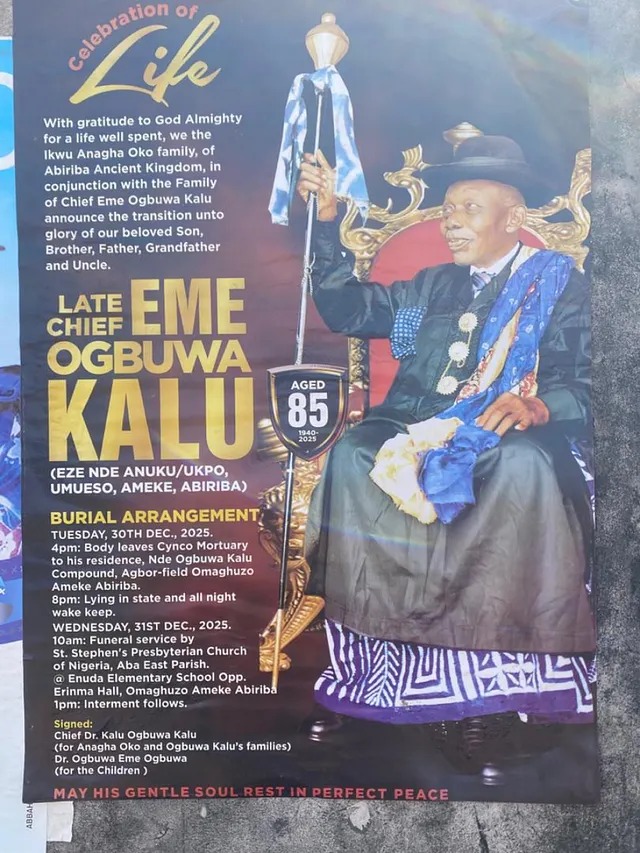
7.
The square was a sea of retreating light, a slow dissolve from the harsh, bleaching white of midday into the bruised, tender gold of late afternoon. I found myself not at its bustling heart where voices clashed and music thrummed, but on its periphery, where the shadows of the ancient ukwa trees stretched long and quiet fingers across the dusty ground. It was from this margin, this place of witness rather than participation, that I began the real work of listening.
I began listening to the conversations around me – first casually, then with the sharpened attention of someone realizing that something sacred had quietly slipped out the back door. At first, it was just the sonic wallpaper of homecoming: greetings, laughter, fragmented updates. But as the days bled into nights and the scheduled events piled up, my ear began to detect a different frequency beneath the cheerful noise. It was the frequency of absence, of a profound vacancy dressed in the glittering costume of presence. I was tuning in not to what was being said, but to what was being desperately shouted over. The sacred – the quiet, reverent space for honoring a life concluded – hadn’t been attacked; it had simply been deemed inconvenient and had excused itself, slipping away unnoticed in the commotion.
This was nowhere more evident than in the transformation of the ritual meant to guard that very sanctity. The wakekeeps had long since mutated into open‑air discos, their original purpose now a faint rumor. The word “wakekeep” itself felt like a fossil, a linguistic shell holding a creature that had evolved into something unrecognizable. The concept of keeping vigil, of maintaining a watchful, prayerful presence through the liminal hours between death and burial, had been hollowed out. What remained was the skeletal structure of a party – sound, light, crowd, consumption – grafted onto a grave. Christian music appeared briefly, almost apologetically, like a shy guest fulfilling a contractual obligation. There was always a designated, awkward slot. A hired choir or a zealous family friend would mount the stage, microphones feeding back, and lead a handful of hymns. “Abide With Me,” “It Is Well With My Soul.” The songs would rise, thin and valiant, into the thick night air, solemn and restrained, before being violently evicted by afrobeats, hip‑hop, highlife remixes, and hard‑core tracks that celebrated excess with the enthusiasm of a carnival float. The transition wasn’t gradual; it was a coup. As the last “Amen” hung in the air, the DJ would drop the needle, metaphorically speaking, on a track whose bassline was a physical assault. The basslines were heavy, insistent, almost defiant. They didn’t accompany grief; they suppressed it. They vibrated in the chest cavity like a second, arrhythmic heart, pounding out a message that drowned all subtlety. The dead, it seemed, had been formally dismissed from their own vigil. The person being “waked” was no longer the focus; they were the pretext. The gathering had declared its independence from the gravity of death and embarked on its own mission of sensory saturation.
And the people, my people, complied with a disturbing fervor. People danced with a fervor that bordered on amnesia, their bodies moving as though the occasion had no gravity beyond the present moment. On dance floors of packed earth under billowing canopies, they threw themselves into the music with an energy that felt unhinged from context. It wasn’t the cathartic dance of a community sharing sorrow through rhythm; it was the escapist dance of a crowd determined to feel only the beat, only the now. I watched and wondered when mourning became such an inconvenience. When did we collectively decide that the raw, awkward, time-consuming process of grief was an impediment to the social calendar? That it was better, cleaner, more efficient to skip the feeling and proceed directly to the festival?
This imperative to bypass mourning manifested most visibly in the arena of competitive appearance. Women competed fiercely – not in grief, but in spectacle – outdoing one another in hairstyles that defied physics, heels that threatened ligaments, and sequins that caught the light with aggressive ambition. The wakekeep became a runway. Elaborate braids woven with golden thread ascended like architectural marvels. Shoes with needle-thin heels sank into the soft earth, posing a genuine hazard with every step. Dresses, tight and gleaming with sequins or shitagi lace, transformed their wearers into human disco balls, reflecting the strobe lights in a thousand defiant sparkles. Each outfit felt like a declaration, not of loss, but of arrival. It announced: “I am here. Look at me. I have resources, taste, and the vitality to stand in these shoes until dawn.” The dead were absent; the living were on display.
Men, on their part, spilled testosterone into the night, loud and performative, circling tables with the restless energy of those seeking validation. Their mourning took the form of boisterous camaraderie. Clusters of them, shiny with sweat and expensive perfume, held court around coolers of drinks, their voices booming over the music. They baited one another with jokes sharpened into weapons, angling for attention from women and affirmation from wine bottles. The laughter was too loud, the back-slaps too forceful. It was a performance of masculine solidity, a wall of noise and bonhomie erected against the unsettling quiet of mortality. Absurdity, I thought, has never been so warmly embraced. We were not just tolerating the bizarre mismatch of club music and coffin; we were celebrating it, leaning into the absurdity until it became the new normal.
This reached a surreal zenith at the wakes of certain figures. At the wakes of Chiefs Akanu – of the Chika brothers fame and Chief Ifegwu Chukwu, Continental – this transformation reached its most theatrical form. These men belonged to a fading archetype: the patriarch of substance, not just show. Their wealth was older, quieter, rooted in land, enterprise, and a reputation for measured authority. They were men whispered about as among the last of the old‑moneyed generation, men who embodied restraint, hierarchy, and a certain quiet authority. One would have expected their final rites to mirror this – dignified, solemn, heavy with the weight of genuine legacy.
Yet their wakes had become the loudest carnivals of excess. The contradiction was staggering. It was as if the community, unmoored from the anchoring presence of such figures, responded not with dignified homage but with a kind of hysterical, compensatory noise. The subtle power they represented was gone, so we replaced it with the only kind of power we now understood how to wield: the power of volume and expenditure. It felt ironic, almost disrespectful, but no one seemed troubled by the contradiction. The cognitive dissonance was suspended in the alcohol-heavy air. The volume kept rising, as if noise itself were a defense mechanism against reflection – a sonic shield against the discomfort of remembering. To truly remember these men, to contemplate the end of an era they represented, would be to face uncomfortable questions about what had filled the vacuum they left. Better to turn up the music.
Amidst this sonic shield, the conversations I tuned into revealed a perverse pride. I listened as conversations turned proudly toward expenditure. The talk wasn’t of the deceased’s wisdom or kindness, but of the production values of his send-off. People spoke not of the departed but of how money flowed like a liberated river – booze stacked endlessly, food arriving in waves, cows and goats consumed in numbers that sounded mythic. The metrics were all tangible, consumable, wasteable. “They killed five cows.” “The beer never finished.” “See the mountain of rice we ate!” It was a recitation of logistical triumph. Plates were filled, abandoned, refilled again. I watched people take heaping portions, eat a few bites, and leave the rest to congeal in the humid air, only to return later for a fresh plate. People were visibly full, even tired of eating, yet delighted to order more simply to watch it sit untouched. Satiation was not the goal; the spectacle of surplus was. Waste became entertainment, proof that abundance had been achieved. The ability to generate and then disregard food was a potent, non-verbal declaration of wealth. It was a theatre of gluttony, performed with the confidence of those who believe that excess is a virtue. In a land where scarcity is a recent, haunting memory, deliberate waste is the ultimate flex, a way of shouting to the ghosts of hunger that we have finally, definitively, won.
And just outside the glow of this theater, the old world lingered, a silent judge. And just beyond the gates, almost within arm’s reach yet psychologically invisible, lingered the other Abiriba. Outside the compound walls, in the pooled darkness between the generator-powered lights, shapes moved. Urchins hovered quietly, eyes trained on discarded plates and half‑finished bottles. Children from the surrounding lanes, faces pinched with a hunger that was both physical and existential, waited. They were not begging; that would intrude on the narrative. They were scavenging, a part of the ecosystem of waste. Hungry faces waited patiently, not for generosity, but for neglect – for the moment when excess might spill over into mercy. Their feast was contingent on our carelessness. They were not part of the event, not part of the narrative. They were the living, breathing evidence of the inequality the carnival was designed to ignore. Their presence was an inconvenient footnote, one that the music successfully drowned out. The bassline was, among other things, a very effective social noise-cancellation device.
Inside the compound, the drama was one of hierarchy, even in chaos. Loud arguments erupted over seating arrangements. In the scramble for plastic chairs under the prime sections of the canopy, dignity was often the first casualty. Everyone wanted to sit in front, as if proximity to the high table conferred meaning, as if chairs themselves were ranking systems. A chair wasn’t just a place to rest; it was a social coordinate, a public declaration of your relationship to the central drama. Voices rose, insults sharpened. I saw two uncles, their faces flushed with drink and indignation, chests puffed out. I watched two men scream at each other with startling intensity. One demanded to know whether the other could “match” him – match him in money, in influence, in anything at all. The word hung in the air, toxic and potent. The word match hung in the air, ambiguous yet perfectly understood. It was a challenge to a duel fought with wallets and connections, not swords. It reduced human worth to a single, vulgar metric: spending power. Here, worth is measured in sprayable currency, in how much new money you can display or waste in public. It wasn’t about what you had built or stewarded, but what you could liquefy and spray into the atmosphere of the moment. It was both a show and a shame, inseparable twins feeding off each other. The spectacle was glorious; the underlying hunger for validation that drove it was pitiable. We were publicly showcasing our private shames.
The morning after brought not remorse, but a curious, hungover pride. The morning after, the farce completed its circle. The sun would rise on a compound littered with bottles, bones, and trampled posters. And into this scene of depletion would walk people still buzzing with the previous night’s energy. A friend came calling early, animated, almost offended that I had not been visible at what he called “the event of the year.” His eyes were bloodshot, his breath sour, but his spirit was triumphant. He recounted the night with swelling pride: the variety of drinks, the endless food, the high and mighty he had mingled with, how he ate and drank to capacity. His narrative was a highlight reel of consumption and proximity. His chest puffed as he spoke, as though he had survived a heroic trial. And in a way, he had. He had endured the marathon of excess and lived to boast about it. I considered telling him that I had been there, that I had seen it all from a quieter corner, but I chose silence. Let him keep his triumph. My presence as a witness, not a participant, would have undermined his story. He needed to believe in the uniform euphoria.
But biology, ever the realist, soon intruded. As he talked, I wondered privately whether, after such indulgence, he could simply hibernate – sleep it off like a Siberian bear until next season. Could one metabolize that much socially-mandated excess? The answer came quickly. But before the thought fully settled, he interrupted himself to ask if there was anything to eat. Morning hunger had arrived right on schedule. The feast of the night before, for all its legendary scale, had left no lasting nourishment. It was empty calories for the soul. Excess, I realized, does not nourish. It only postpones emptiness. The binge was always followed by the pang. The louder the party, the quieter and more profound the hollow that followed.
This realization, arriving in the mundane request for breakfast, crystallized everything. And in that small, almost comic moment, the truth clarified itself. The absurd was not an aberration; it was the operating system. Absurdity is no longer a visitor in Abiriba. It has taken up residence. It wasn’t passing through; it had unpacked its bags, settled into our best chairs, and was giving orders. It sits comfortably at our tables, dances at our wakes, speaks through our arguments, and laughs softly while we confuse noise for joy and waste for success. We had welcomed it in, mistaken its gaudy finery for sophistication, and now it governed us, all while chuckling at the earnestness with which we played its game.
Leaving the square that evening, the physical act was simple, but the psychic disentanglement was not. I leave Agboji Square slowly, not because the road resists me, but because my mind does. My feet could carry me away, but my thoughts were stuck in the glue of what I’d witnessed. The square recedes behind me, yet it keeps speaking – through echoes, through remembered noise, through questions that refuse resolution. The laughter, the arguments, the basslines, the clatter of plates – they formed a chorus of confusion that followed me down the red-earth road. I am no longer simply observing a cultural moment; I am wrestling with a personal reckoning. This wasn’t academic anymore. My own complicity, my own fatigue, my own love for this place that was breaking my heart, all of it was in the ring. What I have witnessed has followed me inward, lodging itself in the uncomfortable space where memory, identity, and responsibility collide.
It was no longer “out there” in the square; it was in the very core of how I understood myself as a son of this soil. I am searching not for outrage anymore, but for clarity. Outrage was easy, a flare that burned bright and short. Clarity was a slower, colder light, and it required looking at things I would rather turn away from. And clarity, I am discovering, is far more demanding than anger. It demanded that I hold the love and the critique in the same hand, that I see the vibrant, resilient community and the self-consuming carnival as two faces of the same, beautiful, troubled entity. The walk home was long, and the loudest voice was the one now speaking quietly, insistently, within my own head.
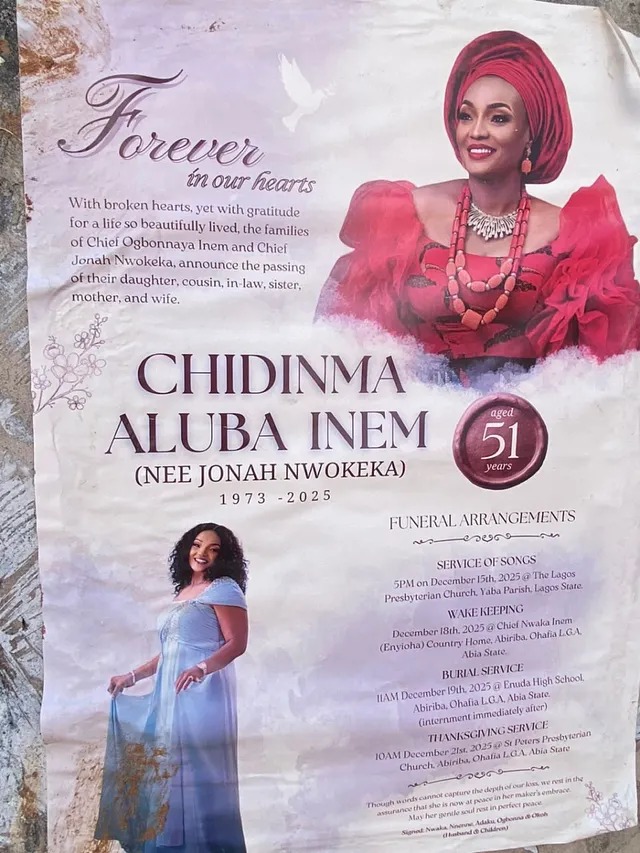
8.
My footsteps have long since carried me from the clamor of Agboji Square, the dissonant symphony of that space fading first to a murmur, then to a persistent, whispering hum in the bones of my memory. I find myself now on a different kind of margin, a geographical and psychic precipice. I am standing at the edge of the old footpath that winds down behind my father’s compound, a slender, red-earth trail nearly swallowed by elephant grass and memory. It leads to the valley where the stream still runs, less forceful now, but singing its same ancient, patient song over moss-slick stones. Here, the air is not charged with generator fumes or the cloying sweetness of spilled beer, but with the damp, fecund scent of leaf mold and distant rain. The silence is not an absence, but a presence – a thick, listening quiet broken only by the water’s whisper and the rustle of a lizard in the dry leaves. It is in this quiet, far from the plastic chairs and fluttering vinyl, that the true shape of my inquiry finally clarifies itself, rising from the sediment of observed detail into the colder, clearer air of understanding.
What I have been writing is not social commentary, and it is not cultural lament. To frame it as such would be to remain on the surface, to tinker with symptoms while ignoring the disease raging in the marrow. A social commentator points at external phenomena – the banners, the noise, the waste – and pronounces them decadent or vibrant. A lament mourns a lost past, a wistful nostalgia for a simpler, quieter time. My project, I now see with a clarity that feels almost surgical, is neither. It is a diagnostic text. I am attempting to read the vital signs not of a social body, but of a collective psyche. I am listening for the heartbeat beneath the carnival’s bassline, taking the temperature of a fever that manifests in spectacle. Beneath the descriptions of banners, wakekeeps, sound systems, and exhaustion runs a philosophical excavation – a descent into the understructures of being, meaning, and psychic survival. I have been cataloging the artifacts – the vinyl icons, the schedules of sleeplessness, the choreography of consumption – but only as an archaeologist brushes away dust to reveal the foundational stones of a temple, or a tomb. The real inquiry is into the beliefs that built it, the fears it was meant to appease, the vision of the human soul it enshrines and entombs.
What appears, on the surface, as a critique of funerary excess is in fact an autopsy of the inner life of a people caught between history, trauma, and the terror of modern dissolution. The excess is merely the most visible lesion. The autopsy must cut deeper, into the organs of memory and identity, into the circulatory system of communal anxiety, into the nervous system shocked by successive waves of historical rupture. We are a people suspended – between a deeply integrated, ancestor-venerating past and a fragmenting, hyper-individualistic present; between the trauma of a war that sought to erase us and a modernity that often feels like a more subtle, economic form of dissolution; between the terror of vanishing without a trace and the terror of being seen only for the trace we can afford to leave. To understand what is truly happening in Abiriba – and by extension across much of Igboland – I must move beneath sociology into psychology, and beneath psychology into myth. Sociology gives me the grid of roles and rituals. Psychology offers the language of defense mechanisms and repressed anxiety. But it is only in the realm of myth – the deep, narrative structures that shape a people’s understanding of life, death, and destiny – that the full, tragic grandeur of our adaptation can be comprehended. We are not just following a social script; we are living out a myth of survival, a myth so desperate and brilliantly constructed it has begun to consume the very souls it was designed to protect.
This is the terrain where Carl Jung becomes unavoidable. His maps of the collective unconscious, of the persona and the shadow, of enantiodromia and the painful journey toward individuation, are not abstract European theories here. They are precise, unsettlingly accurate diagnostic tools for the spiritual condition I witness. In this quiet by the stream, Jung ceases to be a distant thinker and becomes a fellow traveler in the dark wood of our collective soul.
Let us begin with the most obvious artifact, the one that first arrested my gaze in that Umuahia hotel room and now floats before my mind’s eye against a backdrop of forest green. Jung’s concept of the persona – the social mask worn to negotiate acceptance – sits at the center of this inquiry. For Jung, the persona is necessary. It is the “mask” we present to the world, the compromise between our unique inner selves and the demands of society. It allows us to function, to belong. But it becomes pathological when we mistake the mask for the face, when we inflate it to such proportions that it suffocates the true self beneath. These posters are not memorials; they are posthumous personas. They are not attempts to capture the essence of a finished life; they are the final, most elaborate mask commissioned for the deceased, tailored to meet not their own needs, but the social expectations of the living. They are the ultimate act of persona curation. They are masks applied after the fact, smoothing contradictions, erasing ambivalence, and presenting a socially acceptable version of a life. The irascible uncle is masked as the Gentle Soul. The shrewd, sometimes ruthless businesswoman is masked as the Benevolent Matriarch. The anxious, striving academic is masked as the Serene Sage. Every rough edge sanded down, every shadowed corner flooded with digital light. In Jung’s language, this is not remembrance but inflation: the persona swollen until it devours the entire self. The complex, contradictory totality of a human being is compressed into a single, gleaming, socially legible brand: CHIEF. DR. ICON. The psychic crime here is not the creation of a persona – that is inevitable – but the systematic, communal decision to accept the inflated, posthumous persona as the definitive truth, allowing it to completely erase the richer, messier, more authentic self that lived and breathed.
This leads to the eerie, homogenizing effect I observed. What strikes me most in Abiriba’s banners is their uniformity. The same color palettes (royal blue, imperial purple, gold), the same fonts (bold, embossed, commanding), the same stock poses (the regal gaze, the managerial serenity), the same laundry lists of titles. Distinct lives are rendered interchangeable. A teacher, a farmer, a civil servant, a trader – all are funneled through the same graphic design template and emerge looking like variations on a theme of achieved majesty. This signals a psychic shift from individuality to legibility. The community’s unconscious priority has shifted. It is no longer interested in the difficult, time-consuming work of understanding the unique melody of a single life. It demands a quick, easy-to-read score. The community no longer asks, “Who was this person?” but “How should a person appear when they die?” The question is not one of discovery, but of application. There is a template for a “good death,” visually and ceremonially, and the goal is to fit the departed into it as seamlessly as possible. The persona survives; the soul recedes. What is remembered and celebrated is the mask, not the face that wore it. Jung warned that when persona dominates, authenticity collapses, and psychic vitality drains away. A culture obsessed with perfecting the posthumous mask is a culture increasingly alienated from the raw, vital, often inconvenient truth of living authenticity. What I am witnessing is a culture increasingly unable to tolerate the messy truth of human particularity. The flawed, peculiar, glorious uniqueness of a person is now seen as a problem to be solved by graphic design, a stumbling block to a clean, socially affirming narrative.
But what of all that messy truth? Where does it go? Jung provides the chilling answer. Jung insisted that what is denied consciousness does not vanish; it sinks into the shadow. The shadow is the repository for all the aspects of ourselves – and our collective experience – that we find unacceptable, painful, or terrifying: our rage, our pettiness, our fears, our traumas. We disown them, push them down into the darkness of the unconscious, but they do not die. They gather power in the dark. In Abiriba, death itself has become shadow material – not acknowledged as rupture, terror, or injustice, but disguised as celebration. The raw, terrifying reality of mortality – its finality, its indifference, its frequent alliance with suffering and systemic failure – is too much for the collective psyche to bear consciously. So we have performed a spectacular act of psychic alchemy. We have taken the shadow content of death – the grief, the anger, the fear of oblivion, the guilt of neglect – and through a sustained, communal ritual, transmuted it into its apparent opposite: celebration, noise, abundance, glory. The noise, the color, the food, the choreography – these are not expressions of joy. They are defensive structures erected against psychic collapse. They are a mighty dam wall, holding back a rising tide of unconscious anguish. The louder the party, the more successfully we shout down the whispering voice of the shadow.
Consider the source of so much of this shadow. Premature death, systemic neglect, medical failure – these are intolerable truths. They speak of a world out of joint, of promises broken by the state, of vulnerability in the face of chaotic forces. To look directly at them is to confront helplessness and rage. Rather than confront them, the community sublimates them into spectacle. We cannot fix the failed hospital, so we build a magnificent funeral. We cannot undo the pain of a long illness, so we drown its memory in a weekend of feasting. The psychic energy that should fuel civic outrage or profound sorrow is instead diverted into the logistical and financial engine of the carnival. Jung would call this shadow displacement. The anxiety and anger that rightly belong to the failures of the living world are displaced onto, and worked out through, the ritual management of the dead. The more death proliferates without meaning, the louder the rituals become. Each senseless loss adds another log to the pyre of compensatory spectacle. The banner shouts precisely because the soul underneath is afraid to speak. The gilded, shrieking typography is a desperate attempt to proclaim value and meaning in the face of an event that often feels devastatingly arbitrary and meaningless.
This explains the cultural allergy to silence I noted. This is why silence feels dangerous. Silence would allow the shadow to surface. In the absence of the relentless sonic barrage, in a pause between speeches, the repressed material might begin to seep up. The unasked questions – “Why did she die so young?” “Why couldn’t we save him?” “What does this all mean?” – might begin to form in people’s minds. Silence would force confrontation with grief that has no solution, with anger that has no outlet, with guilt that has no ritual absolution. Our rituals, in their current form, offer no container for these raw feelings. They offer only distraction from them. Noise is not cultural vitality here; it is psychic anesthesia. It is the constant, administered drip of sound that keeps the collective patient sedated, preventing the pain of the shadow from breaking through into conscious awareness.
Jung held a specific view of healthy ritual. In Jung’s view, authentic ritual facilitates transformation – a psychic passage from one state of being to another. True rites of passage – initiations, marriages, funerals – are meant to alter the participants. They dissolve old identities and help forge new ones. They make the invisible visible, integrate unconscious material, and provide a symbolic container for navigating life’s great transitions. What I describe, however, is ritual emptied of initiatory power. Our funeral schedule does not transform. It reiterates. The funeral no longer changes anyone. It does not deepen the community’s wisdom about mortality. It does not clarify the values of the living in the stark light of loss. It does not initiate the bereaved into a new, acknowledged state of grief from which they can eventually emerge changed. It does not deepen wisdom, clarify mortality, or reorder values. It simply repeats. The same steps, the same sounds, the same excesses, like a scratched record skipping through a song that has lost all meaning.
This is not a trivial detail. Jung warned that when rituals lose symbolic potency, societies enter periods of neurosis. The ritual becomes an empty shell, a compulsive repetition that fails to discharge psychic tension or facilitate growth. It becomes a symptom itself. The repeated funeral schedule – the wake, the convoy, the school field, the slaughter – is ritual as habit, not rite. It is performed not because it mediates a sacred mystery, but because “it is what is done.” The symbolism has hardened into literalism: the cow is not a sacrifice to the ancestors or a symbol of communal solidarity; it is a unit of social currency, proof of spending power. The canopy is not a sacred space set apart; it is a practical necessity for a large public event. Nothing is metabolized. Nothing is integrated. The grief, the fear, the anger – they are not processed and transformed through symbolic action. They are stirred up by the event and then left hanging, unresolved, to be stirred up again at the next event. Grief circulates but never resolves. It becomes a permanent, low-grade fever in the communal body. The psyche remains stuck. The individual and the community are caught in a loop, performing the motions of passage without ever actually moving.
My unease arises because I sense this stagnation. This is the source of the profound, soul-level exhaustion that transcends physical tiredness. The road is completed, yet no inward journey occurs. We travel the physical road home, we run the gauntlet of the social calendar, but no corresponding inner voyage takes place. We move from event to event without being moved in our essence. Movement without transformation produces exhaustion, not growth. We are like hamsters on a wheel, expending tremendous energy but arriving, breathless and depleted, exactly where we started, spiritually unchanged except more weary.
To comprehend the depth of this stasis, we must plunge further down, into the very bedrock of the communal psyche. At a deeper level, these practices reveal anxiety embedded in the collective unconscious. Jung proposed that beneath the personal unconscious lies a deeper layer, the collective unconscious, inhabited by archetypes – universal, primordial patterns of human experience. He also believed that cultures could develop shared psychic wounds, complexes born of historical trauma. Jung believed cultures carry inherited psychic patterns shaped by historical trauma. For the Igbo, this is not theory. It is lived inheritance. Igboland’s history – war, dispossession, migration, economic precarity – has seeded a fear not just of death, but of disappearance. The Biafran war was not just a military conflict; it was an existential threat, an attempt at political and cultural erasure. The subsequent decades of marginalization, the “kegite” struggles for belonging in a sometimes hostile federation, the necessity of migration as a survival strategy – all have etched a deep, often unspoken anxiety into the collective soul: the fear of vanishing, of being rendered irrelevant, of leaving no trace, of having one’s story swallowed by the larger, indifferent narratives of history or the anonymous metropolises of the diaspora.
The banner responds to this fear. It promises visibility. In the face of this archetypal dread of erasure, the funeral poster is a defiant, graphic rebuttal. It declares: This life mattered. I WAS HERE. It is a claim staked not just in the community, but against the void of historical oblivion. In a world where recognition is scarce and systems routinely fail, posthumous spectacle becomes compensation for existential invisibility. If the state will not see you in life, your people will make you un-ignorable in death. If the economic system reduces you to a statistic, your funeral will elevate you to an Icon. The psyche accepts delayed acknowledgment because immediate affirmation feels impossible. It is a tragic bargain: settle for being invisible, struggling, and uncelebrated while alive, but cling to the iron-clad promise of a magnificent, crowd-drawing, banner-proclaiming send-off that will etch your name, however briefly, into the communal memory. The funeral is the psychic wage paid for a lifetime of often-unseen striving.
This is why critique meets resistance. To question the banner feels, unconsciously, like threatening the last assurance of symbolic survival. To suggest scaling back the carnival is not heard as a call for emotional authenticity; it is heard, at a deep, frightened level, as a proposal to disarm in the face of the threat of oblivion. You are not just criticizing an expense; you are tampering with a vital, psychic defense mechanism against a profound, historical anxiety. The resistance is not mere stubbornness; it is a form of psychological self-preservation.
Yet, in the cruel logic of the psyche, the very defense meant to protect can become the agent of the disease it fears. Jung identified a principle that explains this perfectly. Jung’s principle of enantiodromia – the tendency of extremes to flip into their opposites – is essential here. Push anything too far, and it will inevitably transform into its opposite. The relentless pursuit of light creates a corresponding, powerful shadow. The obsessive avoidance of grief produces a culture incapable of authentic joy. Excessive celebration around death eventually produces emotional numbness. When every exit is a “grand celebration,” the capacity to discern true celebration atrophies. The heart, overstimulated by mandated festivity, grows dull. Hyper‑visibility produces forgetting. When every life is declared an “Icon,” the word loses all meaning, and true iconic lives are drowned in a sea of cheap superlatives. The very act of mass-producing significance renders significance impossible. Collective enjoyment, untethered from meaning, mutates into apathy. The performance of joy, when divorced from genuine feeling, becomes a hollow shell, leaving behind not satisfaction, but a weary, cynical emptiness.
What began as communal solidarity has crossed into performance. The genuine, organic coming together to share the burden of loss has been replaced by a scripted, evaluated social production. What once softened grief now prevents it. The rituals that were meant to be a container for sorrow have become a lid slammed down upon it, trapping it inside to fester. The culture has not become heartless; it has become over‑defended. The heart is armored, not absent. The love, the fear, the sorrow are all still there, but they are now encased in layers of steel-plated ritual, social expectation, and deafening noise, inaccessible even to those who feel them.
My writing presses against this armor. This is the source of its discomfort, its necessary friction. I am not attacking the heart; I am tapping on the armor, listening for the hollow sound, trying to find a seam, a vulnerability, a way for the authentic feeling within to breathe again.
At the most fundamental level, this entire journey – the physical one to Abiriba and the psychic one it has triggered – is about a central Jungian process. At its core, this travelogue is about individuation – Jung’s term for becoming a whole, integrated self. Individuation is the lifelong process of differentiating oneself from the collective, of confronting and integrating one’s shadow, of moving beyond the inflation of the persona to discover and live from the authentic Self. It is the journey toward psychological wholeness. Cultures, like individuals, can fail this task. A culture can remain stuck in a state of collective identification, where conformity is valued over authenticity, where the persona rules supreme, and where the shadow is projected onto outsiders or violently repressed within. When conformity overrides interior truth, individuation stalls. The society produces capable mask-wearers, excellent performers of social roles, but struggles to nurture truly integrated, self-aware individuals.
Abiriba’s funerary culture now rewards sameness over sincerity, display over depth. The greatest accolades go to the family that stages the most flawless, best-attended, most visually coherent spectacle. There is no reward – only social suspicion – for the family that chooses a quiet, simple ceremony to honor a quiet, simple life. The system incentivizes the inflation of the persona, not the revelation of the soul. In such an environment, the individual soul struggles to emerge. The pressure to conform, even in mourning, is immense. The psychic energy required to resist the template, to insist on a goodbye that reflects the unique contours of the life lived, is heroic. Most souls, in their grief and exhaustion, comply. The poster tells me who I am supposed to be, even in death. It provides the final, authoritative edit to your life’s story. The psyche complies, but something essential withers. The authentic memory of the person, with all its beautiful, painful specificity, withers under the glare of the generic, glorious icon.
My discomfort is the voice of individuation refusing erasure. The part of me that seeks wholeness, that values authenticity over conformity, that cannot accept the glossy lie for the complex truth, is in revolt. It is why I fled to Umuahia. It is why I stand by this stream now. It is the part that insists on seeing, on naming, on distinguishing the mask from the face, even when the collective insists they are one and the same.
So, what is the final diagnosis? What is happening in Abiriba is not moral decline or cultural corruption. To label it as such is to engage in shallow judgement. It is a profound, unconscious, and brilliantly adaptive psychic adaptation to sustained pressure – economic, historical, existential. The community, in its deep wisdom and its profound trauma, has crafted a magnificent, complex, and utterly exhausting machine for psychic survival. It is a machine designed to manage unmanageable anxiety, to assert visibility in the face of erasure, to create meaning where meaning has been stripped away by loss and neglect. The community is surviving, but survival has become indistinguishable from denial. The very mechanisms that keep the psychic boat afloat are also preventing it from sailing toward any new shore. They are keeping it bobbing in a stagnant sea of repetition. The funeral has absorbed unresolved fears about life itself. Our anxieties about being unseen, disrespected, poor, powerless, and ultimately forgotten in life are now projected onto, and desperately resolved through, the theater of death. We seek in the grandeur of the exit the dignity, recognition, and abundance that felt elusive in the living.
I am not standing outside this process. I am its conscious edge. I am not a detached observer from another world. I am a product of this same culture, bearing its same wounds and its same strengths. My consciousness is the leading edge of the culture’s own unconscious becoming aware of itself. The anxiety, the love, the exhaustion – they are in me too. My writing is not an external critique; it is the culture beginning to think about itself, to feel its own pain, to question its own adaptations.
Jung believed that when unconscious material presses toward awareness, it does so through symbols, art, and disturbing questions. The dreams of individuals, the myths of cultures, the unsettling art of an era – these are the ways the unconscious signals that something needs to be integrated. This writing functions in that way. It is not prescriptive; it is revelatory. It does not offer solutions; it restores perception. I am not here to prescribe a new funeral template. I am here to make visible the psychic dynamics of the current one, to hold up a mirror so we might see not just the glittering mask, but the strained, sorrowful, loving face beneath it.
By insisting on silence, by longing for stillness, by questioning celebration at the site of loss, I am not rejecting culture. I am calling it back to itself. I am pointing back toward the deep, silent pool from which all authentic ritual springs – the pool of genuine feeling, of shared vulnerability, of awe in the face of mystery. The carnival is a raging, magnificent river, but I am asking if we remember its source.
At its essence, this part of the travelogue says one thing:
A people who cannot mourn honestly will eventually lose the ability to live honestly. The repression required to turn every death into a celebration will bleed into life. We will begin to perform our joys, our relationships, our successes with the same hollow theatricality. We will confuse the banner for the life, the attendance for the connection, the noise for the feeling. The hardening of the heart around death will inevitably constrict its capacity for life.
The posters are not the problem. They are the symptom. They are the fever, not the infection. The real crisis is a soul exhausted by repetition, frightened of depth, and desperate to be seen. It is a collective soul that has built a palace of noise to avoid the emptiness of its own silent rooms, that has polished its masks to a blinding shine because it is afraid of what it might see in an unadorned face.
What I am doing – thinking, saying, writing – is the slow, dangerous work Jung called making the unconscious conscious. It is the work of bringing the shadow into the light, of questioning the tyranny of the persona, of listening to the whispers of the soul beneath the roar of the collective. It is dangerous because it unsettles, because it demands that we feel what we have expertly anesthetized, because it threatens the very defenses that have helped us survive. Without it, the culture will continue, louder and emptier. The banners will get bigger, the sound systems more powerful, the waste more spectacular, and the quiet, hollow space within each of us will grow in proportion. With it, there is at least the possibility of return. Not a return to a romanticized past, but a return to authenticity. A return to the capacity for real feeling. A return to rituals that transform rather than numb, that connect rather than perform.
The stream’s song is constant. It does not shout. It does not proclaim itself an Icon. It simply is, persistent and clear, carving its path through stone over millennia. It carries the memory of the hills in its coolness. I listen, and the final, simplest truth emerges, not as a shout, but as the whisper of water over rock:
Not to silence as absence —
but to silence as truth.
The silence we fear is not the silence of emptiness or neglect. It is the fertile, terrifying, necessary silence in which truth can finally be heard – the truth of a life ended, the truth of our love and our failure, the truth of our fear, the truth of our enduring, complicated, beautiful connection to each other and to this red earth. That is the silence we have filled with noise. And that is the silence to which, if we are to remain truly human, we must someday find the courage to return.
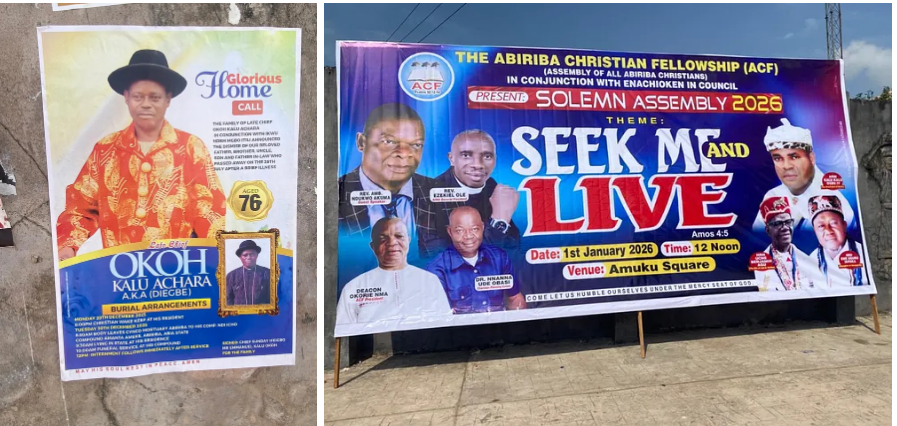
9.
The quiet after the storm is the most disquieting. It is not truly quiet, of course; the echoes of the last generator’s sputter still ring in the ears, a phantom vibration in the marrow. The air, thick for weeks with the perfume of roasting meat, spilled drink, and human sweat, now feels thin, almost brittle, as if the season has consumed all available oxygen. As I finally leave Agboji Square, my feet crunching over the detritus of celebration – a torn piece of a glossy banner depicting a smiling, unfamiliar face, a crushed plastic cup, the brittle skeleton of a fireworks stick – the question that has been a shadowy, half-formed companion throughout this entire odyssey finally steps into the harsh, revealing light of day. It crystallizes not as a whisper but as a cold, hard, and impossible to ignore stone in the gut. If the “Long Road to Abia” – that epic, generational saga of endurance, sacrifice, and longing – truly ends here, inside this synthetic forest of vinyl banners proclaiming lives no one truly lived in the manner depicted, amidst the skeletal remains of canopies that housed not grief but theatrical productions, then we have not arrived at a promised land. We have arrived at a spiritual dead-end. The asphalt, at long last, is smooth. The legendary potholes, those physical metaphors for state failure and collective suffering, have been conquered, filled with aggregate and political will. We arrive faster now, our bodies less battered, our cars less dusty, our time reclaimed from the god of gridlock. And yet, with a sickening clarity, I see that somewhere along this newly paved, efficient path, something essential has slipped through the cracks and been left behind on the old, painful road. The road home, in its physical, infrastructural sense, is finished. But the road back to ourselves – to our authentic feeling, to our capacity for deep and unmediated connection, to the quiet, nourishing heart of what home means – that road remains fractured, unmapped, treacherous, and poorly lit. We have perfected the journey and lost the destination.
This realization does not come as an intellectual exercise; it lands with the weight of a personal betrayal. I have walked these new roads with a swelling pride. I have pointed out the smooth tarmac to relatives, celebrated their completion as tangible, undeniable evidence of progress, of a government finally remembering its eastern citizens. But now, standing in the eerie calm of the square, a hollowed-out victor on a silent battlefield, I am forced to ask: what does this kind of progress truly mean if its ultimate gift is to deliver us more efficiently, more comfortably, into a culture of deafening noise, profound emotional denial, and relentless, performative social theatre? What does development amount to if it merely accelerates our velocity toward a destination where our shared humanity, our vulnerability, our need for genuine solace and quiet understanding, is increasingly absent, paved over as efficiently as the laterite? We have been given a better corridor to travel, only to find that the room at the end of it has been stripped of its soul and turned into a high-volume, high-cost sound stage.
I feel this question not from the detached, clinical vantage of a sociologist, but in the conflicted core of a son of this soil – someone whose bones were formed by its calcium-rich water, whose worldview was shaped by its proverbs, whose very identity is a complex alloy forged in the furnace of its proud, demanding, and brilliant culture. I am not an innocent bystander critiquing from a safe distance. I am a complicit participant. I have danced, however awkwardly, at these sonic-wake-keeps. I have eaten the celebratory jollof rice at funerals where the deceased felt like a narrative inconvenience. I have laughed in crowded tents when laughter felt easier, more socially lubricated, than sitting with the awkward, jagged silence of real grief. I have “shown face,” performed my belonging, paid my dues into the invisible ledger. But somewhere along the line, a quiet rebellion began in my spirit. A faint, persistent signal of unease beneath the booming basslines. At first, it was easy to ignore, a whisper drowned out by obligation and the addictive pull of communal frenzy. But with each passing season, the signal grew stronger, more insistent, until it became a constant, low-grade hum of spiritual protest. Something in me, some deeper, older knowing, began to ask whether what we were enacting was still living culture – a dynamic, responsive expression of shared values – or merely fossilized habit running on the last vaporous fumes of collective memory, a ritual kept alive not by meaning but by social fear and competitive inertia.
If this, then, is where we truly stand – at the intersection of material progress and spiritual attenuation – then mere complaint, the exhausted sighs exchanged in private corners, is a coward’s response. It is insufficient. Lamentation changes nothing if it remains a secret. What we need, what this moment of clarity demands, is nothing less than a manifesto. But not a loud one, not another banner unfurled with pompous declarations, not another speech shouted over a microphone. We need a quiet insurrection. A gentle, deliberate, and courageous refusal, enacted person by person, family by family, to keep mistaking sheer volume for value, spectacle for substance, and frenetic attendance for authentic connection. This manifesto must be written not on paper, but in the choices we make in the hushed intimacy of our compounds, in the conversations we prioritize, in the spaces of stillness we fiercely protect.
First, and most fundamentally, we must reclaim the sacredness of silence and the unassailable right to be still. We have allowed silence to be pathologized, to be seen as awkward, antisocial, a void that must be filled at all costs with noise. We must remember that silence is not emptiness; it is a vessel. It is the container that can hold the raw, unvarnished shape of grief without needing to reshape it for public consumption, that can cradle joy without forcing it into a performative shout. We must collectively dismantle the institutionalized lie that sorrow requires amplification – that mourning, to be valid, must come equipped with subwoofers, midnight basslines, and a kind of competitive, manic exuberance. There are losses that should, by right, drain the color from a room, that should make the very air heavy and difficult to breathe. There are deaths – especially those that are premature, violent, senseless, or preventable – that should render food tasteless and make laughter feel like a foreign, almost blasphemous language. We must, as a community, find the courage to allow those authentic, difficult atmospheres to exist again. We must stop rushing in with the anesthetic of noise. When death enters a home, especially a traumatic death, that space must be permitted to feel broken, to be broken. The ancient practices of sackcloth and ashes were never mere theatrics; they were a brutal, public honesty, a visual and tactile manifestation of a world shattered. A grieving household should not be instantly transformed into event planners and gracious hosts, forced to manage a line of sympathizers while their internal world lies in unrecognizable ruins. No child should be compelled to dance for approval or to prove “strength” while their mind is still a swirling, terrified storm trying to comprehend why a parent has vanished into eternity. In these raw, early moments, silence is not cruelty or neglect. It is the deepest form of protection – a sacred space where the psyche can begin its impossible work without the added burden of performance. It is the soil in which real healing, not just social pageantry, can eventually take root.
Second, we must consciously, systematically redirect our collective resources – our staggering financial outlay, our prodigious energy, our obsessive attention – away from the graphic, theatrical apotheosis of the dead and toward the active, sustained preservation of the living. This is not sentimental poetry; it is a concrete, urgent ethics. The “Long Road to Abia” must lead first to a functioning, well-equipped hospital ward, not merely culminate in a beautifully decorated, Instagram-ready graveside. Our communal pride should be anchored not in the grandeur of our departures, but in the quality and dignity of our journeys together. It should be measured in how long we keep our people alive and well, how compassionately and effectively we care for them when their bodies or minds falter, and how gently, knowledgeably we can accompany them when cure is no longer possible and the only medicine left is presence and peace.
Let us dare to imagine, for a moment, a different calculus. Imagine if even a fraction – a mere ten percent – of the millions of naira poured annually into vinyl banners, matching aso-ebi uniforms, industrial-sized pots of food, and rented sound systems were instead redirected. Imagine it flowing into a community-held health trust that guarantees emergency care for any child, that subsidizes medications for the elderly, that provides palliative care training and support so that our people do not die in pain and fear. Imagine it funding local scholarship endowments for the brilliant but poor student, or seeding small-scale, sustainable industries that provide livelihoods and keep the youth from the desperate lure of crime or the draining diaspora. Imagine a culture where we rally with the same intensity, the same innovative spirit, the same open-handed generosity around a sick member, around a failing business, around a crumbling classroom, as we do around the coffin. That would be a homecoming worth celebrating, a progress that touches the core of human flourishing. That would be legacy made visible and tangible long before the final breath – a living memorial in the form of a healthier child, a more secure family, a more resilient community. The ultimate celebration of a life would be the thriving lives it helped to sustain in its wake, not the ephemeral spectacle that marks its end.
Third, we must undertake the delicate work of de‑commercializing the void and restoring the personal, the intimate, the unadorned to our rituals of loss. Death is not an event to be conquered, managed, or turned into a branded experience; it is a profound, transformative encounter to be endured, navigated, and ultimately integrated. We must actively resist the creeping transactional culture of “marking the register,” where physical presence is less about offering compassionate witness and more about securing future social credit, a debit in the ledger of obligation. The quiet visitation, the simple act of sitting without agenda, must regain its dignity and its central place. Showing up, sitting down, listening more than speaking, sharing minimal, heartfelt words, perhaps a touch on the shoulder, and then leaving without fanfare or spectacle – this is the grammar of true solidarity. It communicates a profound message: I am here, with you, in this. Your sorrow does not need to entertain me.
Funerals should not feel like complex event-management puzzles, with deliverables, vendor contracts, and success metrics measured in decibels and guest counts. They should feel local, intimate, human-scaled. We must strive to become a people who are difficult to distract with glitter and noise, but easy to reach through a quiet gesture of compassion. A true “homecoming,” in the context of loss, should not demand costumes, choreography, or a curated social media story. It should allow a grieving person, a grieving family, to return – to their memory of the departed, to the supportive embrace of their community, and to their own shattered selves – without the exhausting, additional burden of performance. The goal should be to hold space, not to fill it.
As my mind turns toward the generations who will inherit this world we are shaping – my nieces and nephews, the bright-eyed children currently chasing kites unaware of the social machinery around them – my unease sharpens into a blade of acute responsibility. What will they inherit from us? A perfected, hyper-efficient funeral culture and a hollowed-out emotional vocabulary? Will they know, instinctively, how to sit with grief without instinctively reaching to anesthetize it with a party playlist? Will they understand that true remembrance is a slow, patient, often silent process of the heart, not a rapid, loud production requiring printing presses, graphic designers, and MCs? Or will we bequeath to them only templates, schedules, and slick slogans – a toolkit of ready-made, off-the-shelf responses to loss that require no genuine feeling, no personal risk, no vulnerable engagement at all? Will they be the first generation to experience death primarily as a logistical and aesthetic challenge, rather than a spiritual and communal passage?
The physical artifacts of our current mode are tellingly ephemeral. The glossy posters will fade in the sun, the ink will run in the rain. The vinyl banners will curl at the edges, bleach to pale ghosts of their original garishness, and eventually be torn down to be plastered over by the next season’s “Glorious Exit” or “Celebration of Life.” The canopies will be folded and stored, the chairs stacked, the sound systems packed away. But what will not fade, what cannot be packed away, is the stark, living choice that now stands before us, in this moment of post-season clarity. Will we, having finally fixed the treacherous roads that brought us home, continue to be hollow men and women – technically proficient navigators of hellish journeys, masters of logistical endurance, only to consistently lose ourselves, our truth, our soul’s peace, in a glittering, deafening carnival of collective untruth at the destination? Or can we, having demonstrated the political and engineering will to tame the asphalt, now summon the deeper, more personal courage required to repair the heart? Can we build a culture of return that nourishes rather than depletes, that connects rather than performs, that honors depth as much as it celebrates abundance?
This is the question that follows me, a relentless shadow, as I walk away from the square, the village slowly receding in my rearview mirror. It is not a question about what we have built with our hands and our budgets – the bridges, the roads, the renovated halls. It is the more terrifying and essential question of what we are becoming in our spirits, in our relationships, in the quiet of our own hearts. The quiet, weighty, undeniable truth of our shared mortality stands before us, patient and implacable, waiting to be met with authenticity. The deafening, glossy, comforting lie of the spectacle offers itself as a distraction, a substitute, a painkiller. Which we choose, collectively and individually, in the years to come, remains profoundly, agonizingly uncertain. But this much I know: if we consistently choose the latter, if we default to the noise, then we are not pioneers of a vibrant new tradition. We are merely the next shift of weary dancers waiting in the wings, our complex, beautiful, messy lives already pre-reduced to pending pixels on a future vinyl banner, in a village that has, with tragic irony, perfected the dazzling, expensive art of the funeral while forgetting, entirely, how to mourn.
And what finally completes this grim picture for me – what seals my disquiet with the cold, final click of a lock – is not ultimately what I see with my eyes. The eyes can be dazzled, can adjust to spectacle, can find a perverse beauty in the neon-lit chaos. When my eyes grow tired of scanning the slogans and the sequins, my ears take over as the primary organ of truth, and the village, in this season, narrates its own essence in an unmistakable auditory signature. Sound exposes raw intention. It strips away the polite lies of printed programmes and solemn speeches and replaces them with the undeniable data of rhythm, volume, and appetite. In listening closely, without the filter of nostalgia or obligation, I understand with a painful, crystalline clarity that the funeral, the wake, the very container of our collective encounter with loss, has shape-shifted into something else entirely. It has become a familiar, rehearsed, and dangerously comfortable social genre: the high-season party, indistinguishable in its sonic and sensory footprint from a wedding or a birthday bash. The same DJs, the same playlists, the same thunderous bass that prioritizes feeling the music in your chest over hearing the person beside you, the same economy of visibility and display.
And in that very comfort, in that seamless, unchallenged interchangeability, lies the true, quiet emergency. It signals not a culture thriving in dynamic adaptation, but one sleepwalking into a form of emotional automation. It prompts a question that is neither rhetorical nor accusatory, but born of a desperate, loving hope: Has the living culture of Abiriba, in its deepest sense, reached its picturesque, noisy end – a final, brilliant fireworks display before the permanent dark? Or is this profound, gathering discomfort, this ache in the souls of so many who love this place, not the death rattle but the painful, necessary birth pang of its renewal? Is the silent rebellion stirring in the hearts of the exhausted the first, faint seed of a quieter, deeper, more sustainable way to belong? The road is finished. The real journey, it seems, has only just begun.
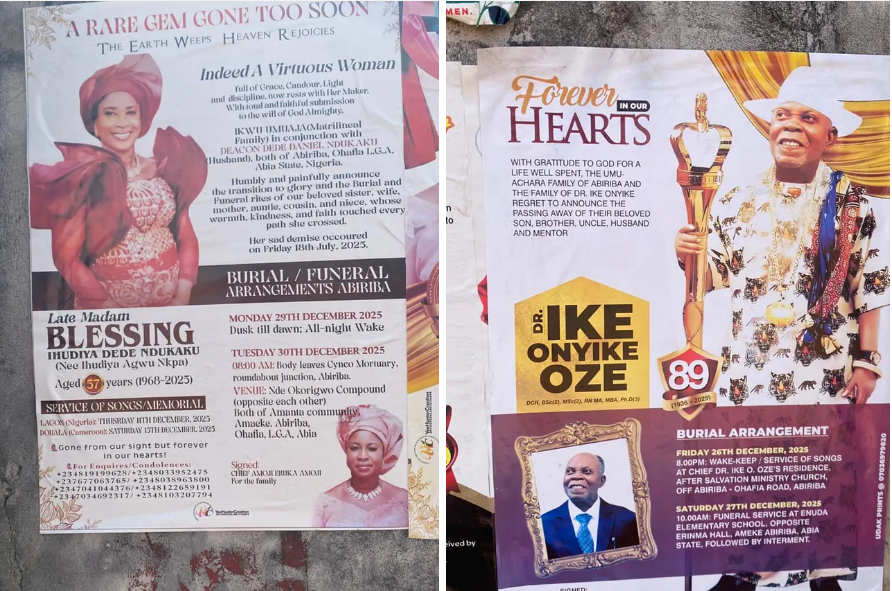
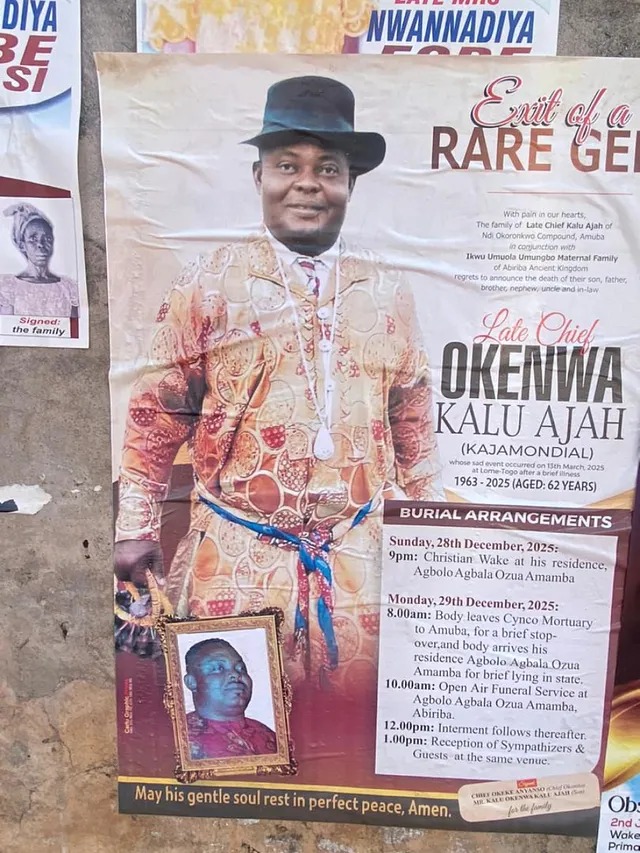
10.
The question is not a cage I walk around; it is the air I am breathing, a persistent, particulate haze that settles on the skin and lines the lungs. I do not hover above the inquiry, a detached analyst with a clipboard and clean theories. I am suspended within it, a participant-observer whose very cells are encoded with the customs I am now, with trembling hands, attempting to parse. I am lodged in the heart of the contradiction, unable to escape the scene I am desperately trying to understand, because the scene is me, my history, my people, my own mirrored reflection in the glossy vinyl of the banners that now pass for our sacred texts. I walk past the posters, my shadow falling across the smiling, airbrushed faces of the departed. I stand beneath them, feeling the weird disjunction of their celebratory slogans – “Glorious Exit,” “A Celebration of Life” – against the dull, primal thud of loss in my own chest. I argue about them with uncles in sun-dappled compounds, my voice rising in frustration against their serene, pragmatic acceptance. I eat beside them, the paper plates balanced on my knees, the jollof rice tasting of ash as I read and re-read the dates that mark a shockingly short span between birth and this stylized departure. And then, in the stolen quiet of the early morning, when the generators have finally gasped into silence, I return to a borrowed desk and write about them with the same hands that, just hours before, were clapping in rhythm at their ceremonies, shaking other hands in condolence, lifting glasses in toasts to the “life well spent.” This is not an external critique delivered from some safe, academic distance. It is an internal interrogation, a civil war waged in the silent territory of my own conscience. The posters have become the unavoidable texts of my homeland, demanding a hermeneutics of belonging I am no longer sure I possess. They speak in a loud, confident visual shout even when I, and so many others, choose to remain silent, our doubt a private, gnawing thing. They ask, without pity, the essential, terrifying questions: What does death now mean to us, in this hyper-curated, performance-saturated age? What has rest become when it is a word plastered over events of relentless activity? What deep, unmet hunger is this compulsory, frenzied enjoyment desperately compensating for? And what kind of future, what model of community and closure, are we rehearsing night after noisy night, without ever admitting the script to ourselves?
The posters announce death, yes, but they do not, in any meaningful way, invite reflection. Psychologically, they function less as vessels for memory or catalysts for mourning and more as sophisticated buffers – bright, colorful objects explicitly designed to intercept raw feeling before it can coalesce into something unbearable, before it can threaten the social equilibrium with its messy, demanding truth. They are emotional shock absorbers. They flatten the multidimensional chaos of loss into a clean, legible schema: Name. Photograph (always the best one, often decades young). Title. Date of Transition. Venue for Service of Songs. This compression is deeply, deceptively soothing. It spares us the exhausting, terrifying labor of actually grappling with the formless, howling void of absence. In reducing a complex, contradictory human life – with all its private joys, secret shames, unfulfilled dreams, and quiet kindnesses – to the manageable dimensions of a banner, we perform a kind of alchemy. We convert the ungovernable mystery of death into something administratively manageable, an event with a timeline, a budget, and a guest list. The poster does not mourn; it organizes. It provides a checklist for grief. And in a society perpetually overwhelmed by repeated, often premature loss – a society where the healthcare system is a rumor of failure, where roads are lethal, where economic pressure is a constant, low-grade fever – this semblance of organization feels like a lifeline, like control. Even when that control is a magnificent, collective illusion, the comfort of the checklist is preferable to the terror of the abyss.
Death itself, once universally understood as the ultimate, unfathomable rupture in the fabric of being, now behaves with the predictable regularity of a cultural appointment. It has a schedule, printed neatly on the back of the funeral brochure. It has an approved color palette (“All guests are kindly requested to appear in ash and gold”). It has a mandatory sound system, its wattage a direct correlate of perceived social stature. It follows a predictable, almost ritualized emotional arc: the initial shock (quickly bypassed), the logistical flurry, the night of loud “vigil,” the day of church service and interment, the reception with music and food. There will be noise, a wall of it, scientifically calibrated to prevent thought. There will be food, mountains of it, as if the calories could somehow fill the hollow space left behind. There will be bodies gathered in dense, sweaty proximity, close enough to feel the heat and vibration of life, a tangible, sensory argument against the fact of extinction, close enough to convince themselves, for a few hours, that nothing of essence has really ended. Funerals no longer insist on the stark, sobering reality of finality; they anesthetize it. They medicate the community with a potent compound of spectacle, social obligation, and sensory overload. Psychologically, this reflects a profound, collective refusal to sit with endings, to dwell in the uncomfortable, fertile ground of “never again.” Stillness, in the face of death, would force us to a terrifying reckoning. It would hold up a mirror to the profound fragility of all the structures we rely on – the medical systems that fail to save, the economic systems that grind people down, the relational systems frayed by distance and stress. To be still with death is to admit how thin the veneer of order truly is. So, with an ingenuity born of trauma, we replace the silent terror of finality with the loud, busy continuity of entertainment. We substitute the question for the party.
This transformation has led to a profound blurring of social genres. Funerals have absorbed, annexed, the social functions once reserved for genuine festivals, communal holidays, and seasonal celebrations. They are now among the few guaranteed, non-negotiable moments of mass collective gathering. This blurring is not an accident of cultural drift; it is a direct, telling consequence of erosion elsewhere. Where everyday, organic communal joy has been leached away – siphoned off by the pressures of mass economic migration to far-flung cities, crushed under the weight of financial anxiety, poisoned by political distrust, and replaced by the fatiguing loneliness of digital pseudo-connection – death has stepped in to fill the vacuum. It has become the last reliable, universally respected excuse to assemble, to see and be seen, to feel the electric charge of a crowd that shares your blood and history. We dress our grief in the borrowed language of celebration (“Celebration of Life!”) not because we are confused, but because we are desperately, chronically starved of shared, uncomplicated pleasure. The funeral, in its modern, turbo-charged incarnation, compensates for the absence of holidays that mean anything beyond crass consumption and passive recovery. It becomes the emotional and social multipurpose hall of the community, the one arena where attendance is mandatory, where passion is permitted, where the full, extravagant spectrum of human expression – from genuine sorrow to forced gaiety to business networking – is not just allowed but expected. It is where we go to feel we belong, because so many other avenues for that feeling have dried up.
In this reconfigured landscape, the very concept of rest has been turned inside out, thoroughly misunderstood and weaponized against the living. The dead are perpetually described as “resting,” finally at peace in the bosom of the Lord. Yet the living, those left to navigate the wreckage, are categorically denied any such respite. Wake-keeps, which etymologically and traditionally suggest a vigil, a watching, a quiet companionship with the mystery of passage, have become endurance trials. They exhaust bodies and nervous systems already worn tissue-thin by the daily struggle for survival in a hostile economic climate. Grief, which in a healthier culture might be allowed to slow time, to create a sacred bubble of suspended animation where one can simply be with loss, is here forced onto a frantic treadmill. It is accelerated, packaged, and put on a tight schedule. Psychologically, this frantic activity around death mirrors a deeper, more pervasive cultural anxiety: rest itself feels dangerous. Silence feels like vulnerability, like an open invitation for all the unnamed fears and unresolved pains to come rushing in. If we stop moving, stop dancing, stop eating, stop talking, something vast and unspeakable might surface – the collective grief for a nation that fails us, the private despair of dreams deferred, the sheer exhaustion of holding it all together. So we choose busyness. We treat death not as a profound truth to be integrated, but as a complex logistical and social task to be completed, a box to be ticked with maximum visible effort. The posters themselves, with their bright, unwavering colors and their upright, assertive presence in the public square, are visual propaganda for this refusal to collapse. They declare that we are handling it, that we are strong, that life – loud, colorful, abundant life – goes on. Even when it doesn’t.
Similarly, the mechanism of communal enjoyment, once naturally tied to the rhythms of seasonal cycles, harvests, and shared communal labor, has been forcibly rerouted into these funerary events. The enjoyment witnessed at a modern wake-keep is often real, visceral. The laughter that erupts from a group of cousins in a corner is genuine. The dancing, however incongruous it may seem, is often heartfelt in the moment. But it is a displaced enjoyment, a pleasure that has migrated from its natural habitat because its original habitat has been destroyed. This laughter erupts where tears or solemnity might be culturally expected, not because people are heartless or have forgotten how to mourn, but precisely because they are emotionally and psychologically overwhelmed. The human psyche is a resourceful survivor; it seeks relief, distraction, a pressure valve, wherever one can be found. The funeral, in its new form, becomes a uniquely sanctioned, guilt-free space to release immense existential pressure without ever having to address the root causes of that pressure – the failing state, the economic despair, the relational fragmentation. This is why external criticism of these practices, especially from outside the culture, often rings hollow and fails to gain traction. It misreads the surface symptom (seemingly inappropriate joy) as a moral failing, a decadence, rather than recognizing it for what it often is: a sophisticated, collective psychological coping mechanism, a way of stealing moments of connection and release in a world that offers precious few other opportunities for either.
On an individual, psychological level, the promise offered by the poster is potent and deeply revealing: You will be seen. In a world where countless people feel functionally invisible in their daily lives – anonymous cogs in the Lagos or Abuja machine, undervalued in their workplaces, reduced to financial obligations within their own families – the guarantee of a dramatic, posthumous recognition is a strangely powerful comfort. The underlying fear is not merely the fear of dying; it is the more acute, modern terror of dying unnoticed, of passing through this world without leaving a visible, acknowledged trace. The banner, plastered across the town square, is a potent anti-anxiety talisman. It assures the anxious, striving self that one’s existence will be validated, commemorated, and spoken of, even if that recognition comes tragically late. Collectively, this obsession with posthumous spectacle reveals a profound, communal insecurity about worth and legacy. When recognition, respect, and a sense of undeniable value are scarce commodities in the daily struggle of life, we ritualize and magnify them in death. The poster, then, is often less about authentically honoring the unique individual who has died, and more about the living collectively negotiating their own deep-seated fears of erasure, of insignificance. It is a bargain struck with mortality: We will give you this spectacular send-off, and in return, you promise us that our own eventual departure will not be forgotten.
There is also a powerful, forward-looking projection at work in this culture – a rehearsal of the future we imagine, or fear, we are entering. These posters, and the elaborate rituals they announce, enact a vision of continuity, stability, and communal coherence. They project a future where, no matter what, the community will still gather. The music will still play. The road will lead home. The extended family will mobilize. It is a future meticulously scripted to feel stable, predictable, and culturally intact, a bulwark against the chaotic, uncertain reality of the present. Yet, if one listens closely to the subtext, beneath that reassuring script lies a thick undercurrent of dread. What if the systemic failures continue unchecked? What if death, especially preventable death, keeps arriving earlier and more frequently? What if the banners begin to multiply across the town square faster than the newborn announcements, becoming the dominant visual language of the community? The very extravagance of the spectacle, then, becomes a form of magical thinking, a collective incantation: See how well we handle this? See how strong we are? We can orchestrate this, so we can survive anything. It reassures us that we have the cultural tools, the resilience, and the resources to handle whatever comes, even as it deftly avoids asking the more radical, unsettling question: Should we have to accept this level of loss and tragedy as a normal, unremarkable part of our collective life at all?
I find myself perpetually, painfully caught in the heart of this contradiction. I am genuinely moved, often to tears, by the palpable warmth of the gathering, by the sight of generations reconvening, by the deep, wordless comfort of familiar faces and shared history. The solidarity, however performative its outer layer, has a real, pulsing heart. And in the very same moment, from the same emotional core, I am profoundly disturbed by the context, alienated by the dissonance between the stated purpose and the enacted reality. I feel comforted by the tribe and alienated by its rites. Writing these thoughts does not absolve me or place me on some higher moral ground; it implicates me further, tying me ever more tightly to the dilemma. My thinking does not progress in a straight line to a solution; it circles, like a tired bird, around the same unresolved, magnetic core: Are these lavish, noisy, exhausting practices ultimately signs of a spectacular, ingenious cultural resilience – a way of forging joy and connection from the raw material of despair? Or are they the clear, glaring symptoms of a profound civilizational exhaustion, a burnout so total that we can only process loss by aestheticizing it and drowning it out? The maddening, human truth is that they are likely both. The human psyche is infinitely adaptive, capable of creating meaning and forging survival mechanisms under the most brutal pressures. But sometimes that adaptation, however brilliant, takes the form of a profound distortion, where the cure begins to mimic the disease, where the ritual designed to process loss becomes a primary contributor to a different kind of depletion.
What these ubiquitous posters ultimately reveal, if we have the courage to read them as the complex sociological and psychological documents they are, is not any kind of morbid “love of death.” On the contrary, they are glaring, fluorescent markers pointing to a pervasive crisis of life. They mark the exact spots – geographically, socially, spiritually – where care, attention, investment, and protection should have intervened much, much earlier. They are monuments to the rest that was never permitted, to the healthcare that was never accessed, to the safety nets that were never woven. They highlight the spaces where communal joy and connection should not have needed the tragic, costly pretext of a funeral to manifest. They are mirrors, held up by a community to itself, reflecting not just the departed, but the collective face of a people negotiating their own identity, values, and survival under immense, unrelenting pressure. In reading them closely, with love and critical care, I am not seeking to destroy a living culture. I am asking, with a heart full of hope and fear, whether that culture is still asking enough of us in return. Is it challenging us to be deeper, more compassionate, more present? Or is it simply demanding that we be louder, more visible, and more exhaustively performative?
And so I remain, and will likely always remain, in the uneasy middle – thinking it, saying it, writing it, living it. The perceived “nonsense” of it all – the dizzying cost, the performative grief, the joyful wake – persists because it serves a powerful, complex function, however psychologically or spiritually distorted that function may have become. To “make sense” of it is not to dismiss it as barbaric or irrational. It is to trace its elaborate, often heartbreaking logic all the way back to its source: our shared, unspoken fears of invisibility and erasure; our deep, unmet needs for security, recognition, and authentic communion; our endlessly deferred hopes for a life of dignity and peace. The future we are currently projecting through the glossy medium of these posters, through the thunder of the generators and the mountains of rice, will follow one of two paths. It will either repeat this cycle with ever-greater technical efficiency and dazzling spectacle, a high-definition loop of managed mourning. Or it will, prompted by whispers of discomfort like this one, find the courage to interrupt the cycle with a greater, more demanding honesty. That choice – uncomfortable, unfinished, and trembling with possibility – is not waiting for us in some distant tomorrow. It is being rehearsed, decided, and enacted every single time a new banner is hoisted against the sky, every time a microphone is switched on to shout down the silence, every time we, as a community, choose between the comforting, deafening lie and the difficult, quiet truth.
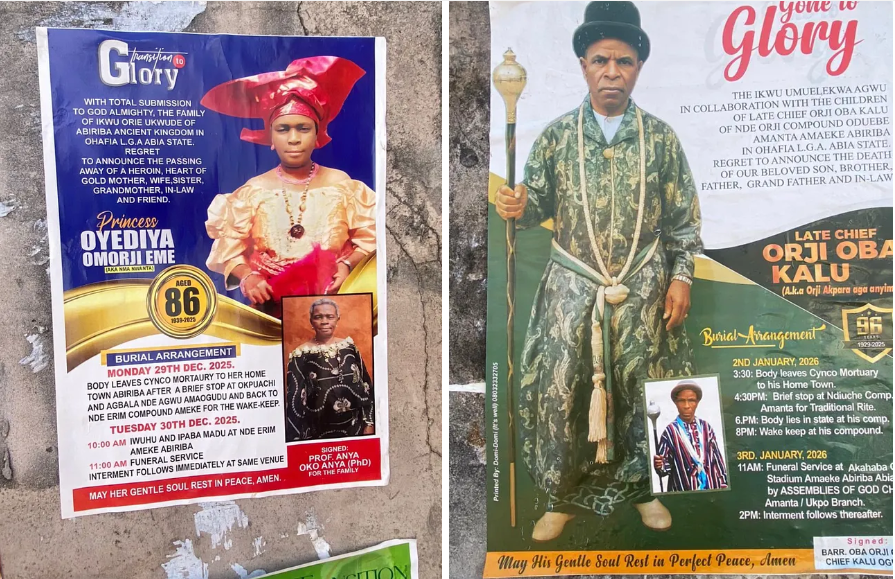
11
What this long, winding, and often punishing journey has revealed – through the visceral grind of the road and the intricate labyrinths of ritual, through the silent screams of vinyl banners and the physical assault of omnipresent basslines, through the sepia-tinted filter of memory and the high-definition glare of collective denial – is a truth that transcends geography. The story of Abiriba, for all its unique textures and local specificities, its proverbs and its peculiar pride, is not merely a local narrative, a charming or disturbing anecdote from a corner of Nigeria. It is a living, breathing, exhaustively detailed microcosm of a larger, more profound psychic drama unfolding across the entire landscape of Igboland, and perhaps, in its essential contours, across every diasporic or rapidly modernizing community on earth that is struggling, with varying degrees of consciousness and success, to reconcile the relentless pull of modernity with the gravitational anchor of memory, to balance the seductive promise of material progress with the irreducible sanctity of personhood, to negotiate the brutal arithmetic of mere survival with the soul’s non-negotiable hunger for sincerity.
Everything I have painstakingly described – the cacophonous noise that functions as a kind of social anesthetic, the meticulously stage-managed spectacle that substitutes for depth, the bone-deep exhaustion worn as a perverse badge of honor, the synthetic forests of glossy banners that bloom overnight like industrial fungi, the industrialized, monetized wake-keeps that resemble open-air stock exchanges of social capital, the inflated, performative personas adopted like costumes for a desperate play, the shadowed, unprocessed grief that lingers like a persistent ghost beneath the strobe lights – all of these phenomena do not exist in isolation. They are not random cultural eccentricities. They belong, inextricably, to a single, complex, self-reinforcing ecosystem. An ecosystem whose soil was laid down by layers of history – the trauma of war and scattering, the proud legacy of itinerant trade and resilience, the deep-seated fear of social oblivion. An ecosystem now under immense, distorting pressure from the demands of the present – the atomization of urban life, the tyranny of economic precarity, the erosion of traditional social buffers, the anxiety of globalized irrelevance. And an ecosystem that is, at its core, terrified of a future that seems to promise only further fragmentation, further loss of control, further dilution of a hard-won identity. What we see playing out on the surface – the dancing, the shouting, the eating, the photographing – is only the choreography, the visible performance. Beneath that dazzling, exhausting surface lies the choreography’s cause, the deep structure of fear, longing, and adaptation that makes these steps not just possible, but feel necessary, even obligatory.
The newly smooth,Governor-built roads that now bring us home in record time, sparing us hours of agony, have not, in any meaningful sense, brought us closer to ourselves. They have merely shortened the distance between two states of alienation. The vibrant, mass-produced banners that promise a kind of vinyl immortality, that swear we will not be forgotten, have not taught us the quieter, more arduous art of how to truly remember – to hold the complex, contradictory essence of a person in the heart, beyond slogan and airbrushed photo. The massive, compulsory gatherings that meticulously mimic joy and communal vibrancy have not healed the essential, modern loneliness that gnaws at the core of so many, a loneliness that persists even in the densest crowd. The elaborate, costly rituals that claim, with grand oratory, to honor the dead have not succeeded in teaching us the more urgent, humble skill of how to effectively, sustainably care for the living – how to build systems that prevent premature death, how to offer presence that isn’t contingent on spectacle. The entire breathtaking spectacle, which insists with such volume and visual force on its own profound meaning, has not resolved the creeping sense of meaninglessness, the existential void, that so many fear awaits in the quiet moments between events.
This, then, is the central, inescapable paradox at the heart of this entire inquiry, the knot that my mind cannot untie:
We have, with immense effort and newfound political will, perfected the external infrastructure of arrival – the bridges are solid, the potholes filled, the journey streamlined. But we have, with a neglect that feels both collective and tragic, left to decay the internal architecture of belonging – the quiet spaces for reflection, the language for vulnerable sharing, the rituals that nurture rather than deplete, the connections based on being rather than appearing. We can now reach the physical destination with unprecedented efficiency, but we are increasingly lost upon arrival, unsure of what to do, how to be, once we are there.
The colossal ego that animates our most extravagant funerary displays, that demands the loudest sound system and the most eye-catching banner, is not simple vanity, though vanity plays its part. It is, at a more fundamental level, crystallized fear – the fear of social invisibility, the terror of personal insignificance, the dread of being utterly swallowed and erased by a vast, indifferent, globalized world that no longer offers automatic, culturally-guaranteed recognition simply for being a son or daughter of the soil. The industrialization of grief, the turning of mourning into a branded, logistical production, is not an act of collective cruelty or emotional illiteracy. It is a sophisticated, if ultimately unsustainable, form of coping – an elaborate psychological and social defense mechanism erected against the unbearable, soul-crushing frequency of loss in a society where public systems (health, safety, infrastructure) fail predictably and long before the human body is meant to. When death comes too often and too soon, the psyche and the community together build a factory to process it, because the artisan workshop of quiet mourning would be overwhelmed and destroyed.
What is said, literally, in the bold fonts of the posters is simple, stark, administrative: a name, a title, dates of birth and “transition.”
What remains unsaid, hovering in the negative space around those words, is everything else: the years of silent struggle, the medical neglect due to cost or access, the preventable decline in a substandard hospital, the unspoken collective guilt of “could we have done more?”, the unresolved anger at a system that failed yet again, the quiet, personal terror of our own shocking fragility in the face of chaos. The poster is the tip of the iceberg; the submerged bulk is the cold ocean of shared, unarticulated trauma.
What is seen by all, documented in countless smartphone videos, is the spectacle – the canopy, the crowd, the dancing, the spread of food.
What is unseen, internalized in the nervous systems of the participants, is the psychic and physical cost of maintaining that spectacle – the debt incurred, the sleep lost, the real grief postponed and ossified, the familial tensions exacerbated, the personal health sacrificed on the altar of social expectation.
What is performed, with great energy and often genuine skill, is celebration – a show of vitality, resilience, and abundance.
What is diligently, systematically avoided is the actual work of mourning – the sinking into sadness, the acceptance of finality, the painful restructuring of a world that has been irrevocably altered by absence.
What is repeated, year after year, event after event, with minor variations, is the form of tradition – the schedule, the symbols, the expected behaviors.
What is often forgotten, buried under the weight of habit and social pressure, is the original, animating meaning of those traditions – the communal support, the spiritual passage, the reaffirmation of bonds that transcend the individual life.
And yet, within this thicket of contradiction, this dizzying loop of symptom and cause, there lies a strange, stubborn, and undeniable ember of hope. The very excess that disturbs and exhausts us is itself evidence, writ large, of a people still fiercely, desperately trying. Trying to gather in a world that scatters. Trying to honor in a context that cheapens. Trying to feel something – connection, significance, joy – in a landscape that can feel emotionally arid. Trying to survive, culturally and psychologically, with the tools they have inherited and adapted. The noise is a shield against a threatening silence, yes, but the fact that they are still building shields means they are still in the fight. The banners are distortions of individual lives, granted, but they are also public confessions of a need to be remembered, a need so powerful it will accept a caricature over oblivion. The rituals have become repetitive, even sterile, but repetition is often the first, most fundamental language of cultures that are lost, searching for themselves in the dark, holding onto the familiar form while the spirit within it undergoes a slow, painful metamorphosis.
If this arduous inquiry, this walking and writing and witnessing, has shown anything of value, it is that the current crisis is not a final curtain, not the death rattle of a culture. It is, rather, something more dynamic and agonizing: it is formative. We are not passive witnesses to an ending. We are active participants in a painful, protracted, and necessary rebirth. We are not seeing the death of Igbo culture or of communal feeling; we are witnessing the profound exhaustion of a particular cultural form – a set of practices and expectations – that has been asked to carry too much symbolic weight for too long, that has been tasked with solving problems (of loneliness, meaning, identity) it was never designed to solve, and is now buckling under the strain, revealing its seams even as it continues its magnificent, deafening performance.
The question that remains – unresolved, ethically insistent, existentially necessary – is therefore not whether we will change, for change is already upon us in the form of this pervasive fatigue and quiet discontent. The question is one of direction. Will we continue, reflexively, to anesthetize our collective grief and placate our anxieties with ever-grander, ever-more-expensive spectacles, treating the symptom while the disease metastasizes? Or will we, individuals and families and communities, dare to reclaim the quieter, more demanding, and ultimately more healing work of mourning honestly, of connecting vulnerably, of celebrating in ways that replenish rather than drain? Will we keep pouring our resources and genius solely into building better roads that lead only outward, to the physical homeland, or will we, with equal courage, begin the infinitely harder, more intimate construction project: the inward road, the one that leads back through the noise, past the performances, to the bedrock of authentic meaning, to the wellspring of true memory, to the core of ourselves that exists before and after all the banners have faded?
This part of the writing, this fifth movement in the symphony of questioning, ends here, on the page. But the lived inquiry, the daily choice in how we belong and how we grieve, does not end. It continues in the compound, at the meeting, in the quiet of the heart. The posters will inevitably fade, bleached by sun and rain. The noise will thin, replaced by the ordinary sounds of life. The rituals, in some form, will repeat, for we are creatures of pattern. But beneath all that surface activity, in the substratum of our shared spirit, the deeper work waits – patient, unfinished, and quietly, urgently calling. It is the work of building a homecoming that is more than a journey to a place, but a return to a state of being.
The long road to Abia, then, in its fullest, most demanding sense, is not ultimately a journey across land, measurable in kilometers and checkpoint delays. It is a journey across consciousness, a pilgrimage through the interior landscape of who we are, what we value, and how we choose to love and lose in an age of profound transition. And the true homecoming, if it ever arrives, will not be announced by a signpost or celebrated with a banner. It will be measured not in the smoothness of the asphalt, but in the quiet, revolutionary courage to be still, to be real, and to belong from the inside out.