The Renaissance of The Night
By Agbeze Ireke Kalu Onuma, AI-KO
Crossing into Umuahia just before 10 p.m. on the 17th of December felt like an instant benediction, a quiet laying on of hands after a day that had shaken both body and patience from the first light in Lagos. The shift was not only geographical; it felt almost sacramental, as though the invisible line between states carried a rinsing force that washed off the dust, the frayed nerves, the small angers gathered from every bad overtake and cratered stretch. Umuahia – this modest capital of Abia State – rose before us not as a mere waypoint but as a threshold, a city whose name is braided into the country’s memory. During the Nigerian Civil War, when Enugu fell in 1967, it became the second and longest‑serving capital of Biafra, a nervous system of command and survival until its own fall in 1969. Somewhere beneath this same red earth, the so‑called Ojukwu bunker once held strategy sessions and desperate prayers. Driving through at night, I felt that layered history under the tires – the present path laid over old scars, the asphalt a thin, black bandage over a landscape that has known artillery and hunger.
Here, at last, the car found its rhythm. Not the frantic, clenched‑jaw speed of trying to outrun the dark or second‑guess the next invisible…
For the first time since leaving at dawn – Lagos with its restless choreography of hawkers, danfos, and generators singing their off‑key anthem of improvisation – we allowed ourselves to unclench. Our conversation, which had been all nerves and warnings – “Hold that side,” “Slow down, checkpoint ahead” – softened into something looser, more human. I found myself slipping into stories, the kind that only come when the body feels safe enough to remember. I talked about Abiriba, about chasing fireflies as a child in the fields behind our compound at Ùgwù-Ézì Ameke. Our bare feet drumming the earth until an elder’s voice cut through the darkness, warning us not to disturb the ancestors. I remembered New Yam festivals where the atmosphere grew thick with the smell of pounded yam and rich soups, drums calling bodies into a circle that felt older than the nation itself. Those memories were not footnotes; they were part of the journey. As Chinua Achebe once wrote, “The story is our escort; without it, we are blind.” In that vehicle, on that smooth expanse, I felt escorted – by my people’s stories, by my own.
Umuahia itself, under the moon, revealed a quieter charisma than its neon swagger. We slipped past the Abia Tower, that concrete sentinel on the Port Harcourt – Enugu expressway, its height and inscription – “Welcome to Abia; God’s Own State” – announcing both arrival and expectation. The structure has always been more than a roundabout; it is a kind of thesis statement in cement, a symbol of a place that has known both neglect and attempted rebirth. Tonight, it felt like a gate into a different tempo. We cut deeper, partly out of necessity, partly out of curiosity – to “drink in more of the Otti wonder,” as I half‑joked, thinking of how I had once described him in my writing as a leader willing to walk into the fire for a different kind of Igbo future. The streets bore traces of that ambition: cleaner medians, fewer craters, a sense that someone, somewhere, had decided that this city deserved to be more than a sleepy civil‑service outpost.
We passed the turn that leads towards Holy Rosary Girls’ Secondary School, one of the long‑standing institutions, and then towards the junction that points to the National War Museum. At this hour the museum was, of course, closed, but in my mind its grounds were already awake: tanks resting like retired beasts, aircraft frozen mid‑mission, the underground radio bunker where the Voice of Biafra once spoke into the static. The museum, established in 1985, is officially a repository of military history, but for many of us it is also a shrine of unresolved questions – about how a people remembers defeat without surrendering dignity. Walter Benjamin once warned that “not even the dead will be safe from the enemy if he wins,” and as we glided past the dark road that leads there, I felt how fragile memory can be if it is not constantly re‑inscribed in roads, in schools, in the ordinary life of a city.
The night itself seemed to change costume as we moved. The heavy cloak of exhaust fumes and burnt oil that had followed us from Ogun, Ondo and Edo gave way to gentler scents: roadside fires grilling plantain to a caramel edge, the smoky comfort of roasted yam, the faint tang of palm oil from a buka still open for late travelers. Under the clearer southeastern sky, the stars looked less like decoration and more like witnesses. House lights spilled from compounds in warm amber rectangles, revealing small domestic rituals – someone rinsing plates in a plastic bowl, a child being chased indoors, a generator coughing reluctantly to life. A lone cyclist pedaled past us, his bicycle stacked with sacks whose contents I could only guess at. In his silhouette I saw an echo of older trade routes, when men walked these corridors long before rail lines and expressways, carrying salt, cloth, stories.
Somewhere in that eased rhythm, reflection arrived without fanfare. Hardship, I realized, is not only something to be endured; it is also a lens that sharpens the edges of relief. The straightness, the absence of sudden fear, the simple ability to talk without scanning the darkness for hazards – these became luxuries I could feel in my chest. It was past 10 p.m., but the city’s relative order made it feel like late afternoon, that soft hour when the day is tired but not yet surrendered. I thought of my father and uncles, traders who had once moved along these routes when they were little more than stubborn paths, sometimes on foot, sometimes in rattling lorries, navigating colonial checkpoints and later military ones. Their stories of being stopped, questioned, searched – of learning how to read the mood of a soldier the way a farmer reads the sky – rhymed uncomfortably with today’s police stops and improvised roadblocks.
In that moment, the highway became a question. How far have we really traveled from those days? Yes, the asphalt is smoother, the streetlights more reliable, the rhetoric of “urban renewal” more polished. Yet the deeper issues – who gets to move freely, whose dreams these roads are built to serve, whose histories are honored in concrete and whose are buried in silence – remain unsettled. Frantz Fanon once wrote that “each generation must, out of relative obscurity, discover its mission, fulfill it, or betray it.” On that December night, somewhere between the Abia Tower and the sleeping War Museum, I felt my own small mission tugging at me: to keep telling these layered stories of road and memory, of a city that once held a dying republic and now holds the fragile hope of a different kind of rebirth.
And so I sat there, hands on my knees, eyes on the dark ribbon ahead, fully present in the car and yet also elsewhere – walking with my ancestors on footpaths of red earth, standing in bunkers carved beneath Umuahia, watching cranes lay fresh asphalt under a reformist governor’s gaze. The night, for a brief stretch, felt like a renaissance not because everything had been fixed, but because, for once, the journey, the history, and my own voice were traveling together.
The vehicle kept its gentle rhythm, gliding through with a softness that felt almost medicinal after the day’s long assault. Our conversation loosened, drifting into eddies and curves like a river finally free of rocks. There was a new brightness in the air, a quiet optimism that rose as the capital revealed itself – not as a destination, but as a threshold to the deeper heartland waiting beyond. Hours earlier, the darkness had felt like an adversary conspiring with bad roads and blind corners; now it seemed to lean toward us, offering a small but unmistakable promise that even the longest ordeals eventually yield to renewal. Abiriba still called from the distance, but for this brief stretch we allowed ourselves to rest inside the moment, letting our bodies unclench and our spirits lift as memory and observation intertwined to guide us forward.
Leaving the city’s core felt like stepping into a corridor deliberately carved out of the dark. Streetlights stood in disciplined intervals along the highway, their overlapping halos turning it into a luminous ribbon. It reminded me of those early‑December evenings of childhood when the first festive bulbs appeared in the village square, transforming familiar paths into something enchanted. The contrast with earlier years was stark. There was a time when passing through these same towns on broken, unlit surfaces felt like drifting through a shadowed underworld, each village a dim island of survival. Tonight, the atmosphere was almost leisurely. People walked along the shoulders in small clusters, unhurried, claiming the cool night as if fear belonged elsewhere. Kiosks and corner shops stayed open, their doors wide, radios murmuring highlife or gospel, goods arranged under fluorescent tubes and rechargeable lanterns. There were no long gulfs of darkness where the imagination could run wild – only a steady, reassuring pulse of human presence.
As we moved farther from the city, the landscape unfolded with a richness that reminded me of a woven tapestry – dense with detail, alive with quiet ambition. The roads on this axis were noticeably improved, their surfaces smoother, their markings clearer, the result of recent state works that had finally begun to treat this corridor as more than an afterthought. Modest two‑storey houses leaned toward the highway, verandas lit by warm bulbs where families lingered in the night air. Small provision stores glowed in the dark, selling recharge cards, biscuits, sachet water, and loaves of bread wrapped in yesterday’s newspaper. Billboards did not shout luxury; they announced possibility: a local ICT centre offering coding classes, an agro‑input dealer promising higher yields, a solar installer advertising “light without NEPA.” Motorcycles threaded through it all, riders balancing crates of drinks or sacks of produce, while the occasional polished SUV slid past, a quiet sign of a middle class taking tentative shape. In the distance, the outlines of new buildings – churches, hotels, private schools, and a few fledgling tertiary institutions – rose against the sky, their scattered lights suggesting a slow but undeniable ferment. Some of these projects, I knew, dated back to the 1990s when federal and private investment began to trickle into the region; others were more recent, their concrete still raw, their scaffolding clinging like ribs.
By then, the arithmetic of the day had settled into my bones. Thirteen hours had passed since we left Lagos at first light, slipping past its sprawling suburbs and onto the Lagos – Benin – Ore axis, then enduring the punishing stretches through Ogun, Ondo, and Edo where every crater felt like a small betrayal. My body carried the record of each jolt. My thighs ached from bracing against sudden dips, my lower back throbbed with a dull, insistent ache, and my hands retained a faint tremor from gripping the seat and door. My eyes, which had spent hours scanning a treacherous darkness for unmarked obstacles, now stung slightly in the relative brightness of these lit roads. A low headache pulsed at my temples, the residue of sustained vigilance. Emotionally, I hovered in a strange in‑between: the sharp irritation of earlier delays had worn off, replaced by a softer, reflective fatigue. There was relief – a cool, spreading sense of “we made it this far” – but it sat alongside a heightened awareness of my own limits. Travel in Nigeria ages you in fast‑forward; by the time we cleared Umuahia, I felt as though the day had added quiet years to my bones.
In that softened state, my thoughts stretched beyond the immediate comfort of the smooth surface. Journeys like this are small laboratories of character. They test patience, reveal fault lines, and expose the stories we tell ourselves about who we are. Under the glow of the streetlights, watching our shadows flicker across the dashboard, I found myself thinking about how far we had come – not only in kilometres, but as a people whose histories are etched into these landscapes. Umuahia, once battered by bombings and blockades during the civil war, now pulsed with a tentative normalcy. It brought to mind the translation of a proverb my grandmother loved: the one who serves the king will be served by the king. We had “served” this road with our endurance, and now it seemed to be serving us back with ease. Yet I knew better than to romanticize it. Progress here is always provisional, always at risk of being undone by neglect or greed. I remembered my father’s stories of driving these routes in the 1980s, during the boom‑and‑bust cycles of oil money, when communities rebuilt schools and markets with communal labour because official promises rarely materialized. His lesson was simple: real development rises from below, from people who refuse to wait forever for rescue.
But even inside this corridor of light, a quieter, more primal fear sat in my chest. In recent years, the southeast has been stalked by a new vocabulary of dread: kidnappings for ransom, armed ambushes, and the spectral presence of “unknown gunmen.” I had read the reports and heard the stories – buses stopped on lonely stretches, passengers marched into the bush, families scrambling to raise impossible sums. Friends had told me of near misses: a suspicious vehicle tailing them for kilometres, a sudden burst of gunfire on a neighbouring road, a relative who did not make it home on time. Those accounts had the sticky texture of lived experience, not distant headlines. So even as the journey here felt safe, my imagination kept darting ahead to the darker bends, to the unlit rural stretches that still lay between us and Abiriba. What if this easy glide was only a thin surface over deeper instability? What if the same night that now cradled us could, in an instant, turn hostile?
That tension – between visible improvement and invisible threat – sat at the heart of my reflections. Achille Mbembe once wrote that postcolonial life is lived in a constant negotiation between possibility and precarity, and I felt that sentence in my body as we drove. The new streetlights, the open shops, the laughter on verandas all testified to a people insisting on normal life; the knot in my stomach testified to how fragile that normalcy remains. Yet even inside that unease, there was a stubborn thread of hope. The very fact that families still walked at night, that traders kept their doors open, that young men rode motorcycles laden with goods instead of weapons, felt like a quiet refusal to surrender the public space to fear.
Somewhere between Umuahia and the turn‑off that would eventually lead us toward Abiriba, I realized that this experience was doing more than carrying me home. It was forcing me to see the region anew – not as a static backdrop of nostalgia and war stories, but as a living, contested space where light and darkness, safety and danger, progress and decay are constantly wrestling. And in that wrestling, I felt my own voice sharpening into something more deliberate. I was not just a passenger being ferried through history; I was a witness, a chronicler, someone whose task is to name both the beauty and the terror of these roads. The car moved on, the lamps flicked past in steady rhythm, and I sat there, tired but alert, letting the night write itself into me.
Wise thoughts rose to the surface as I turned the matter over in my mind. Security in Igboland has never been a simple question of policing; it is the visible symptom of deeper, older wounds – historical, political, psychological – layered with grievances that were never fully acknowledged, let alone healed. The Biafran War, that devastating conflict from 1967 to 1970, left behind more than ruins; it left a legacy of marginalization, uneven development, and a quiet but persistent sense of exclusion that still shapes the region’s relationship with the Nigerian state. The economic disparities that followed – industries that never returned, federal allocations that never matched need, opportunities that dried up before they could bloom – have pushed generations of young men into desperation. It is from this soil that separatist sentiments like those of IPOB draw their energy, and from this same soil that the phenomenon of “unknown gunmen” emerges: a tragic echo of a past that refuses to stay buried.
I found myself reflecting, with a kind of weary clarity, on how frustration over poor infrastructure, unemployment, and perceived injustice can mutate into chaos. How many young men, brimming with talent but starved of opportunity, turn to crime as a warped form of rebellion? It is a cycle in which fear breeds more fear: communities arm themselves, vigilantes rise, and the line between protector and predator becomes dangerously thin. My own anxieties deepened as I considered this – not just fear for my personal safety on these open roads, but fear for the soul of Igboland itself. What if these unresolved issues erode the very resilience that has defined us for generations? After hours of vulnerability on the highway, the sorrow hit me with surprising force: the sense that our immense potential is shackled by insecurity, turning a land of innovation into a landscape of cautionary tales.
Yet even in that heaviness, a thread of hope persisted. I thought of Governor Alex Otti, whose administration since 2023 has made visible strides in road rehabilitation and security reforms, deploying more patrols and strengthening community policing. It was a beginning – promising, but incomplete. True transformation, I knew, would require addressing the roots: youth empowerment, equitable federal investment, and a deliberate effort to rebuild trust between the region and the state. I shared these thoughts with the driver, my voice steady but edged with emotion. “These smooth surfaces are a balm,” I said, “but they can’t hide the shadows. Every mile reminds me how fragile things still are.” He nodded, offering his own story about a cousin who had joined a local security outfit to push back against the gunmen – a small act of courage in a landscape where fear often dictates the rules. His anecdote added a human weight to my reflections, grounding them in lived experience.
As the road stretched ahead, I remarked that the drive was beginning to feel like moving from Ajah to Ikeja – those Lagos routes where neighborhoods blur into one another until the city becomes a single, breathing organism. Something similar was happening here: development stitching communities together, boundaries dissolving, the region pulsing with a new coherence. If this momentum continues, I mused, Otti might not just be repairing surfaces; he might be laying the quiet foundations of a super city-state – an emergent powerhouse rising from the southeast, blending tradition with modern ambition. Under the warm amber glow of the streetlights, which softened the night’s edges and illuminated half-built plazas and lively markets, I could almost see the future taking shape. These towns, once seasonal havens for holiday returnees like me, could become year-round centers of industry and learning – factories humming, schools thriving, young people choosing to stay rather than fleeing to Lagos or abroad. It was a reversal of the old post-war migration patterns, when economic necessity drove millions away from the southeast. The thought filled me with cautious optimism: perhaps, after all these hours of trial, the path ahead – literal and metaphorical – held more light than shadow.
In that expansive reverie, the night’s renaissance deepened. My thoughts, sights, and emotions wove themselves into a narrative of endurance and possibility. The long journey had stripped me bare, revealing fears and hopes in equal measure, but it had also reaffirmed a quiet truth: in Igboland, as in life, progress always dances with peril, and it is our collective resilience that nudges the dance toward dawn. As Umuahia’s lights receded behind us, I carried this layered introspection forward, toward the heart of Abia and the home that waited.
By ten o’clock, as the dashboard clock glowed with its soft indifference, we approached the Uzuakoli army checkpoint. Our speed eased into a cautious crawl, an instinct honed by years of navigating unpredictable stops. The shift from Umuahia’s smooth glide to this familiar junction felt like stepping from a well-lit parlor into a bustling courtyard – still under the spell of the night’s renewal, but now infused with a raw, communal vitality that hummed in the air. Uzuakoli, nestled in the rolling hills of Abia State, greeted us with an energy that defied the late hour, stirring something deep within me: nostalgia, surprise, and a quiet awe after the day’s exhausting toll.
The scene unfolded like a vivid night-market tableau. The checkpoint, usually a stern arrangement of sandbags and metal barriers under harsh floodlights, stood eerily unmanned – no soldiers in sight. On another night, this absence might have unsettled me, but tonight it felt like a subtle nod to stability, as if the shadows had been pushed back by collective will. Instead of desolation, the junction buzzed with life. Vendors clustered around charcoal braziers, flames casting flickering halos on animated faces. The air thickened with the aroma of suya sizzling over open grills, the smoky char mingling with the sharp tang of onions and yaji. Women in bright wrappers balanced trays of fresh bread, calling out prices in a melodic blend of Igbo and Pidgin. Parked buses and motorcycles idled nearby, their engines rumbling softly.
Young men lounged on plastic chairs near a kerosene-lit stall, sharing palm wine and bursts of laughter that echoed into the night. Children darted between legs, chasing glowing phone screens or begging for coins with mischievous grins. Overhead, strings of bare bulbs dangled from wooden poles, illuminating handwritten signs advertising everything from phone charging to herbal “quick energy” tonics – a testament to the entrepreneurial spirit that thrives even in uncertainty. The scene was framed by the silhouettes of palm trees and mud-brick compounds, their zinc roofs catching the starlight. Above it all, the sky stretched wide and impossibly clear, the stars unfiltered by urban haze, as if the night itself had paused to witness this small, vibrant pocket of life.
After nearly fourteen hours on the road – since that first push out of Lagos at dawn, when the city still yawned under a pale sky – I felt emotions settling inside me like layers of silt drifting to the bottom of a stirred river. My body had become a catalogue of complaints: my back stiff from hours of vigilance, my legs cramped from immobility, a faint nausea lingering from caffeine, resulting from the constant tea I’ve been drinking from Lagos. Yet the moment I stepped out to stretch, the cool night air wrapped around me with the tenderness of a long‑delayed embrace. Something in me softened. The fatigue peeled back my defenses, leaving me strangely open, exposed, grateful. It was as though the journey’s trials had stripped away every unnecessary layer, making the simple act of arrival feel intimate and profound.
My thoughts drifted toward the wisdom I had inherited – family stories, communal memory, the quiet resilience that has shaped Igbo life for generations. Journeys, I realized, are never just about distance; they reveal the inner terrain we often ignore. After such endurance, the ordinary becomes miraculous. I remembered my uncle’s stories of traveling these same routes in the 1970s, in the uneasy calm after the civil war, when federal troops still manned checkpoints and the air carried the tension of a peace not yet trusted. He would stop here for bread, he said, as a ritual of reclaiming normalcy. “The road tests you, but the stop revives you,” he liked to say – an insight that felt almost ancestral now, grounding my own exhaustion in a lineage of survival.
Almost without thinking, we had slowed the car and pulled over, guided by a habit as old as my first paycheck from a job in Lagos. Back then, I would buy bread at every major stop on the journey home – a small ritual of continuity, a way of saying to myself, you are still connected to where you come from. The driver understood immediately. I stepped onto the dusty shoulder, joints cracking in relief, the earth beneath my feet firm and familiar. But then I froze, struck by how profoundly the place had changed.
This junction had once been a ghost town by this hour – silent, shuttered, tense. In the early 2000s, when I had just come back from my sojourn in Russia, buses would speed past with windows rolled tight, passengers whispering about bandits or lingering post‑war paranoia. The army’s presence was both reassurance and warning. But tonight, the transformation was unmistakable. Vendors haggled without hurry. Travelers lingered in conversation. A group of elders played draughts beneath a tree, their board illuminated by a single lantern. The air pulsed with life. What had shifted? Was it the recent roadworks under Governor Otti, smoothing paths and encouraging commerce? Or was it something deeper – a communal reclaiming of space after years of insecurity?
These questions tugged at me, drawing me into a deeper reflection on safety and possibility in Igboland. My fears, always close companions on long journeys, rose again – wise in their caution, unwelcome in their persistence. What did these people know that the rest of us were still learning? Here, in this vibrant junction, they seemed to embody a quiet defiance: the understanding that security is not merely enforced from above but cultivated from within – through vigilance, community bonds, and a refusal to let fear dictate the rhythm of life.
I thought of the region’s challenges: the “unknown gunmen” whose attacks unsettle entire communities, the kidnappings that fracture families, the clashes that turn farmlands into contested spaces. After hours on the road, these fears clung to me like shadows – visceral, insistent. I feared for the young vendors exposed in the open, for travelers like us, for the very soul of Igboland, where decades of marginalization since the civil war have hardened into modern unrest. It is not mere criminality, I reflected, but the symptom of systemic neglect – federal policies that leave the southeast underfunded, economic disparities that strand graduates in joblessness, and the cycle of violence where separatist agitations collide with state crackdowns, turning brother against brother. Why, I wondered with a quiet ache, do we allow these wounds to define us?
Yet even in that sorrow, determination flickered. Communities like Uzuakoli were showing another path – one built on grassroots resilience and economic revival. And I found myself asking why this quiet renaissance wasn’t being celebrated. Why wasn’t this dignified, thriving night economy in the heart of Igboland being amplified as loudly as the stories of chaos? This wasn’t the frantic, overwhelming energy of Oshodi in Lagos. This was something steadier, more intentional – a symphony of small enterprises working in harmony, where safety was woven into the fabric of daily life through mutual watchfulness and shared prosperity.
History added its own resonance. Uzuakoli had been a colonial trading post in the early 20th century, a hub for palm oil and kernels. Its people had adapted through British rule, independence, war, and the long years after. My aunt, who lived here just after the war, used to speak of markets that closed at dusk because of post‑war banditry. Yet tonight, her successors thrived deep into the night. Perhaps Otti’s reforms were nudging the region forward, but it was the people’s ingenuity – their insistence on creating light in the darkness – that truly powered this revival.
In my fatigue, this realization felt like a quiet empowerment. Even amid fear, possibility blooms when communities choose hope over surrender.
I finally bought the loaves of bread – warm, slightly sweet, wrapped and packed in sets in a paper bag the way tradition insists – and my driver took one and bit into it with gusto. The taste I could see was enjoyable to him and grounded him, blending nostalgia with a renewed appreciation for the present. The junction’s energy seeped into my weary spirit, turning fear into reflection, reflection into resolve. As we prepared to continue toward Abiriba, I carried the scene with me: a testament to Igboland’s enduring spirit, where the night – once a veil of uncertainty – now revealed pathways of deliberate promise.
The road ahead stretched into darkness, but for the first time in hours, it felt less like a trial and more like a homecoming already underway.
As we pulled away from the Uzuakoli checkpoint, the warm smell of fresh bread still lingering in the car like a talisman from gentler times, I felt an irresistible urge to savor the night more deeply. The road ahead – now a dark ribbon curling through Abia’s undulating hills – seemed to whisper invitations to linger, to breathe, to remember. “Go even slower,” I murmured to the driver, my voice soft but insistent, as though speaking too loudly might break the fragile spell of belonging swelling inside me like a tide returning to shore. He obliged with a knowing smile, easing off the accelerator until our pace matched the lazy drift of fireflies weaving through the roadside bushes. Slow enough for the night to etch itself into memory. Slow enough for my spirit, battered by the day’s relentless grind, to rediscover its rhythm.
By now, the clock flirted with half‑past ten, and my body felt like a weary archive of aches – shoulders knotted from vigilance, legs trembling faintly from hours of braced tension. Yet beneath the fatigue, a rare peace unfurled. It was as if the journey’s hardships had distilled my emotions into something pure: a deep, soulful belonging that washed away the alienation of city life. A quiet joy. A sense of being exactly where I was meant to be, roots rediscovering soil.
As we crept along, the ordinary transformed into the extraordinary. The landscape – Igboland’s quiet heart – rolled gently under the moonlight. Clusters of thatched‑roof compounds peeked from groves of banana and plantain, their leaves rustling like applause in the night breeze. Streetlamps, sparse but steady, cast golden halos on red‑earth footpaths branching off the main road. Lanterns bobbed in the distance like wandering spirits – villagers returning from evening gatherings, their silhouettes swaying with the rhythm of old stories.
Villages blurred softly into one another, their boundaries dissolved by shared histories and the quiet continuity of life along this old road. Names tied to this stretch – Lekwesi, Uzuakoli’s outer hamlets, and the smaller settlements tucked into the folds of the hills – drifted past, each carrying its own layered stories. In Lekwesi, a community known for its ancient farmlands and once a modest node in the colonial-era palm produce network, elders were said to gather beneath towering trees to recount the old cosmologies: tales of the thunderous sky deity who upheld justice, the earth guardian who watched over morality, and the trickster spirit whose unpredictable nature explained the world’s contradictions.
Local folklore along this corridor speaks of the Uzuakoli hills, where travelers in the pre-electricity era often described mysterious flickering lights dancing along the footpaths at night. These lights – believed by some to be wandering ancestral spirits guiding travelers, and by others to be harmless natural glimmers from fireflies clustering in the thick underbrush – became part of the region’s oral tradition. Older storytellers spoke of nights when a lone lantern seemed to bob ahead on the trail with no visible bearer, a lingering echo of the era when traders walked these routes carrying palm kernels, salt, and woven goods long before colonial surveyors carved new roads through the land.
Historically, this corridor traces back to pre‑colonial trade routes – arteries through which kola nuts, palm wine, and salt moved between clans long before British surveyors carved their own lines across the land in the late 19th century. A friend from here once told me a story he heard from decades past, of an old man who once described walking these same paths in the 1960s, balancing baskets on their head while dodging colonial tax enforcers who patrolled with an iron fist. Their recollections were a reminder that resilience has always been woven into the fabric of this region.
Now, in the slow crawl of our vehicle, I saw signs of modern evolution: solar‑powered lights flickering on in remote homesteads, part of recent efforts to counter the chronic blackouts that have long plagued the southeast. The night, once a void, had become an opportunity.
As the road stretched on, my thoughts deepened. After hours of navigating peril and persistence, I found myself contemplating the art of savoring – a counterpoint to Lagos’s frantic tempo, where time is spent like loose change. Here, belonging wasn’t rushed; it was savored like fine palm wine, allowed to unfold in layers. Gratitude swelled in me – relief from the road’s trials mingled with a tender nostalgia, tightening my chest with unspoken thanks for this homecoming.
Yet even in this serenity, shadows lingered. Slowing down heightened my awareness of vulnerability. The dark thickets along the road could conceal ambushes. The “unknown gunmen” – a phrase that has become a grim refrain – move with ghostly precision, their motives a murky blend of criminality, political grievance, and economic despair. I feared for the driver, whose livelihood depended on these nocturnal runs; for the villagers whose lives teetered on instability; for the soul of Igboland, where the legacy of the Biafran War – five decades old yet still pulsing – continues to fuel separatist sentiment and distrust.
Security here is a delicate ecosystem. Economic disenfranchisement pushes youth toward desperation in a land rich in talent but starved of opportunity. A neutral voice from the war years once recounted hiding in these very hills from advancing troops, surviving on bushmeat and whispered solidarity. The parallel to today’s herdsmen incursions – farmers displaced, retaliatory violence simmering – was impossible to ignore.
My emotions churned: apprehension that one errant shadow could upend our journey, and resolve that communities here, through vigilante groups and communal pacts, were forging their own shields against chaos. Why, I wondered, do we amplify only the sensational stories of strife and not these quiet triumphs of ingenuity? These are the narratives that could inspire a national reckoning – one rooted in equitable development and healing.
Then, as if the night had been saving its crescendo, we reached Akara Junction.
The stillness vanished – swallowed by a whirlwind of life that erupted around us like fireworks. It felt like stumbling into CMS at peak rush hour in Lagos, but here the chaos was joyous, unfiltered, and uniquely eastern. The junction – where roads from Umuahia, Okigwe, and Arochukwu, Abiriba, Ohafia converge – had transformed into a vibrant nocturnal carnival.
Bikes and kekes buzzed like mechanical bees, weaving through crowds with acrobatic precision. Women in Ankara prints haggled over tomatoes and peppers, their voices rising in melodic banter. Men clustered around in a bear parlor and a radio blaring highlife and Afrobeats, guitar riffs threading through the din. Children darted about, clutching sticks and playing whatever version of a war game, their laughter slicing through the night like sparks.
The air was thick with scent: roasting bushmeat – antelope, grasscutter – turned over glowing coals, the aroma mingling with pepper spice and the sweetness of charred plantains. It tugged at me, urging me to stop, to feast, to surrender to the primal ritual of roadside indulgence. As I’ve done countless times in the past here. Time refused to be conscripted.
Historically, Akara Junction earned its name from the fried bean cakes once sold here in colonial times. It grew from a modest trading post in the early 1900s – part of the British palm produce extraction network – into a resilient commercial hub that survived war, curfews, and economic downturns. A neutral traveler from the 1990s once described passing through during a tense curfew, the place subdued and silent. Tonight’s exuberance was its opposite – a testament to hard‑won peace and communal revival.
As we inched forward, the night wrapped itself around me – alive, defiant, hopeful. The road to Abiriba still stretched ahead, but here, in this luminous chaos, the homecoming had already begun.
My companions in the other vehicle, having surged ahead in their eagerness to press on, suddenly noticed our absence in the rearview mirror and called, their voices crackling with a blend of concern and impatience. “Where are you? Everything okay?” they asked. I reassured them with a laugh that rose from a place of genuine delight, dissolving the heaviness of the long hours. “We’re fine – just mesmerized, caught in the current of home,” I replied, and the truth of it warmed me from within. After the fatigue and the quiet fears that had shadowed our journey, this moment felt like a balm, a reminder that Igboland’s spirit – vibrant, communal, unyielding – still had the power to outshine its darker corners. I found myself reflecting that scenes like this are their own form of security: the sheer density of life deters malice, creating a kind of collective guardianship where everyone is both participant and protector. Hope swelled in me, tempering the lingering dread of hidden threats with the joy of rediscovery, as though the junction itself was whispering that home is not merely a place but a force that pulls you toward itself.
Immersed in this renewed energy, the night’s renaissance reached a new crescendo. The sights, scents, and sounds blended into a symphony of belonging that revived my weary spirit. Fear still lingered at the edges, but it was overshadowed by the kaleidoscope of life at Akara – a testament to the region’s enduring zest. When we finally eased back onto the road, leaving the jubilant din behind, Abiriba felt closer than ever, the highway now a bridge between the trials behind us and the embrace ahead.
As we reluctantly left the pulsating heart of Akara Junction, its joyous noise fading like the last notes of a highlife melody, the road ahead unfurled with a grace that made the remaining distance feel almost weightless. The miles slipped by as though time itself had decided to hasten our arrival. The smooth asphalt – part of the recent rehabilitation efforts – carried us effortlessly through the night.
We swept through Alayi and Igbere in what felt like moments, these familiar towns gliding past in moonlit silhouettes. Alayi’s rolling hills – once patterned with cassava ridges, yam mounds, and the quiet geometry of communal farmlands – now carried the outlines of new houses and half-finished structures. The transformation was unmistakable. Where the land once whispered of agricultural traditions older than colonial intrusion, shaped by terracing and cooperative labor, it now bore the imprint of concrete ambitions. The landscape had not improved; it had simply changed. And in that change lay a truth many of us hesitate to confront: the growing Igbo penchant for large, imposing buildings that often stand empty, monuments to aspiration rather than habitation.
As we continued, Igbere’s new clusters of houses along the expressway glowed softly with scattered lights, their flickering reflections dancing across the road like distant memories of festivals where masquerades once moved with ancestral grace. Those rituals have endured war, colonial disruption, and modern uncertainty – but the land that held them is shifting. The air grew cooler, infused with the earthy scent of impending rain and the faint fragrance of leaves from roadside gardens. It stirred a deep anticipation in me, a sensory bridge to the heartland. Yet beneath that anticipation was a quiet unease.
Because what I was seeing – what many of us see but rarely name – is the slow erasure of farmland, the quiet swallowing of green by concrete. Across Igboland, the building frenzy has become a cultural signature: sprawling compounds, multi-story mansions, architectural statements meant to signal success. But each structure claims a piece of earth that once fed families. Each fenced plot narrows the space where future generations might plant, harvest, or breathe. The hills that once held crops now hold empty houses waiting for owners who return only at Christmas, if at all.
And the consequences ripple outward. Shrinking farmland means heavier dependence on imported food, higher prices, and the gradual loss of agricultural knowledge passed down through generations. The soil, once alive with seasonal rhythms, becomes compacted under foundations. Rainwater, no longer absorbed by vegetation, rushes downhill unchecked, carving gullies and flooding roads. The ecosystem – already fragile – bears the weight of our architectural ambitions.
There is also a cultural cost. The Igbo relationship with land has always been sacred: land as inheritance, land as identity, land as the anchor of lineage. But in the race to build, we risk severing that bond. A house can stand empty for years; farmland cannot. A mansion can symbolize success; a field sustains life. And when the balance tilts too far toward concrete, the community loses more than scenery – it loses resilience.
Passing through Alayi and Igbere, I felt both pride and concern. Pride in the visible signs of progress, the determination to build, to leave a mark. But concern in the shadows cast by those same structures – shadows that fall on shrinking farms, on displaced wildlife, on the quiet disappearance of the landscapes that shaped our childhoods.
The night air carried both promise and warning. And as the road curved toward Abiriba, I couldn’t help but wonder: in our quest to build, are we also unbuilding something essential? Are we trading the sustenance of the land for the symbolism of structures? And if so, what will the next generation inherit – houses without people, or land without life?
The anticipation remained, but now it was layered with reflection. The heartland was calling, yes – but so was the land itself, asking us to remember that progress must be balanced, that beauty must be preserved, and that the future must have room not just for buildings, but for the earth that sustains them.
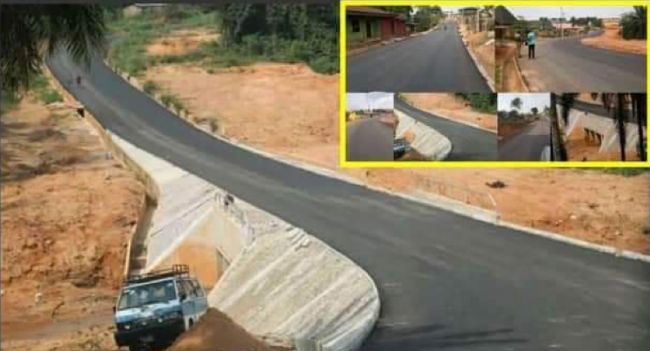
After more than fifteen hours on the road – each pothole, checkpoint, and detour etched into my bones – I felt the weight of fatigue begin to lift. A lightness took its place, as though we were no longer pushing against the road’s trials but being carried home by its benevolence. The swift passage through these towns painted a portrait of quiet transformation. Alayi’s squares and spaces, now dim and shuttered by dusk, now extended into the night under solar-powered lights. A solitary Woman bundled loads on their heads, her silhouette graceful against the glow – an image far removed from the fearful evenings of years past. Igbere junction also hummed with subtle activity: young men on motorcycles by kerosene lamps, fueling the transport networks that connect these communities and their far flung villages. The road itself was a marvel – freshly paved, free of the craters that once turned travel into an ordeal, flanked by drainage systems that kept the rains from swallowing the highway. Above us, the stars multiplied in the clear sky, unfiltered by pollution, reminding me of childhood nights spent staring upward in Abiriba, imagining the creation stories where the Supreme Being scattered lights across the void.
An Uncle once described traveling these same stretches when they were little more than dirt tracks, riddled with tales of bandits and forcing men and vehicles to move in convoys in tight formation. Now, the smoothness invited contemplation rather than vigilance – a testament to progress shaped by collective effort.
My body, though exhausted, felt renewed by proximity to home. Muscles knotted from hours of bracing began to loosen; my eyes, heavy from scanning shadows, softened; even the persistent thirst seemed to ease. Emotion swelled in me like a river after drought – relief, yes, but also a deeper contentment, a sense of reclamation that made every ache feel worthwhile. I found myself reflecting on the alchemy of journeys: how adversity sharpens appreciation, turning ordinary arrivals into sacred rites. In the quiet hum of the engine, I thought of the belief that when a person commits to a path, the universe aligns with that resolve. Our persistence had met the road’s mercy, and the reward was this swift, peaceful passage.
But what amplified this relief most was the transformation in security. Late-night driving, once a gauntlet of dread, had become a meditative voyage. No longer did every shadow feel like a threat. Restored checkpoints and coordinated patrols – visible signs of renewed commitment – added layers of assurance that allowed my mind to wander freely, savoring the scenery rather than scanning for danger. This shift was profound. It soothed the psyche after hours of quiet fear: fear of ambushes by armed groups, fear of kidnappings that have scarred families across the southeast, fear of herdsmen incursions that turn fertile lands into contested spaces. Improvements like these are not conveniences; they are lifelines. They allow night markets to thrive, families to reunite without terror, and travelers like me to embrace the night as an ally rather than an adversary.
This newfound safety was the result of a collaboration between people and government – a symphony of grassroots resilience and strategic leadership. Communities have taken ownership of their security: vigilante groups, formed in response to the insecurity of the post‑2010 era, now patrol with discipline and local insight. In towns like Alayi, I’ve heard accounts of these groups training under seasoned community figures who lived through earlier conflicts, turning historical trauma into proactive defense. They organize night watches, share intelligence through community networks, and build trust that deters crime before it takes root. This spirit of unity has reduced incidents dramatically, allowing commerce and social life to extend into the night.
Government efforts have complemented this foundation. Under Governor Alex Otti, investments in road infrastructure have doubled as security measures – better lighting, improved visibility, and coordinated deployments of joint task forces. Initiatives like the Abia Security Trust Fund have brought surveillance tools and community partnerships into the fold. The approach echoes earlier reconstruction efforts but with a more inclusive, community-centered philosophy. The benefits ripple outward: safer roads boost trade, enabling farmers in Igbere to transport produce without fear; young people find reasons to stay and build rather than migrate; cultural festivals regain their vibrancy; and the psychological burden of fear begins to lift.
In that moment, driving through the night with the road stretching ahead like a promise, I felt the full weight of what had changed. The night, once a shroud of uncertainty, now revealed possibilities. Every mile became an affirmation of progress, a quiet declaration that the land was reclaiming itself – and welcoming us home.
These thoughts crystallized into memorable reflections, etching this journey into the annals of my personal travelogue as a chapter of triumph over tribulation. I remembered a particularly harrowing trip in 2015, when rumors of gunmen forced travelers to abandon the main road near Igbere and slip into bush paths, navigating by flashlight with hearts pounding, emerging muddied and shaken. To contrast that terror with tonight’s seamless sweep felt like redemption – an arc from peril to peace that underscored how human agency, when aligned with collective will, can reshape destiny. Another memory surfaced from the 2020 EndSARS unrest, when the east briefly lost its checkpoints and the resulting vacuum bred chaos. Seeing those checkpoints restored under Otti’s administration now felt symbolic – a blend of authority and empathy returning to the landscape. I reflected that true security is holistic: community vigilance prevents crime at its roots, while government infrastructure provides the scaffolding. Together, they create the conditions for tourism to flourish, allowing visitors to explore Igboland’s rich tapestry – from the ancient stone monoliths associated with Igbere’s early settlements to the pottery traditions that have long defined Alayi – without hesitation. This late-night drive, buoyed by such relief, felt like a personal renaissance. The fears I had carried earlier shrank to whispers, replaced by swelling pride in our collective strides. In a region where history has often been a ledger of losses – from the slave raids of the 18th century to the devastation of the civil war – resilience continues to bloom, turning roads into rivers of renewal.
At last, the familiar checkpoint into Abiriba appeared on the horizon, its outline materializing like a long-awaited embrace. A heavy wooden beam, hewn from local timber, blocked the road – a simple but sturdy barrier glowing faintly under the floodlights. Instead of irritation, a surge of relief washed over me, profound and unexpected. I had heard whispers that the soldiers were gone for good, reassigned amid shifting federal priorities, leaving a void that could invite the shadows back. But here they were – present, steady, a layer of protection restored. Stepping out of the car, the cool night air invigorating my senses, I walked toward them, gravel crunching beneath my feet like applause for this moment. Their faces, illuminated by the interplay of light and shadow, carried the familiar warmth of the region. “I heard you had left for good?” I asked. “No,” one replied with a smile, “just an assignment – we’re back now.” “It’s good to have you back,” I said, and meant it. In that brief exchange, layered with mutual respect, the relief deepened. Here was the human face of security – not an imposition, but a partnership – allowing late travelers like us to arrive not in fear, but in fellowship.
The checkpoint became a pinnacle in the night’s renaissance, weaving relief, security, and communal triumph into a tapestry that elevated the entire journey. The fears I had carried – once looming giants – now receded, overshadowed by the benefits of these improvements: safer paths fostering economic vitality, cultural preservation, and a renewed sense of possibility. As we cleared the beam and pressed toward Abiriba’s heart, the road felt like a promise fulfilled, a testament to endurance where government vision and community resolve converge to light the way home.
With a final nod from the soldiers, their smiles lingering like sentinels of goodwill in the rearview mirror, the road opened into the embrace of Abiriba itself. The name alone stirred a symphony of memories that quickened my pulse. “Kaa,” I whispered involuntarily – the Abiriba greeting that marks both arrival and departure – slipping out like a prayer answered, a shorthand for the profound relief of crossing thresholds. The first roundabout emerged under the soft glow of newly installed streetlights, a circular sentinel where roads converged like veins to the heart. Signposts announcing upcoming events stood proudly, echoing the legacy of a people who, since the 18th century, forged trade networks across West Africa – from the influence of the Aro Confederacy to the modern business magnates who built fortunes in Lagos and beyond.
As we cleared the checkpoint with a final nod from the soldiers, their silhouettes fading into the rearview mirror like quiet guardians, the road opened into the familiar contours of Abiriba. Even at this late hour, the name alone stirred something deep in me – a tightening in the chest that comes when a long journey finally yields to home. The Amaogudu roundabout appeared almost immediately, its shape emerging under the muted glow of the streetlights. A right turn there would have taken us into Amaogudu proper, but we stayed on the main road, letting the car roll past its quiet circle.
The night was still, the kind of stillness that settles over Abiriba when the day’s bustle has folded into rest. Houses along the roadside were mostly dark, save for the occasional glow of a generator-powered bulb or the faint flicker of a television behind half-drawn curtains. The road ahead curved gently, leading us toward the older, well-known roundabout – the one generations of travelers have used long before newer expansions reshaped the town’s edges. Even in the dimness, its outline was unmistakable, a familiar landmark that signaled the true entry point into the heart of Abiriba.
We veered right at that roundabout, taking the route toward Agbor Court. The turn felt like slipping into a well-worn groove, a path my memory recognized even before my eyes fully registered it. The neighborhoods here were quiet, their compounds closed for the night. A few gates stood slightly ajar, revealing only shadows and the faint glow of dying embers from evening cooking fires. The air carried the scent of red earth cooling after a long day, mixed with the distant hum of generators and the soft chorus of night insects.
The final stretch unfolded with a calm that felt almost ceremonial. Trees arched overhead, their branches forming a natural canopy that filtered the moonlight into soft patches on the road. The familiar iron gate of the compound came into view at last, its silhouette steady and reassuring. Seventeen hours had passed since Lagos, yet in that moment, the exhaustion dissolved into a quiet, overwhelming relief. The long road, with all its trials and revelations, had delivered us home.
Abiriba revealed itself not through spectacle but through presence – the steady quiet of a town at rest, the subtle glow of a few scattered lights, the contours of streets shaped by generations. Even at 11 p.m., with most of the town asleep, the essence of the place was unmistakable: a blend of heritage, resilience, and quiet pride. The roundabout we had passed, the turn into Agbor Court, the muted rhythm of the night – all of it formed a simple, honest welcome. No grand scenes, no bustling activity – just the profound comfort of arrival.
After these interminable hours – seventeen in total, an odyssey that had tested every fibre of my being, leaving my body mapped with aches from the unyielding seat, my hands stiff from gripping through turbulent stretches, and a weariness so deep it made my eyelids feel weighted – my emotions rose in a wave of cathartic release. It was a fulfillment that went beyond physical relief. I felt lighter, as though the journey’s burdens had been distilled into something wiser, leaving behind a quiet triumph and a soulful joy. Home, in that moment, was not just a destination; it was a healing force, stitching together the small fractures that distance and doubt had created.
My thoughts drifted into deeper reflections on the meaning of home in the Igbo imagination – how it is both anchor and aspiration. There is a saying that home is good, but other places also have their value; yet after a journey like this, the goodness of home shines with unmatched clarity. The potholes, the dust, the tension – they all shrank into footnotes in a much larger narrative of return. The improvements in security amplified this feeling. What could have been a tense finale became a calm procession. Restored checkpoints and renewed community vigilance had reshaped late-night travel from a gamble into something closer to a gift. The fears that once haunted every bend – ambushes, armed groups, the unpredictable shadows – faded into the background, replaced by a growing trust in the quiet efficiency of the system. That relief added layers to the experience: emotional freedom, the ability to savour the journey’s beauty, and the knowledge that night-time movement now supports family reunions and small trades that keep the community alive.
The synergy between the people and the government has been central to this transformation. Grassroots efforts remain the backbone – Abiriba’s age-grade system, a centuries-old structure for communal organisation, has adapted into modern security committees that patrol with torches and radios. These groups draw from older traditions of communal order, updated for present needs. A neighbour once shared how, during a spike in kidnappings in 2018, these committees worked with community leaders to identify vulnerable spots, reducing incidents through vigilance rather than fear. It is a people-powered model that channels youthful energy into protection rather than desperation.
Government efforts complement this foundation. Under Governor Otti, surveillance at key entry points and stronger collaboration with federal forces have reinforced the region’s defences. The approach echoes earlier periods when coordinated efforts helped stabilise communities after unrest. The benefits ripple outward: safer roads attract investment, allowing Abiriba’s entrepreneurs to potentially expand businesses; cultural events can hold their gatherings without anxiety; and socially, trust begins to mend after decades of marginalisation that followed the civil war. In my reflections, this journey felt like a pinnacle – contrasting sharply with another 2019 trip a friend made, when a midnight breakdown between Uzuakoli and Akara junction left travellers tense and fearful amid rumours of bandits. Tonight’s assured passage underscored how far things have shifted. Security’s relief had turned endurance into insight, making late driving feel almost meditative, deepening my bond with the land.
And then the gate creaked open. The compound lay bathed in the soft glow of a porch bulb, and the moment crystallised. My aunt, Nwulari, who had already retired for the night, stirred at the sound of our arrival. Her silhouette emerged in the doorway, steady and familiar. My wife’s hug erased the chill of the road; the kiss dissolved the day’s spectrum of emotions into something warm and whole. Suddenly, the potholes, the dust, the grit – all of it felt insignificant, mere trials that heightened the sweetness of return. Home revealed itself as both place and fulfillment: the community with its layered histories, the house standing firm against time, my wife’s presence a constant flame, and the scent in the air – a blend of that peculiar Abiriba smell only natives understand, distant cooking fires, and fertile earth – unmistakably Abiriba, imprinting itself on the soul like a signature.
In this homecoming, the night’s renaissance reached its peak. Exhaustion intertwined with ecstasy, fear with fortitude, forming a tapestry of unbreakable spirit. The seventeen-hour saga, rich with glimpses of revival and reflections on resilience, affirmed that in Igboland, every journey home is a victory – a crossing from shadow into light, where community and progress illuminate the path.
And so, in the quiet after the journey’s end, with the compound gate latched behind us and the night settling gently over Abiriba, my mind drifted back to the illuminated road. I thought of the thriving night in Uzuakoli, where vendors’ fires glowed like small acts of defiance; the pulse of Akara Junction, alive with motion and melody; and the seamless glide through Alayi and Igbere that carried us home with unexpected ease. Now seated on the veranda, a cup of hot tea warming my hands, I replayed these scenes not as fleeting impressions but as signs of change – fragments of a larger mosaic whispering of renewal in Igboland’s tired heart. The exhaustion of seventeen hours softened into a contemplative glow, leaving room for the understanding that this single drive had captured something transformative: a quiet revolution unfolding under the cover of night.
What I was seeing in those retrospective flashes revealed a landscape quietly alive with renewal, each junction and stretch offering its own proof that resilience was reclaiming the narrative. Uzuakoli’s checkpoint – unmanned yet vibrant – no longer felt like a relic of imposed authority but a space reshaped by the people themselves. Women sold bread under strings of bulbs powered by small generators, their makeshift stalls extending the warmth of their homes into the night. Scenes like this have long roots in the region’s post‑colonial years, when communities built informal night markets to sustain themselves as formal structures faltered. Akara’s chaotic symphony – kekes weaving through crowds, the hiss of roasting meat drawing clusters of hungry travelers – echoed the entrepreneurial energy that has defined Igbo communities for generations. Tonight, that energy felt amplified by the simple fact that the night was safer, allowing commerce and movement to spill into hours once surrendered to fear.
The glide home, smooth and unhindered, showcased the quiet power of infrastructural upgrades: fresh asphalt catching the moonlight, drainage channels keeping the road firm where floods once carved gullies, and the absence of the deep craters that used to turn travel into endurance tests. These roads trace the same corridors that once linked communities in the Aro trading era, but now they support modern logistics without the old perils of erosion or isolation. An Elder once recounted how, in the 1960s, these same routes could become impassable after heavy rains, forcing travelers into long detours. Tonight’s efficiency felt like a gentle rebuttal to that memory – a visual affirmation that the East is stirring from its long slumber.
After seventeen hours on the road – hours that etched fatigue into my face, stiffened my limbs, and layered my thoughts with dust and doubt – I found myself overwhelmed by a profound gratitude. Physically drained but spiritually replenished, I felt emotions mingling like tributaries into a single river: relief at the journey’s end, yes, but also a rising hope sparked by the scenes I had witnessed. It felt as though I had glimpsed a pivot point, a subtle shift in the region’s story. For decades, the East has been defined by departure – its brightest minds and strongest hands leaving for Lagos, Abuja, Port Harcourt, or overseas, chasing futures that seemed impossible to build at home. Villages became seasonal museums, lively only during Christmas or funerals. Houses stood silent for most of the year, waiting for the annual return of their owners. This exodus, intensified after the civil war, drained the region of talent that might have rebuilt it.
Yet tonight, the relief brought by improved security hinted at a possible reversal. Late‑night travel no longer felt like a gamble. Restored checkpoints, coordinated patrols, and community watches had woven a safety net that allowed the night to breathe again. Travelers no longer braced for the unknown at every bend. The assurance was visceral – a lifting of invisible weights. After hours of harboring quiet dread, I could finally breathe deeply, savor the scenery, and imagine futures rooted here rather than elsewhere. Security, I reflected, is not accidental but deliberate. It creates emotional freedom, allowing families to reunite without fear, and economically, it extends the life of local markets, encouraging the diaspora to return not just for holidays but for investment.
The synergy between people and government has been central to this shift. Communities have stepped forward as architects of their own safety. Vigilante networks in places like Uzuakoli and Akara draw from long-standing traditions of communal responsibility, now updated with mobile alerts and youth training programs. During a visit in 2015, I saw residents in Alayi pool resources to install floodlights after a series of robberies – a simple act that strengthened both security and solidarity. These grassroots efforts reduce incidents, empower youth, and create a culture of accountability that prevents the desperation fueling crime.
Government actions complement this foundation. Under Governor Otti, targeted policies – improved lighting on major roads, better coordination with federal forces, and the deployment of rapid-response teams – have strengthened the region’s defenses. These measures build on earlier models of community‑government cooperation but adapt them to today’s realities. The benefits ripple outward: safer environments attract investment, allowing entrepreneurs in towns like Abiriba to expand businesses; families feel confident enough to return permanently; schools fill again; cultural festivals regain their vibrancy; and the psychological burden of fear begins to lift.
In the quiet afterglow of arrival, these thoughts crystallized into a sense that the journey had been more than a drive – it had been an essay in hope. Uzuakoli’s lights, Akara’s energy, the seamless glide through Alayi and Igbere – all of it felt like a dawning era for the East. The reversal felt tangible, a countercurrent against decades of outflow, promising villages alive with steady vitality. Settling into the embrace of home, I felt the night affirm that with collective will, the story of departure can indeed be rewritten into one of return.
And then my mind wandered further, asking whether the road itself might be becoming the conduit for a new story – a narrative artery pulsing with the lifeblood of transformation. Sitting in the quiet after arrival, the compound walls echoing with the soft sounds of night, I found myself unraveling the deeper mechanics of this reversal. What if this “reverse migration” is not just nostalgia but the foundation of a genuine renaissance? A rebirth woven from infrastructure, heritage, and collective agency. It begins with the basics: roads that work, power that stays on, connectivity that links villages to the world. When these foundations hold, everything changes. A road that is no longer a gauntlet but a gateway shifts the entire psychology of a region. It replaces uncertainty with possibility. It creates an ecosystem where ambition can take root without the constant threat of disruption.
In that quiet moment, I realized that this journey had shown me more than the road home – it had shown me the road ahead.
What I was seeing in my mind’s eye, replaying the night’s vignettes like a slow‑turning reel, revealed the quiet gears of change turning across the landscape we had crossed. In Uzuakoli, the unmanned checkpoint had become more than a crossing point; it was a small ecosystem of resilience. Vendors arranged their goods under modest lights powered by rechargeable lamps and small solar units – the kind of community-driven adaptation that has grown in recent years as people seek reliable ways to keep their livelihoods running after dark. Women bundled bread and produce for early-morning deliveries, their confidence buoyed by the knowledge that the road ahead was safer than it had been in years. It wasn’t grand, but it was real – a micro-economy strengthened by predictability.
Akara Junction’s whirlwind – kekes weaving through crowds, the aroma of roasting meat drawing clusters of travelers – embodied the kinetic energy that thrives when people feel secure enough to stay out late. Historically, Akara has always been a crossroads for local trade, and tonight it pulsed with that same spirit, now amplified by the simple fact that the night no longer belonged to fear. Small traders could extend their hours, riders could ferry passengers without dread, and the community’s rhythm could stretch naturally into the late evening.
The glide through Alayi and Igbere showcased the quiet power of improved infrastructure. Freshly paved surfaces, free of the deep craters that once defined the route, made the journey smoother and safer. The drainage channels along the road – simple but effective – kept the shoulders firm where rains once carved gullies. These improvements didn’t erase the past, but they softened it. A friend once told me how, in the early 2000s, this same stretch could become nearly impassable after heavy rain, forcing drivers into long detours. Tonight’s ease felt like a gentle rebuttal to that memory – a sign that the region was slowly, steadily reclaiming its footing.
These scenes unraveled deeper narratives: the road as a metaphor for mobility, both literal and social. A young artisan anywhere along this reconstructed road, crafting pottery or weaving baskets, could now transport goods to Umuahia or Aba without the prohibitive costs of delays or damage. A small business owner in Abiriba, or elsewhere, relying on more stable power and better connectivity than in years past, could run an online shop or manage clients remotely without constant disruption. I remembered a university friend who once abandoned a promising idea because the infrastructure simply couldn’t support it. Tonight’s illuminated path suggested a counter-story – one where such talents might return, their ideas finding fertile ground at home.
After these exhaustive hours – a journey that had imprinted its rigors on my body like a map of endurance – my emotions swelled into a layered gratitude. My joints ached, my skin carried the dust of the road, and my mind was only just emerging from the fog of sustained vigilance. Yet beneath the fatigue was a rising optimism, grounded and steady. Relief from the journey mingled with excitement for what the night’s scenes hinted at: a region quietly shifting, gears turning beneath the surface.
Thinking deeply, I reflected on how reverse migration – long spoken of as a dream – might be gaining momentum. Not through grand declarations, but through the slow, steady torque of infrastructure. When roads work, everything else begins to move: goods, people, ideas, capital. A fish or Poultry famer in Abiriba, Igbere, Akara or Uzuakoli could deliver to Umuahia by dawn. A trader in Item could link with a buyer in Uzuakoli without fear of breakdowns or ambush. A young graduate could decide to settle down in Abiriba and run a digital service without needing to relocate to Lagos or Abuja. These are small shifts, but they accumulate – each one a thread in a larger tapestry of renewal.
Security improvements amplify this momentum. The layered protections – checkpoints, patrols, community watches – have transformed late-night travel from a gamble into a viable option. Shadows no longer dictate detours. Travelers can focus on potential rather than peril. Families can plan evening outings without the gnawing anxiety that once curtailed ambition. This relief creates feedback loops: safe roads enable consistent deliveries; consistent deliveries build trust; trust attracts investment; investment creates jobs; jobs reduce desperation; reduced desperation strengthens security. It is a quiet, intricate dance – but it is happening.
The synergy between people and government has been central to this shift. Grassroots efforts remain the backbone. In communities like Igbere and Uzuakoli, age-grade associations and local committees have taken on roles in advocacy, maintenance, and vigilance. During a visit in 2012, I saw residents in Alayi filling potholes themselves after waiting too long for repairs – a small act of agency that has since evolved into more structured partnerships with local authorities. These community-driven efforts reduce incidents, empower youth, and create a culture of shared responsibility.
Government actions complement this foundation. Under Governor Otti, targeted investments – better lighting on major roads, improved coordination with security agencies, and more responsive maintenance – have strengthened the region’s defenses. These are not sweeping reforms, but they are meaningful. They address long-standing gaps and create conditions where people can imagine staying, building, and thriving.
The benefits ripple outward: safer environments attract investment; families return more often; schools fill again; cultural events regain their vibrancy; and the psychological burden of fear begins to lift. In my reflections, I contrasted a desolate Christmas drive in 2005 – when empty homes in Igbere mirrored the region’s hollowed spirit – with tonight’s vibrant pulse. The difference was not just in the scenery but in the feeling: a sense that the East was stirring, slowly but unmistakably.
These thoughts crystallized into the understanding that this journey had been more than a drive. It had been a quiet attempt in hope. Uzuakoli’s lights, Akara’s energy, the smooth glide through Alayi and Igbere – all of it felt like the early signs of a region rewriting its story. A countercurrent to decades of outflow. A whisper of return.
And as I sat in the quiet after arrival, the compound walls holding the soft sounds of night, I found myself imagining the road not just as a path home, but as a conduit for a new story – one where infrastructure, security, and community converge to create a future that feels possible again.
In my reflections, the gears of change crystallized through personal lenses. I remembered a 1998 drive when a breakdown near Uzuakoli left travelers stranded through the night, nerves frayed by rumors of bandits and the uncertainty that once defined these roads. That vigil felt like a symbol of the East’s stagnation – movement stalled, hope suspended. Tonight’s fluid passage stood in stark contrast: a manufacturer delivering goods on time, a young professional making a late meeting without fear, each moment hinting at a region quietly rediscovering its rhythm. Another memory surfaced from stories of the 1970s, when many left the East after the war and returned only occasionally. Now, some of those same individuals come back more frequently, drawn by improvements that make mentoring, investing, or simply reconnecting feel viable again. It is a cycle beginning to close – security and opportunity interlocking in ways that turn late-night drives from anxious endpoints into launchpads for new beginnings.
In this wider contemplation, the road’s new story unfolded as a quiet engine of renewal, its gears meshing security, infrastructure, and human will into a force nudging Igboland toward vitality. Reverse migration, long dismissed as sentimental nostalgia, began to appear instead as a strategic reclamation – an economic and cultural recalibration where departure slowly yields to presence. As the night deepened in Abiriba, the echoes of the journey affirmed that with these mechanisms at work, the East’s narrative may indeed be shifting toward a brighter chapter.
The implications ripple outward like concentric waves from a stone cast into still water, touching every facet of Igboland’s social and economic fabric. Sitting on the veranda, the steam from my soup curling upward in the dim light, my reflections deepened into the cascading effects of this transformation. Secure roads and revitalized communities become fulcrums for broader change. If this foundation holds – sustained infrastructure, consistent security, and community initiative – these towns will no longer be dormant repositories of memory, animated only during festive seasons. They could become active workshops of the future, places where innovation is shaped by local ingenuity rather than exported to distant cities.
One can imagine cottage industries taking firmer root in Alayi – textiles, crafts, food processing – scaled modestly but sustainably for regional markets. In Abiriba, small tech clusters could emerge in homes and compounds, where young people collaborate on digital services or creative projects without needing to relocate. In Uzuakoli, creative groups might blend traditional designs with modern media, producing content that travels far beyond the town’s borders. None of this requires megacity infrastructure – only stability, connectivity, and the confidence that effort will not be undone by insecurity. As more people choose to build at home, the pressure on Lagos eases, and the heartland regains its pulse, echoing the decentralized prosperity that once defined pre‑colonial Igbo society.
This is how a “super city-state” forms – not as a single sprawling metropolis, but as a network of revived, interconnected towns, each leveraging its strengths. Abiriba’s entrepreneurial heritage, Igbere’s agricultural backbone, Alayi’s artisanal traditions – woven together, they create a resilient web that distributes growth rather than concentrating it. The East’s enduring strengths – community, self-reliance, adaptability – have carried it through upheavals before. Coupled with infrastructure and governance that enable rather than extract, those strengths could become engines of sustainable development.
These visionary projections, layered over the night’s actual scenes like a translucent overlay, revealed the subtle gears of this ripple effect. In Uzuakoli, the thriving night market was more than commerce; it was a prototype for dispersed innovation. Vendors experimenting with simple preservation tools could one day form cooperatives supplying regional markets, their reliability supported by roads that no longer collapse under rain. Akara’s pulse hinted at the potential for more organized transport systems – nothing futuristic, just better coordination, digital payments, and predictable routes that keep economic activity local. The glide through Alayi and Igbere suggested workshops in embryo: farmers adopting improved methods through local training programs, artisans repurposing family compounds into shared workspaces, young creatives digitizing cultural motifs for broader audiences.
Deeper narratives emerged: the road as a network transmitting ideas across towns, where a graduate in Abiriba collaborates remotely with a fabric maker in Igbere, or where community groups in Uzuakoli pool resources for small solar installations that power evening businesses. I thought of someone I knew who left Lagos during the pandemic, worn down by costs and congestion, and returned to Abiriba to run a remote consultancy that now employs locals. It was a small story, but it captured the essence of dispersion – cities relieved of pressure, heartlands revitalized by returning talent.
What the night revealed was not a fantasy, but a possibility – one rooted in what already exists, and what could grow if the conditions continue to align.
After these marathon hours – seventeen in total, a stretch that had carved fatigue into my muscles and left my palms imprinted with the stubborn grip on the handles – my emotions settled into a layered calm. The tension in my back, the grit on my skin, the dryness in my throat all softened in the presence of home, leaving my mind open and alert, ready to absorb the meaning of what this journey had revealed. The haze of exhaustion lifted just enough to let exhilaration seep in, a quiet thrill at the implications of what I had witnessed along the road. Personal relief blended with a broader sense of hope, turning my arrival into something larger than myself – a feeling that I had stepped into a moment where history might be turning gently toward renewal.
Thinking deeply, I found myself reflecting on how movement across the East is beginning to shift. Not toward a single megacity, but toward a network of towns – each with its own character – slowly becoming more connected, more confident, more capable of holding onto its people. Abiriba’s long-standing mercantile spirit, Igbere’s agricultural backbone, Alayi’s crafts and small trades – these identities, once overshadowed by the gravitational pull of Lagos, now seemed poised to work together through improved roads, better security, and a growing sense of possibility. This kind of dispersion doesn’t require grand declarations. It begins with small, steady changes: cottage industries finding reliable transport routes, young professionals able to work remotely without constant disruption, creative groups sharing their work online from home rather than relocating to distant cities.
Governance that supports rather than extracts strengthens this shift. When communities can contribute to their own development – through local levies, cooperative projects, or simple maintenance efforts – their sense of ownership deepens. It echoes older Igbo traditions of communal decision-making, where progress was built from the ground up. Even modest initiatives, like using agricultural by-products for small-scale energy solutions or coordinating water management in flood-prone areas, can reduce environmental strain and create local jobs. These are not fantasies; they are practical steps that towns across the East have already begun exploring in small ways.
Security improvements magnify all of this. The relief of traveling at night without the old dread – of ambushes, stalled vehicles, or deserted stretches – creates space for life to expand. When people feel safe, evening markets stay open longer, transport runs later, and ideas move freely across communities. This confidence becomes a catalyst: investors take more interest, young people stay longer, and families plan without fear. It creates a loop where safety encourages activity, and activity reinforces safety.
The partnership between people and government is central to this momentum. At the community level, age-grade groups and local committees continue to play vital roles – organizing cleanups, supporting small repairs, coordinating neighborhood watches. These efforts aren’t new, but they’ve taken on renewed importance as towns look inward for solutions. In places like Abiriba and Alayi, residents have long pooled resources to fix roads or improve lighting when official responses lagged. These acts of self-reliance, rooted in tradition, now align with more responsive governance, creating a synergy that feels promising rather than burdensome.
Government actions complement this foundation. Under leaders like Governor Otti, targeted improvements – better road surfaces, more consistent patrols, clearer coordination with federal agencies – have made travel more predictable. These aren’t sweeping transformations, but they are meaningful. They create the conditions where people can imagine building, staying, and thriving at home.
The benefits ripple outward: diversified local economies, cultural events that feel safer to attend, families spending more time together, and a growing sense that the East can chart its own path without relying solely on distant cities. In my reflections, I contrasted the chaos of Lagos in the 2000s – overcrowded, strained, overwhelming – with tonight’s calm glide through familiar towns. The difference wasn’t just in geography; it was in the feeling that the East was beginning to reclaim its heartbeat.
In this wider contemplation, the road’s story unfolded as something more than asphalt and distance. It became a symbol of what could emerge when security, infrastructure, and community align. The journey’s echoes suggested that the East’s long narrative of departure might be slowly giving way to one of return.
This possibility wasn’t a fantasy born from the relief of arriving safely. It came from what I witnessed along the way: steady lights guiding the highway, markets alive with calm activity, people moving without anxiety, and a checkpoint manned by someone whose quiet confidence reflected a broader shift. These small scenes suggested a region slowly reclaiming its nights and its autonomy.
Transformation grows from simple decisions – choosing to invest rather than abandon, to organize rather than wait, to support rather than obstruct. With each improvement, the East feels less like a place one escapes and more like a destination shaped with intention.
Homecoming will always stir emotion, but it no longer needs to be tied to hardship. That night revealed a different possibility: a journey defined not by dread but by steady assurance, leading into a landscape quietly reinventing itself. A place preparing for its own renewal.
That realization reshaped everything. Home became less a refuge and more a platform – somewhere to build, not merely return to.
As the night’s impressions settled, a clearer picture emerged: progress rooted in small, deliberate acts. Streetlights reflected thoughtful planning that extended business hours and restored confidence. Markets showed how cooperation and adaptation strengthen livelihoods. The checkpoint reminded me that security is ultimately human – people choosing to uphold stability. Even the smooth road beneath us spoke of layered effort: federal work, state attention, and community oversight. A story a neighbor once shared about a single borehole transforming his village resurfaced, reminding me how meaningful change often begins with one well-placed step.
After seventeen demanding hours, my body was exhausted, but my mind felt sharpened. Relief blended with a sense of possibility. I sensed that the region, long burdened by neglect and migration, might be entering a quieter, steadier phase of renewal. Each repaired road, each strengthened market, each safe passage contributes to an environment where people can build rather than merely endure. In such a setting, small cooperatives thrive, artisans expand their reach, and returnees find space to apply their skills. Homecomings become foundations for growth.
Improved security reinforces this momentum. Traveling at night without fear turns the highway into a channel for opportunity. When checkpoints function and communities remain vigilant, the darkness becomes usable again. Movement – of ideas, goods, and people – flows more freely. Confidence grows. Safe roads attract investment, investment strengthens communities, and stronger communities deepen security. It becomes a self-sustaining cycle.
This progress rests on collaboration. Grassroots groups maintain shared facilities, support local businesses, and keep neighborhoods organized. These long-standing traditions of mutual support now align with more responsive governance. Residents help maintain lighting and sanitation, creating conditions where enterprise can flourish. Government contributes through targeted repairs, better coordination with security agencies, and clearer planning. These may not be dramatic reforms, but they create the stability needed for growth.
The benefits unfold across multiple layers. Economically, improved roads and safer nights strengthen supply chains and expand market reach. Culturally, communities can host events without fear, blending tradition with modern expression. Socially, families feel more connected, less fragmented by distance or danger. Environmentally, small-scale improvements – better drainage, cleaner streets – lay groundwork for sustainable practices. Politically, stability grows when people see tangible progress in their daily lives.
In my reflections, these gears converged into vivid contrasts: memories of journeys defined by hardship set against tonight’s steady glide; the soldier’s calm presence at the checkpoint; Uzuakoli’s market glowing with possibility. Even my years away, spent navigating the chaos of Lagos, now seemed to affirm the East’s emerging potential. The difference was not just in the road, but in the feeling that the region was beginning to reclaim its agency.
In this culminating reverie, the night’s renaissance crystallized into a future not imagined but gradually built – one where the East’s roads lead to places alive with purpose, where communities are not waiting for rescue but preparing for renewal. The seventeen-hour odyssey, rich with glimpses of reversal and resilience, affirmed that when these gears align, hardship gives way to steady progress, and home becomes not just a refuge but a foundation for what comes next.
As the first hints of dawn begin to pearl the eastern sky over Abiriba, filtering through the compound’s thatch and casting long shadows that mingle with the remnants of night, my reflections on this seventeen‑hour odyssey settle into a quiet affirmation of change. The road’s new narrative – shaped by improved security, better infrastructure, communal effort, and deliberate choices – feels less like a reversal and more like a gentle renaissance taking root in the soil of Igboland. What began as a weary drive through checkpoints and lively junctions has unfolded into a tapestry of interlocking moments: Uzuakoli’s unhurried market stalls, Umuahia’s steady streetlights, Akara’s confident bustle. Each scene hints at communities shifting from passive endurance to active shaping, forming a network of towns whose vitality eases the strain on distant megacities and strengthens local engines of self‑reliance. The emotional charge of homecoming, once tied to hardship, now hums with possibility – turning the road into a canvas where progress is drawn choice by choice.
In this broader retrospect, as the night’s vignettes merge into a single vision, I see the subtle gears of a future already turning. The soldier’s presence at the checkpoint reflects a renewed trust in systems that once faltered. The late‑night walkers in Akara, moving without fear, embody a confidence that allows small cooperatives and evening trades to flourish. Even the simple act of arriving home safely becomes part of a larger story – one that echoes earlier eras when communities built together after independence, stitching the East into a cohesive whole through shared effort. It mirrors the gradual return of many who once left, now drawn back by the sense that something is shifting, that the region is ready to work again.
After these seventeen exhaustive hours – hours that have left my body taut with fatigue, my mind sharpened by reflection, and my spirit buoyed by what the night revealed – I feel a deep, resonant peace. Gratitude blends with a forward‑looking energy, transforming my personal arrival into a threshold that feels communal, as though I’ve stepped into a moment larger than myself.
Thinking deeply, I see how these elements – community strength, responsive governance, and steady security – interlock to redefine home. Not as a place visited occasionally for rest, but as a living hub where building, creating, and thriving can happen year‑round.
The relief brought by improved security crowns this narrative. It smooths the machinery of choice, allowing journeys like mine to unfold without fear, sustaining the momentum of renewal. When people feel safe, they invest more boldly; when investments take root, communities grow stronger; and when communities grow stronger, security deepens. It is a cycle that reinforces itself.
The people and government, working in quiet alignment, have set these gears in motion. Their combined efforts – community vigilance, targeted road repairs, better coordination – form a blueprint for a future where agency and strategy weave together to build resilient networks across the East.
In the reflections that will further shape this travelogue in the next instalments, tonight’s glide stands as a pivotal chapter. It contrasts sharply with earlier journeys marked by tension and uncertainty, offering instead a glimpse of an alternative alive with purpose. It lays a foundation for what comes next.
And so, in this concluding reverie of part two, the journey distills into a beacon of hope. The road to the East, once a gauntlet, now feels like a path clearing steadily toward revival. As I rise from the veranda, the compound stirring with the first sounds of morning, I feel the pull of the next chapter – one rooted in the intimate rhythms of homecoming, where the broader shifts of the night meet the lived realities of daily life in a revitalized Abiriba. It promises reflections that bridge vision with reality, night’s possibilities with day’s unfolding truth.