By Enam Obiosio
UZOR Maxim Uzoatu’s ‘White Men Can’t Write’ is not merely a short story. It is a political fable disguised as absurdist comedy, a satirical parable that borrows the elasticity of folklore to interrogate corruption, neo-colonialism, mass psychology, media repression, and the dangerous seduction of miracle wealth. Like the finest African political allegories, it refuses to announce its targets explicitly. Instead, it trusts irony to perform the execution.
The story’s greatest strength lies in its understanding that the absurd is often the most faithful language for describing reality.
Chan Dum is deliberately exaggerated beyond human proportions. He is less a character than a myth manufactured by society itself. His wealth is so immeasurable that arithmetic becomes useless; mathematicians collapse before it. This hyperbole does not celebrate wealth. It ridicules society’s willingness to suspend reason whenever confronted by spectacular riches. Uzoatu suggests that once wealth exceeds comprehension, people stop asking where it came from and instead begin worshipping it.
The name ‘Chan Dum’ is itself ingenious. It sounds vaguely Chinese, suggesting global capitalism, international commerce, mysterious financial networks, and the contemporary African fascination with foreign economic power.
Yet the name ultimately belongs nowhere. It is an invented identity, reflecting the fabricated mythology surrounding the man himself. Chan Dum is both everywhere and nowhere, an archetype rather than an individual.
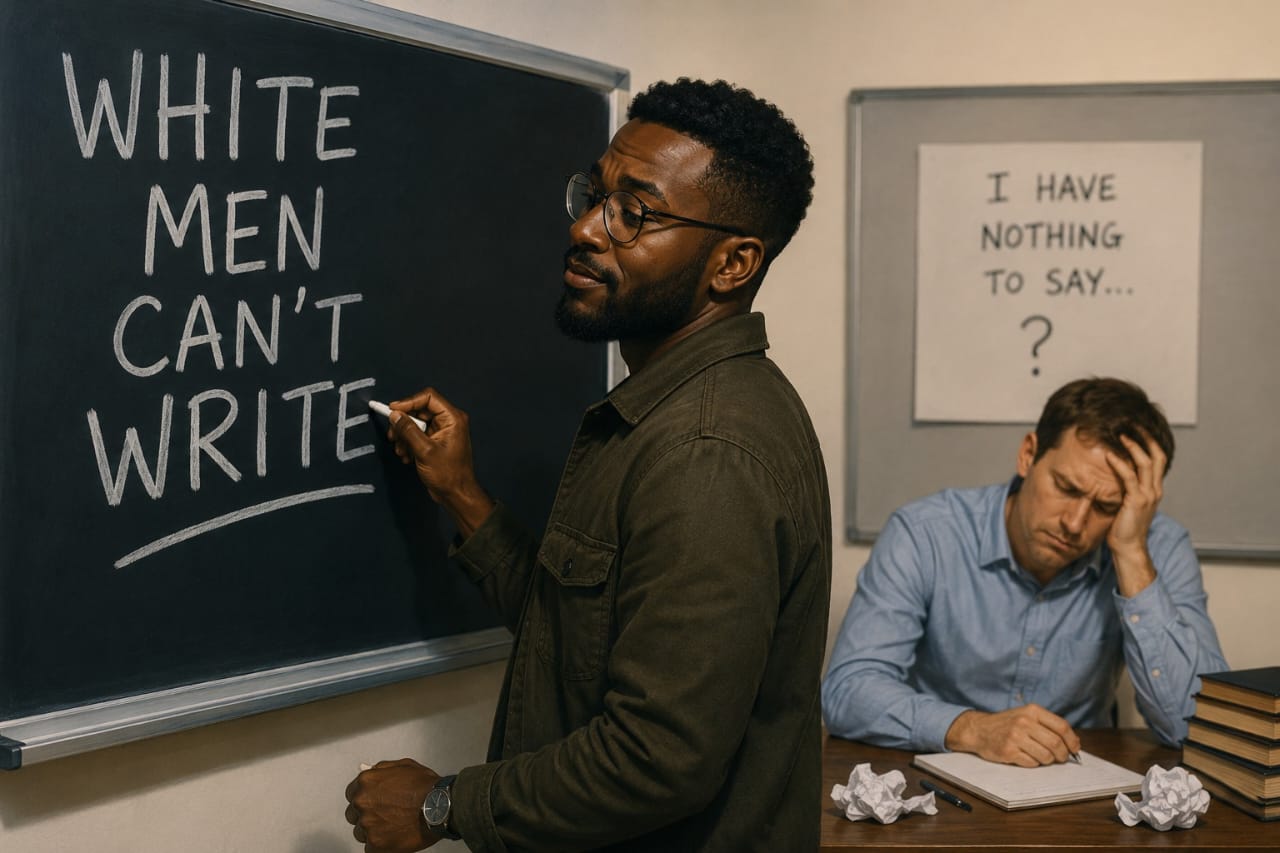
Perhaps the story’s boldest intellectual move is its inversion of colonial discourse. Throughout history Africa has often been portrayed as intellectually inferior to Europe. Chan Dum reverses this narrative with his outrageous declaration that “White men can’t write.”
The statement is obviously ridiculous on its face. White societies produced Shakespeare, Tolstoy’s translators, Dickens, Joyce, Hemingway, and countless literary traditions. Yet the absurdity is precisely the point. Chan Dum is not making a literary argument. He is manufacturing nationalist mythology to conceal criminal enterprise. His slogan functions exactly like political propaganda. It flatters local pride while distracting from uncomfortable truths.
The story therefore exposes one of power’s oldest techniques: invent an external enemy whenever internal scrutiny becomes dangerous.
The white man, interestingly, never actually appears. He exists only through Chan Dum’s narration.
This absence is profoundly significant. The supposed colonial threat may be real, imagined, exaggerated, or entirely fabricated. Uzoatu never resolves the ambiguity because the story is not ultimately about white people. It is about how African elites manipulate memories of colonialism to shield themselves from accountability. Colonial history becomes political currency rather than historical reality. The fortress itself operates as the story’s richest metaphor.
The people willingly construct the very structure that excludes them. They surrender half their land, labour without question, and create an architectural monument to their own political irrelevance. When completed, they realise it is impregnable not only to outsiders but also to themselves.
The irony is devastating. Oppression is not imposed. It is collectively constructed.
This recalls George Orwell’s insight that authoritarian systems survive not merely through force but through public participation. Kita’s people become architects of their own exclusion. Pita the Pressman represents perhaps the story’s moral centre.
His name is almost comically simple, yet his function is profound. He is journalism itself, the inconvenient voice that interrupts political theatre with empirical reality. He strips away mythology in a single sentence:
“You have just been paid handsomely by some dubious Europeans to transport toxic waste to Africa.”
Suddenly every previous claim collapses. Chan Dum is not defeating colonial exploitation. He is facilitating it.
The alleged nationalist hero has become an intermediary in environmental crime.
The irony here is exquisite. The same Europeans supposedly incapable of writing have successfully written contracts lucrative enough to recruit their loudest critic.
Even more contemporary is Chan Dum’s immediate response. “Pita the Pressman is fake news.”
With these four words, Uzoatu compresses an entire modern political vocabulary. Truth is no longer disproved through evidence. It is neutralised through branding. The accusation of “fake news” functions as censorship disguised as public scepticism. That this story anticipates the now-global weaponisation of the phrase gives it remarkable prophetic force.
Equally compelling is Uzoatu’s treatment of the crowd. The people of Kita are not portrayed as innocent victims. Neither are they monsters.
They occupy the morally uncomfortable territory between gullibility and complicity. They cheer. They praise. They labour. They never question. Only after the toxic waste appears do they flee.
The ending is especially brilliant because it denies readers emotional satisfaction. There is no heroic uprising, no revolutionary justice, no poetic punishment for Chan Dum. He remains safely inside the fortress while the people escape from the consequences of their own credulity. Justice never arrives. Reality does.
Stylistically, Uzoatu writes with the cadence of oral storytelling. His repetitions, rhythmic exaggerations, ceremonial speeches, praise names, and communal dialogue echo Igbo narrative traditions while simultaneously embracing the elasticity of magical realism. The language shifts effortlessly between proverb, political rhetoric, folklore, journalism, and grotesque comedy. The result is prose that frequently behaves like fermented poetry.
If there is one limitation, it is that the symbolism occasionally becomes so transparent that subtlety gives way to declaration. Chan Dum’s speeches sometimes explain what the satire has already demonstrated. A little more restraint might have deepened the ambiguity and invited greater interpretative participation from the reader. Yet this is a relatively minor criticism in a work that consciously adopts the performative excesses of oral satire.
Ultimately, ‘White Men Can’t Write’ is not about race, nor is it truly about writing. It is about narrative itself, specifically, who controls it, who believes it, and who profits from it. Chan Dum’s greatest fortune is not made by writing letters. It is made by writing a story that an entire community chooses to believe.
The final image encapsulates the entire moral architecture of the tale. The container holds no promised prosperity. Instead, it contains toxic waste, a bottle of beer, and an empty stamped envelope. The symbolism is devastating. The wealth was always refuse, the celebration always intoxication, and the celebrated ‘writing’ that supposedly produced limitless riches ultimately contained nothing at all.
The envelope is empty because the greatest fraud in the story was never the letter. It was the narrative.