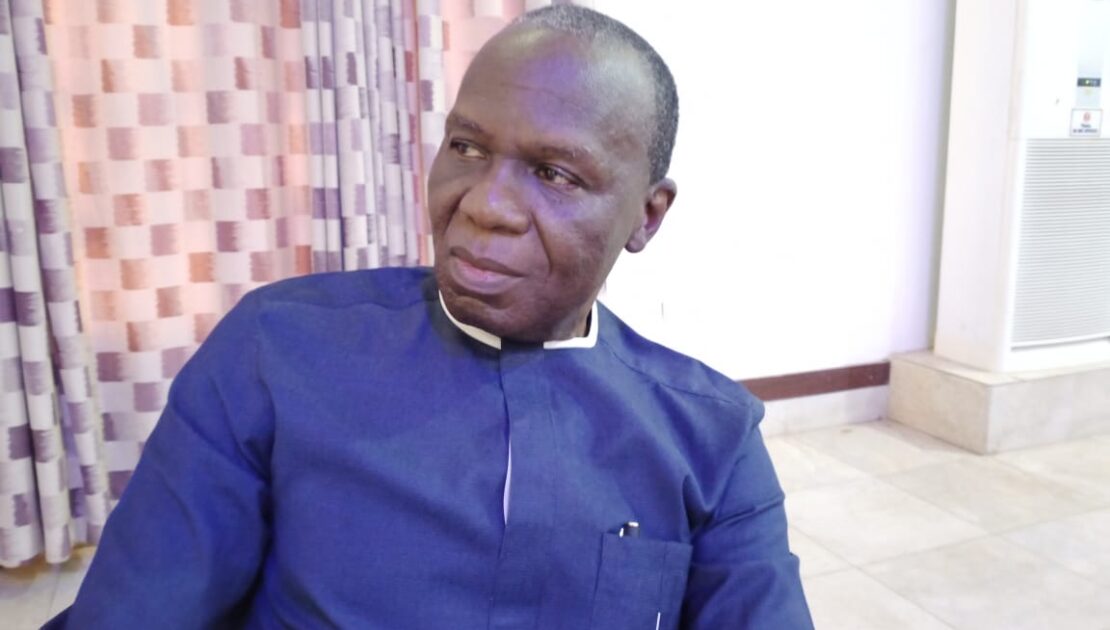
By Tony Onyima, Ph.D.
At about 8:45 a.m. on Thursday, August 20, 2026, I touched down at Incheon International Airport in Seoul after an exhausting 15-hour flight from Lagos.
I posted a photograph of my arrival but deliberately did not disclose my location. With the photograph, I quoted the celebrated medieval Moroccan scholar and explorer, Ibn Battuta: “Travelling leaves you speechless, and turns you into a storyteller.”
I did not know then how prophetic those words would prove to be. The events of the following day left me not only speechless but overwhelmingly proud as a father. Looking back, I realise that my journey to South Korea was not simply a trip to attend my daughter’s graduation. It was a journey into a story I will probably tell for the rest of my life.
Let me tell the story. Nnenna is my second daughter. Three years ago, in September 2023, she won a South Korean government scholarship to study for a Master of Science degree in Business Administration at Daejeon University.
She was among 1,099 scholars selected from applicants from 131 countries and one of only 14 successful Nigerians.
But the story of how she got there is, to me, even more fascinating than the scholarship itself. Nnenna’s journey to Korea began in the most unlikely way.
She had developed an intense fascination with Korean movies, K-drama and K-pop. At home, she was constantly engrossed in Korean movies, much to the discomfort of everyone else in the family.
There were times when I wondered what exactly she was getting from all these Korean movies. Naturally, we disagreed.
But rather than dismiss her interest, I eventually decided that if she was going to be so fascinated by Korea, she might as well turn that fascination into something useful.
So the family encouraged her to learn Korean. That decision would eventually change the course of her life. She began learning Korean and later passed preliminary examinations in the language. Her progress brought her to the attention of the Korean Embassy in Lagos, which invited her to apply for the Korean Global Scholarship.
She went through a rigorous four-stage selection process. And she made it. What had started as an obsession with Korean movies had become a scholarship to study in Korea.
Sometimes, the things we initially regard as distractions can become pathways to extraordinary opportunities when properly channelled.
Moving from Nigeria to South Korea was not going to be easy. I knew it. Nnenna knew it. And so did many of the people who questioned her decision.
Why Korea? Why leave home?
Would she cope in a country where she did not speak the language? Would she be able to pass her examinations?
Would she be able to adapt to an entirely different culture? Those questions were not unreasonable. In fact, they became so persistent that Nnenna began asking herself the same questions. She would later acknowledge this in her graduation speech.
Before she moved to Korea, she said, many people asked her why she was going. “So much so that I also began to ask myself why,” she recalled. I could relate to those concerns. Sending one’s daughter thousands of kilometres away into a country with a different language and culture is not a decision a parent takes lightly.
But sometimes, parenting requires more than protecting one’s children from risks. Sometimes, it requires giving them the courage to take the right risks. Nnenna took hers.
Three years after she left Nigeria, I found myself standing on the beautiful campus of Daejeon University. I had travelled to Korea because my daughter had insisted that I attend her special convocation ceremony for international students.
Initially, I was hesitant. The journey from Lagos was long. The visa process was also taking longer than expected, and the uncertainty made me wonder whether I would eventually make it. Then, just four days before the planned trip, the visa was approved. There was no longer any reason not to go. So, I packed my bags and embarked on the long journey to South Korea.
On Friday, August 21, 2026, we arrived at Daejeon University for the convocation. I thought I knew what awaited me. I was wrong.
The ceremony began in the usual manner. Names were called. Certificates were presented. Graduates celebrated. Parents beamed with pride.
Then something happened that I had not anticipated. Nnenna was called upon to respond on behalf of the international students. For a few seconds, I wondered why.
Then it dawned on me. This was why she had insisted that I come. She had kept a secret from me.
My daughter was the valedictorian. Suddenly, the long flight from Lagos, the visa anxiety and all the stress of the journey seemed insignificant.
I understood why she had wanted me there. She wanted me to witness the moment. And what a moment it was. Nnenna stood before the international students and spoke confidently in Korean.
I listened in amazement. Here was my daughter—a Nigerian —speaking to a gathering of international students in a language that was neither hers nor theirs.
At that moment, I remembered how this journey had started. I remembered the Korean movies.
The arguments at home. The decision to learn the language. The scholarship application. The four-stage selection process.
The departure from Nigeria. The uncertainties. The three years of academic and language studies.
And now, here she was. Near fluent. Confident. Graduating summa cum laude. And speaking on behalf of her fellow international students. She captured the wonder of the moment herself:
“How insanely amazing it is that I, a foreigner, am delivering a speech to a group of other foreigners in a language that is neither mine nor theirs.” I could not have put it better.
In her speech, Nnenna spoke honestly about the fears that accompanied her decision to move to Korea. What if she did not learn the language well?
What if she failed her examinations? What if the entire adventure turned out to be a mistake? But three years later, she had her answer. “This was the best risk I’ve ever taken,” she declared.
Those words struck me deeply.
As parents, we spend so much time trying to protect our children from failure, disappointment and uncertainty. But sometimes, the greatest gift we can give them is the freedom to pursue an opportunity even when the outcome is not guaranteed. Nnenna did not know exactly what awaited her in Korea. She only knew that she had an opportunity.
She took it.
And she made something extraordinary of it.
What makes me particularly happy is that her Korean experience was not defined only by grades. In her speech, she talked about laughing, crying, learning to swim, and even taking up exercise.
She made friends across continents. She created memories. She experienced a different culture. She grew. And perhaps that is the real meaning of education. A degree is important. Academic distinction is admirable. But education at its best changes the person. It stretches one’s mind.
It expands one’s world. It teaches courage. It creates memories. And it makes us capable of doing things we once thought impossible. Nnenna’s three years in Korea did all of these things.
As I watched my daughter speak on that stage, I felt an emotion that is difficult to describe adequately. Pride, certainly.
Gratitude to God, even more so. I was grateful for the opportunity that brought her to Korea. Grateful that she dared to take it. Grateful that she had persevered. And grateful that I had been there to witness the moment.
I also thought about the irony of it all. The girl whose fascination with Korean movies had sometimes tested everyone’s patience at home had eventually travelled thousands of kilometres to Korea, learned Korean, and graduated with the highest academic distinction.
What had once looked like an obsession had become a vocation? What had seemed like a distraction had become a door.
What had seemed like a risky decision had become a life-changing adventure.
And the father who once wondered about all those Korean movies was now sitting in South Korea, watching his daughter deliver a valedictory speech in Korean. Life has a wonderful way of completing its own stories. As I left Daejeon University, I kept returning to Ibn Battuta’s words:
“Travelling leaves you speechless, and turns you into a storyteller.” I arrived in Korea as a traveller. I left as a storyteller.
But this is not really my story. It is Nnenna’s. It is the story of a young Nigerian woman who dared to leave the familiar, embrace the unknown and discover what she was capable of achieving. It is the story of a young woman who took a risk.
And won. Her journey reminds me that our children’s dreams may not always look like the dreams we have for them. Sometimes they may even appear strange to us. Our responsibility, perhaps, is not always to understand their dreams immediately. Sometimes, it is to help them turn those dreams into something meaningful. That is what happened with Nnenna. A love for K-drama led to Korean language.
Korean language led to a scholarship. The scholarship led to Daejeon. Daejeon led to a master’s degree.
And the master’s degree led to a moment when my daughter stood before an international audience and spoke a language that had once belonged entirely to strangers. Then she graduated summa cum laude. And became valedictorian.
As a father, I could not have asked for a more beautiful surprise. Nnenna once asked herself whether moving to Korea was the right decision. Three years later, she had answered the question for herself. It was.
It was the best risk she ever took.
And for me, it was one of the proudest journeys I have ever made.