By Charles Obiajulu Ugwu- PhD
Consider a fast-moving consumer goods company whose shareholders, exhausted by three consecutive years of stagnant dividends and eroding asset values, arrived at the annual general meeting in open revolt. Their target was not the numbers alone. It was the leadership team whose competence and strategic coherence they openly questioned. Threatened and rattled, that leadership reached for the nearest available remedy: a consultant armed with ROI frameworks, KPI cascades, and a reorientation programme presented with the confidence of a final answer. Two months later, the organization was haemorrhaging talent. Three-quarters of those who resigned were millennials. More telling still, they were the very people being groomed for the next generation of leadership. When HR collected their exit interviews, a single theme dominated the responses: the organization had become suffocating, stripped of humanity, indifferent to the feelings and concerns of the people carrying it forward.
That sequence of events is not a peculiarity of one company in one industry. It is a pattern that recurs with uncomfortable regularity across sectors and geographies. And it raises a question that this essay addresses directly: where was HR in all of this, and what should HR’s role have been? The answers to those two questions point toward a fundamental reimagining of what human resources management is actually for.
The Problem with Being Useful
For most of its institutional history, human resources has been extraordinarily good at being useful in ways that kept it peripheral. Payroll ran on time. Compliance frameworks were maintained. Recruitment pipelines were managed. Appraisal cycles were administered with dependable regularity. These are not trivial contributions. Organizations would seize without them. But usefulness of this kind carries a structural cost: it positions HR as a service function rather than a governing intelligence, and service functions, however competent, do not shape the character of an organization. They respond to it.
This positioning was sustainable in a world where organizations moved slowly, talent was relatively captive, and the social contract between employer and employee was largely implicit and uncontested. That world no longer exists. The FMCG company described above is a mirror of broader organizational life. Across industries, the same pattern repeats: financial pressure triggers strategic tightening, strategic tightening triggers a performance orientation that crowds out human consideration, and human consideration — once crowded out — turns out to have been the load-bearing wall the entire structure depended on. By the time the exits begin, the damage has already been done at a level that quarterly KPIs are not designed to detect.
The question is not whether HR saw it coming. Often, HR does see it coming. The question is whether HR had the structural authority, the conceptual vocabulary, and the personal courage to intervene before the crisis made intervention unavoidable. In most organizations, the answer is no, and the reasons are worth examining with some honesty.
HR has, in many cases, consented to its own marginalization. It has allowed itself to be defined by what it administers rather than what it understands. It has spoken the language of compliance when it needed to speak the language of consequence. It has presented to leadership as a support function when it needed to present as a strategic interpreter of the one variable that determines whether any strategy succeeds or fails: human behavior under pressure. Until HR claims that role explicitly and defends it structurally, it will continue to be called into crises it could have prevented and asked to repair damage that accumulated in its presence.
What Arbitration Actually Requires
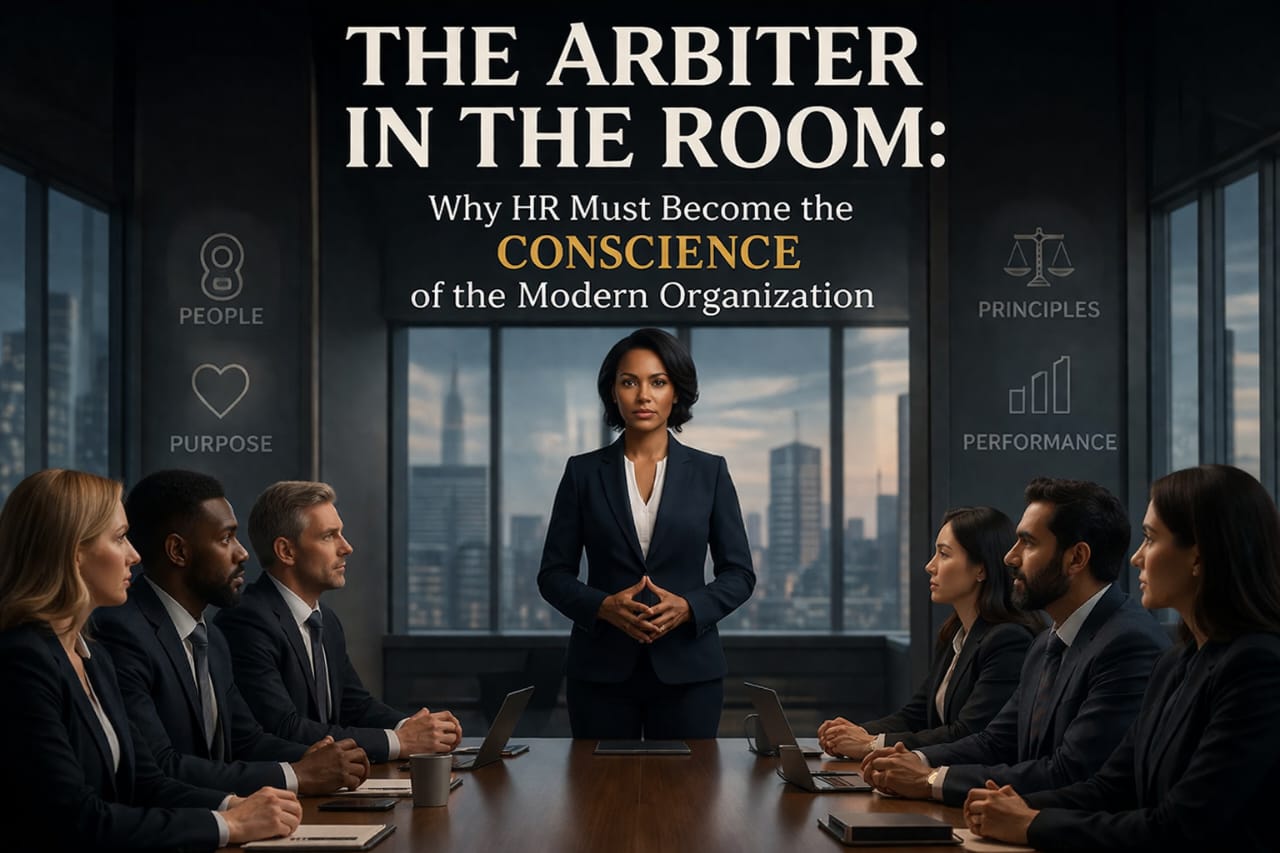
The word arbiter deserves more than metaphorical use here. In its original sense, an arbiter is one who has the authority to judge between competing claims, not to split the difference between them, but to apply a higher-order reasoning that serves the interests of the whole. This is precisely what the modern organization needs from HR, and precisely what it rarely gets.
Consider the shareholder-stakeholder tension at the center of the FMCG company’s crisis. Framed as a conflict between two rival interests, it becomes an unsolvable problem. Every concession to one side reads as a betrayal of the other. But reframed through the lens of organizational sustainability, which is the lens HR is uniquely positioned to hold, the tension resolves differently. Shareholders do not, at their most rational, want short-term returns at the cost of long-term organizational destruction. Workers do not, at their most rational, want an organization incapable of generating the returns that fund their jobs, their development, and their futures. Both parties are making legitimate claims. Both are also making those claims through the narrow aperture of their immediate pain. The arbiter’s role is to hold the wider view and to translate between the two with enough credibility that both sides feel genuinely heard, not managed.
This requires something that HR professionals are not always trained to develop: the capacity to sit with unresolved tension long enough to understand it rather than rushing to dissolve it. Organizational tensions are not, in the first instance, problems to be solved. They are signals to be decoded. The millennials who left the FMCG company did not leave because the strategy was wrong. They left because the strategy communicated something about the organization’s values that they were unwilling to accept. That is information of extraordinary strategic value. An HR function capable of reading that signal and presenting it to leadership not as an HR problem but as an existential organizational risk is functioning as an arbiter. An HR function that processes exit interviews as data for a retention report is functioning as a recorder. The distinction matters enormously, and it is not merely semantic.
Organizations are currently navigating disruptions whose scale and speed dwarf anything that the previous generation of HR thinking was designed to handle. The introduction of robotic process automation, artificial intelligence, and agentic systems into the workplace is not simply a technology story. It is a story about identity, dignity, and the meaning people derive from work. When a process that gave a worker a sense of competence and contribution is handed to a machine, the worker does not merely lose a task. In many cases, they lose a piece of the narrative they had been telling themselves about their value. HR functions that approach this transition as a retraining exercise, offering new skills, new roles, and thanks for flexibility, are addressing the surface while the depth goes untouched.
The deeper work is to help organizations understand that technological transitions are also human transitions, and that human transitions are only navigated well when the people going through them feel that someone with institutional authority is genuinely paying attention to their experience. This is not sentimentality. It is organizational science. Research in change management consistently shows that resistance to transformation is rarely about the change itself. It is almost always about the relationship between the people experiencing the change and the people implementing it. HR, positioned correctly, is the custodian of that relationship at scale.
The Multi-Dextrous Imperative
The concept of multi-dexterity, the capacity to operate with equal facility across domains that are typically kept separate, is the core capability that distinguishes the arbiter-level HR professional from the administrator. It is not about knowing everything. It is about knowing enough across enough domains to hold the whole organization in mind simultaneously.
A multi-dextrous HR leader reads financial statements not to become an accountant but to understand what the organization’s economic pressures are actually saying about the decisions leadership is likely to make next. They read organizational psychology and behavioral economics not to cite research in presentations but to interpret why people behave as they do under the specific conditions their organization creates. They understand technology sufficiently to anticipate what automation will do to roles, relationships, and the informal social structures that hold teams together. These structures appear on no org chart but experienced HR professionals know they are often more important than the formal ones. They understand culture not as a value statement on a website but as the accumulated pattern of what the organization actually rewards, tolerates, and punishes when no one is watching.
This breadth of understanding allows the multi-dextrous HR professional to see connections that others miss. In the FMCG case, the connections between a shareholder’s frustrated dividend expectation, a consultant’s KPI framework, and a millennial engineer quietly updating her profile on a recruitment platform at eleven on a Tuesday night are not separate events. They are the same event, observed from different vantage points. The HR professional who can read all four vantage points simultaneously and articulate the coherent story they tell together is functioning as the organization’s most valuable strategic intelligence asset.
This is also why HR’s relevance in an era of intelligent automation is more secure than many in the profession fear, provided HR makes the right strategic choice about what it stands for. The functions most vulnerable to automation are those that are routine, predictable, and transactional. Payroll processing is vulnerable. Automated screening of standardized applications is vulnerable. The production of templated compliance documents is vulnerable. None of these define HR’s highest value.
What cannot be automated without profound organizational risk is the capacity to hold the moral and relational complexity of human systems and to navigate that complexity with judgment informed by experience, context, and genuine care for the people involved. A machine can analyze sentiment data from exit interviews. It cannot sit with a talented manager who is six months away from a promotion and talk honestly about why she feels invisible in the organization she has given seven years to, and then translate that conversation into a structural recommendation that prevents the next seven people like her from reaching the same conclusion. That conversation is irreplaceable.
Its value is not in the words exchanged. It is in the trust required to have it and the institutional courage required to act on what it reveals.
The Social Contract, Rewritten
Organizations have always operated on an implicit social contract between those who own or lead them and those who work within them. For most of the twentieth century, that contract was relatively stable. Its terms were simple if unspoken: loyalty and competence in exchange for security and reasonable reward. The contract has broken down, not suddenly, but progressively, under the accumulated weight of restructuring cycles, performance optimization regimes, and the growing recognition among workers, particularly younger ones, that organizational loyalty is a one-sided bet.
What has replaced the old contract is not a new one. It is a vacancy. And into that vacancy, organizations have poured strategy documents, engagement surveys, and wellness programmes with the apparent belief that these instruments can substitute for the genuine human acknowledgment that workers are actually asking for. They cannot. The FMCG company’s top talent did not leave because the wellness programme was inadequate. They left because the organization, in its moment of crisis, revealed that it saw them primarily as instruments of recovery rather than as people whose experience of the organization mattered in its own right.
The new social contract that HR must help organizations write is built on a different premise entirely. It begins with the recognition that organizational performance and human dignity are not competing priorities to be balanced against each other. They are mutually constitutive. Organizations that treat their people with genuine respect, that invest in their growth not merely because it improves performance metrics but because it is the right way to treat a human being who has given their time and energy to a shared enterprise, consistently outperform those that do not.
The evidence for this is substantial and growing across decades of organizational research. But beyond the evidence, there is a more fundamental point: organizations exist within societies, and societies are composed of people. An organization that systematically degrades the human experience of its workers is not simply underperforming a benchmark. It is withdrawing from a broader obligation.
HR, as the function closest to that human experience, carries a particular responsibility to name that obligation and hold the organization accountable to it. This is not a comfortable position. It requires HR professionals to sometimes deliver findings that leadership does not want to hear. It requires the courage to say, in a board-level conversation, that the strategic initiative under discussion will likely produce the exact opposite of its intended result because of what it will communicate to the people required to implement it. It requires, in short, the willingness to be the person in the room who speaks for the organization’s long-term human health when everyone else in the room is focused on the quarter.
The Volatility That Will Not Resolve
The business environment that organizations are operating in is not temporarily difficult. The volatility, brittleness, and distortion that characterize the current global ecosystem are structural features, not passing conditions. Supply chains will continue to fracture unpredictably. Geopolitical realignments will continue to redraw the competitive landscape. Technological change will continue to outpace the organizational structures designed to manage it. In this environment, the organizations that survive and grow will not be those with the most sophisticated strategies. They will be those with the deepest human resilience: the capacity to absorb disruption, adapt without disintegrating, and continue to generate the discretionary commitment from their people that no strategy document can mandate.
Human resilience of this kind is not an accident. It is built, deliberately and continuously, through the quality of relationships within the organization, the degree to which people feel trusted and respected, and the extent to which leadership demonstrates through behavior rather than communication that the people in the organization are genuinely valued. Building and sustaining those conditions is not a peripheral function. It is the central organizational challenge of the coming decade. And HR, properly understood and properly positioned, is the function most equipped to lead it.
The parallel with medicine is instructive here. A hospital system under financial pressure might reasonably examine where costs can be reduced. But no serious administrator would propose reducing the quality of clinical care as a cost-saving measure, because everyone in the room understands that clinical care is the core value proposition the institution exists to deliver. Damage it, and you have not saved the organization. You have destroyed the reason for its existence. HR’s role in a people-dependent organization is structurally analogous. When cost pressures or strategic urgency produce decisions that damage the human conditions necessary for organizational performance, HR is the function that must name what is happening and refuse to treat it as an acceptable trade-off. That is not obstruction. That is governance.
The FMCG company at the center of this story has a choice that is available to every organization facing similar pressures. It can treat its current crisis as a retention problem to be solved through revised compensation structures and a refreshed employer brand. Or it can treat it as a signal that the organization needs a fundamentally different relationship with the people who carry it, a relationship in which HR is not the administrator of policies but the guardian of the human conditions that make sustained performance possible. The first path is familiar. The second is harder and less certain. But only the second addresses what actually happened.
The Role That Was Always Available
There is a reason the arbiter’s role has gone largely unclaimed by HR, and it is worth naming directly. Claiming it requires HR professionals to accept a level of organizational exposure that the service-function model conveniently avoided. When HR’s job is to administer processes, a failing process is a management problem that HR reports on. When HR’s job is to be the conscience of the organization, a failing human system is a problem HR must own and address, even when doing so creates friction with the leaders HR formally serves. That is a genuinely different kind of professional courage, and it is not evenly distributed in the profession.
But the organizations that are struggling most visibly right now are struggling, in significant part, because no one in them claimed that role in time. The FMCG company’s consultant could only offer what consultants offer: frameworks applied from the outside. The shareholders could only apply the pressure that owners apply when returns disappoint. The top leadership could only react with the urgency that threatened leaders produce. None of these actors held the whole organization in view. None of them were positioned to translate between the legitimate claims of owners and the equally legitimate needs of workers. None of them had the relational access, the institutional knowledge, or the professional mandate to do what needed doing. HR did. And HR, in that particular moment, was not yet ready to do it.
That gap between what HR is and what HR needs to become is the most consequential professional development challenge in organizational life today. It is not solved by training programmes or updated job descriptions. It is solved when HR professionals, individually and collectively, decide that their function exists not to administer the organization’s relationship with its people but to make that relationship worthy of the trust it asks for. When that decision is made and acted on, HR stops being a function that organizations call when the damage is done and becomes the function that prevents the damage from accumulating in the first place.
That is what being an arbiter actually means. Not a mediator who splits differences. Not a diplomat who softens messages. An arbiter: someone with the authority, the judgment, and the courage to hold the organization to its highest obligations, especially when doing so is inconvenient, especially when the quarterly numbers are doing the talking, and especially when the most talented people in the building are quietly beginning to wonder whether the organization they joined is still the one they are working for.
HR has spent decades proving it can be useful. The moment now demands something more difficult and more important: that it prove it is necessary.
About the Author
Dr Charles Obiajulu Ugwu is a Human Resource consultant and contrarian thinker writing from Lagos