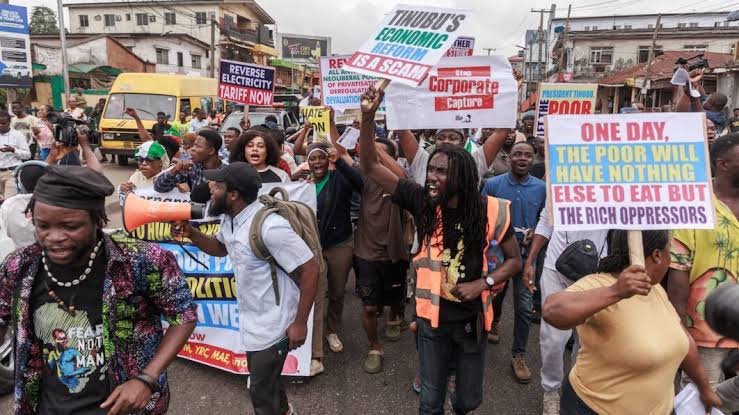
Nigeria was simply not founded to succeed. This is why political figures like Atiku Abubakar, Peter Obi, and Bola Tinubu recur in our electoral cycle every season. They are superstructures that cannot help but collapse under the weight of a broken substructure. The system is wired to fail, and the democracy that is relished in other lands falters here due to a wonky foundation. We live in a country hijacked by criminals who run the elections, yet expect us to participate in them.
The upcoming 2027 election cannot solve our story; without addressing the foundation, it can only make it worse. Those were Otubanjo’s gripping but scary sermon. The professor even made a more damning prophecy: after the 2027 elections, regardless of who ‘wins’ that election, we would be back to our sorrow and lamentations. If you believe the Nigerian structure, as currently constituted, can ever make you happy as a Nigerian, you are the cruelest joke of the century.”
“They just tend not to be honest. Nigerians as a group, frankly, are marvelous scammers. I mean, it is in their national culture.” That damning comment appeared in the September 25, 1995, edition of The New Yorker. That scathing assertion stirred a hornet’s nest, and its author — Colin Powell, the urbane American diplomat, Army General, and later the 65th Secretary of State (and the first Black American to serve in that role) — courted unpleasant rebukes for those remarks. Powell was like smelly rot on whom flies perched as he courted outrage with that unflattering categorization.
A similar whitewash of Nigeria occurred years later. It was in May 2016 during Queen Elizabeth II’s 90th birthday celebration at Buckingham Palace. British Prime Minister David Cameron was overheard describing Nigeria and Afghanistan in derogatory terms while reporting to the Queen on an upcoming anti-corruption summit in London. He was quoted to have said: “We’ve got some leaders of some fantastically corrupt countries coming to Britain… Nigeria and Afghanistan, possibly the two most corrupt countries in the world.”
Nigerians were almost unanimous in rebuking these characterizations as unfair. Following Powell’s 1995 remark, human rights activist and legal luminary, Femi Falana, told Powell in The Washington Post that, “You should never make sweeping generalizations like that to describe a people. Those comments are very unbecoming of a man of his stature.”
Regarding Cameron’s outburst, BBC Diplomatic Correspondent, James Landale deployed litotes — a literary technique where a gravity-laden issue is deliberately downplayed using subtle, restrained expression to qualify it. “On the face of it,” Landale began in his critique of Cameron: “It is perhaps one of the most undiplomatic things a prime minister could say — to describe two countries as fantastically corrupt, just hours before their leaders visit Britain. The prime minister’s remarks were outspoken and unguarded, but they were not untrue. Both Afghanistan and Nigeria come high on lists of the world’s most corrupt nations.”
Indeed, at that time in 2016, Transparency International’s 2015 Corruption Perception Index handed Nigeria the medallion of 136th on the corruption ladder globally, with Afghanistan ranked 167th, sitting just ahead of Somalia and North Korea.
Our lot has since taken a turn for the worse. We have become the proverbial young man who, in a fit of rage, pelted the Agẹmọ with a stone. The Agẹmọ, in its physical form, is merely a chameleon. Yet, in Yoruba mythology, it is a sacred chameleon spirit — the servant of Ọlọrun, the Supreme Being — credited with assisting in the creation of the Yoruba pantheon of deities (Òrìsà) and serving as a divine messenger.
Yoruba mythology features a fable explaining why the chameleon is capable of mutating into distinct colours and why the Agẹmọ is held in such awe. Legend dictates that a child who pelts the Agẹmọwith a stone will not die immediately or rot from any external wound; instead, they will simply retard into nothingness. Their clothes will fade into the brownish, tattered plumage like the àparò(partridge), whose coat of feathers serves as a natural camouflage amidst grass and brush. Methinks Nigeria has stoned the Agẹmọ and the outcome is this national retardation and is the cause of a seeming curse to merry-go-round on a spot, while battling challenges of development.
If figures like late Powell and Cameron were presented with an opportunity to assess Nigeria today, they would deploy even harsher epithets. We are confronted by a rapacious and criminal political class, a morally deficit society, and a future hanging by a cliff. The distressing news that sieves out of Nigeria daily, likeputrid water leaking from a broken cistern, points to a country that has completely slipped through our hands.
Whenever I feel distressed about Nigeria’s trajectory, as I was last week, I go out seeking corroboration — lest I become the only loony in the sanatorium. Recently, I visited the office of an elderly Senior Advocate of Nigeria. Famous for his piety in a judicial ecosystem where many practitioners have sold their souls to Mammon — whom Christian writers and medieval theologians personified as the demon prince of greed — the Learned Silk’s head was completely grizzled with age and law. My hunch told me I was in the right place.
While a systemic cancer in the judiciary (of which we were both victims) was our ostensible reason for meeting, my hidden motive was to gauge how advanced my own Nigeria-induced insanity had become. We asked each other how we felt about Nigeria. He knew my stance, but I was eager to learn about his, wanting to peer beyond the veneer of his public acclamation for judicial integrity. After our discussion, I regretted the encounter because my despair worsened. I left his office carrying a deteriorating malady. I was however comforted because, ingauging his own level of dissatisfaction with Nigeria — I was happy that I was not alone. I was reassured that, trapped inside Nigerians who wear comely faces in public is a burning, agonizing distress about our country.
Last week, Professor Femi Otubanjo further aggravated that feeling of madness. On a television show, the man I escaped being his postgraduate student at the University of Ibadan, at a time of his stint with Gen Oladipo Diya, worsened my mental state. He propounded the theory of a destroyed foundation. Deploying the biblical theory of a ruptured foundation that is the righteous’ nightmare, he called Karl Max to the rescue. Let me add Max Weber’s deterministic ideological infrastructure to the mix. Both of them authored the causal relationships between substructure and superstructure.
In his The German Ideology, Karl Marx says society’s social consciousness is the totality of that society’s legal, political system, as well as its infrastructure. In their theory of society, students of sociology make use of this causal relationship of substructure and superstructure a lot. It simply says that social realities are the products of social structures, which is the ideologies related to politics, laws, morality, art, philosophy of that society. It explains the nature of the relationships among social structures and their consequences for human realities.
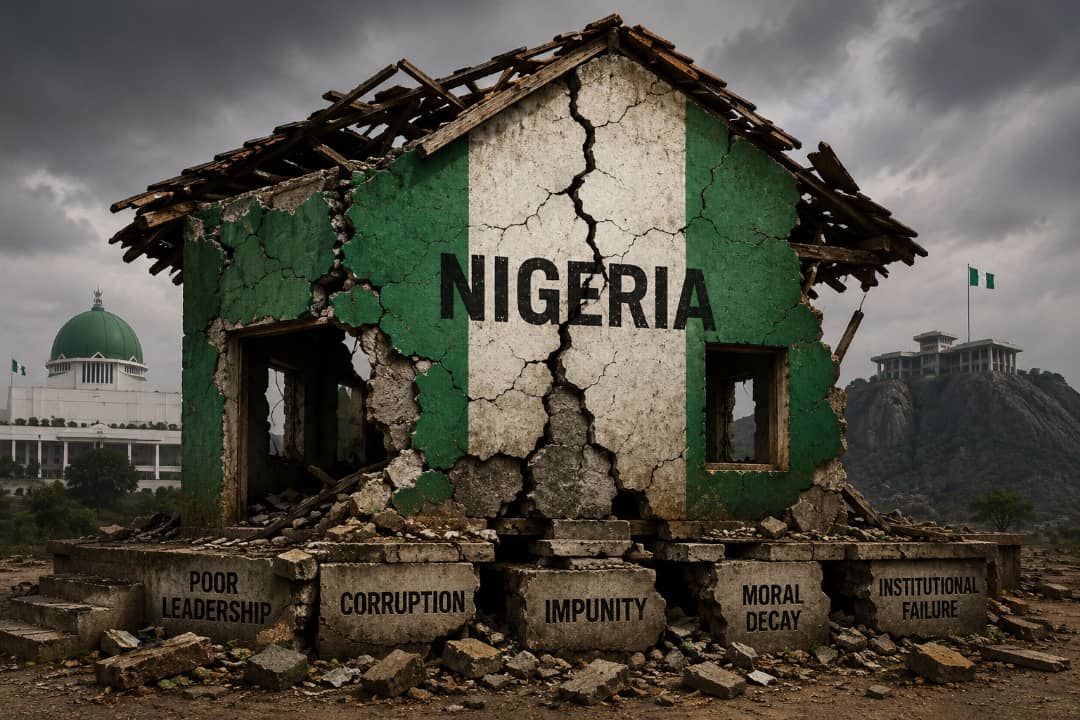
Both thinkers – Max and Weber – explored the causal relationship between the substructure (material and economic infrastructure) and the superstructure (ideology, law, and politics). Put in chewable terms: if you erect a grand superstructure on a defective substructure, as Karl Maier observed in his damning biography of Nigeria, This House Has Fallen, the house will ultimately fall.
Otubanjo applied this directly to our Nigerian predicament. Bad leaders, endemic corruption, election riggers, an uncritical electorate, and a rapacious National Assembly notorious for budget padding (the proceeds of which foot soldiers collect to rig subsequent elections) all constitute Nigeria’s flawed substructure. Because Nigeria lacks a sound moral foundation, nothing worthy can stand upon it. Policies that look workable on paper and succeed in other nations inevitably fail here.
Nigeria was simply not founded to succeed. This is why political figures like Atiku Abubakar, Peter Obi, and Bola Tinubu recur in our electoral cycle every season. They are superstructures that cannot help but collapse under the weight of a broken substructure. The system is wired to fail, and the democracy that is relished in other lands falters here due to a wonky foundation. We live in a country hijacked by criminals who run the elections, yet expect us to participate in them.
The upcoming 2027 election cannot solve our story; without addressing the foundation, it can only make it worse. Those were Otubanjo’s gripping but scary sermon. The professor even made a more damning prophecy: after the 2027 elections, regardless of who ‘wins’ that election, we would be back to our sorrow and lamentations. If you believe the Nigerian structure, as currently constituted, can ever make you happy as a Nigerian, you are the cruelest joke of the century. Geographic Reference
Numerous theories exist to explain why Nigeria has failed to work: There is what I call the colonial blueprint theory. This is a theory that points to the mis-philosophy of Nigeria’s founding. The British, this school argues, never intended to build a functional nation. This reflects in the Northern Nigerian Premier, the Sardauna of Sokoto, Ahmadu Bello’s famous reflection where he said, “God did not create Nigeria; the British did.” There are so many other empirical affirmations that the British didn’t create Nigeria to succeed.
This school is further reinforced by the “Two Publics” theory of political sociologist, Prof Peter Ekeh. In 1975, Ekeh propounded the theory of this theorywherein he argued that post-colonial African societies feature two distinct realms with opposing moral rules: the civic public and the primordial public. Today, however, emerging realities have trumped Ekeh’s thesis; even in the primordial realm, moral allegiance has been submerged, as people compromise both the civic and the sacred with baffling abandon.
Then, there is the metaphysical and leadership schools. Thinkers like my teacher at the University of Lagos, Prof. C. S. Momoh argued that the Nigerian problem was metaphysical. Others blame the conflict between natural nationhood and an artificial nation-state. To them, Nigeria is in this horrific state because it is not a nation but a nation-state. Chinua Achebe belongs to this leadership challenge school. Writing in The Trouble With Nigeria, (1983) Achebe said that “the trouble with Nigeria is simply and squarely a failure of leadership.” Conversely, others argue that the general electorate — from whom leaders emerge — is so colossally tainted that its DNA cannot withstand good governance.
Sociologists also point to the “resource curse” that afflicts mineral-producing states like Nigeria. In this school, it is believed that a looting machine inevitably forms around raw wealth. Examples are the Democratic Republic of Congo, Angola etc. Nigeria is exceptionally badbecause it has produced a vast number of criminals tied round her oil wealth who now constitute the ruling elite — men and women who were active participants in global and national illicit enterprises.
In April 2005, retired policeman and Senator Nuhu Aliyu surveyed the National Assembly chambers and confessed that sitting alongside him as colleagues were senators he had previously arrested, questioned, and detained. Today, known rogues, fraudsters, perverts, and murderers are addressed as “Excellencies” in many of the 36 states and the presidency. The same people make rules. It reminds me of British roots reggae band, Steel Pulse, in its 1978 “Babylon makes the rules” track song where it sang: “Babylon makes the rules/Where my people suffer…”
We are ruled by a rogue political elite, a tainted business class, an uncritical public and a wayward press with all of us traveling a road that leads toward perdition. Tainted wealth is everywhere, while moral leadership is at zero point. Those who argue that corruption is a recent phenomenon are being ahistorical; the Nigerian corruption has deep roots in social networks and moral conventions pre-dating the 1914 amalgamation.
Because the state is central to everyday life in Nigeria, there is an eternal, desperate rush for the jugular of power. Every four years, we repeat these rituals. It is difficult to disagree with theologian Ogbu Kalu who wrote that Nigeria’s political culture “is like a virus, feeding on the red blood corpuscles of the primal world.” From its inception, Nigeria has operated as a crime scene or Albert Camus’ theatre of the absurd. These absurdities tie directly back to our primal foundation.
All of this reinforces the argument that social realities are direct products of social structures. Impunity is a dime a dozen, reigning unchallenged to build empires in both high and low spheres of society. Too many go scot-free for grievous malfeasance.
Look no further than the legislature: Deputy Speaker Benjamin Kalu recently offered public explanations as to why his office allocated N780 million — and not N1 billion — for a church, while N30 billion sits in the budget for palaces and places of worship. This is in a country while millions struggle to feed. A former Deputy Senate President became stupendously wealthy through similar heists: his foot soldiers yearly ferried out nondescript government agencies, asked their directors what they wanted, inserted those projects into the budget, and sent contractors to collect the funds. Today, Karma has caught up with him.
Though Senate President Godswill Akpabio was a guest of the EFCC prior to his ascendancy, he does not shuttle between the Red Chamber and the anti-graft agency’s office any longer because Nigeria is simply not wired for accountability. To that maggots-encrusted system, it is an insult for the Imperial Majesty Senate President to be called to answer for his past — and present. Aso Rock itself houses occupants whose histories are clouded by allegations of fraud, and the 36 states serve as a paradise for maggots. Until we confront and rebuild the faulty substructure of our nation, every attempt at progress remains a farce built on shifting sand.
The most distressing part of the Agẹmọcurse is the allegation that the Nigerian presidency is in an adulterous relationship with the judiciary. And that, purchasing justice in Nigeria is as easy as getting the al’álùpàyídà (magicians) to summon a chattel through his famous trickery. This reminds me of those days when we gathered as kids to watch pidánpidán andhis compatriots, the al’álùpàyídà, both magicians, perform their trickery. While the signs are writ large like mysterious hieroglyphics in the sky, it is too absurd to countenance. If true, this dalliance of executive and judiciary would have gone beyond incest. It would be a signal that indeed, this house has collapsed. In which case, it is time to close shop.