By Tony Onyima
The Ogene, a metallic idiophone widely used among the Igbo people of Southeast Nigeria, has evolved from being a mere traditional instrument into a dynamic tool of communication, identity, and artistic innovation. Historically struck to summon villagers, announce events, or accompany dances, the Ogene’s sound carries deep symbolic and social meaning. However, the instrument has undergone a fascinating transformation in recent years – adapting to the realities of a digital and globalised world. Through the creativity of artists like Ejyk Nwamba and Phyno, and the scholarship of authorities such as Wilberforce Echezona, Meki Nzewi, and J. H. Kwabena Nketia, the Ogene continues to assert itself as both a cultural heritage symbol and a communicative instrument of contemporary African expression.
In precolonial Igbo society, the Ogene was an indispensable means of aural communication. Its sharp metallic tone could travel long distances, enabling community leaders or town criers (Onye ozi) to relay important messages (Lo-Bamijoko, 1987). The rhythmic patterns produced by striking the Ogene were not random but often encoded messages understood within specific local contexts. According to Echezona (1963), the Ogene’s timbre and resonance made it an effective “talking metal,” comparable to African slit drums in communicative efficiency. It was used to summon meetings, announce deaths, or mark ceremonial transitions such as weddings or title-taking.
Beyond its pragmatic function, the Ogene also served as a spiritual medium. The Igbo believed that sound bridged the visible and invisible worlds. As Achebe (1958) observes in Things Fall Apart, music and drumming accompanied nearly every ritual, reinforcing social cohesion and collective identity. The Ogene’s sound thus symbolised authority, unity, and the ancestral voice—its ringing tone a reminder that the community was alive and interconnected.
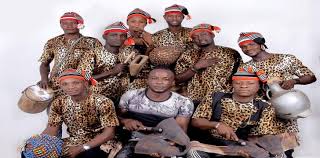
The musical form most closely tied to the instrument is Egwu Ogene, literally “the music of the Ogene.” Egwu Ogene embodies the Igbo rhythm, storytelling, and communal participation ethos. It blends percussive energy with lyrical commentary, serving as a channel for public discourse and moral reflection (Nwankwo, 2019). The songs often narrate personal struggles, praise community heroes, or criticise social vices—turning performance into a vehicle for education and entertainment.
Meki Nzewi (1997) describes indigenous music as “a continuum of sound, movement, and meaning,” where instruments like the Ogene become extensions of speech and thought. Thus, the Ogene’s role as a communicative instrument is not only functional but semiotic—encoding messages, emotions, and values in rhythmic sound.
With the advent of digital technology and social media, traditional instruments like the Ogene have found new life and broader audiences. Contemporary artists such as Ejyk Nwamba, popularly known as “Ogene Master,” and the hip-hop star Phyno (Chibuzor Nelson Azubuike) have been instrumental in this renaissance.
Ejyk Nwamba, an Enugu-born musician, has fused traditional Ogene sounds with modern production elements—basslines, synthesisers, and digital beats—creating a genre sometimes termed “urban Ogene.” As documented by Onuora-Oguno and Ibekwe (2023) in Adaptation of the Egwu Ogene in a Digital World, Nwamba’s artistry “demonstrates how cultural authenticity can thrive through technological mediation.” His collaborations with gospel and hip-hop artists, and his viral performances on platforms like YouTube and TikTok, have popularised the Ogene among younger, tech-savvy audiences. Through this, the instrument communicates cultural pride, bridging generational and geographical divides.
Similarly, Phyno, one of Nigeria’s most successful Igbo-language rappers, integrates Ogene sounds into his tracks, notably in “Fada Fada” and “Connect.” His collaboration with Ejyk Nwamba in “Ogene (Remix)” recontextualised the traditional instrument within urban soundscapes, blending indigenous rhythms with rap lyricism. This creative fusion has turned the Ogene into a symbol of modern Igbo identity, proving that tradition can coexist with innovation.
Ethnomusicologists argue that musical instruments are semiotic systems that transmit meaning through sound. According to Nketia (1974) in The Music of Africa, “the communication process in African music is both social and spiritual—it informs, educates, and binds.” Within this framework, the Ogene operates as both medium and message—its sound carrying emotional, historical, and communal weight.
Scholars such as Mabel Okpara (2015) and Ezeanyim & Umezinwa (2020) have shown that indigenous instruments like the Ogene play crucial roles in socialisation and cultural education. They are repositories of collective memory, transmitting values, histories, and linguistic patterns across generations. Adapting the Ogene into digital formats—recordings, remixes, live-streamed performances—ensures that these communicative roles are not lost but amplified through technology.
The fusion of traditional Ogene rhythms with digital production has broadened the scope of Igbo music and reshaped global perceptions of African sound. Phyno’s worldwide audience and Nwamba’s viral success illustrate how the Ogene functions as a transcultural communicator—linking local heritage to global creative currents.
Samuel Akpabot (1986) observed that Nigerian instruments maintain their cultural power when adapted with sensitivity to their original context. Ejyk Nwamba’s and Phyno’s works exemplify this principle: their innovations neither dilute nor distort tradition but expand its communicative potential. The Ogene’s clang, once confined to village squares, now resonates across continents, serving as artistic expression and cultural diplomacy.
The Ogene, once a rural metallic bell, has become a sonic emblem of Igbo identity and innovation. Its adaptation in the digital world demonstrates the resilience of indigenous communication systems in the face of modernisation. Through artists like Ejyk Nwamba and Phyno, and the insights of scholars such as Echezona, Nzewi, Nketia, and Akpabot, we see that the Ogene is not a relic of the past but a living language of sound—a medium through which the Igbo people continue to communicate, celebrate, and define themselves in an interconnected world.
Dr Onyima teaches media and communication at Paul University, Awka, Anambra State