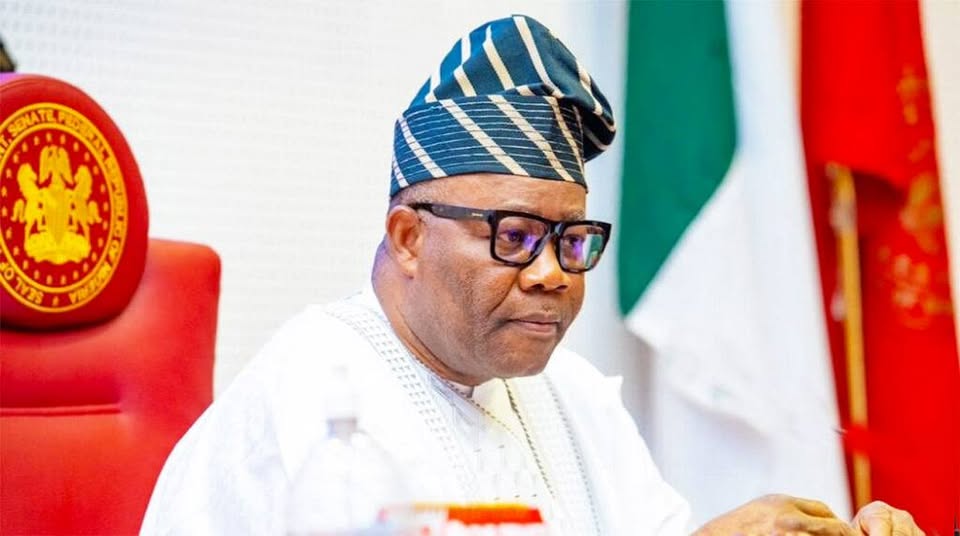
The President of the Senate, Godswill Akpabio, on Tuesday stirred national debate after declaring that the recent surge in terrorist attacks across Nigeria was part of a calculated “gang-up” aimed at undermining the reform agenda of President Bola Ahmed Tinubu.
Akpabio made the remarks in Abuja during his goodwill message at the official inauguration of the Nigeria Revenue Service Headquarters, a ceremony that brought together top government officials, lawmakers, and economic stakeholders. The event, which was meant to celebrate a milestone in Nigeria’s revenue administration, quickly took on a political tone as the Senate President addressed the country’s worsening security situation.
Standing before a packed audience, Akpabio spoke with a mix of conviction and urgency, linking the recent wave of bombings and violent attacks to political forces allegedly threatened by the sweeping reforms of the Tinubu administration.
“Believe me, Mr President,” he said, directing his comments to Tinubu, who was present at the event, “two weeks after you win the elections in 2027, the bomb blasts will stop. People are sponsoring it to distract you from your work.”
The statement, bold and controversial, immediately captured the attention of political observers and security analysts alike. Akpabio went further to commend Tinubu’s leadership, insisting that despite mounting pressures, the President had remained focused on steering the country through difficult economic and structural changes.
“You’re doing so well despite the gang-up on your administration,” he added, drawing applause from sections of the audience.
Nigeria has in recent months witnessed a troubling escalation in security challenges, with terrorist attacks, banditry, and communal clashes affecting various parts of the country. From the North-East to parts of the North-West and even central regions, communities have continued to grapple with violence, displacement, and loss.
While successive governments have battled insurgency for over a decade, the persistence of attacks has raised fresh concerns about intelligence failures, coordination among security agencies, and the broader political implications of insecurity.
Akpabio’s remarks, however, introduced a new dimension to the conversation, suggesting that the violence may not only be a security issue but also a politically motivated strategy.
The Senate President’s assertion that attacks could cease shortly after a future electoral victory by Tinubu has sparked mixed reactions. Supporters of the administration view the comments as a candid acknowledgment of the political resistance facing ongoing reforms, particularly in areas such as fuel subsidy removal, tax restructuring, and public sector efficiency.
Critics, on the other hand, argue that linking terrorism to political conspiracies without concrete evidence risks trivializing the suffering of victims and could distract from the urgent need for practical security solutions.
Some analysts believe Akpabio’s statement reflects growing tensions within Nigeria’s political landscape, where economic reforms, though widely considered necessary, have also triggered hardship and dissent among citizens.
Since assuming office, President Tinubu has embarked on a series of ambitious reforms aimed at stabilizing Nigeria’s economy and improving governance. These include fiscal adjustments, efforts to boost internally generated revenue, and policies designed to attract foreign investment.
The inauguration of the Nigeria Revenue Service Headquarters itself symbolizes a push toward modernizing revenue collection and reducing leakages, a critical step in addressing the country’s long-standing fiscal challenges.
Akpabio, in his speech, emphasized that such reforms often come with resistance, particularly from entrenched interests that benefit from the status quo.
According to him, the administration’s determination to overhaul key sectors may have unsettled powerful groups, thereby fueling attempts to destabilize the country.
In the aftermath of the remarks, there have been calls for further clarification from both the Senate leadership and the presidency. Security experts stress the importance of intelligence-driven responses and caution against politicizing national security issues.
They argue that while political dynamics can influence security, addressing terrorism requires sustained investment in military capacity, community engagement, and regional cooperation.
For many Nigerians, however, the immediate concern remains safety. Across affected communities, citizens continue to demand stronger protection, accountability, and visible progress in the fight against insurgency.
As Nigeria navigates a complex intersection of security challenges and economic transformation, Akpabio’s comments have added a new layer to the national discourse. Whether seen as a warning, a political statement, or a reflection of deeper realities, his words underscore the high stakes surrounding the Tinubu administration.
For President Tinubu, the path forward will likely require not only steadfast commitment to reforms but also renewed efforts to reassure citizens that their security remains a top priority.
In a nation where politics and security often intertwine, the coming months may prove decisive, not just for the success of reforms, but for the stability and unity of the country as a whole.