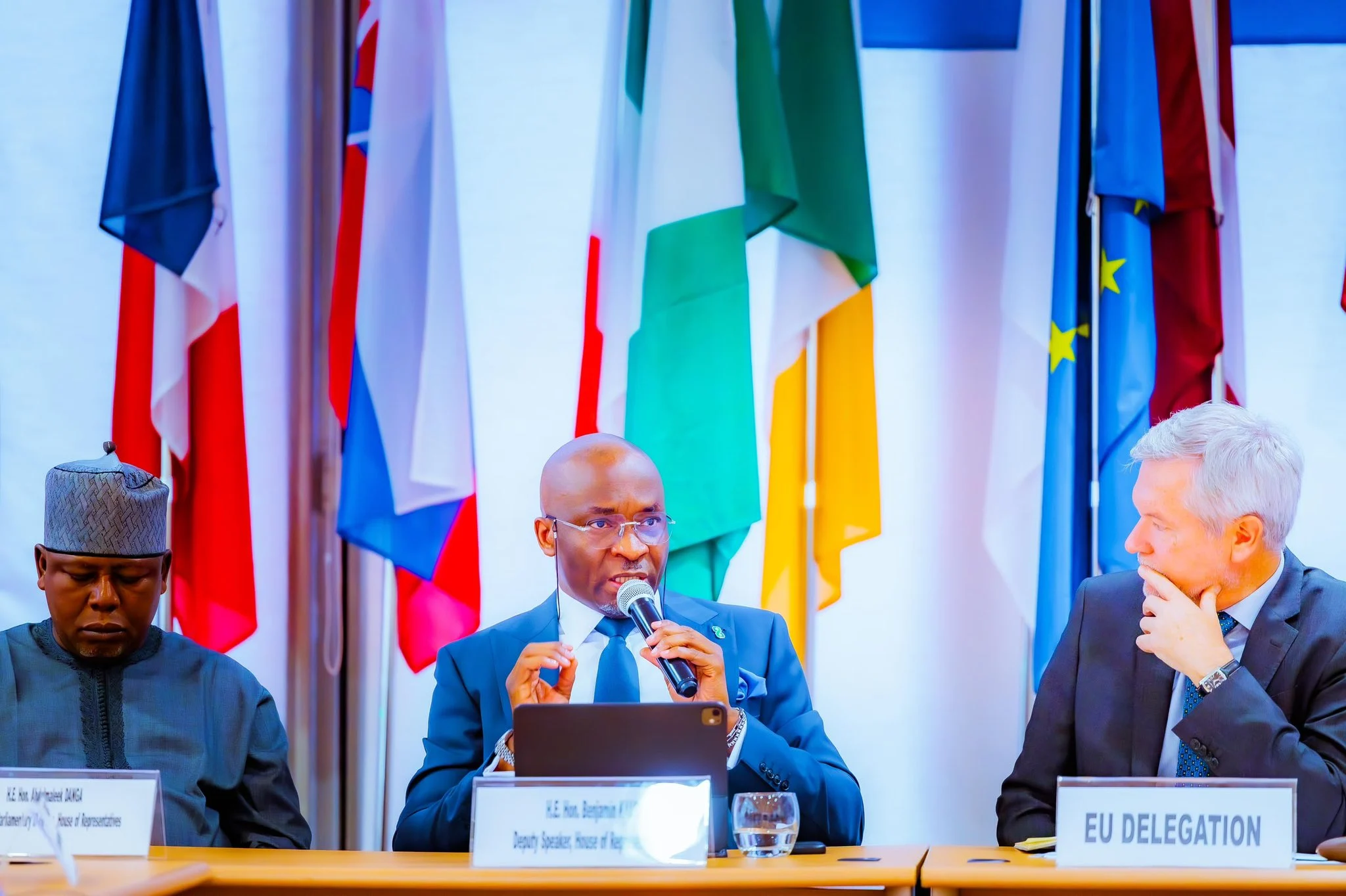
The Deputy Speaker of the House of Representatives, Benjamin Kalu, on Tuesday moved to calm growing concerns over the proposed creation of state police, assuring Nigerians and international partners that the constitutional amendment bill currently before the National Assembly contains adequate safeguards to prevent political abuse and ensure transparency, accountability and respect for the rule of law.
Kalu, who also serves as Chairman of the House Committee on Constitution Review, gave the assurance during a reception hosted by the European Union Delegation to Nigeria and ECOWAS Ambassador, Gautier Mignot, in Abuja.
The event brought together Heads of Mission from member states of the European Union and other stakeholders, providing an opportunity for discussions on Nigeria’s ongoing constitutional reform process and broader efforts aimed at strengthening democratic institutions.
Speaking at the gathering, Kalu sought the support of European Union missions for the National Assembly’s constitutional amendment exercise, describing the reform process as one designed to improve governance, enhance security and deepen democratic accountability across the country.
He noted that one of the most significant proposals under consideration is the establishment of state police, a long-debated issue that has gained renewed attention amid persistent insecurity affecting different parts of Nigeria.
According to the Deputy Speaker, the proposed constitutional amendment has been carefully designed to address concerns expressed by Nigerians, civil society organisations, development partners and members of the international community over the possibility that state governors could misuse state-controlled police formations for political purposes.
He acknowledged that fears had been raised that governors might deploy state police against political opponents, critics or rival parties, particularly during elections and other politically sensitive periods.
However, Kalu insisted that the proposed legislation goes beyond mere promises by embedding constitutional safeguards that would make such abuses difficult.
He explained that the bill introduces institutional checks and oversight mechanisms intended to ensure that state police operate within the confines of the law and remain accountable to constitutional provisions rather than political interests.
According to him, the objective of the legislation is not merely to decentralise policing responsibilities but to create a constitutional framework that guarantees accountability, professionalism and respect for citizens’ rights.
“And to legitimate concerns about abuse; concerns we have heard, including from partners in this room, the bill responds not with assurances but with architecture,” Kalu said.
“Our objective is not simply to decentralise policing; it is to constitutionalise accountability.” The Deputy Speaker stressed that the National Assembly had taken time to study concerns surrounding state policing before incorporating multiple layers of oversight into the amendment bill.
He maintained that lawmakers recognised the importance of balancing greater autonomy for states with effective constitutional safeguards capable of preventing misuse of security agencies.
Kalu argued that Nigeria’s current security challenges require innovative and practical solutions, adding that decentralising policing could significantly improve intelligence gathering, rapid response to crimes and collaboration between security agencies and local communities.
He observed that officers operating within their states would possess better knowledge of local terrain, languages, customs and security dynamics, making them more effective in addressing criminal activities.
The lawmaker also emphasised that constitutional reform remains central to Nigeria’s democratic evolution, noting that the review process seeks to strengthen institutions rather than individuals.
He appealed to Nigeria’s international partners, particularly the European Union, to continue supporting reforms aimed at promoting good governance, democratic accountability and institutional development.
Kalu said constructive engagement from development partners would contribute to building stronger democratic structures capable of addressing emerging governance and security challenges.
He reaffirmed the commitment of the House Committee on Constitution Review to conducting an open, transparent and inclusive amendment process that reflects the aspirations of Nigerians from all regions of the country.
The Deputy Speaker expressed confidence that the proposed constitutional reforms, including the state police initiative, would ultimately enhance national security while preserving democratic principles, fundamental rights and constitutional order.
He added that the National Assembly remains committed to ensuring that any amendment to the Constitution strengthens public confidence in government institutions and delivers lasting benefits for Nigeria’s democracy and security architecture.