By Valentine Obienyem
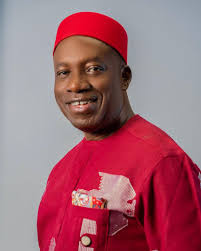
I must begin by offering a modest apology for repeatedly referencing Governor Charles Soludo in this reflection. It is not out of any desire to single him out for undue attention. Rather, his statements in Enugu today, delivered in the course of political engagements that have since gained national traction, make him an unavoidable point of departure. When influential ideas are publicly advanced, especially on matters touching the collective self-understanding of a people, they inevitably become subjects of wider philosophical scrutiny.
That said, it is important to stress at the outset that this piece is not ultimately about him as a person. It is about a recurring mode of political reasoning that many others, in different tones and registers, also subscribe to. In that sense, “Soludo” here becomes less an individual and more a symbol of a broader intellectual disposition found across segments of our political class.
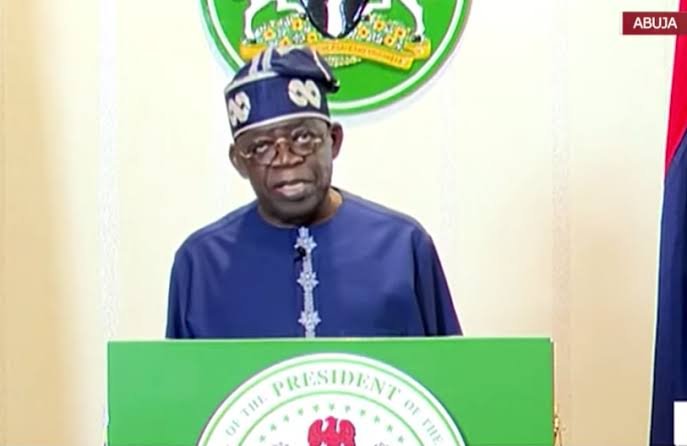
The immediate context that provoked this reflection is political and symbolic in equal measure. Governor Soludo travelled from Awka to Abakaliki, a distance of over 100 kilometres, where he joined other birds of a feather in endorsing President Bola Ahmed Tinubu for a second term. In the course of that gathering, he advised Ndigbo to align themselves fully with President Bola Tinubu, arguing that rather than missing the “cow” entirely, it is wiser to cut and preserve the “tail.”
That metaphor – at once simple in form and weighty in implication – has since become the centre of intense reflection. It borders on what my mentor, Prof. Okey Ikechukwu, would call “incestuous reasoning.” For many, it raises a fundamental philosophical question: is the political destiny of Ndigbo best understood as participation in a structure where the full prize is assumed unattainable, and only residual gains are realistically worth going after?
Honestly, if it is only the tail that we are content to cut, what then of the full cow? The statement is, for many, a collective insult to Ndigbo. In 2023, when President Tinubu said “Emilokan,” did he speak of cutting the tail? The underlying suggestion, as many have interpreted it, is that Ndigbo should consciously lower the altitude of their political aspiration and resign themselves to whatever remains – even if what remains is only the tail of the cow.
But beyond the heat of immediate reaction lies a more enduring philosophical concern: what kind of political imagination is being cultivated here? The metaphor quietly presupposes a political universe in which the cow is already permanently foreclosed, already owned elsewhere, and in which intelligence consists not in reclaiming possibility, but in dignifying partial loss as wisdom.
Yet no people secure their future by permanently accepting the metaphysics of exclusion. Once that assumption is internalised, it ceases to be a mere strategy; it becomes identity. And a people who begin to see themselves through the lens of fragments will, in time, struggle to remember the grammar of wholeness. We have bandied that “tail” for so long that some of us have began to forget there is a whole.
The metaphor itself begins to collapse under closer scrutiny. The tail is not a trophy of conquest; it is what remains when the pursuit of the whole has not been achieved. No hunter returns to the village and hangs the tail as a symbol of triumph. At best, it is a record of what was lost, not what was won. To elevate such a remnant into a governing political philosophy is to dignify limitation and risk transforming resignation into doctrine.
The deeper danger, therefore, is not external exclusion but internal accommodation to reduced expectation. When a people are persistently encouraged to value fragments, they may slowly forget that wholeness was ever part of their legitimate horizon of aspiration.
Yet history offers a different testimony about Ndigbo. They have rarely been a people of diminished imagination. Their story is written in the idiom of reconstruction after rupture, of enterprise in constrained environments, and of excellence achieved without inherited advantage. Such a trajectory sits uneasily with a philosophy that normalises the tail while the cow remains within sight.
It is within this context that one may, without diminishing respect for Governor Soludo’s widely acknowledged rhetorical brilliance – at times echoing Cicero’s forceful architecture of argument, Juvenal’s piercing satirical clarity, and Tacitus’ dense moral compression – observe that even the most finely wrought eloquence cannot ultimately redeem a fragile or questionable premise. Style may polish a metaphor to persuasive brilliance, but it cannot, in every case, salvage the burden of its underlying implication.
The present moment, therefore, calls for clarity about proportion. If the “cow” of political possibility is still within reach – as many believe it is – then the central task is not how to dignify its remnants, but how to engage its fullness with disciplined strategy and historical awareness.
Even beyond the talk of a cow and its tail, Mr Peter Obi has transcended that narrow framework. To reduce the present political conversation to what portion Ndigbo can secure from existing arrangements is to miss the larger reality. Today, Peter Obi is not being promoted merely because he is Igbo; he is being embraced by many Nigerians because they believe he is qualified. His appeal extends beyond ethnicity, region and religion. For many, he represents competence, prudence, accountability and a refreshing departure from the old political order.
Nigeria today needs a leader with the courage and moral firmness to confront waste, challenge entrenched interests and begin the difficult task of national renewal. Many see in Peter Obi that fortitude. They see a leader capable of helping to build a country where opportunities are more closely aligned with talent, where merit counts more than connections, and where public office is viewed as a sacred trust rather than an avenue for personal enrichment.
That is why the discussion should not be about tails and fragments. The real question is how to build a Nigeria that rewards excellence and inspires hope. The ultimate goal is not to secure a tail from a passing cow, but to create a nation where such metaphors become unnecessary—a nation where the language of our politics is no longer about scraps and concessions, but about competence, productivity, justice and national greatness.