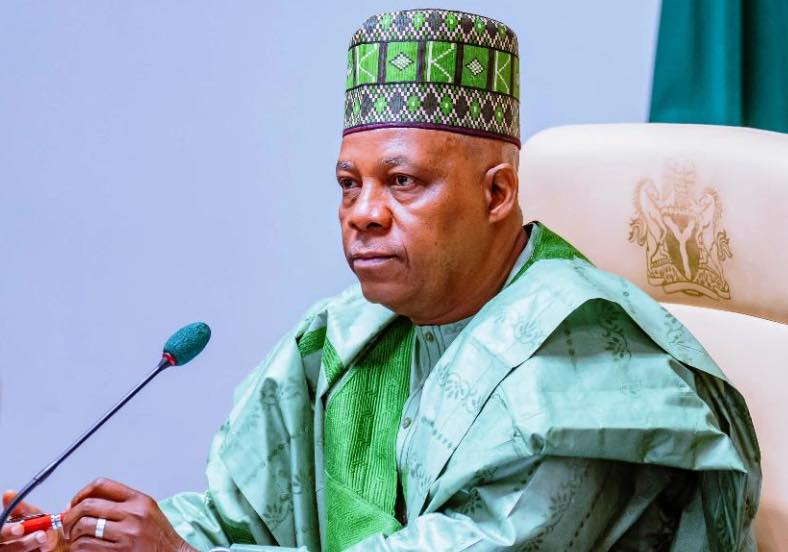
Vice President Kashim Shettima has called for a stronger and more constructive partnership between the media and the government, urging journalists to embrace critical thinking and responsible engagement in order to strengthen Nigeria’s democracy.
Shettima made the call in Abuja during the public presentation of a book titled My Life and Journalists Hangout and the 60th birthday celebration of veteran television journalist Babajide Kolade-Otitoju. The event attracted media professionals, politicians, academics, and public officials who gathered to celebrate the journalist’s contributions to the media industry and national discourse.
Speaking at the event, the Vice President emphasized that democracy can only thrive where the media remains vigilant, responsible, and committed to truth. He noted that the relationship between the government and the media should not be adversarial but collaborative, with both sides working toward national development and democratic stability.
According to Shettima, journalists play a crucial role in shaping public opinion, holding leaders accountable, and ensuring that governance remains transparent and responsive to the needs of the people. He stressed that responsible journalism requires not just reporting events but also critically examining policies, decisions, and ideas that affect society.
“The health of any democracy depends significantly on the vigilance and responsibility of the media,” the Vice President said. He added that the role of the media goes beyond headlines and breaking news, explaining that journalists serve as watchdogs who must constantly question authority and challenge ideas for the good of society.
In a thought-provoking remark, Shettima stated that societies are not destroyed by a lack of ideas but by the absence of individuals who are willing to question and interrogate those ideas. He urged journalists to cultivate the courage to ask difficult questions and to test policies and public statements against reason and facts.
“A society is destroyed not by the absence of ideas but by the absence of men and women with the courage to interrogate ideas, to test them against reason, and to ask the difficult questions that save a people from the seduction of easy answers,” he said.
The Vice President noted that constructive criticism is essential in a democracy, explaining that when the media and government engage constructively, policies improve and governance becomes more effective. He said the government needs the media not only to communicate its policies but also to provide feedback from the public and highlight areas that require improvement.
He also used the occasion to celebrate Kolade-Otitoju, describing him as a journalist who has contributed significantly to public discourse through his interviews, political analysis, and television programmes over the years. Shettima noted that the journalist’s career reflects the importance of professionalism, courage, and consistency in the media industry.
The event also featured tributes from colleagues, media executives, and political leaders who praised Kolade-Otitoju for his impact on journalism and his role in promoting political awareness and civic engagement through television journalism.
Media analysts at the event noted that the Vice President’s call for stronger collaboration between the media and government comes at a time when the role of the press in democracy is increasingly being discussed, particularly in relation to misinformation, political communication, and public accountability.
They stressed that while the media must hold government accountable, it must also ensure accuracy, fairness, and professionalism in reporting, as misinformation can undermine democratic institutions and public trust.
The gathering ended with a renewed call for professionalism in journalism, mutual respect between the media and government, and continued dialogue aimed at strengthening Nigeria’s democratic institutions.
As Nigeria continues to navigate political, economic, and social challenges, stakeholders at the event agreed that a responsible media and a responsive government remain essential pillars for sustaining democracy and national development.