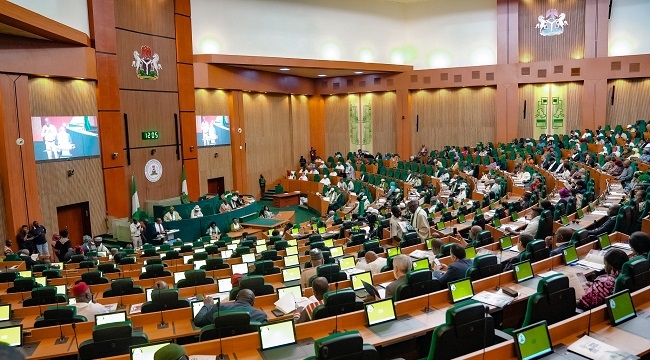
The green chamber of Nigeria’s legislature was unusually charged on Wednesday as lawmakers gathered beneath the high ceilings of the National Assembly, their voices carrying the weight of a nation long burdened by shifting policies and interrupted visions. At the heart of the debate was a proposal many described as ambitious, even historic, a bill seeking to chart Nigeria’s economic destiny for the next half-century.
Presiding over the plenary was Benjamin Kalu, whose steady gavel kept order as members of the House of Representatives of Nigeria took turns dissecting what could become one of the most consequential legislative frameworks in the country’s history.
The bill, sponsored by Amobi Ogah, proposes the establishment of a 50-year national economic plan spanning from 2026 to 2076. It is, by all accounts, a direct response to a recurring challenge that has haunted Nigeria since independence: the inability to sustain development strategies across successive administrations.
Rising to present the bill, Ogah spoke with a tone that blended urgency and conviction. He painted a familiar picture, of abandoned projects, discarded policies, and development plans that rarely outlived the governments that conceived them. According to him, Nigeria’s economic struggles were not merely the result of limited resources but of inconsistent direction.
“A 50-year national economic plan,” he declared, “represents a bold and transformative legislative initiative aimed at addressing one of the country’s persistent development challenges, policy inconsistency and short-term economic planning.”
Around the chamber, lawmakers nodded, some in agreement, others in cautious contemplation. The proposal, though widely acknowledged as visionary, raised questions about feasibility, enforcement, and adaptability in a rapidly changing global economy.
Ogah pressed on, emphasizing that the bill was not just another policy document but a legal instrument designed to bind future governments to a shared national vision. By embedding long-term planning into law, he argued, Nigeria could finally break free from the cycle of discontinuity that has stalled its progress for decades.
The proposed framework would serve as a guiding compass for economic decisions, spanning infrastructure, education, industrialization, and technological advancement, ensuring that each administration builds upon, rather than dismantles, the work of its predecessor.
For many lawmakers, the idea struck a chord. Nigeria’s history is replete with ambitious blueprints, the Vision 2010 agenda, the Transformation Agenda, and various medium-term plans, yet few have achieved their full potential due to changes in leadership and priorities.
One legislator, rising in support, described the bill as “a generational contract,” arguing that it could provide the stability needed to attract long-term investments and restore confidence among both domestic and international stakeholders.
But not all voices were entirely optimistic. Some members cautioned against the rigidity of a 50-year plan, warning that unforeseen global shifts, technological disruptions, climate change, and geopolitical realignments—could render aspects of the framework obsolete if not designed with flexibility in mind.
Others raised concerns about implementation, pointing out that even the best-crafted plans could falter without strong institutions and accountability mechanisms. “The challenge has never been planning,” one lawmaker remarked, “but execution.”
Despite these reservations, the general mood in the chamber leaned toward cautious hope. The bill’s emphasis on continuity, legal backing, and strategic foresight resonated with a growing recognition that Nigeria must think beyond electoral cycles if it hopes to achieve sustainable development.
Outside the National Assembly, policy analysts and economic experts followed the debate closely. Many viewed the proposal as a necessary evolution in Nigeria’s approach to governance. In a world where nations like China and India have leveraged long-term planning to drive growth, the idea of a structured, decades-spanning economic roadmap seemed both timely and essential.
Yet, they also stressed that the success of such a plan would depend on inclusivity, ensuring that it reflects the aspirations of Nigerians across regions, sectors, and generations, and on transparency, which would allow citizens to track progress and hold leaders accountable.
As the session drew to a close, Deputy Speaker Kalu commended the robust debate, noting that the bill would undergo further legislative scrutiny. Committees would refine its provisions, stakeholders would be consulted, and adjustments would be made to strengthen its viability.
Still, there was a sense that something significant had begun. For a country often preoccupied with immediate challenges, the conversation had shifted, if only briefly, to the distant horizon.
In that chamber, amid the debates and deliberations, Nigeria dared to imagine itself not just as it is, but as it could be in 2076: a nation guided by continuity, anchored in vision, and driven by a commitment to a future that outlives politics.
Whether that vision becomes reality now rests on the will of its leaders, and their ability to turn long-term dreams into lasting change.