By Emmanuel Gandu
HIGHLIGHTS
* The big issue
* The Debate
* Islamic position
* Christian viewpoint
* Menace of Boko Haram.
* Almajiri, and 20 million out-of-school children
* El Rufai’s Friday work free
* Falling standard of education
* Prelude to poor performance in GCE/SSCE/NECO : the statistical data/facts
* JAMB performance and Quota system
* Compare candidates perfomance in Northern and Southern states
* Concluding remarks
THE BIG ISSUE
The rate at which religious holidays, public holidays, and observance of rest days as obligatory for both Christian and Islamic adherents in Nigeria is taking a good number of days off from the school season calendar thereby leaving a negligible period for serious academic work.
Unfortunately, the practice of government shifting public holidays from the weekend to working days is making matters worst.
For the Nigerian government to, for example, move the celebration of Christmas or new year or Easter that ordinarily falls on a weekend to a working day leaves much to be desired. Same applies to other religious/national holidays.
Lamentably, some Northern states decision to close schools for the duration of religious activities is adversely affecting the standard of education in the region. This situation is eliciting public discourse and commentary about the influence of religion on both Nigeria’s educational system and public life. The debate over the influencing role of religion on education has been with Nigeria for over several decades.
The controversy is assuming an alarming divisive dimension between adherents of the two major religions of Christianity and Islam.
While the Supreme Council for Islamic Affairs (SCIA) have thrown its weight behind the action of some Northern states on closure of schools during such religious observance insisting it is in the interest of Islam especially during the months of Ramadan to close down schools, the Christian Association of Nigeria (CAN) is not in favour of the closure. CAN argues that the closure will be a set back to the educational advancement of not only the students but the entire country.
This controversy has equally attracted the sympathy of Nigerians. Some are in support of the Islamic stand while others are in support of the Christian viewpoint.
THE DEBATE
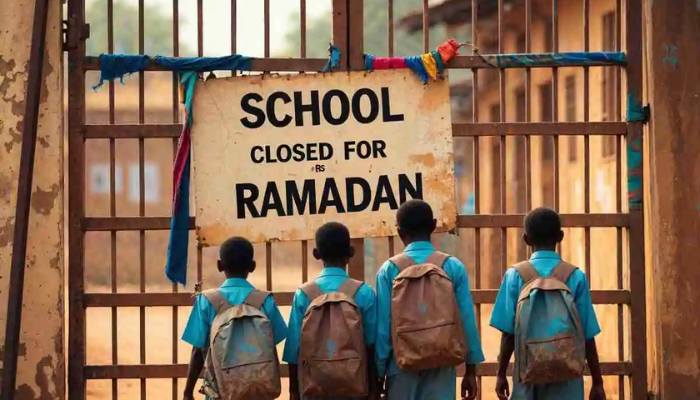
In 2025 and 2026 some states in Northern Nigeria including Bauchi, Katsina, Kano, and Kebbi ordered a 5-week closure of public and private schools for Ramadan. This is affecting nursery, primary and secondary schools, as the policy is sparking controversy over educational disruption.
While intended to support religious observance, this prolonged closure of schools has generated debate over prioritizing a healthy educational continuity versus religious and cultural sensitivity.
The decision aims to accommodate fasting students but ends up affecting all students regardless of faith, leading to criticism from the Christian Association of Nigeria (CAN), and others, as a violation of educational rights.
Critics argue that this closure is a policy decision rather than a requirement of Islamic law.
According to the opponents of the policy :
1. The 5-week closure is a break that disrupts academic calendar.
2. It is worsening the already high rate of out-of-school children especially in the North.
3. It is aggravating the abysmal poor performance of Northern students in public examinations.
4. It portrays the North as an un serious regional block to matters of educational development.
Available data (2025) shows a 44% rate of out-of-school children in the Northern Region compared to a healthy state in the South.
On its part, the Middle Belt Forum (MBF) expressed concern that non-Muslim students are forced to stop their education during the closure periods.
There is also concern by many watchers of the policy over what this closure means for the Nigerian secular status.
Constitutionally, this policy is seen by many including Professor Sam Amadi as infringing on secular education, as enshrined in section 10 of the 1999 constitution of the Federal Republic of Nigeria as amended.
The international community is watching the unfolding drama with rapt attention.
On its part, ‘Open Doors’ Sub-Saharan Africa through its legal expart John Samuel says that “This action violates the fundamental rights to education and religious freedom, and a dangerous precedent.”
The media is not left out of this imbroglio either.
The ‘Premium Times’ for example, cites international good practices to buttress the tabloid’s opposing views to the closure. According to the ‘Premium Times’, “many other Muslim-majority countries and regions such as Saudi Arabia and the United Arab Emirate (UAE) adjust school hours rather than closing for the entire month.”
MENACE OF BOKO HARAM, ALMAJIRI, AND 20 MILLION OUT -OF-SCHOOL CHILDREN
In the midst of all these backward and forth fire-like rhetorics is the resurfacing of the notorious sharia imbroglio, feeling of religious superiority / fear of domination, and issues like secularism, politics, and governance are brought to the fore.
Another fire brewing in the kitchen is the devil called the “Falling standard of Education”, and its implication of regular school closure on academic performance.
Lamentably, Nigeria is still under the violently launched attacks from the terrorists Islamic sect called Boko Haram who are opposed to Western Education as they call it blasphemy.
For any government to close down schools in a Northern Region that boasts of the largest percentage of the twenty (20) million out-of-school children, and another group in the name of Almajiri beggars who roam the streets with plastic bouls during school hours leaves a bad taste in the mouth.
EL RUFAI FRIDAY WORK FREE
Aside from that, former governor of Kaduna state Nasir El – Rufai slammed the state with a four-day working week when he declared Friday a work free day for the workers. This action reduced the school days to only four in a week.
These, have no doubt contributed to the falling standard of education in Kaduna state and indeed the entire Northern Nigeria.
FALLING STANDARD OF EDUCATION IN NORTHERN NIGERIA – THE STATISTICS :
The Northern states are producing unqualified O’Level / Secondary school products as university materials.
Likewise, some of teachers at these secondary schools are products of this Nigerian university system. Their suitability and competence at the job is a reflection on the performances of their students at the O’ Level examinations. Hence, the academic performance of some students in public examinations like the SSCE, GCE, NECO and JAMB is sometimes abysmal, unfortunate, unacceptable and abhored. Incidentally, this is the factory mill for the universities.
A research by Onwuka (2016) revealed that in the 2016 Unified Tertiary Matriculation Examination (UTME) for example, the six North East states produced 96,280 candidates for that examination, while Imo state alone had 104,383 candidates for same examination.
Another revealing scenario is that the seven North West States together presented 163,240 candidates in this same examination. According to this reseach, the sad reality was that the 3 states with the highest candidates for that 2016 examination had Imo with 104,383 candidates, Delta (78, 854), and Anambra (77,694) produced more candidates for university admission (260,931) than the entire 13 states of the North East and North West who had a combined total candidates of 259, 660.
Another survey published in the Punch Newspaper of 9th July 2019 indicates that while literacy levels in some Southern states are as high as 96%, that of the Northern states was as low as 7%, with only Benue, Kogi, Taraba and Adamawa crossing the 50% mark.
JAMB AND QUOTA SYSTEM
Regretably, the discriminatory admission policy implemented by the Joint Admission and Matriculation Board (JAMB) for candidates seeking university entry does not reward merit, competency and hardwork. Rather, quota system and cut off marks are applied according to states. This system is meant to favour educationally disadvantaged states. It therefore means that the best qualified candidates may not get admitted into the university system, hence “garbage in garbage out.”
NECO EXAMS PERFORMANCE
In another report, and according to the Registrar/Chief Executive of the National Examination Council Professor Dantani I. Wushishi’s comment in February 2023, out of the candidates that sat for the NECO Senior School Certificate Examination (SSCE) in the year 2022, thirty three thousand nine hundred and fourteen (33, 914) of them representing 57.36% got five(5) credits and above including English and Mathematics, while 46,825 candidates representing 79.20% got 5 credits and above without English language and Mathematics. The NECO Registrar also reported that a total of 11,419 candidates were booked for exams malpractice of various forms in the 2022 examinations as against 4,454 in 2021.
This implies that three things were likely responsible for the abysmal performance by those who could not meet the pass conditions :
1. 79.20% candidates were not qualified for university admission in 2023 because they failed to meet the requirements of credit in English language and Mathematics.
2. The teachers, who incidentally are products of the university system may not have been qualified as teachers to execute their duties effectively in preparing the students for the examinations.
3. There was high increase in examination malpractice by the students/candidates because they failed to prepare adequately for the examination but waited to cheat their way through.
CONCLUDING REMARKS
It therefore remains to be seen whether the Northern states will divorce religion from education to save the future of their ever-increasing large youthful out of school populalation through the provision of functional and uninterrupted school system/education or continue to suffer from self inflicted wounds through religious policies.