By Adom Kyaagba
“I am in politics to baptise politics and make it pure.” – Fr. Moses Adasu, priest and Governor of Benue State, 1992 “Clerics are forbidden to assume public offices which entail a participation in the exercise of civil power.” – Canon 285 § 3, Code of Canon Law
The Question Nobody’s Answering
Emmanuel Gandu closed his reflection on clergy in public office with a resigned “time will tell.”
That is not good enough. Time does not decide this crisis. Choices do.
I write as a Knight of the Honoured Order of St Mulumba, not as an outsider, but as a lay Catholic formed in the duty of civic responsibility.
The debate keeps circling the same tension: Fr. Moses Adasu’s pledge to “baptise politics and make it pure,” against Canon 285 § 3’s blunt ban on clerics holding offices that share in civil power. But the question is not whether that ambition is wrong – Fr. Adasu’s instinct may have been exactly right.
The real question is where it belongs.
What The Church Actually Did
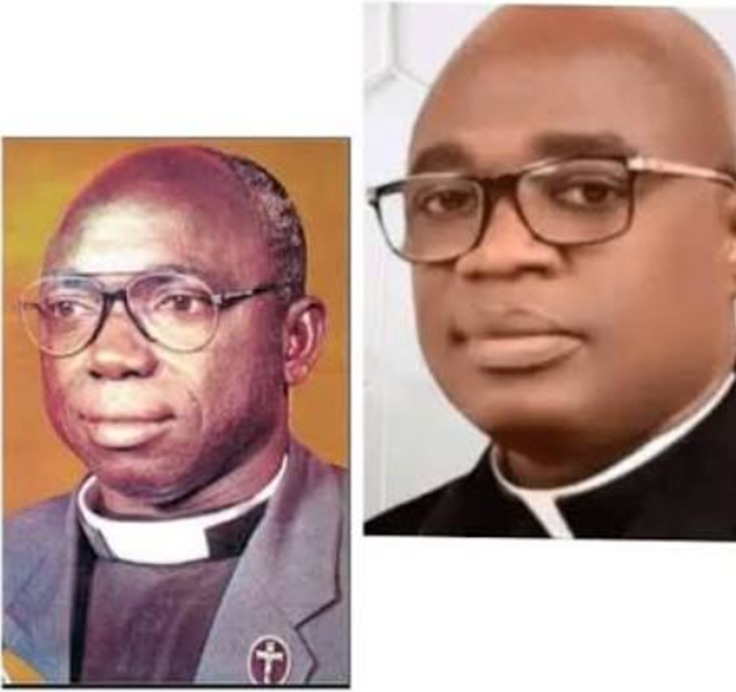
Contrary to the popular narrative around Fr. Hyacinth Alia’s governorship in Benue State, the Catholic Church never waved his political ambition through. Long before Alia took the oath of office, Bishop William Avenya of the Catholic Diocese of Gboko suspended him from sacred ministry, “until he ceases from contumacy” (ACI Africa; Catholic For Life).
That single fact changes the whole debate. This was never a Church too naïve to see the collision between cassock and statecraft coming. The discipline existed, was articulated clearly, and was applied. Fr. Alia simply defied it.
When commentary swelled in September 2026, Gandu’s piece in Daily Query, Vanguard’s “Fr. Alia and the Seduction of Power,” SundiataPost’s critique of clerical hypocrisy, it read as one unified chorus. But treating this as one priest’s misstep misses the real failure. The question is not why the Church allowed a priest into politics. It is why discipline failed to stop him once he was in.
Reading The Law Precisely
Clerical-politics debates tend to flatten two separate rules into one blanket ban. Canon 285 § 3 is absolute: clerics “are forbidden to assume public offices which entail a participation in the exercise of civil power.” No exceptions. Canon 287 § 2 is conditional: clerics “are not to play an active role in political parties… unless, in the judgment of competent ecclesiastical authority, this is required for the defense of the rights of the Church or to promote the common good.”
A state governorship is direct, coercive civil power. It fails Canon 285 § 3 outright, before any question of party-political permission under 287 § 2 even arises.
Lord Acton’s old warning explains why: power tends to corrupt, and absolute power corrupts absolutely. Party politics under 287 § 2 still sits inside a field of colleagues, opposition, and voters, bounded power, open to correction. The Executive office under 285 § 3 concentrates power in one hard-to-check hand, exactly the condition Acton warned about.
Nigeria adds its own complication: Section 221 of the 1999 Constitution bars independent candidacy outright, so there is no bounded, independent path into politics here, not even for a priest whose bishop judged it necessary. Only submission to whichever party will have him.
Gaudium et Spes § 43 supplies the theology beneath all this. Vatican II said secular duties belong to the laity, and warned pastors against claiming the Church’s authority for their own political opinions. A priest who takes a side in politics stops speaking for the whole Church and starts speaking for one faction of it.
The Cases Gandu Left Out
Gandu’s eleven historical examples: Jozef Tiso in wartime Slovakia, Fulbert Youlou in Congo, Fernando Lugo in Paraguay, Jean-Bertrand Aristide in Haiti, make a real point. Clerical authority collapses easily under political ambition. But a list built entirely from collapse proves its point by selection, not comparison. Widen the lens:
• Fr. Robert Drinan served a decade in the US Congress as a respected human-rights legislator, and complied immediately when John Paul II ordered priests out of electoral politics in 1980, no scandal, no defiance.
• Fr. Moses Adasu accepted his canonical suspension gracefully after winning the Benue governorship in 1992, founded Benue State University, and left office through a military coup, not scandal, keeping his people’s respect.
• Archbishop Makarios III of Cyprus fused the Archbishop’s office with the presidency and won re-election with 96 percent of the vote, but the same fusion triggered an episcopal revolt, a guerrilla campaign, and the 1974 coup that briefly exiled him. (Orthodox, not Catholic, a comparison, not a Catholic precedent.)
What separates Drinan and Adasu from Tiso and Aristide is not nationality or virtue. It is whether Church discipline was respected, and whether the power was bounded. The successes stayed inside legislative or single-term roles.
The disasters happened where priests defied their bishops or seized unbounded executive power, precisely the line Canon 285 § 3 draws.
Why Nigeria Makes It Worse
Canon law explains that a priest should not hold civil office. It does not explain why Nigerian politics swallows even the most well-intentioned pastor so fast.
Nigerian officeholders live in two moral worlds at once. Peter Ekeh called them the civic public and the primordial public, the impersonal state, where resources feel fair game, and one’s own community, where diverting resources to it feels like sacred duty. Richard Joseph named the pattern prebendalism: state office as a personal prebend for one’s own people.
This trap catches a priest faster than an ordinary politician, not slower, his whole formation trains him to feel his people’s needs as moral claims on him. Put him in the executive office, as Adasu was in 1992 and Alia in 2023, and that instinct fuels prebendal capture instead of guarding against it. He does not see an electorate. He sees his parish grow larger.
A second, quieter mechanism compounds this. A homily is a proclamation, not debate, delivered as a settled word, with no room for the congregation to talk back. The correction a priest’s formation does supply, through confession and obedience to his bishop, runs upward to one man, in private, with no equivalent of a legislative floor or a free press.
Drinan thrived where that correction existed, colleagues, debate, press scrutiny, and submitted without a fight when Rome corrected him. Adasu did the same. Where it was missing, as in Makarios’s presidency, the fusion of pulpit and office proved far less stable.
What Catholic Action Actually Did
Pope Pius XI’s Catholic Action gets cited often in this debate, and usually gets it wrong. It was not a political party, it was an incubator of Christian conscience, built on a sequence: first, rigorous formation of the laity; second, lay initiative in civil society; third, and only third, independent political parties.
Get that sequence right, and formed lay leaders build the parties and institutions that stabilised postwar European democracies, without compromising the Church’s neutrality. Get it backwards, clergy assuming office or seeking party endorsement directly, and you get exactly what canon law was built to prevent: the clericalization of power and the erosion of the Church’s moral authority.
That sequence, not the shortcut of clergy in office, is the actual precedent for what Nigeria needs.
The Honest Tally
The case for clergy in office is real, and should not be waved away. A priest brings moral authority, an existing bond of trust, and a pastoral commitment that can produce real results, Fr. Adasu’s Benue State University is proof of that.
But weigh the benefits against the costs, and a hard asymmetry appears:
• The advantages are personal. They depend entirely on the one priest’s virtue, skill, and resilience.
• The disadvantages are structural. When a priest-politician falters, the damage is not his alone, it fractures diocesan communion, compromises the Church’s neutrality, and drags down the credibility of the priesthood itself.
One more caution, even without a documented case behind it: clerical life removes ordinary exposure to money and its temptations, a reason for caution, not confidence, though it is not what any of the failures above actually trace to.
An exceptional priest may win personal political victories, but the structural cost of failure falls on the whole Catholic community. Personal gains fade; institutional damage does not. That asymmetry, not an arbitrary rule, is what Canon 285 § 3 is actually protecting.
Where The Ambition Belongs
The answer to Nigeria’s political crisis is not to bar Catholic conscience from public life. It is to point that ambition at its proper target: a disciplined, formed laity, not just the more ethical choice, but the only one with the scale to work.
Nigeria’s Constitution bars independent candidacy outright, so no priest, however well formed, can run for office without submitting to an existing party’s machinery. Only an organised lay movement has the numbers to build or reform a party from within, the way Catholic Action’s laity eventually built Christian Democracy in Europe. A single cleric has no such leverage; he simply takes whatever party will have him.
Existing structures: the Knights of St Mulumba, Catholic Men’s and Women’s Organisations, Diocesan Pastoral Councils, need to grow beyond fellowship and devotion. The Catholic Bishops’ Conference of Nigeria should establish a dedicated Institute for Catholic Social Thought, training lay believers in subsidiarity, solidarity, and the common good for public service, campaign ethics, and policy governance.
Fr. Moses Adasu’s own words carry the answer. “I am in politics to baptise politics,” he said, a noble desire aimed through the wrong channel. Canon 861 § 2 already tells us who steps in when the ordinary minister is absent or impeded: lay Catholics, as extraordinary ministers of baptism. And Canon 285 § 3 already impedes a priest from holding civil office, in exactly the sense that canon means.
Baptising politics was never a job reserved for the clergy alone. Canon law already names who takes it up when the priest cannot: the laity, standing ready to do the work.
Adom Kyaagba is a Knight of the Honoured Order of St Mulumba and a public policy analyst writing on faith, governance, and public life in Nigeria.