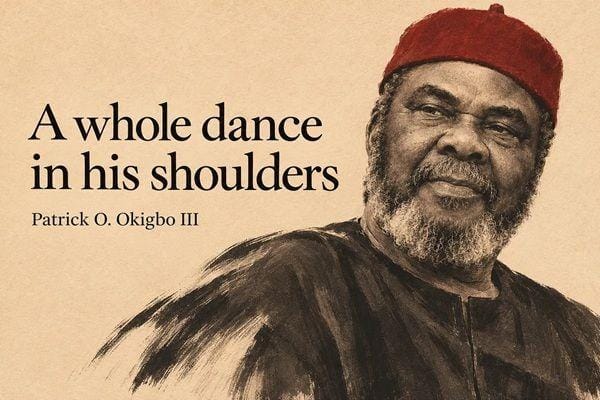
By Patrick Okigbo III
Watch him dance to the ufie, the deep-toned wooden slit drum. He holds a walking stick or an ákúpé, the cowhide fan of a titled man. You wait for him to begin. One shoulder rises a little. He inclines his head. He smiles. He takes a step, then another.
The first time I met Pete Edochie, I called him Uncle Peter. My mother corrected me. Pete. I was about fifteen and had never met anyone named Pete. Then she told me what he’d called his children. Leo. That I could comprehend — we read the horoscopes on the back page of the dailies. But Yul? Nobody in Enugu, which was pretty much the extent of my universe, went by that name.
My mother was studying mass communication and interning at the Anambra Broadcasting Service. Sometimes, when I was out on errands with her, she would pull up at the station, leave me in her blue Peugeot 504 and run in. Sometimes she took me inside.
In 1987, Pete became the founding director of the service’s new FM station. My mother liked the way he’d give someone a job to do if he thought they could do it, whatever their rank. The station played rap and soul and employed people who could hold a conversation between records. Pete called it Sunrise 96.1 FM.
Pete had grown up in northern Nigeria. In 1966, when Ndigbo were being hunted and killed there, he fled to the East. During the civil war that began in July 1967, he and his wife, Josephine, worked for the Voice of Biafra. They would close transmission at three in the morning and walk home.
Decades later, Pete said the war still came back to him when he was alone and thought of colleagues he had lost. The rising sun was Biafra’s emblem. Pete recalled that the military governor, Colonel Robert Akonobi, once asked him why he’d named the station Sunrise. Pete offered to change it if the governor could tell him where else the sun rose. The governor let him keep it.
I wonder now what my mother, Ijele Nwanyi, heard when an announcer said Sunrise. Did she hear in that word an acknowledgement of what she had lived through? For me, I just waited for Chuzzy Boko or DJ Snake to play the next record.
In 1980, while training at the BBC, Pete bought records for Music from the Masters, a programme he wanted to start when he got back to Enugu. There he was in a British record shop, choosing LPs for people he might never meet. Some of us heard Handel, Mozart or Schubert for the first time on his programme. At the time, I preferred Run-D.M.C., Public Enemy or Eazy-E.
I think of a country as a canvas each generation inherits with a good deal of work already on it. Those records were among the things Pete added to ours. I call that Olu Obodo, community service. Pete thought somebody in Enugu might come to love Schubert, given the chance to hear him. The cost of finding out came out of his pocket.
Watch him dance to the ufie, the deep-toned wooden slit drum. He holds a walking stick or an ákúpé, the cowhide fan of a titled man. You wait for him to begin. One shoulder rises a little. He inclines his head. He smiles. He takes a step, then another.
As for Yul, the answer had been in our living room all along. As kids, we watched The King and I over and over. It never occurred to me that Pete had named his youngest son after the bald man who played the king, Yul Brynner.
On Saturday nights, Pete was Okonkwo. The Nigerian Television Authority’s adaptation of Chinua Achebe’s Things Fall Apart held us the way Ali Mazrui’s The Africans did. Things Fall Apart was one of the few programmes that could persuade my father to come and watch with us.
Pete was my second-favourite Okonkwo. I preferred Charles Oguejiofor, who played him in Igbo. Oguejiofor had a slight stutter that suited a man whose anger so often got ahead of his words. In Igbo, he barely had to open his mouth for me to know how much trouble his wives, Ojiugo and Ekwefi, were in. In English, for me, there was that fraction of a second further to travel. What I remember best from both performances is the killing of Ikemefuna. Ezeudu has warned Okonkwo to have no hand in the boy’s death. The boy calls him father. When the first blow falls, it is to Okonkwo that he runs.
I missed much of Pete’s ascent in Nollywood. We used to swap VHS copies of Living in Bondage and Nneka the Pretty Serpent. By the DVD years, other interests were claiming my evenings. Meanwhile, viewers across Africa were coming to recognise an Igbo elder by the way Pete carried himself.
When a man takes the Ozo title, my people say he has washed his tongue. Our parents told us what that meant. From then on, he must tell the truth. Pete could convey the weight of that obligation in the few seconds before he spoke.
Whenever Pete met his old friend Olu Jacobs for a drink, he brought a bottle of Campari. Olu was the Senior Man. Before Pete opened the bottle, he held it out for Olu to touch. Then they would sit and drink quietly. In all their years together, Pete said, they never once disagreed. The last time they met, they were leaving separate film locations and stopped on the road. “Pete, our mates are gone,” Olu said. They stood there holding each other while people took photographs.
When Olu died in September, Pete recorded a tribute. “Olu J, Dan Kano,” he began. Then he shook his head. Pete had fled the north as a young Igbo man. In his old age, mourning a Yoruba friend born in Kano, he reached for Hausa. I hear a line from our national anthem in that greeting: “Though tribe and tongue may differ, in brotherhood we stand.”
That September I watched Pete on Curiosity Made Me Ask, a programme popular with my children’s generation. He said he’d come to encourage the host, Isbae U, a young man he thought had a future. Pete recited Shakespeare. In 1962, he told Isbae U, he’d acted in The Merchant of Venice at school in Kaduna. He was fifteen. At fifteen I had rap, Achebe, the horoscopes and as many viewings of The King and I as I pleased. How had I imagined a smaller world for Pete? My mother, all those years ago in the 504, had the measure of him well before I did.
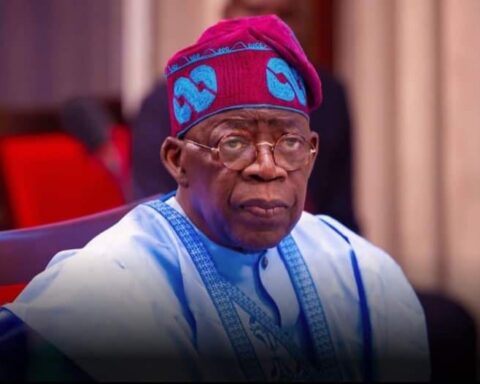
Pete died in Enugu on November 25, aged seventy-nine, after a long illness with prostate cancer. Leo announced his father’s death on behalf of the family. I wrote to Leo to send my condolences to them all.
Of the many names Pete went by, the one that comes to me now is Ọgàdàgídí. Think of a man who could make the earth tremble. Then watch his shoulder. It rises a little, and you realise he has been dancing all along.
When next we hold the kola nut and summon those who faithfully walked this path before us, I shall think of Pete among the elders, his ákúpé in his hand. If the ufie is playing, I know where to look.
Ka ndị àlà na ndị ịchie nabata ya n’ndokwa. Ịsé!
May the gods of the earth and our good ancestors receive him in peace. Amen.