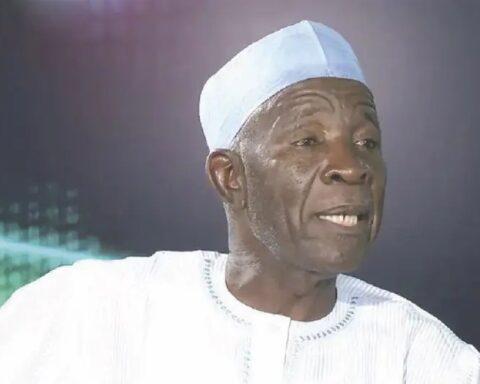
Prominent human rights lawyer and Senior Advocate of Nigeria (SAN), Femi Falana, has affirmed that the Economic and Financial Crimes Commission (EFCC) acted strictly within its legal mandate when it placed a Post No Debit (PND) restriction on the Osun State Government’s bank accounts.
Speaking on Friday, August 7, 2026, during an appearance on Channels Television’s Politics Today, Falana emphasized that Nigerian law empowers the anti-graft agency to freeze government accounts linked to suspicious transactions, provided it secures an ex parte court order within 72 hours.
“Under the law, the EFCC has the power to freeze the account of the Federal Government or of any state or local government in Nigeria and, in not more than 72 hours, has to go to court,” Falana stated. “As far as the law is concerned, the EFCC has not acted illegally.”
Falana cited a September 2022 Court of Appeal decision in a case between the Benue State Government and the EFCC, which established that anti-corruption agencies have the legal standing to investigate and place temporary freezes on state government accounts.
Responding to concerns that the action comes close to the state’s gubernatorial election, Falana warned against creating an impression that law enforcement must pause investigations during election cycles. “We must be very careful that we don’t give the dangerous impression that when elections are 10, 20 or 30 days away, the anti-graft agency must turn the other eye,” Falana added.
Falana argued that President Tinubu’s intervention should have been executed formally through the Attorney-General of the Federation (AGF) rather than a direct executive order, preserving the EFCC’s statutory independence.
Wilson Uwujaren (EFCC Director of Public Affairs): Stated that the anti-graft agency acted under Section 34 of the EFCC Act and Section 7(6) of the Money Laundering Act 2022 to prevent the diversion of ₦11 billion in public resources.
Kola Olabisi (Osun APC Spokesperson) defended the anti-graft probe, maintaining that President Tinubu’s directive did not exonerate the Osun State Government from ongoing financial scrutiny.
Governor Ademola Adeleke maintained that the restriction was an unconstitutional disruption of state governance and essential public services, demanding N2 billion in exemplary damages.