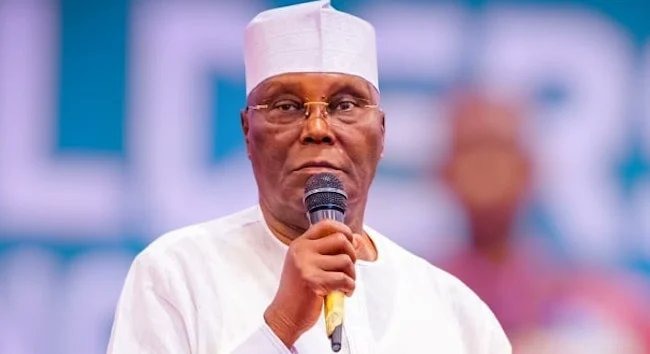
In a political landscape already brimming with permutations ahead of the 2027 general elections, a fresh voice has emerged from Imo State, calling for a generational shift in leadership. Collins Osuagwu, a former local government chairman candidate of the African Democratic Congress, has made a passionate appeal to former Vice President Atiku Abubakar, urging him to reconsider any plans to contest the presidency once again.
In an open letter that has begun to stir conversations across political circles, Osuagwu framed his appeal not as criticism, but as a call to legacy. He acknowledged Atiku’s decades-long presence in Nigeria’s political evolution, describing him as a figure whose contributions to democratic growth cannot be ignored. However, he argued that the time had come for the elder statesman to embrace a different role, one that prioritises guidance over ambition.
Osuagwu pointed out that Atiku’s presidential journey, which dates back to the early 1990s, has been marked by resilience but also repeated setbacks. From his initial aspirations in 1992 to his more recent bids, Atiku has remained a constant contender in Nigeria’s highest political race. Yet, according to Osuagwu, the political terrain has shifted significantly, and the realities of today demand a new approach.
He stressed that stepping aside should not be viewed as defeat, but rather as a strategic and honourable decision. In his words, “There comes a time when the greatest act of leadership is not to persist, but to yield, for the sake of unity, stability, and the future.” He described such a move as one rooted in wisdom and strength, capable of cementing Atiku’s place in history as a leader who recognised when to pass the baton.
The letter also highlighted the growing demand among Nigerians, particularly the youth, for fresh leadership. Osuagwu argued that a younger candidate could better connect with the aspirations of a new generation facing economic uncertainty, unemployment, and rapid technological change. By throwing his weight behind such a candidate, he suggested, Atiku could play a decisive role in shaping a more inclusive and forward-looking political direction.
Beyond generational arguments, Osuagwu framed his appeal within the broader context of national stability. He warned that prolonged dominance by familiar faces might deepen political fatigue among citizens, potentially weakening trust in the democratic process. Supporting new leadership, he said, could reinvigorate public confidence and signal a commitment to renewal within the political class.
While acknowledging that the final decision rests solely with Atiku, Osuagwu’s message was clear: the moment calls for reflection, not repetition. He urged the former Vice President to transition fully into the role of a statesman, one who mentors emerging leaders, fosters unity across party lines, and contributes to nation-building without seeking electoral office.
As the 2027 elections draw closer, such calls may become more frequent, reflecting a broader debate about continuity versus change in Nigeria’s leadership. Whether Atiku heeds this appeal or chooses to remain in the race, the conversation ignited by Osuagwu underscores a pivotal question facing the nation: when is it time for experience to give way to renewal?
For now, Osuagwu’s letter stands as both a challenge and a tribute, recognising a long-standing political figure while urging him to embrace a legacy that extends beyond the ballot box.