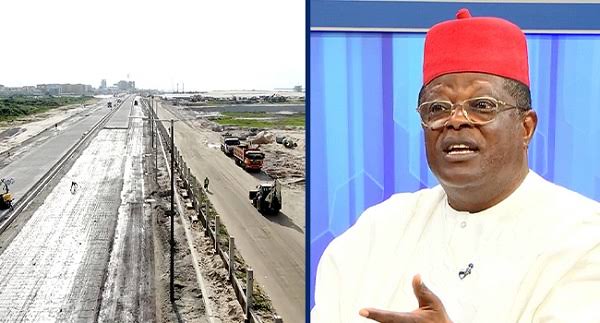
The Minister of Works, Senator David Umahi, has reaffirmed President Bola Tinubu’s unwavering commitment to completing the 750-kilometre Lagos-Calabar Coastal Highway, declaring that nothing will stop the delivery of the flagship infrastructure project.
Umahi made the declaration on Sunday afternoon, November 22, 2026, during an inspection tour of completed and ongoing bridges along Sections 1 and 2 of the coastal highway corridor in Lagos, which included stops at the newly unveiled flyover and U-turn bridge around Maiyegun Estate and Jakande Estate, as well as Chainage 9 and Chainage 47.
The minister’s remarks, which followed a weekend inspection schedule that also covered the Carter and Eko bridges on Saturday, November 21, were formally detailed in a press statement issued on Monday, November 23, 2026, by his Senior Special Assistant on Media, Francis Nwaze.
Addressing journalists at the Lagos inspection site, Umahi emphasized that the coastal superhighway enjoys the direct backing of the presidency and represents a strategic use of public funds. He stated that the President had directed the project to be completed strictly as envisaged, explaining that borrowed funds are being channeled directly into lasting infrastructure investments across the country.
During the tour, the minister disclosed that road construction on both Section 1 and the 53-kilometre Section 2 has been completed, incorporating reinforced concrete pavement, solar-powered streetlights, underground drainage systems, and pedestrian walkways. He announced that President Tinubu is expected to officially commission Section 1 either later this month or in early December 2026, while selective bidding for the highway’s service lanes will soon be finalized.
Beyond easing transportation, Umahi underscored the commercial viability of the corridor, noting that the highway is structured to generate direct revenue for the Federal Republic of Nigeria. He explained that the use of durable concrete pavement and solar-powered lighting qualifies the country for international carbon credit claims, which will be complemented by planned windmill energy installations along the coastline from Lagos to Calabar.
In addition, the corridor will integrate closed-circuit television surveillance alongside industrial factories, housing developments, and tourism hubs, with private investors already expressing strong interest in cost-recovery partnerships. Key project officials and contractors who accompanied the minister during the Sunday inspection also provided technical updates on the pace of work.
The Federal Controller of Works in Lagos, Olufemi Dare, confirmed that out of the 20 bridges planned across Sections 1 and 2, comprising 10 bridges per section, the first flyover bridge has been completed and opened to traffic, while construction is advancing simultaneously on the remaining 19 structures.
Providing further engineering details, the Managing Director of Hitech Construction Company Limited, Dany Abboud, noted that while road pavement on Section 2 is 100 per cent complete, contractors have achieved roughly 85 per cent piling completion across all bridges and are finalising bearings and expansion joints on the Chainage 9 U-turn flyover.
Abboud added that all remaining road furniture along the stretch will be completed before the end of December 2026. Meanwhile, the Senior Special Assistant to the President on Community Engagements in the South-West, Moremi Ojudu, commended Umahi’s consistent field oversight, noting that the newly opened bridges will significantly improve connectivity and the movement of people and goods across Lagos State under the Renewed Hope Agenda.
Concluding his remarks, Umahi reassured Nigerians that the coastal highway is not diverting attention from other critical federal road networks. He pointed to ongoing construction on the 1,068-kilometre Sokoto-Badagry Superhighway, which has surpassed 30 per cent completion.
Alongside the 465-kilometre Trans-Saharan Highway, emergency palliative works by Hitech on 40 kilometres of the Benin-Asaba corridor, and dualisation plans for the East-West Road in the Niger Delta as evidence that the administration is executing transformative infrastructure simultaneously across all geopolitical zones.