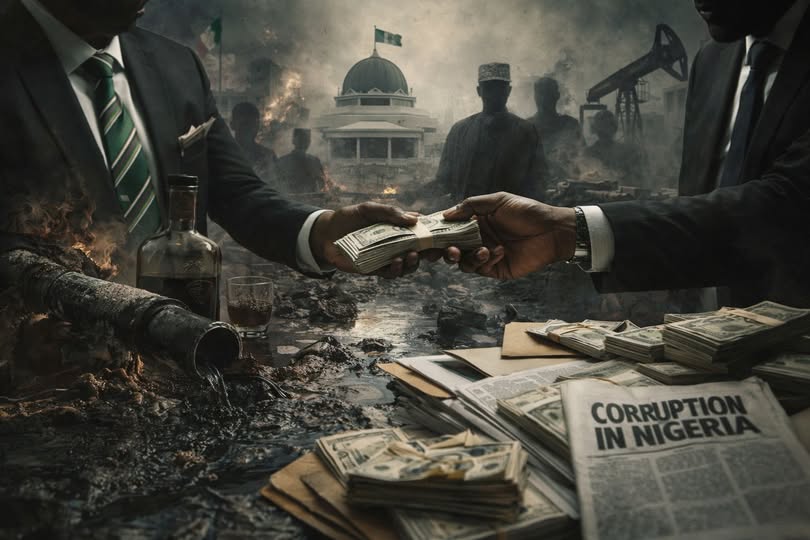
How Nigeria’s most decorated class became its most consequential liability
By Charles Obiajulu Ugwu- PhD
There is a class of Nigerians the country has been taught to revere on sight. They arrive with the right degrees, the right accents, the right institutional affiliations, the right boards and the right invitations. They speak the vocabulary of reform with practised ease. They are photographed at the conferences where the country’s future is supposedly being designed. And under their stewardship, across four decades and counting, Nigeria has gone backwards in almost every metric that matters.
This is the contradiction the national conversation has refused to confront. Nigeria’s collapse has not been administered by its illiterate. It has been administered by its decorated. The men and women whose biographies the society reads aloud at funerals and lifetime achievement dinners are, in disproportionate measure, the same men and women whose institutional decisions, signatures, silences, and active facilitations have produced the country every ordinary Nigerian is now trying to escape. The reverence the society pays them is not a reflection of what they have built. It is a habit, inherited from a more hopeful era, that has long outlived its justification.
Call them what they are. The Nigerian elite. Not the merely wealthy, not the merely titled, not the merely educated, but the credentialed operating caste that occupies the consequential rooms of national life. They run the banks. They chair the boards. They preside over the electoral commissions, the regulatory agencies, the universities, the judicial panels, the professional associations. They populate the cabinets across every administration regardless of party. They cycle, with remarkable mobility, between public office and private gain, between ministerial appointment and consulting retainer, between vice-chancellorship and senatorial ambition. They are not a faction. They are the operating system. And the operating system has failed.
Every nation whose developmental ascent invites serious study reveals the same class beneath its progress, performing a different function. In post-war Germany, in South Korea’s industrial leap, in Singapore’s improbable transformation, in present-day Rwanda and Vietnam and the United Arab Emirates, a recognisable elite has acted as the catalytic spine of national reconstruction. Intentional, courageous, technically competent, and bound by a covenant with the society that produced them. They convert formation into structural consequence. They submit themselves to the institutions they lead rather than extracting from them. Where this kind of elite is present and functioning, nations move. Where it is absent, or worse, where it is present but inverted in function, nations decay.
By every reasonable measure, Nigeria should be among the most striking case studies of the catalytic phenomenon on the African continent. The country has produced this class in extraordinary abundance, across generations and continents. Nigerian professionals populate the consequential institutions of the global economy. Nigerian academics hold chairs in the world’s leading universities. Nigerian executives run divisions of multinational corporations. Nigerian creatives shape culture from Lagos to London to Atlanta. The raw material is not in dispute. What is in dispute, increasingly and uncomfortably, is what this class has done with itself once positioned inside Nigeria.
The puzzle is not their docility, though docility is part of it. The puzzle is the mounting evidence of their direct authorship of the national dysfunction. They are not absent from the rooms where the country is being undone. They preside in those rooms. They draft the instruments. They legitimise the outcomes. They lend their credentials to processes whose integrity they privately concede to be compromised. The harm Nigeria suffers is not principally the work of the uneducated or the unexposed. It is, with disturbing regularity, the work of those the society has trained, decorated, and elevated precisely so that such harm would not occur.
Consider the electoral cycle, where the institutional umpiring of the democratic process is routinely conferred on members of this class. Vice-chancellors, senior academics, retired judges, technocrats of established reputation. The record across successive cycles is not stewardship but quiet capitulation, and in too many instances, active complicity. The 2007 general election, presided over by a professor of the highest academic standing, was so degraded in its conduct that the eventual beneficiary publicly acknowledged its flaws. The pattern has not meaningfully reversed in the cycles since. Each time, the country is told that the credentials of the umpire are a guarantee of integrity. Each time, the country discovers that credentials are not character, and exposure is not conviction.
Consider commerce, where privileged intellect has been deployed less to build durable enterprise than to game the system. The architecture of subsidy fraud, the manipulation of foreign exchange windows, the systematic capture of regulatory agencies by the industries they were created to regulate, the elaborate schemes through which public resources are converted into private holdings abroad. These are not the works of the unlettered. They require sophistication. They require legal counsel. They require accountants who can structure transactions to evade scrutiny. They require bankers who can move funds without leaving traceable signatures. Every element of these arrangements is the handiwork of trained minds. The fuel subsidy probe of 2012 implicated firms operated by individuals whose professional pedigrees would, in any other context, be considered exemplary. The pattern has only deepened in the years since.
Consider the judiciary, where the architecture of justice has been bent by serving and retired judges whose academic credentials are unimpeachable. Consider the universities themselves, where the very institutions meant to produce the next generation of this class have been hollowed out by the same class, through chronic underfunding tolerated, through industrial actions weaponised, through certificate scandals quietly settled, through plagiarism cases buried, through the routine sale of grades and qualifications. Consider the regulatory agencies, where appointees with international training and visible competence have presided over the systematic erosion of the very standards they were appointed to enforce.
Consider the boardrooms of the banks, where the 2009 banking crisis exposed how thoroughly the country’s most credentialed financial minds had been complicit in the inflation of fictitious balance sheets, the issuance of insider loans without recoverable backing, and the orchestrated misleading of regulators and shareholders alike. The Sanusi reforms of that period named individuals whose professional trajectories had been celebrated for decades. None of them were uneducated. All of them were precisely the kind of citizen the society had been taught to revere.
Consider the professional bodies, where the codes of ethics that govern accountants, lawyers, engineers, and medical doctors are routinely set aside when the practitioner is sufficiently senior or sufficiently connected. Consider the legislative chambers, where the most expensively educated cohort of public officials on the African continent has presided over budgets whose opacity defies the basic principles of public finance taught in any first-year university course.
The pattern repeats across every consequential institution of national life. Wherever this class has been entrusted with serious responsibility, the country has emerged poorer for the encounter, not richer. The accumulated record is not ambiguous. It is documented in the reports of the Auditor-General that successive administrations have ignored. It is documented in the findings of judicial panels whose recommendations have never been implemented. It is documented in the disclosures of the Nigeria Extractive Industries Transparency Initiative across more than a decade of reporting. It is documented in the country’s own gradual descent in every credible global index of governance, human development, and institutional integrity.
This forces a reconsideration that Nigerian public discourse has long avoided. The reflexive assumption that the educated, exposed, professionally accomplished citizen is automatically a positive catalyst no longer survives contact with the evidence. The society has been ascribing to this class a developmental function it has demonstrably refused to perform. The reverence is unearned. The expectation has been misplaced for so long that it now operates as a structural deception, shielding the very people most implicated in the country’s deterioration from the scrutiny their record deserves.
The deeper damage is what this misplaced reverence has done to the civic imagination of ordinary Nigerians. For decades, the citizenry has been instructed, implicitly and explicitly, that salvation will come from this class. That the right professor, the right technocrat, the right reformed banker, the right repatriated executive will at last appear and bend the country toward sense. This expectation has produced a passive citizenry, oriented toward waiting rather than demanding, toward deferring rather than interrogating. It has narrowed the imagination of accountability to the question of which credentialed figure should next be installed, rather than the more serious question of what structural conditions would force any figure, credentialed or otherwise, to perform.
What this essay has done is name a condition the country has been circling for years without confronting. What must follow is the harder work, and that work cannot be delegated to the very class whose failure made the work necessary. The conversation has to widen. It has to descend from the conference circuit into the streets, the markets, the union halls, the parishes, the campuses, the diaspora associations, the civic platforms where Nigerians of ordinary station hold opinions that the credentialed have long dismissed as unsophisticated. Those opinions, on the evidence of the last four decades, have been closer to the truth than the position papers.
Citizens must learn to read the elite as a record rather than as a reputation. The questions that matter are not where someone studied, but what institutions they have led, what those institutions looked like before and after their tenure, what they signed, what they declined to sign, whom they protected, whom they sacrificed. These questions are answerable. The information exists. What has been missing is the civic appetite to gather it, publish it, and refuse to forget it when the next appointment cycle begins.
Journalists, researchers, civil society organisations, professional associations of conscience, religious institutions still capable of moral seriousness, and citizens of every station have a part to play in this audit. The country’s recovery, if it is to come, will be built on the discipline of evidence rather than the reflex of reverence. It will be built on a citizenry that has learned to ask, in every room and of every figure, the question the culture has spent two generations avoiding. Not whether they are credentialed. Not whether they are accomplished. But whether their record, on the institutions of national life, has built the country or hollowed it out.
The reawakening Nigeria needs will not be authored by the counterfeit elite. It will be authored by the citizenry that finally withdraws the unearned reverence and replaces it with the harder discipline of attention. Let the conversation begin in earnest. Let it be sustained. Let it be evidenced. And let it not stop until the country has answered, for itself and aloud, the question it has been too polite to ask.
About the Author
Charles is a Contrarian thinker writing from Lagos