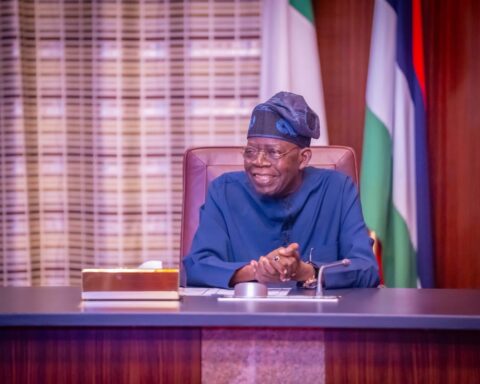
President Bola Ahmed Tinubu declared on Tuesday, October 6, 2026, that Nigeria has significantly reduced its reliance on crude oil revenues, outlining a strategic pivot toward natural gas to power the country’s industrial growth, boost electricity supply, and expand national energy access.
Speaking through Vice President Kashim Shettima, President Tinubu also warned international and local oil companies operating in Nigeria that the federal government will hold them strictly accountable to their capital investment commitments.
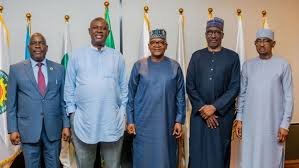
The announcement was made at the State House Annex in Abuja during the fifth anniversary celebration of the Nigerian Upstream Petroleum Regulatory Commission (NUPRC), established under the Petroleum Industry Act (PIA).
Addressing an audience of regulatory chiefs, energy executives, and international investors, President Tinubu emphasized that while oil remains a critical pillar for foreign exchange earnings and exchange rate stability, Nigeria’s economic future depends on a diversified, energy-rich non-oil economy driven by natural gas.
“Our economy is undergoing a structural shift under the Renewed Hope Agenda,” President Tinubu said via Vice President Shettima. “We are systematically reducing our budget’s single-sector reliance on crude oil revenue by expanding high-growth non-oil sectors such as agriculture, manufacturing, and digital industries.
However, a diversified economy still needs energy. With the world’s most promising natural gas reserves, Nigeria is using this ‘Decade of Gas’ to ensure our domestic resources directly feed our industrial hubs, light up our power grids, and deliver energy access to every home.”
President Tinubu highlighted the administration’s recent fiscal incentives and regulatory reforms aimed at unlocking up to $50 billion in deep offshore and gas sector investments. He noted that stream-lined fiscal terms have restored investor confidence, ranking Nigeria among Africa’s top destinations for upstream capital commitments for two consecutive years.
However, the President issued a stern directive to petroleum licensees and international oil majors, stating that regulatory leniency is over.
“Regulatory certainty goes both ways,” President Tinubu stated. “As a government, we have removed bureaucratic bottlenecks, slashed approval timelines, and structured attractive fiscal regimes. In return, oil and gas companies must meet their development commitments. Idle field retention without active development plans will no longer be tolerated. Investors will be held strictly to account on their capital deployment timelines.”
Also speaking at the event, Permanent Secretary of the Ministry of Petroleum Resources, Mrs. Patience Oyekunle, representing the Minister of State for Petroleum Resources (Gas), Ekperikpe Ekpo reaffirmed the ministry’s policy focus on domestic gas utilisation.
Oyekunle praised the NUPRC for creating a transparent regulatory framework that separates commercial interests from regulatory oversight.
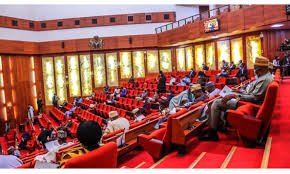
Adding parliamentary backing, Senator Jarigbe Agom Jarigbe, Chairman of the Senate Committee on Gas, commended the executive branch’s gas-first energy transition model.
He pledged that the National Assembly will continue providing legislative support to ensure regulatory clarity and attract additional foreign direct investment into domestic gas processing, transmission, and power infrastructure.
The administration reaffirmed its commitment to a “just energy transition” that balances international climate goals with domestic economic development, positioning natural gas as the primary transition fuel for Africa’s largest economy.