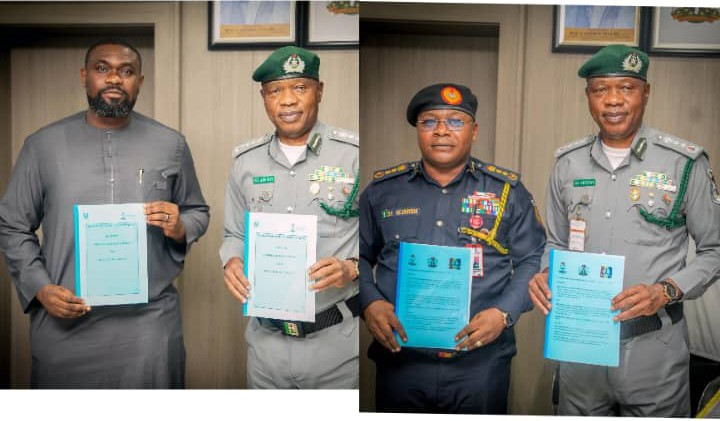
The Nigeria Customs Service (NCS), on Friday in Abuja signed separate Memoranda of Understanding (MoU) with the Federal Fire Service (FFS), and Unilever Nigeria.
The move aims to strengthen inter-agency and public-private collaboration, enhance security, protect legitimate trade, safeguard lives and consumers, and support Nigeria’s economic growth.
The NCS Spokesperson, Mr Abdullahi Maiwada, in a statement, quoted NCS Comptroller-General Bashir Adeniyi, during his engagement with the FFS, as describing the MoU as a bold, deliberate and strategic step towards strengthening inter-agency collaboration.
Adeniyi said the agreement would support the shared mandates of both agencies to protect lives, property and critical national assets.
He added that it would enhance fire safety standards across NCS facilities, facilitate rapid emergency response, support joint training and capacity building, and promote information sharing on fire safety and preparedness.
“I am very confident that this MoU will translate to practical actions that save lives, protect government assets and enhance our collective capacity to respond to emergencies,” Adeniyi said.
On his part, the Controller-General of the FFS, Olumode Adeyemi, described the agreement as a significant step towards strengthening collaboration between the Fire Service and the NCS.
Adeyemi assured his host that the FFS would deploy its strength and expertise to protect NCS personnel, facilities and assets.
Similarly, during his engagement with Unilever Nigeria PLC, the C-G said the partnership reflected the service’s commitment to deeper collaboration with the private sector, particularly in addressing challenges affecting trade and industrial development.
Adeniyi said the agreement would enable the NCS and Unilever to work more closely to prevent counterfeiting, share intelligence as well as identify and verify suspected counterfeit products.
He added that the MoU would provide a structured channel for real-time information on trademarks, product identification features, packaging and product samples.
He noted that engagements with private-sector stakeholders often provided useful insights that informed Customs policies and operational decisions.
“Some of the takeaways we get from these engagements with the private sector influence the policies and decisions that we take,” he said.
He appreciated Unilever’s sustained investment, innovation and employment generation in Nigeria and described the company as a major partner in the country’s trade and industrial sector.
Speaking on the development, Unilever Nigeria PLC Managing Director, Tobi Adeniyi, said the company had localised more than 70 per cent of its raw materials and supported about 15,000 direct and indirect jobs.
He commended the NCS for its reforms aimed at repositioning the service, particularly its digitalisation initiatives, the Authorised Economic Operator (AEO) programme and other trade facilitation measures.
According to him, previous engagements with the NCS had already produced practical results, including the application of lessons from training involving more than 70 Customs officers.
He reaffirmed Unilever’s commitment to working with the service to combat counterfeiting and illicit trade, while expanding the partnership through further engagements across the country.