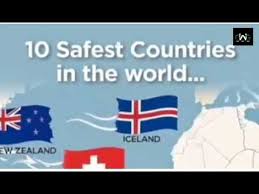
While no country is completely immune from global fallout, security analysts say some nations are far less likely to become direct targets in a large-scale conflict of World War 3 and as such among the safest places to be.
The reasons? Geography. Neutrality. Low military value. Food independence.
 1. New Zealand – The Billionaires’ Bunker
If there is a gold medal for “global distance,” New Zealand wins it.
Remote. Agricultural. Politically stable. Far from major military theatres. The island nation has long been whispered about as a preferred bolt-hole for global elites in crisis scenarios.
Translation: If chaos erupts, New Zealand is about as far away as you can get.
2. Iceland – The Peace Champion
Consistently ranked among the world’s most peaceful countries, Iceland has no standing army and sits isolated in the North Atlantic.
Low military profile + geographic distance = low strategic value.
In war calculations, that matters.
3. Switzerland – The Neutral Fortress
Neutral for centuries. Mountain-locked. Bunker-ready.
Switzerland has historically stayed out of global conflicts, investing heavily in civil defence infrastructure.
4. Bhutan – The Himalayan Shield
Tucked away in the Himalayas, Bhutan keeps a low international profile and avoids entangling alliances.
Its rugged terrain alone makes military targeting unattractive.
5. Fiji – Paradise, Off the Radar
This Pacific island nation sits far from global flashpoints and carries no strategic military weight.
In global war calculus, irrelevance can equal safety.
6. Tuvalu – Too Small to Target
Tiny. Remote. Strategically insignificant.
In a war driven by power projection, Tuvalu barely registers on the map.
And that might be its biggest strength.
It combines Western stability with a lower defence profile.
8. Argentina – Southern Hemisphere Distance
Distance matters. Argentina sits far from many geopolitical hot zones.
In a Northern Hemisphere-focused war, southern latitude could be an advantage.
9. Chile – Nature’s Natural Barrier
With the Andes on one side and the Pacific on the other, Chile’s geography creates natural protection.
Stable governance adds another layer of resilience.
10. Costa Rica – The Army-Free Nation
Costa Rica abolished its military in 1948.
No army. No aggressive posture. A strong diplomatic tradition.
In global warfare, sometimes having less makes you less of a target.
But Here’s the Hard Truth
Even the “safest” countries would not be untouched in the event of World War 3
A true world war would disrupt:
• Global food supply chains
• Energy markets
• Financial systems
• Internet infrastructure
• Air travel
Economic shockwaves do not respect borders.
So “safe” in World War III may simply mean less directly bombed, not untouched.
The Bigger Question
In a hyper-connected world, nowhere is fully insulated.
But if the unthinkable happens, these countries are often ranked among the least likely to sit in the direct line of fire.