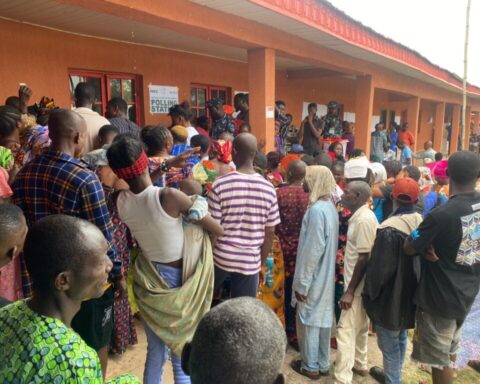
“They chased us away from our farms. We thought it would soon be over. Now, they have also chased us away from our homes, from our businesses. Can you see? Ehn. Can you see? Can you see? Houses locked. Nobody. Oro-Ago District, Oke Oyan, Kajola—everywhere. This is how they are deserted now. It is a very pathetic situation.”
I heard the above in a five-minute, forty-six-second video —a save-our-soul message soaked in tears. An old university classmate sent it to me on Saturday night.
Where I come from, every human experience has its bucket of proverbs. “Ẹmọ́ kú, ojú ọ̀pó dí; àfẹ̀rìmọ̀jò kú, ẹnu ìsà ń sọ̀fọ̀” (When the bush rat dies, its path is overtaken by weeds; when the striped ground mouse dies, its burrow mourns). If you are alive, your father’s compound is expected to be free of grass. These ones are not dead yet, but their parlours have stopped breathing. If I am allowed to say that the dead live, I would submit that, apart from stubborn goats manning the streets, lonely, grieving graves are the only other entities that remain in that Kwara community.
What the narrator says in the video is what 90 percent of communities in the North, and more than 60 percent in the South, would say. Yet, we insist we have a country.
Will that Kwara community, and others like it, agree that Nigeria is not finished?
The narrator in the video continues his monologue:
“If anybody had told us that we were going to witness what we are witnessing at the moment in Oroland, we would have said it was impossible. But… the situation we are in, in Oro-Ago District of Ifelodun Local Government Area of Kwara State, is beyond us.
“Insecurity in our domain, we must confess, is beyond our powers. This is our community. Deserted. Deserted. People have fled for their lives; left their properties, their farms, their businesses—everything. The whole community is deserted now. The whole district. The whole Oro-Ago District; even the suburbs—they are all deserted now.
“A place that was alive, bustling with commercial and agricultural activities—see the whole community deserted now. See. People left their belongings. From here to Oke Owa, down to Irabon, that’s how you see houses closed. Can you see? Houses closed. Nobody. Every house that was a home has now been deserted. I think this is beyond us… beyond us…
“And, as I am talking now, we even have some of our community members in the bush, kidnapped. We don’t know their situation. It is a very pathetic situation. It is sad—very saddening. We are worried; we are threatened in Oro-Ago District. Please, we are appealing to the Kwara State government, the federal government, and all who can to come to our aid. This is a situation which even our fathers and forefathers did not witness.
“We are appealing to the government to please do the needful. You did in the past; you started it well. But one should have known that these people would come with a reprisal. This is a reprisal attack on us. Ehn. This is a reprisal attack. The whole community is deserted. If you see anybody here now, maybe he is a vigilante or a stranger who does not have anywhere to escape to…”
Across our country, misfortune comes not lightly, but in overwhelming torrents. Shakespeare says so:
“When sorrows come, they come not single spies,
But in battalions.” — Hamlet (Act IV, Scene V).
The playwright was probably here when he wrote those lines. For there is yet another disturbing video showing hundreds of villagers in Nasarawa State—including children, women, and the elderly—fleeing on foot, on motorcycles, and in overcrowded vehicles to escape fresh bandit attacks that have killed several and destroyed communities. Reports say homes were burned, families displaced, and survivors forced to trek long distances with no clear destination.
Because it does not rain in Nigeria—it pours—yesterday in Benue, as villagers marked the resurrection of Christ on Easter Sunday, agents of death chose the day to kill and maim, leaving at least 17 people dead in Mbalom, Gwer East Local Government Area.
The rain has not stopped.
How much is a Nigerian life? I asked someone. The cynical respondent said he would have said a Nigerian life was priceless but, after watching and hearing the president at the Jos airport last Thursday, he now thinks human life in Nigeria is worth whatever value the leader places on it.
In Angwan Rukuba, Jos, on Palm Sunday, terrorist gunmen killed 27 innocent persons. And, so, the president was in Jos to mourn with the bereaved, lament the deaths, and promise justice and care. But he arrived with a recast of his “where-are-the-cows” comment of July 2019, when he visited a bereaved Pa Fasoranti who had just lost his daughter to murderous cowmen.
In Jos on Thursday, the president of Nigeria told grieving citizens who had lost loved ones to gunmen: “You have no light at the airport. I have to fly back within the next 10 minutes. To the victims, there’s nothing I can give you but a promise that this experience will not repeat itself.” What a promise! Òní l’ó mo, ìjà olè – ‘it will end today’ is a lazy man’s battle cry.
Consider the Oro-Ago man’s cries for rescue; think about the ten-minute airport stopover of our president; then recall the rescue of an American soldier in Iran at about the same time as the Nigerian tragedy. Compare Tinubu’s eunuch promise with Donald Trump’s proud announcement of a rescue operation: “We got him,” Trump declared. “Over the past several hours, the United States military pulled off one of the most daring search-and-rescue operations in U.S. history.” He added, with striking confidence, that the airman was injured but “he will be just fine… We will never leave an American warfighter behind.” As toxic as Trump is, one could still feel leadership in what he ordered, what was done, and in how he spoke.
Foundational leadership matters. If you build a shrine for excrement, you will worship flies. A Nigerian federal lawmaker from the North, in a viral video, laments what we lack and what America has: a working system of leadership. “The problem is failure of leadership. The country is going down. Everywhere, drums of war are sounding… Killings every day. What is the value of human life in Nigeria?” The senator asked in exasperation.
The president has already given him an answer: twenty-seven human lives lost to terror are worth ten minutes of a consolation stopover. To get the value of one, simply do the arithmetic: divide 27 lives by 10 minutes—and you will arrive at the official exchange rate of human life in Nigeria.