By Darlington Onedibe
Innovation took center stage yesterday as the grand finale of the 2026 National Engineering Olympiad (NEO) concluded in a thrilling showcase of engineering ingenuity. The prestigious event brought together academia, heavy-industry stakeholders, and the nation’s brightest young minds to celebrate groundbreaking technical solutions aimed at solving local infrastructure challenges.
Out of hundreds of initial entries nationwide, four top finalist universities pitched their working prototypes before a strict panel of industry judges.
The final podium saw an exceptional display of technical talent across various critical sectors.
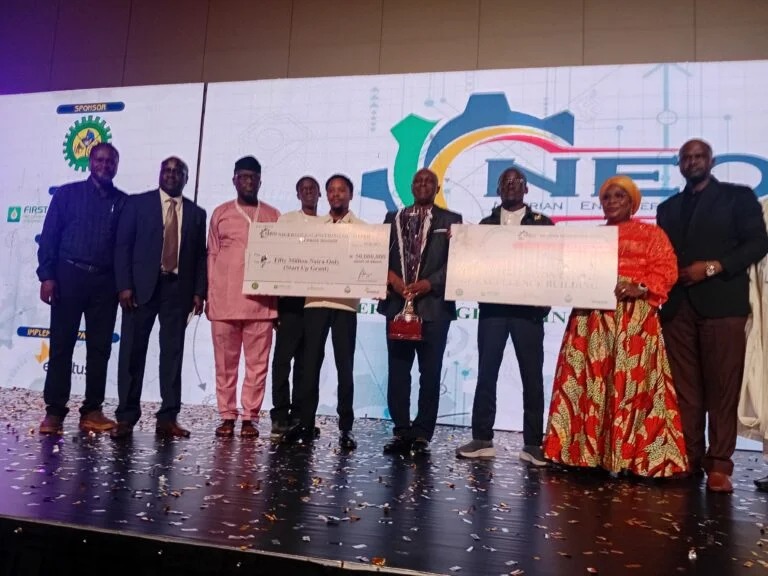
Team Mavericks from The Modibbo Adama University Adamawa emerged as the grand champion of the 2026 National Engineering Olympiad (NEO), securing the top ₦50 million prize at the grand finale held yesterday at the Eko Hotels & Suites, Lagos with the innovative design of A rapid automated emergency alert system for community security.
In 2nd Place was University of Ibadan (Team Aurora) with the “Aurora Birth” low-cost neonatal healthcare medical device, receiving ₦30 million cash prize and ₦75 million worth of engineering equipment for their faculty.
The University of Jos (Team Fortizo) came 3rd place with an Innovative solar-powered agricultural AI monitoring device. Claiming ₦20 million cash prize and ₦50 million worth of faculty equipment.
The University of Nigeria, Nsukka (Team Flameless) came 4th place with an off-grid renewable energy innovation. They walked with ₦10 million cash reward.
The highly competitive initiative, organized by the Nigerian Society of Engineers (NSE) in partnership with Enactus Nigeria, was made possible through a powerful coalition of industry sponsors dedicated to bridging the gap between classroom theory and real-world industrial application.
Sponsors were amazed by the problem solving devices designed by participants and course leadership. The key Sponsors include The Nigerian Content Development and Monitoring Board (NCDMB), Renaissance Africa Energy Company Ltd and FIRST Exploration and Petroleum Development Company Ltd (FIRST E&P).
Prominent industry leaders spoke forcefully about moving beyond “classroom prototypes” and pushing for industrial scale.
The President of the NSE, Mrs. Margaret Aina Oguntala, opened the presentations by highlighting the creative power of the youth.
“The future belongs to those who dare to create it. This is a deliberate investment in youth development, engineering entrepreneurship, and national growth. Our youth have ideas, but they need the sustained infrastructure of funding, incubation, and patenting.”
The Director-General of the National Agency for Science and Engineering Infrastructure (NASENI), Mr. Khalil Suleiman Halilu (represented by Dr. Emmanuel Ajani), delivered a strong call-to-action. He challenged researchers to transform prototypes into market-ready consumer products, announcing that the top three winners will be immediately admitted into the NASENI Innovation Hub for business mentorship and manufacturing support.
Furthermore, Mr. John Alamu, General Manager at FIRST E&P, alongside Mrs. Alexis Emele of the NCDMB, reiterated that corporate Nigeria is ready to ensure that brilliant student ideas do not simply sit and gather dust on academic shelves.
Echoing these sentiments, Michael Ajayi, Country Director of Enactus Nigeria, drew urgent attention to the nation’s demographic potential. With youth constituting roughly 70% of Nigeria’s population, Ajayi emphasized that the country must aggressively leverage this creative workforce to curb unemployment and drive self-reliance.
Representing the Nigerian Content Development and Monitoring Board (NCDMB), the Executive
Secretary, Omatsola Ogbe, whose words were delivered by Abayomi Bamidele (Director of Capacity Building at NCDMB) pointed out the strategic necessity of the Olympiad. Bamidele revealed that nearly 70% of engineering graduates currently lack the hands-on technical abilities aligned with modern industry standards.
“The Nigerian Engineering Olympiad embodies our belief that innovation must be nurtured where it begins, in the minds of young engineers,” Ajayi remarked. “By connecting academic creativity with industry realities, NEO provides the bridge that transforms knowledge into impact, and ideas into enterprise.”
Ajayi noted that the initiative will harness the raw energy of young Nigerians to solve real-world industrial and societal problems, effectively empowering them to build sustainable tech businesses and create future jobs.
”This gap has significant implications,” Bamidele warned. “It contributes to a shortage of competent local engineers, heightens reliance on expatriates, and fuels the brain drain as talented Nigerian engineers seek opportunities abroad.”
He affirmed that the NCDMB’s partnership with the Olympiad is a concrete step toward reversing this trend by reinforcing local capacity in robotics, digital technology, and petroleum engineering.
Bringing the prestigious night to a close, the NEO Steering Committee delivered the closing remarks. The committee congratulated all participants, noting that entries from the competition would be hosted on the official NEO repository to attract corporate buyers and private sector partnerships.
With the curtains officially drawn on the 2026 NEO Grand Finale, the message to the engineering ecosystem remains clear: academic research must now seamlessly integrate with commercial industries to drive the country’s next industrial revolution.