Yesterday, they asked for your vote against each other, drawing clear lines and sharper arguments, speaking with the urgency of men who wanted you to believe that the distance between them was not just political, but fundamental. Today, they sit together. Tomorrow, they may ask you to forget.
Yesterday’s rivals.
Today’s companions.
Tomorrow… coalition?
There are many gatherings in Nigeria.
Weddings bring families together.
Funerals unite even distant relatives.
Conferences gather professionals.
And then there is another kind of gathering that defies logic, history, and sometimes even basic memory. Political Convergence Without Explanation, or PCWE.
Entry requirement, selective amnesia and a working smile.
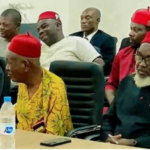
Somewhere in Kano, a table was set, not for a wedding or a funeral or even a formal conference, but for what appeared to be a simple visit, the kind that comes with the season, the kind that carries the language of culture and courtesy rather than strategy. Senator Seriake Dickson was there, as was Governor Seyi Makinde, and in the same orbit were former Governors Rabiu Musa Kwankwaso, Peter Obi, and Governor Bala Mohammed, all formerly of the Peoples Democratic Party, PDP. These names that, not too long ago, stood on different platforms, spoke to different crowds, and represented different promises of what Nigeria should become. They still do?
We were told it was a Salah visit, a gesture of goodwill, a moment of shared humanity that transcends politics. And perhaps, at the beginning, that was all it was meant to be. But in Nigeria, the line between courtesy and calculation is rarely as firm as it appears. Somewhere between the greetings and the photographs, between the quiet conversations and the unguarded laughter, something else began to take shape, something less visible but far more familiar.
Because in this country, politics has a way of entering the room without announcing itself. It does not always arrive with microphones and press statements; sometimes it comes dressed as tradition, cloaked in culture, moving softly enough that by the time you recognise it, it has already settled in. What began as Salah did not abruptly transform into politics, it drifted there, gently and almost naturally, like a conversation that finds its real subject only after the formalities have been exhausted.
And that is where the discomfort begins.
During elections, these same men do not share space like this. They are separated not just by party lines but by narratives carefully constructed to make those lines feel permanent. They speak with conviction about why the other must not be trusted, why the country cannot afford the alternative, why the choice before Nigerians is not just important but urgent. Their words carry weight, and that weight is transferred to the people who listen, who believe, who internalise those divisions and defend them with surprising intensity.
You are told that one represents hope while another represents structure, that one embodies reform while another offers stability, and gradually these distinctions harden into identities that citizens carry beyond the ballot box.
Conversations become arguments, disagreements become loyalties, and before long, the political landscape is no longer just about leaders but about the people who have chosen to stand behind them.
And then moments like Kano quietly undo all of that.
Because when men who once stood apart can now sit together with such ease, without visible tension or the residue of past disagreements, it forces a different kind of reflection. If the differences were as deep as they once appeared, they should still be present, lingering in posture, in tone, in the subtle language of discomfort. But there is none of that here, only the calm familiarity of individuals who understand that whatever separated them before was perhaps not as rigid as it seemed.
This is not to suggest that dialogue is a problem or that political actors should remain permanently estranged. On the contrary, engagement is necessary in any functioning democracy. But what this moment reveals is something more layered, something less comfortable to admit – that the rigidity of political division often exists more in the minds of the electorate than in the calculations of those they support.
In Nigeria, ideology frequently functions as a campaign instrument rather than a permanent anchor. It is sharpened when needed, amplified when useful, and softened when circumstances demand flexibility. The voter, however, is rarely afforded that same flexibility. You are expected to choose, to commit, to defend, and sometimes to fight for positions that the very people you support may later choose to reinterpret.
What the Kano gathering illustrates, in its quiet and unassuming way, is that Nigerian politics operates less like a battlefield and more like a marketplace, where alliances are not betrayals but negotiations, and where yesterday’s opposition can become today’s conversation without the need for public explanation. The real decisions are often made in spaces that are not televised, in tones that are not amplified, and in moments that appear, on the surface, to be entirely unrelated to politics.
So while citizens argue in absolutes, drawing lines that feel immovable, the political class moves within a different reality, one defined by possibility rather than permanence. They cross the very boundaries that the public is encouraged to defend, not out of inconsistency but out of an understanding that power, unlike rhetoric, requires room to adjust.
Seen from that perspective, the Kano meeting is not confusing at all. It is, in fact, perfectly consistent with a system where alignment is fluid and interests are constantly being recalibrated. What appears surprising to the public is simply part of a pattern that has repeated itself often enough to be predictable.
Yet, even with that understanding, a question remains, and it is not one that can be easily dismissed.
If what began as a Salah visit could so naturally evolve into a moment of political convergence, if the boundaries that once seemed so firm can soften without resistance, then perhaps the division was never as deep as it was presented. Perhaps, it was constructed, emphasised, and sustained because it served a purpose at the time.
And if that is the case, then the real tension is not between the men who sat at that table in Kano. It is between the narrative that was sold and the reality that continues to reveal itself in moments like this.
Because in the end, the most unsettling possibility is not that politicians can come together despite their differences, but that those differences may never have been as fundamental as we were led to believe.
And if that is true, then the question is no longer about why they can sit together.
It is about why we were so certain that they never could.
Shaakaa can be reached through: shaakaastephanie@yahoo.com