By Agbeze Ireke Kalu Onuma, AI-KO
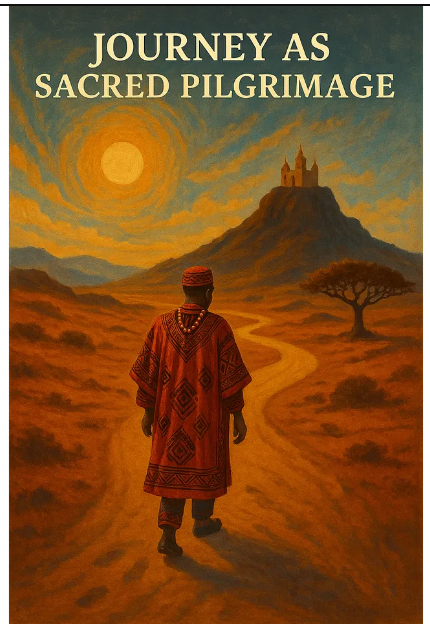
Life is a journey.
This journey of existence unfolds as a sacred pilgrimage – a slow unfurling from Spirit into flesh, and back again to Spirit. Lately, I’ve found myself sitting quietly in the evenings, turning over memories like smooth stones from distant rivers: trips made but never truly minded, rushed through like market days; journeys I failed to make, stalled by fear or circumstance; and those still shimmering on the horizon – places whispered in my prayers like unopened letters from God. But beneath these wanderings, restless as harmattan winds, stirs a deeper truth.
Travel, for us Igbos, is never merely movement. In our Igbo bones, we know it as ije ndụ – a sacred current flowing through the riverbed of existence. It’s written into our proverbs: “He who travels widely raises a wise child.” Every path taken, whether to the next village or across oceans, is woven into the fabric of our becoming, a thread pulled by the hand of one’s Chi.
I remember images of my Nkpọrọ folks arriving for the New Yam festival; their sandals cracked and dust-caked after walking long distances. They came not just with palm wine and stories, but with a quiet light in their eyes – as if the road had scrubbed their spirits clean. Nwa M, “The earth speaks when you walk slow enough to listen.” They understood what the psalmist knew: “Your way, O God, is holy. What god is so great as our God?” (Psalm 77:13). Our journeys are altars. They demand the sacred pause – the ritual breaking of kola (ịwa ọjị) before departure, where we whisper, Chukwu duzie anyi (“God, lead us”). Not merely for safety, but for revelation. Like Cleopas on the Emmaus road (Luke 24:13 – 35), who says we might not find Christ walking beside us in the guise of a Fulani herder sharing sour milk under a baobab tree, or in the patient eyes of a monk lighting candles in Armenia’s Geghard Monastery, his chants rising like incense from stone cut by faith.
Yet modern travel tempts us toward ije ọsọ ọsọ – the hurried journey. We scroll through glossy images of Santorini sunsets or Kyoto temples, mistaking consumption for communion. We pack itineraries like the rich fool’s barns (Luke 12:16 – 21), forgetting Augustine’s ache: “You have made us for Yourself, O Lord, and our hearts are restless until they rest in You.” The Stoic Epictetus warned, “It is not places that move us, but our judgements about them.” True pilgrimage begins not with a boarding pass, but with surrender: Chi ná ẹdụ, show me what You see here. Let me feel the ache in a Bolivian miner’s shoulders as he descends into Potosí’s silver veins – that I might pray with my hands. Or sit with Sami reindeer herders on Norway’s tundra, where the Northern Lights dance like the mmụọ (spirits) our ancestors honored, and hear in their joiks the universal cry for belonging. This is ije obi – the journey of the Soul – where borders dissolve, and Christ’s voice echoes in the stranger’s story, the shared meal, the unexpected kindness that bridges Babel’s ruins.
Wisdom for the Path
Igbo Identity & Discernment:
Our ancestral wisdom anchors every voyage: “He who acts in haste, his child inherits the consequences.” This calls for journeys undertaken with discernment – guided by ancestral insight and Chukwu’s hand.
Kola Nut Ritual Revisited:
The oji ceremony transcends ritual; it consecrates our compass. When elders invoke “Chukwu gozie anyi n’ije anyi” (“God bless our path”), they transform travel from checklist to communion with the divine.
Divine Companionship:
Whether walking with companions or alone, Christ’s presence manifests in shared stories, bread broken with strangers, or creation’s silent awe – echoing Emmaus but extending to all paths.
Sacred Itineraries:
Purposeful wandering means seeking God in unfamiliar terrain: crawling through Lalibela’s rock-hewn tunnels (symbolizing rebirth), or listening to Maasai elders read Scripture under acacia trees – fulfilling Revelation’s vision of “every nation, tribe, people, and language” (7:9) in worship.
Resisting Hustle Culture:
Ije Ọkụ Ọkụ (journey of haste) betrays our spirit. We Igbos cherish nwayọ bụ Ije (slow but steady) – a call to walk Jerusalem’s Via Dolorosa meditating on Christ’s suffering, or canoe Niger Delta creeks listening for God’s “still small voice” (1 Kings 19:12) in water lapping wood.
Stoic Vision:
As Seneca observed, “Travel changes not the soul, but the eyes.” Let yours see as Christ’s: in Bedouin coffee offered in Jordan’s deserts, recognize divine hospitality – “I was a stranger and you invited me in” (Matthew 25:35).
Pilgrimage of Reflection:
Ije Ntụgharị Uche demands journals like Desert Fathers kept. Record prayers by the Ganges amid Hindu chants; weep at Rwanda’s genocide memorials. These are altars where God meets us as He met Hagar (Genesis 16:7). The Igbo warn: “If one’s life is only within the house, they have nowhere else to go.” Venturing out shatters parochialism, teaching David’s humility: “When I consider your heavens…” (Psalm 8:3 – 4).
Labor as Worship:
Redirect toward Ije Ọrụ – journeys of labor. Teach Haitian children chalk-dusted hope; dig wells with Turkana women laughing through drought. Here, Onye aghana nwanne ya (“Be your brother’s keeper”) becomes flesh. This redeems travel – tourists become pilgrims, consumers become cultivators.
Surrendered Plans:
Hold plans loosely (Proverbs 16:9). A delayed flight may seat you beside a soul needing prayer; a storm rerouting to Sicily might unveil a village feast where fava beans and Psalms unite. Like the early church at Antioch (Acts 13), let the Spirit redirect for gospel fruit. Pack light: Scripture on your phone, a rosary for anxiety, a heart asking, “What is God showing me here?”
Closing Invitation
As you dream of roads untraveled – Thailand’s floating markets or Canada’s moss-draped Haida Gwaii – remember: Your suitcase carries your soul’s posture. Pack reverence. Pack listening. Pack the Igbo truth: “Your life exists where you are.” For in every step, sacred or stumbling, God awaits – not just at destinations, but in the dust on your feet, the blisters on your heels, and the sky unfolding within your soul.
On Journeys
A curated anthology of wisdom:
“A river that forgets its source will run dry.” (Igbo Proverb)
“The best journeys answer questions you did not know to ask.” (AI-KO)
“The real voyage of discovery consists not in seeking new landscapes, but in having new eyes.” (Marcel Proust)
“Walk as if the soil beneath your feet is praying with every step.” (Lalla, 14th-century Kashmiri mystic)
“Travel makes one modest. You see what a tiny place you occupy in the world.” (Gustave Flaubert)
“Let your path be prayer, your arrival gratitude, and your return a deeper belonging to the world.” (AI-KO)
“He who travels with the Creator never walks a lonely path.” (Igbo Proverb)
“The longest road is from the head to the heart; travel softens the distance.” (AI-KO)
“We are not human beings on a spiritual journey, but spiritual beings on a human journey.” (Pierre Teilhard de Chardin)
“Let your steps be prayers, your breaths praises, and your rest trust.” (AI-KO)