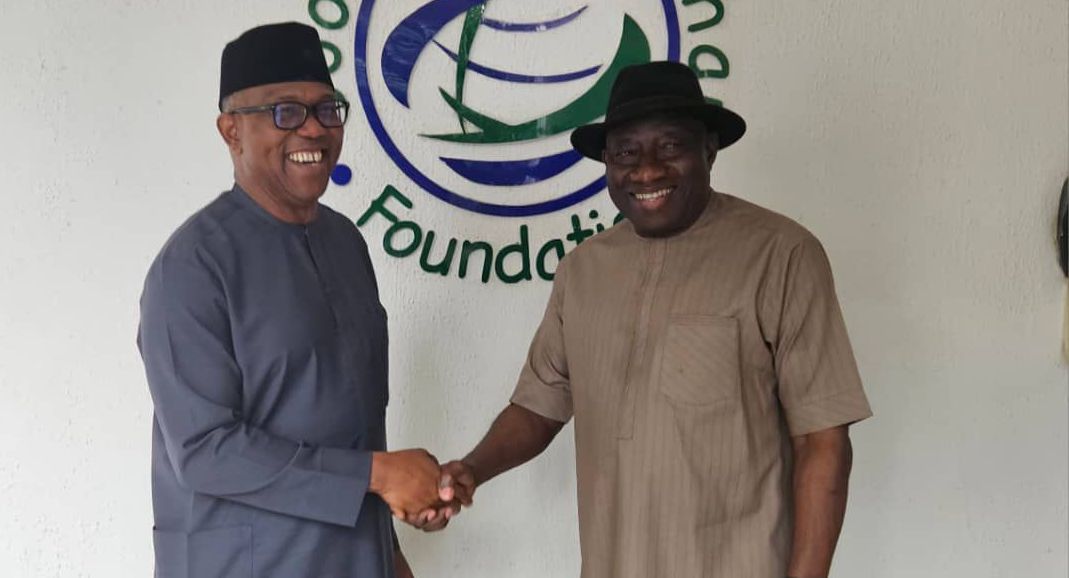
Fresh insights have emerged regarding the closed-door meeting between former President Goodluck Jonathan and former Anambra State governor Peter Obi, shedding light on what insiders describe as part of broader political consultations ahead of Nigeria’s 2027 general elections.
The meeting, which took place on Monday, immediately sparked widespread reactions across the political landscape, with analysts and observers interpreting it as a strategic engagement amid intensifying efforts by key political actors to reposition themselves ahead of the next electoral cycle.
Clarifying the purpose of the high-profile interaction, Obi’s former campaign spokesman and National Coordinator of the Obidient Movement Worldwide, Dr Yunusa Tanko, offered details in an exclusive interview. According to him, the discussion between the two prominent figures was rooted in national interest, dialogue, and the need for inclusive consultations as Nigeria approaches another critical political season.
Tanko explained that the meeting was not an isolated event but part of a deliberate effort by Obi to engage with respected leaders across the country, regardless of party affiliations. He noted that such consultations are essential in building consensus on key national issues and fostering unity in a politically diverse environment.
“This is about Nigeria first,” Tanko reportedly said. “Conversations like these are necessary if we are serious about addressing the challenges facing the country and charting a better course for the future.”
The interaction between Jonathan and Obi was held behind closed doors, a detail that has only heightened public curiosity. While neither of the principal figures publicly disclosed the full content of their discussions, the symbolism of the meeting has not been lost on political watchers.
Observers point out that Jonathan, widely regarded as a statesman with influence across party lines, remains a significant voice in Nigeria’s political discourse. His engagement with Obi, who continues to command a strong support base, particularly among young Nigerians, is being interpreted as a signal of potential alliances or at least mutual understanding ahead of 2027.
The meeting gained even more traction after it was publicised online by African Democratic Congress Vanguard, the mobilisation wing of the party’s coalition structure. The group shared videos and photographs from the encounter on its official X (formerly Twitter) handle, triggering a wave of reactions, speculations, and commentary across social media platforms.
For many supporters of Obi, popularly known as the Obidient Movement, the development is seen as a positive step toward broadening political engagement and strengthening networks that could prove crucial in future contests. Others, however, have adopted a more cautious stance, urging patience until clearer political alignments begin to emerge.
Political analysts say the timing of the meeting is particularly significant. With less than two years to the next general elections, consultations, alliances, and strategic meetings are expected to intensify across the country. Such engagements, they argue, often serve as the foundation for future coalitions, policy alignments, and electoral strategies.
In Nigeria, where political dynamics are shaped by a complex interplay of regional interests, party structures, and personal influence, meetings of this nature rarely occur without deeper implications. While it may be too early to draw definitive conclusions, the Jonathan–Obi interaction has undoubtedly added a new layer to the evolving political narrative.
Dr Tanko, however, cautioned against overinterpreting the meeting, emphasizing that dialogue among leaders should not always be reduced to political scheming. He reiterated that Obi remains committed to issue-based politics and constructive engagement aimed at national development.
As discussions continue behind the scenes and more political actors begin to make strategic moves, Nigerians are watching closely, aware that the road to 2027 is already taking shape in subtle but significant ways.
For now, the closed-door meeting between Jonathan and Obi stands as a reminder that in politics, conversations often precede coalitions, and that the future is frequently negotiated long before it is publicly declared.