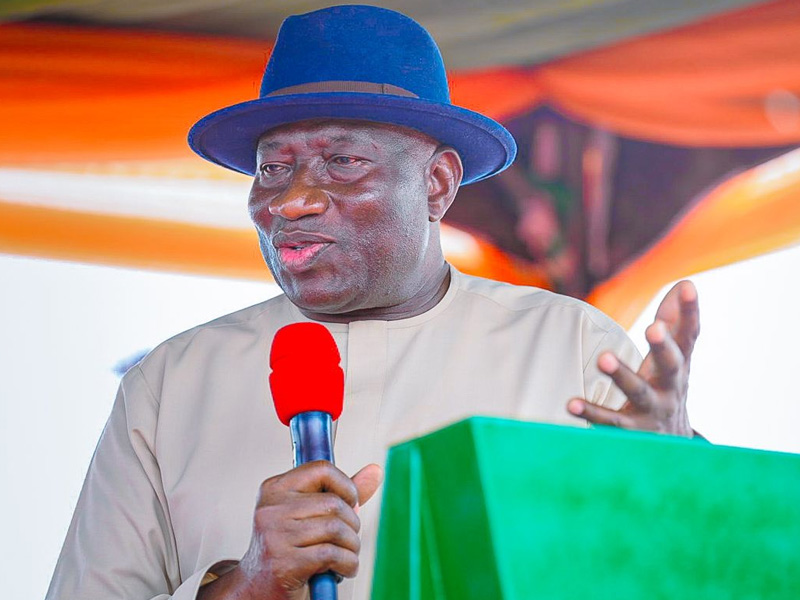
Former President Goodluck Jonathan has called for purposeful, honest, and visionary political leadership to repair Nigeria’s damaged international reputation and restore the global respect the nation once commanded.
Delivering the keynote address during the morning session of The Paul Alaje Colloquium (TPAC) 2026, themed “The Brand Nigeria”, at the NAF Conference Centre, Kado, Abuja, on Saturday, November 21, 2026, Jonathan warned that money-driven politics and primitive wealth accumulation by public officeholders are eroding democratic standards and stalling national progress.
Addressing an audience of policymakers, business executives, diplomatic representatives, and youths, the former president lamented that Nigeria’s global standing has been severely dented by persistent insecurity, corruption, unemployment, and weak public institutions.
He noted that some of the practices prevalent in the country’s political space do not represent genuine democracy, warning that the current brand of politics would set the nation backward because democracy operates on clear standards.
Jonathan also criticised contemporary politicians who rely on hired consultants to draft party manifestos without any genuine understanding of or commitment to those policies.
Urging leaders to prioritise legacy over personal enrichment, he pointed to the late Chief Obafemi Awolowo as a benchmark for visionary governance, recalling how Awolowo’s compulsory education policy transformed the old Western Region into a hub of academic excellence.
Emphasizing that national rebranding cannot be achieved through public relations campaigns or empty slogans, Jonathan maintained that real change requires merit-based appointments, productivity-enhancing agricultural policies, efficient transportation, and heavy investments in healthcare, education, and the younger generation.
Drawing a comparison with Singapore, which transformed its passport into one of the strongest in the world despite its small size, he cautioned Nigerian youths against the “quick-money mentality,” cybercrime, and drug trafficking, stressing that restoring the country’s image requires collective responsibility.
Speaking earlier at the event, the Convener of the colloquium and Senior Partner at SPM Professionals, Dr. Paul Alaje, noted that Nigeria’s reputational deficit carries steep economic costs, discouraging foreign investment while accelerating capital and talent flight.
Alaje identified governance and security, the economy and investment, healthcare, artificial intelligence, and the creative economy as the five critical sectors requiring urgent reform to strengthen the Nigerian brand.
Declaring that the Nigerian brand is not merely a campaign to be launched but a nation to be built, he urged stakeholders to ensure the forum’s resolutions translate into concrete policy shifts and institutional accountability.
Also speaking at the gathering, the Chairman of the Local Organising Committee, Fehintoluwa Oduekun, explained that Jonathan was selected as the keynote speaker because of his historic 2015 electoral concession.
Oduekun noted that a nation’s international credibility rests heavily on the conduct of its leaders, citing Jonathan’s peaceful transfer of power to an opposition party as a defining standard of statesmanship.