By Festus Adedayo
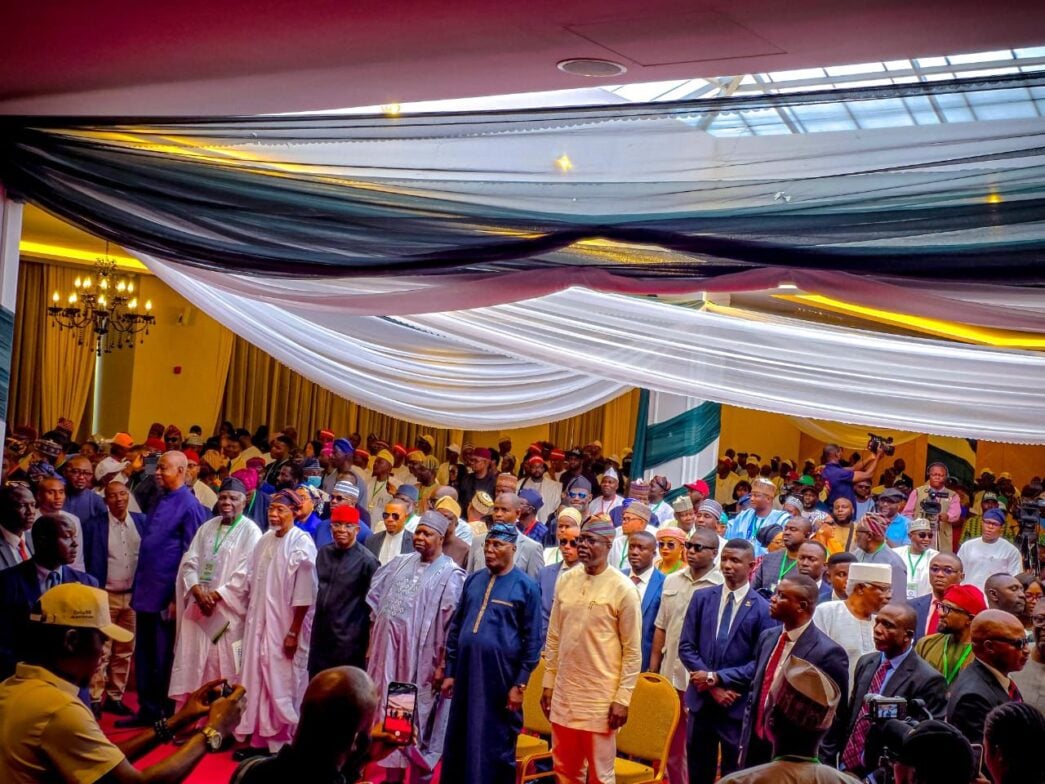
Yesterday, Seyi Makinde, governor of Oyo State, rallied Nigeria’s opposition political parties to Ibadan. According to him in his welcome address, the summit was to rescue Nigeria from the stranglehold of Nigeria’s apparent descent into autocracy, “a pattern where the space for real political competition is disappearing.” Ibadan summit’s message is an echo of a famous proverbial phrase and song of late Yoruba broadcaster and actor, Papa Adebayo Faleti, in the classic film, Saworoide. Faleti warned the maximalists of Jogbo country, especially its ruler, Lapite, a corrupt and ambitious king who skips traditional rituals to rule selfishly and perhaps forever, that there will be consequences for inordinate ambition. “Òrò yìí yó mà l’éyìn, àjàntièlè,” Faleti sang.
To underscore Ibadan’s historical centrality in recalibrating a drifting Nigeria and warning its rulers of calamity ahead, Makinde made reference to a similar summit held on Ibadan soil in 1950 and the calamity of Operation Weti e. A Yoruba word for “drench it” during the violent political crisis in Western Nigeria between 1962 and 1965 which led to the “Wild Wild West” anarchy tag. It was hallmarked by riots, arson and drenching of political opponents with petrol as a result of attempt to rig elections. That crisis became the precursor of the 1966 coup.
From January 9 to 28 of 1950, a review of the Nigerian Constitution took place in Ibadan to address shortcomings of the 1946 Richards Constitution. Ibadan welcomed fifty members of the Legislative Council where the push for greater autonomy and regional representation that laid the groundwork for the 1951 Macpherson Constitution was made.
Same summit held in Ibadan on October 19, 1954. On this day, some of the most influential nationalist figures of mid-20th-century Nigeria gathered in Ibadan. The mercurial Adegoke Adelabu was there. So also were figures like T.O.S. Benson, Dr. M. I. Okpara, Dr. Nnamdi Azikiwe, Dr. Okechukwu Ikejiani and another NCNC top-shot, Mr. Arimah. That gathering was a reflection of the importance and dominance of Ibadan as a major political force and battleground.
From the 1950 summit, to that of 1954, Ibadan has always been a hot-seat of roiling politics and attempt to reshape a broken Nigerian space. Ibadan never looked back. Its party politics is a hotbed of intense rivalry, shifting coalitions, alignment and realignment of interests. One of its markers was the infamous First Republic phrase, “If you see my hand, you cannot see the inner of me; Demo (NNDP) is the party I support” “B’òo r’ówó mi, oò rí’nú mi, Demo n’mo wà”. The Mabolaje-NCNC alliance conversation, held in Ibadan, prepared grounds for Nigeria’s October and December regional and federal elections. NCNC and the Mabolaje, a dominant Ibadan-based political movement, led by Adelabu, was mordantly opposed to Chief Obafemi Awolowo’s Action Group.
Music had a place of pride in this electrifying politics. In pre-colonial Africa, not only were musicians custodians of history, they were defenders of political figures. Their songs addressed political, social, and economic issues of society. At the Mabolaje-NCNC alliance of 1954 venue, though I have no empirical fact to back it up, I am almost sure Odolaye Aremu, Ilorin Dadakuwada music exponent, would be on the bandstand. As Hubert Ogunde was AG’s official musician, so also was Odolaye for the NCNC. You will recollect Ogunde’s Yorùbá Ronú song, a politically motivated rendition which was a total condemnation of SLA Akintola’s government. Odolaye also shot back with his adulatory dirge for SLA and Adelabu when both died.
Wrapped up in a unique traditional Yorùbá musical genre originating from Ilorin, Kwara State, which combines Oríkì (praise chanting), Òwe (proverbs), and Àròfò, (poetry) Odolaye delivered lacerating punches to counter the Action Group. One of such was his mockery of Awolowo’s free education policy which he claimed was not well thought out. He sang, “e jé ká ra léèdì (pencil) k’a si ra’we, iwe ti won ò rà télè télè láti kékeré o, ìgbà wo l’àá kà’wé t’ó di baba?”. On Adelabu’s car crash in 1958 while returning to Ibadan from Lagos, which led to riots and many deaths because he was believed to have been murdered, Odolaye made a cryptic quip insinuating he was murdered: “Death came for Adelabu suddenly… must we set trap for ourselves?” – “Ó kù dèdè k’ó w’Olúyòlé l’olójó dé o/Njé ó ye ká de tàkúté de’ra wa?”
In a few days time, I will be doing a public review of the book, Black Esther: The Tales of Ìyá Olóbì, My Grandmother. Written by Kayode Samuel, veteran journalist and former Chief of Staff to ex-Governor Gbenga Daniel of Ogun State, Samuel’s grandmother was a profoundly witty woman. Her grandson, the author, must have inherited her spellbinding wits. Ìyá Olóbì (Woman trader in Kolanut) was most times very prickly, especially on issues that had to do with Omo Yíbò (the Igbo).
She was a willing accomplice of the then spiraling mutual mistrust between Yoruba and Igbo which gained notoriety shortly before independence. Often times, Ìyá Olóbì manufactured other wordly-like stories that ended up as ethnic profiling of the Igbo. Undoubtedly, however, she was a parlour heroine, a victim of her own animus, a woman whose daily life was an admixture of women wiles, humour and mastery of the power of the Yoruba language.
Black Esther is full of Ìyá Olóbì’s linguistic nuggets. Let me single out two of those which exhibit her Yoruba mastery. They flashed through my mind two Saturdays ago immediately I saw the musical tantrums of Saheed Osupa, Yoruba Fuji music icon, whose real name is Akorede Babatunde Okunola.
On that Saturday, Ibadan attempted to erupt again. Not because of the catalyst for the eruption, a gubernatorial intention declaration, tucked away in an innocuous part of the city. It was Osupa’s descent into needless talkaholism.
As I said earlier, Ibadan has an unmatchable historical pedigree as epicenter of electrifying politics. Its politics has evasiveness and flamboyance. It is equally garnished with volatile swear words and name-calling. This gives it a remarkably competitive edge, more than many other cities in Nigeria. You may wonder why two gubernatorial aspirants in the same APC, Sharafa Alli and Bayo Adelabu, have declared and counter-declared to govern the state; why a neutralizing force in the person of Teslim Folarin is waiting patiently like a vulture to harvest their mutual destruction. Having captured 32 states, I am told, Ibadan is so important to Bola Tinubu that, he might personally relocate to Oluyole to monitor its 2027 gubernatorial election.