Damilola Charles
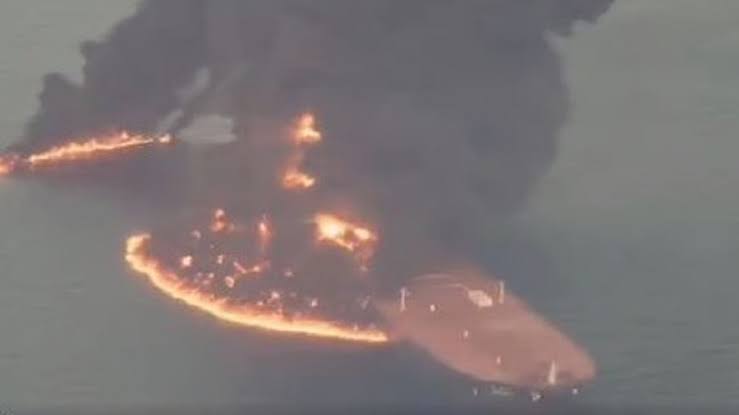
Two tankers and a tugboat caught fire in the Strait of Hormuz, Iranian media reported early on Thursday, citing the Islamic Revolutionary Guard Corps (IRGC).
One of the tankers struck a mine, the Fars news agency reported.
The report provided no information on what caused the fire on the second tanker.
The tugboat had approached to help fight the fires but then caught fire itself, according to the report.
The Iranian reports could not immediately be independently verified.
The Strait of Hormuz, a crucial shipping route for global oil and gas supplies, has recently seen repeated attacks on vessels.
The United States has blamed Iran for the attacks.
The number of ships that have reported being attacked in and around the Strait of Hormuz has hit a record high, BBC Verify analysis of data from a UK maritime agency shows.
Twelve vessels were attacked between 5 and 11 October – the largest number of weekly strikes reported to the UK’s Maritime Trade Operations (UKMTO) agency since the U.S.-Israeli war with Iran began.
The previous week saw 10 ships reporting attacks.
Six of the vessels were struck last Sunday, according to the UKMTO, a one-day high.
From October 5 to 11, there have been four reported attacks.
As the number of strikes has risen, the recovery in oil shipments through the strait seen last month has slowed, industry data suggests.
BBC Verify collated incident reports published by the UKMTO on its website and created a timeline based on the first date cited in each report.
This is approximate because some incidents use the date of the attack and some the date on which it was reported.
Experts say Tehran has been attacking ships in an effort to assert greater control over the waterway as the U.S. military has increased the number of tankers it is shepherding through the south of the strait to evade Iranian strikes.
Iran is also carrying out more attacks on vessels further away from the Strait of Hormuz, according to experts.
The U.S. military’s Central Command, which oversees operations in the Middle East, posted on social media that even with the attacks, “commercial traffic continues to flow through the Strait of Hormuz with co-ordinated protection from U.S. forces and regional partners”.
The aftermath of one of Sunday’s six reported attacks was captured in verified footage showing the Nicaragua-flagged tanker Petro Dolphin on fire, as filmed by the crew on a smaller boat nearby.
The vessel was struck by a drone close to the Sohar Anchorage, Oman, more than 250km (150 miles) from the strait, according to the maritime intelligence firm Vanguard.
Eleven Indian seafarers were rescued but two are still missing, the Forward Seamen’s Union of India said.
Attacks have continued this week with the container ship GFS Pride sinking after a strike by an unknown projectile in the strait on Tuesday. Twenty-one crew were safely evacuated.
Iran’s Islamic Revolutionary Guard Corps (IRGC) published footage of what appeared to be the same ship sinking.
It said the vessel was carrying “2,500 containers of contraband” and had taken an “unauthorised route”.
The recent increase in attacks comes as U.S. Navy data indicates the number of vessels assisted to navigate the Strait of Hormuz during the first 10 days of October was up 85 per cent compared with the same period in August.
Most of the oil being shipped from Gulf Arab states recently has been carried using a “shuttle” system where a fleet of tankers load up and sail through the strait before transferring their cargo to larger tankers in the Gulf of Oman.
These shuttle ships use a route close to Oman’s coastline.
Iran says this is “unauthorised” and insists vessels take an alternative route closer to its own shore.