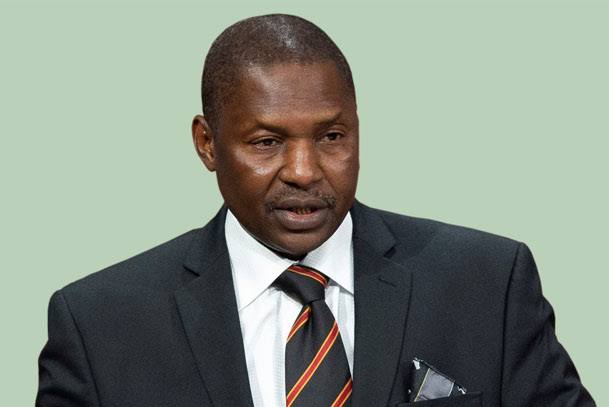
Former Attorney-General of the Federation and Minister of Justice, Abubakar Malami, has declared that he harbours no regrets over his time in public office, even as he faces a high-profile legal battle over alleged financial crimes.
Malami made his position known shortly after regaining freedom from prison custody, insisting that his actions while serving the country were guided by law and national interest. His statement comes amid ongoing prosecution over a 16-count charge of alleged money laundering brought against him and members of his family.
Also named in the case are his wife, Bashir Asabe, and his son, Abdulaziz Malami. The trio has formally pleaded not guilty to all charges filed by the Economic and Financial Crimes Commission, setting the stage for what is expected to be a closely watched legal contest.
Speaking through associates, Malami maintained that he would vigorously defend himself in court, expressing confidence that the judicial process would ultimately vindicate him. He emphasized that the allegations do not reflect the integrity with which he carried out his duties while in office.
“I have nothing to regret,” he was quoted as saying, reiterating his readiness to confront the charges head-on.
The legal drama surrounding the former minister has been marked by a series of dramatic developments. After an earlier period in detention at Kuje Prison, Malami was initially released, only to be rearrested on January 19 by operatives of the Department of State Services. The re-arrest added another layer of intrigue to an already complex case.
Observers say the case highlights Nigeria’s ongoing efforts to tackle corruption and enforce accountability among public officials, regardless of their former status. At the same time, it has sparked debate about due process, the role of security agencies, and the independence of anti-corruption institutions.
Legal analysts note that the not-guilty plea entered by Malami and his co-defendants shifts the burden to the prosecution to substantiate its claims with credible evidence. The proceedings are expected to test both the strength of the case assembled by the EFCC and the defence strategy of the former minister’s legal team.
As the case unfolds, attention will remain fixed on the courtroom, where Malami’s assertion of innocence will be weighed against the allegations levelled against him. For now, the former justice chief appears resolute, framing the moment not as a fall from power, but as a fight to protect his name and legacy.