By Agbeze Ireke Kalu Onuma, AI-KO
On the 26th of June, 2025, the news broke: a commercial tricycle rider in Aba, Abia State – Mr. Lucky Okoro – had returned ₦4 million forgotten by a Cameroonian woman in his vehicle.
I first encountered the story through a flurry of social media posts, each one more incredulous than the last. At first, I thought it was a satire skit. In a country where such sums vanish without a trace even in government vaults, the idea that a keke driver would not only return the money but also comfort the distraught woman and escort her to safety felt almost mythic. But it was real.
Okoro, a devout Jehovah’s Witness from Umuomei in Obingwa LGA, had discovered the bag after dropping the woman off at Ariaria Market. She was weeping, reportedly on the verge of suicide. He found her, returned the money, and refused any reward. “I need a new Keke,” he said, “but not another woman’s money.”
That line struck me as if it was lifted from the scripture. It wasn’t a declaration of honesty – it was a rebuke to a nation that has normalized theft, glorified fraud, and baptized greed.
As I started reflecting on the story of Lucky Okoro, what struck me was not the act itself but what it reveals about the climate in which it occurred. Okoro’s simple decision – to return a forgotten bag containing ₦4 million to a Cameroonian trader – unfurled across Nigerian social media like a miracle from a moral fable. She had been at the edge of despair, contemplating suicide. He was mocked and ridiculed, called “Mugu” by peers for returning money that could have transformed his life overnight. And yet he stood firm. For me, the gesture reverberated beyond sentiment; it felt archaeological, as though Okoro had unearthed a relic from a lost civilization – a glint of moral gold beneath the sediment of present day Nigerian cynicism.
His action reminded me of another, equally poignant: that of Emmanuel Obodoezie, also a keke driver, who returned ₦2.4 million to a passenger and was rewarded ₦1.4 million by Governor Alex Otti. Such men should not be anomalies. They should be the norm. And yet in contemporary Nigeria, such gestures are so alien, so contrary to prevailing norms, that they appear to us as flashes of grace – unexpected, disruptive, almost divine.
But what does it mean that returning lost money is now radical? That integrity must be rewarded not merely with gratitude, but with financial compensation and political recognition? It signals something terribly profound. We live today in a society where ethical courage is greeted with mockery, where honesty draws derision, and where conscience often results in punishment. The refrain of our time is clear: wealth, however acquired, is king; virtue, unless commodified, is folly.
Open in appSign up
Sign in
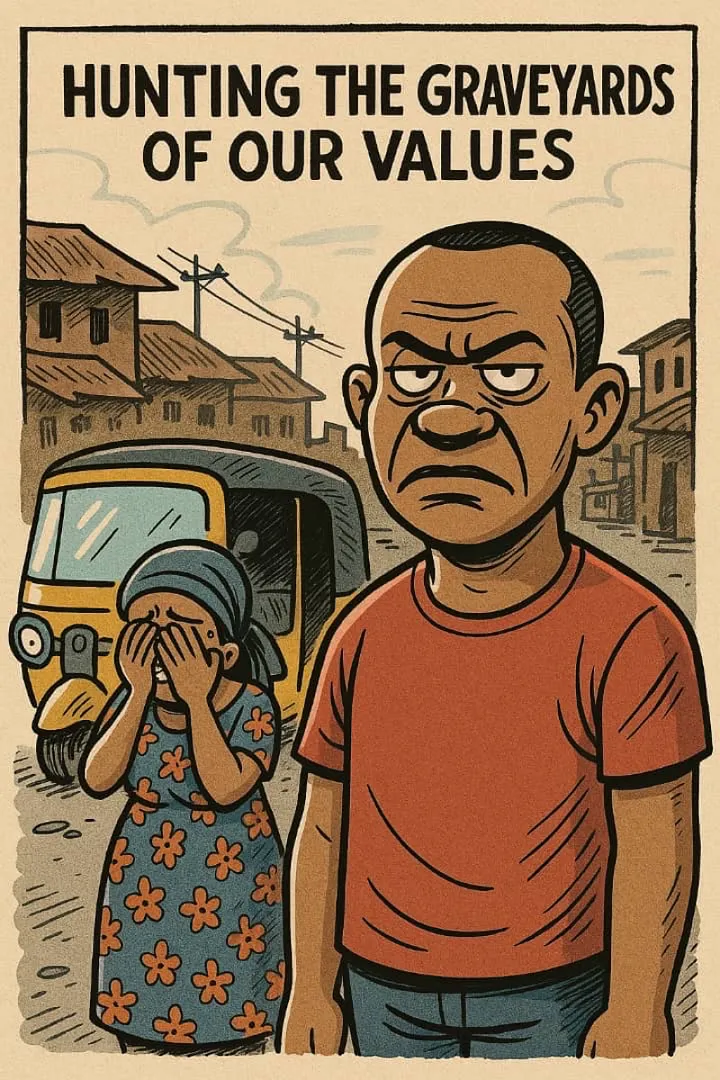
HUNTING THE GRAYEYARDS OF OUR VALUES: EXCAVATING ETHICS IN NIGERIA’S MORAL WASTELAND
Agbeze Ireke Kalu Onuma, AI-KO
Follow
14 min read·
10 hours ago
Listen
Share
By Agbeze Ireke Kalu Onuma, AI-KO
On the 26th of June, 2025, the news broke: a commercial tricycle rider in Aba, Abia State – Mr. Lucky Okoro – had returned ₦4 million forgotten by a Cameroonian woman in his vehicle.
I first encountered the story through a flurry of social media posts, each one more incredulous than the last. At first, I thought it was a satire skit. In a country where such sums vanish without a trace even in government vaults, the idea that a keke driver would not only return the money but also comfort the distraught woman and escort her to safety felt almost mythic. But it was real.
Okoro, a devout Jehovah’s Witness from Umuomei in Obingwa LGA, had discovered the bag after dropping the woman off at Ariaria Market. She was weeping, reportedly on the verge of suicide. He found her, returned the money, and refused any reward. “I need a new Keke,” he said, “but not another woman’s money.”
That line struck me as if it was lifted from the scripture. It wasn’t a declaration of honesty – it was a rebuke to a nation that has normalized theft, glorified fraud, and baptized greed.
As I started reflecting on the story of Lucky Okoro, what struck me was not the act itself but what it reveals about the climate in which it occurred. Okoro’s simple decision – to return a forgotten bag containing ₦4 million to a Cameroonian trader – unfurled across Nigerian social media like a miracle from a moral fable. She had been at the edge of despair, contemplating suicide. He was mocked and ridiculed, called “Mugu” by peers for returning money that could have transformed his life overnight. And yet he stood firm. For me, the gesture reverberated beyond sentiment; it felt archaeological, as though Okoro had unearthed a relic from a lost civilization – a glint of moral gold beneath the sediment of present day Nigerian cynicism.
His action reminded me of another, equally poignant: that of Emmanuel Obodoezie, also a keke driver, who returned ₦2.4 million to a passenger and was rewarded ₦1.4 million by Governor Alex Otti. Such men should not be anomalies. They should be the norm. And yet in contemporary Nigeria, such gestures are so alien, so contrary to prevailing norms, that they appear to us as flashes of grace – unexpected, disruptive, almost divine.
But what does it mean that returning lost money is now radical? That integrity must be rewarded not merely with gratitude, but with financial compensation and political recognition? It signals something terribly profound. We live today in a society where ethical courage is greeted with mockery, where honesty draws derision, and where conscience often results in punishment. The refrain of our time is clear: wealth, however acquired, is king; virtue, unless commodified, is folly.
The ethical collapse in Nigeria is neither accidental nor sudden. It is the product of many years of institutional betrayal, cultural dislocation, and societal fatigue. From unpaid pensions to crumbling educational infrastructure, the signals of state dysfunction are everywhere. I think often of Governor Otti’s unscheduled visit to Abia State University – how he encountered students cooking with dangerous kerosene stoves in filthy, dilapidated hostels. That encounter prompted a ban on those stoves and orders for renovation, but it was also a revelation: physical decay is often the mirror of moral erosion.
There’s something deeper here – the way infrastructure, or its absence, conditions imagination. When one daily navigates pothole-ridden roads, queues endlessly to verify pensions that never arrive, and watches unqualified politicians acquire wealth with impunity, what emerges is a societal philosophy of futility. In this climate, honesty seems eccentric, and goodness becomes indistinguishable from naivety.
This moral disfiguration finds expression in the language of the street. “Mugu” – once an insult reserved for victims of scams – has morphed into a generalized denunciation of virtue itself. To be upright, it seems, is to be foolish. We laugh uneasily, but the laughter conceals something grave: a society that can no longer recognize its heroes cannot remember how to become one.
I, too, am haunted by how deeply this distortion penetrates. Consider the reaction to Okoro’s gesture on social media. Rather than celebrating his integrity, many speculated that it was staged. “Arranged return of money,” they wrote. “My mind dey tell me say nah arrangee.” Such cynicism is not simply a private failing – it is the residue of long-standing public betrayal. We expect corruption, we assume manipulation, because it has become the only plausible storyline.
Yet it is not only in the realm of politics or street transactions that our moral architecture has crumbled. Our institutions – the very scaffolding of society – have become agents of ethical amnesia. Politicians fracture age-old clans by creating “autonomous communities” and installing compliant monarchs in exchange for political loyalty. The traditional stool, once a symbol of ancestral wisdom and moral authority, has been repurposed as a trophy for the highest bidder.
I find it increasingly impossible to disentangle Nigeria’s moral collapse from the deliberate hollowing out of its cultural soul. One needs only to examine the slow funeral procession of the Igbo language – its speakers dwindling, its proverbs forgotten – to see the contours of a much wider erosion. UNESCO warned, rightly and ominously, that Igbo risks extinction – not at the barrel of a colonizer’s gun, but under the roof of Igbo households, by the very hands that should cradle it. The erasure is polite, systematic, and often well-intentioned: parents forbid their children from speaking the language, insisting on English as the exclusive medium of aspiration and achievement. English is framed not merely as communication, but as salvation. In doing so, these families exchange fluency for fracture – surrendering not just a mother tongue but the indigenous compass by which morality was once taught and inherited.
Because language is not only a tool – it is a vessel. It carries idioms that encode restraint, customs that prioritize communal dignity, and metaphors that discipline desire. To abandon our language is to abandon the ethics shaped within it. What remains is a people fluent in ambition, but illiterate in ancestral wisdom.
But the loss of language is only one door through which decay has entered. We must also confront the haunting script we now hand to our children, one that begins with the differential training of boys and girls for moral ruin. The Nigerian male child is often forged in the furnace of materialism. From a young age, he is told – explicitly and implicitly – that his worth is pegged to his pocket. He is praised for “hustling,” regardless of the method. His manhood is gauged by the size of his bank account, the brand of his shoes, the weight of his wristwatch. Little room is left for tenderness, for self-reflection, for ethics. In his ears rings a refrain: “Make money, no matter how. Just don’t get caught.”
Conversely, the female child is often taught – sometimes gently, sometimes brutally – that her primary passport to relevance is her body. Her beauty is curated before her mind is cultivated. Her validation arrives not through accomplishment, but attention. And in this context emerges a new lexicon: “Slay queen,” “Baby mama,” “Sugar baby,” “Body goal.” These are not merely slang terms – they are cultural code words for a transactional femininity that rewards surface over substance. These phrases have no ancestral roots in Igbo or any Nigerian language. They are imports: shiny, globalized, colonized concepts, now encoded into local aspiration.
And so, the boy becomes a breadwinner by any means, while the girl becomes the bread – packaged, priced, and displayed for consumption. Both are victims of a society that has outsourced dignity and incentivized distortion. When we raise boys to see emotional vulnerability as weakness and girls to see sexualization as strength, we dismantle the very architecture of mutual respect on which any healthy society must rest.
This cultural engineering seeps into every corner of public life. Our music videos blare it. Our Instagram timelines rehearse it. Even our religious spaces often sanctify it by celebrating “testimonies” of wealth without questioning the path. What moral formation can survive in a country where the vocabulary of virtue has been traded for hashtags?
This cheating mindset is no longer a deviation; it is doctrine. It is taught, shared, mimicked, applauded. What used to shame us now thrills us. We are a people numbed to the sound of theft, deaf to the cry of conscience. In everyday conversation – at joints, offices, and barbershops – you’ll hear it, proudly paraded like a badge: “That was a clean kill,” one man boasts, describing a scam. “I chopped am and cleaned mouth.” Another chimes in, recounting the number of women he’s used, discarded, and defiled – each woman renamed with slurs, her worth compressed to anatomy. Listen closely, and you’ll hear it in the laughter. These are the new laurels. These are the medals we hang around the necks of the broken.
But let us not pretend that the rot is gendered only in one direction. Women, too, have learned to play this game. Many now curate lives around aesthetic manipulation, transactional allure, and calculated seduction. In some corners, sisterhood has been repackaged as competition: who can command the most “sponsors,” who can score the next vacuous Instagram validation. The term “slay queen” has become aspirational – a caricature of feminine triumph tethered not to intellect, creativity, or impact, but to visibility, desirability, and spectacle. And in all of this, we forget: none of these labels – “slay queen,” “bad guy,” “Oga at the Top” – have ancestral roots. They are not indigenous. They are imports – synthetic, colonial, corrosive. Yet we wear them proudly, as though they were kente.
What haunts me most is how this moral inversion has quietly, ruthlessly taken over every square inch of our lives. No domain has been spared. The home has become ground zero – where parents cheat power meters, falsify tax claims, bribe school officials for report cards, then lecture their children on “being serious.” The children are not fooled. They are watching. They learn not from instruction, but imitation.
Our churches and mosques have not only been invaded – they have been colonized. Pastors preach prosperity without principle, imams offer benedictions to politicians with blood on their hands. The sacred has been outsourced to the profitable. There is hardly an altar left where truth is not auctioned.
Even the streets – once the last bastion of raw, unfiltered community intuition – have surrendered to the ethic of “grab what you can before the next man does.” Everything is under siege: marriage, friendship, mentorship, governance. Nigeria is not just battling corruption of state; it is battling corrosion of soul.
And then there is the name of God. Once invoked with trembling reverence, now wielded with weaponized hypocrisy. The thief shouts “God knows my heart.” The adulterer swears “Na God go judge.” The contract inflator begins meetings with “Let us pray.” The murderer lifts his hands to heaven. In their mouths, divinity becomes a smokescreen. A justification. A disguise. And I confess – I am not only confused. I am angry. Righteously angry. How can we claim to fear the God we continuously mock with our actions?
What frightens me is not just the immorality – it is our comfort with it. It is the applause. The normalization. We don’t just witness wrongdoing. We rehearse it. Ritualize it. Reward it. Which is precisely why a man like Lucky Okoro, who returns forgotten money, becomes not a symbol of virtue but a victim of mockery. He challenges the new consensus, and so the world recoils. They call him “Mugu” because they no longer recognize a moral act when they see one.
This is where we are. A country dragging its moral carcass through the market square, still expecting applause.
Nigeria is under attack. But the real siege is not from without. There is no point praying for rain when the well within has already run dry. If the collective conscience of a nation is broken, no ritual, revival, or reform can mask the stench of its rot. We cannot outsource transformation to divine intervention while we bathe in duplicity. Until we re-sensitize ourselves to the sting of wrongdoing – until cheating feels shameful again, until kindness reclaims its place as wisdom – we are merely singing hymns in a crumbling temple.
So let us stop treating morality as performance and start living it as muscle – something trained, something tested, something real. Our redemption, if it will come, must start not from declarations on the pulpit or policies on paper, but from the silent rebellion of everyday choices: the student who refuses to cheat, the trader who sells without swindling, the parent who lives the values they preach.
We now inhabit a world where the pursuit of wealth is not only normalized – it is moralized. And the only sin left is getting caught. “Hustle” has replaced “hard work” as a virtue. “Packaging” has replaced “truthfulness” as a survival tactic. The family dinner table is no longer a site of intergenerational wisdom, but a stage where results are demanded without inquiry.
Is it any wonder then, that when a young man like Okoro returns ₦4 million, he is mocked as a Mugu rather than celebrated as a man? He acted from a moral compass that many can no longer read. His peers derided him not out of malice, but confusion – they could not locate him within the prevailing ethic. That, perhaps, is the most terrifying proof of how far we have strayed.
If our culture is a body, then language is its bloodstream, and values its breath. We cannot lose one and expect the others to remain alive. What is needed is not nostalgia, but moral re-engineering: to raise boys who know that integrity is manly, to raise girls who know that intellect is beautiful, and to rebuild a society where you don’t need to apologize for being principled.
This erosion is exacerbated by a systemic abdication of responsibility. As a moral philosopher of the street, I observe how education fails us not only in content but in character. The ICPC has acknowledged the need to embed moral instruction in core subjects – English, Mathematics, Civic Education – but implementation remains feeble. Schools have become factories of credentials, not crucibles of character. Meanwhile, television glorifies overnight success, and music extols fraud as hustle. Children now mimic online scammers, celebrating “yahoo boys” and fantasizing about rituals for wealth. What they absorb is not merely entertainment, but an ethics curriculum.
Yet, in this wasteland, there are still flames that refuse to go out. There is resistance – not only from individuals like Okoro and Obodoezie, but also in political innovations like those in Abia State. There, leadership celebrates not just efficiency but ethics. It was Governor Otti who publicly condemned preachers of “wealth without work,” who funded infrastructure renewal to restore dignity to the commons, who launched the “New Umuahia City” project to tackle urban decay at its roots. In those gestures, I detect the stirrings of something we have not felt in a long time: moral imagination.
Even institutions like the Universal Basic Education Commission are now waking up to the scale of the crisis. Their recent push for “moral regeneration curricula” is a tacit admission that ethics must be taught explicitly, or not at all. It is a fragile beginning – but one that must be strengthened by practice, not just policy.
The fight against impunity must extend to the commanding heights of our economy. Agencies like AMCON, charged with recovering toxic debts, are regularly obstructed by politically connected debtors who game the legal system. Sixty percent, by their own report, employ litigation to delay repayment indefinitely. If we cannot enforce consequences against the elite, how can we demand honesty from the vulnerable?
Here again, technology offers some tools – AI models like KREENO’s EmoRisk can flag behavioral risk in loan applicants; the Central Bank’s Global Standing Instruction allows automated recovery across bank accounts. But these tools mean little without the moral will to deploy them, and to deploy them fairly.
Even the law is not immune to corrosion. The American Bar Association’s recent ethics opinion – allowing lawyers to abandon clients when “no material harm” is caused – reminds me, chillingly, of how Nigerian leaders discard communal obligations for private gain. When even professional codes endorse selective loyalty, we must ask ourselves: what then anchors us?
If we are to chart a path forward, our culture must undergo urgent surgery. States should reward not only whistleblowers and reformers, but the clerk who refuses a bribe, the teacher who refuses to cheat on exam day, the trader who gives honest change. These are the new architects of hope.
Our educational systems must recover their civic soul. Instruction in indigenous languages should be mandated, not optional. Value-transmission must be embedded across subjects, not tacked on as moral studies. Media must cease its infatuation with spectacle and scandal and turn instead to spotlighting acts of quiet integrity.
But culture alone is insufficient without structure. Economic diversification is not only a policy imperative – it is an ethical one. When 7.8 million people in the Northeast rely on humanitarian aid due to climate displacement, desperation corrodes dignity. Investment in climate-resilient agriculture, green infrastructure, and education is moral infrastructure.
I believe, deeply, that the resurrection of Nigeria’s values will not come from miracle workers, but from ordinary people who choose to live by uncommon convictions. Like the Cameroonian trader who prayed over Lucky Okoro. Like the language teacher in Enugu who insists that her students recite Igbo proverbs before class. Like the anonymous father in Nsukka who told his children that prosperity is hollow if it silences conscience.
We languish today not for lack of moral exemplars, but because we venerate the grave-diggers of ethics – those who steal, and lie, and rise – while mocking the gardeners trying to replant our collective soul. Yet I insist: the tricycles of Aba carry more than passengers. They carry evidence that even in the graveyard of our values, bones still rise to speak.
And if I must be a “Mugu” to awaken what we have buried – honesty, compassion, communal duty – then let it be so. The excavation begins with me. And with you. And with each unflinching choice to plant again, despite the soil. We must teach once more that there is no wealth without restraint, no pride in exploitation, and no future in forgetting. If not, we risk raising a generation fluent in trends, but mute in truth. A nation rich in influencers, but bankrupt in influence.
Lucky Okoro is no “mugu.” He is not a tragic anomaly in a sea of cynicism. He is the quiet blueprint for the country we claim to want. In a land where honesty is mocked, where betrayal is monetized, where success is often forged in shadows, his act glows like a lantern in a collapsing mine. He is not the exception – we must make him the standard.
If we are ever to resurrect what has been buried in the graveyards of our values, we must carve new saints from the soil. Not those enthroned in marble or fattened by stolen applause, but men and women like Okoro – ordinary citizens who choose truth in a culture built on trickery. We need their stubborn decency. We need their quiet refusal to conform to decay. We need their courage to be ridiculed for doing what is right.
Because if there is any luck left for Nigeria, it lies not in oil wells or policy papers, not in another election cycle or foreign aid cheque. It lies in the return of our collective conscience – in the moment we stop treating goodness as weakness and integrity as madness. The nation we long for will not be handed to us; it must be built, one moral rebellion at a time.
And so, let us say it clearly and say it often: Lucky Okoro is not naïve – he is necessary. He is not a fluke – he is a forecast. If we have the courage to follow his lead, to become “mugus” for justice, then perhaps, just perhaps, we might get lucky turning this wounded nation around. Not by magic. But in the mirror. By looking deeply at men like him, and daring to become what we praise.
Nigeria is not irredeemable. Though the hour is late, and the fire is dimming. If we still believe in our own salvation, we must dig – not just graves, but foundations. And rebuild from the ruin.
Follow us on all social media platforms @dailyquery for news and analyses around the globe.