By Paul Sanusi
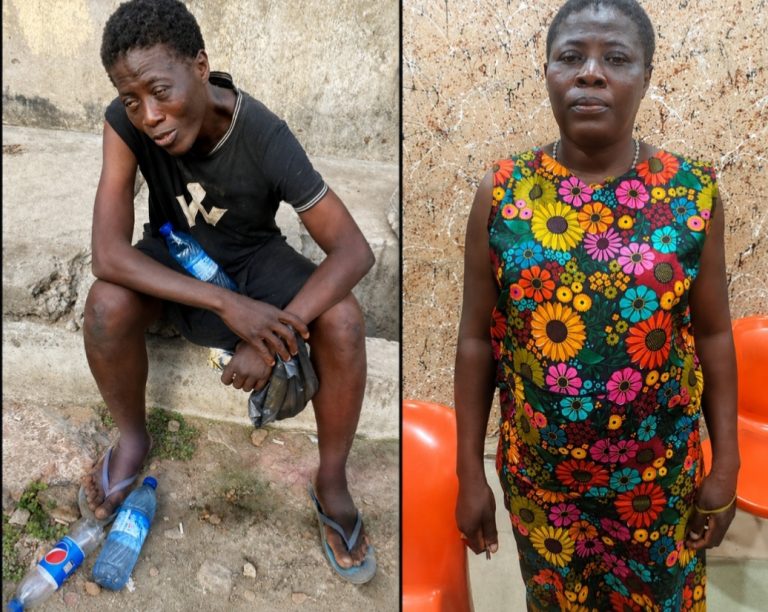
For years, the streets around Odaliki in Lagos Mainland were more than just familiar territory to Veronica Agakwu. They became her home, her refuge and, eventually, a painful reminder of a life that had slipped beyond her control.
Once a policewoman attached to the Odaliki Police Post, Veronica found herself living on the streets after her life was disrupted by mental illness, homelessness and separation from her family.
But on Tuesday, August 11, 2026, her story entered a new chapter. After more than two years of treatment and rehabilitation, Veronica was discharged from the Neuropsychiatric Hospital, Yaba, Lagos.
She walked out of the hospital not as the woman who had wandered the streets, but as someone being given another opportunity to rebuild her life.
Asked what she wanted most after her discharge, Veronica’s response was striking in its simplicity. “I want my house. I want to see my children,” she said.
Those few words carry the weight of years of separation and uncertainty.
For Veronica, a house is not merely a building. It represents stability, dignity and a place from which she can begin again. Her desire to see her children is equally profound, coming after years in which illness and circumstances kept her away from them.
Veronica, who bears police service number 028-345, recalled that the last time she wore the police uniform was in 2023.
According to her account, her uniform was stolen, after which her circumstances deteriorated and she became homeless. “I am a police woman with service number 028-345. My uniform was stolen in 2023, and I became homeless and I started smoking,” she recalled.
By 2024, her condition had become serious enough that concerned members of the community intervened and sought medical assistance for her.
A community refuses to look away: One of the people who became central to Veronica’s rescue was Rotarian Oluwaseun Williams, a community leader in Ebute-Metta.
Rotarian Williams had repeatedly seen Veronica wandering around the community. When he learnt that the woman is a police officer, serving at Odaliki Police Post, he became increasingly concerned about her condition.
His intervention eventually brought her to the Neuropsychiatric Hospital, Yaba. “Veronica was always strolling around my community. Because I learned she was a police officer at Odaliki Police Post, that was how she got used to that environment,” Rotarian Williams said.
He recalled that in 2024, he decided that something had to be done. He had met the management of the hospital at a lecture and approached them about Veronica’s condition. The hospital agreed to take her in, after which an ambulance was arranged and she was taken to the facility.
“That was how her journey of rehabilitation began,” he said.
For Williams, Veronica’s case goes beyond one individual. He believes it raises questions about how society responds to people living with mental illness, particularly those who end up on the streets.
He appealed for greater government and public support for the treatment and rehabilitation of people living with mental illness.
Medical treatment, he argued, is only one part of the solution. “What is most important for me is the integration into society,” he said. “We cannot leave her on the road in society like this. It is very painful, especially for someone who was in the police force.”
More than a hospital bill: For more than two years, the Neuropsychiatric Hospital, Yaba, provided Veronica with medical care, medication, feeding and other forms of support.
Rotarian Mary Akpan, Assistant Chief Administrative Officer at the hospital, said Veronica’s case was presented to the Medical Director, Dr Owoeye, who accepted it as a rehabilitation project.
Akpan said one of the hospital’s guiding philosophies was that mental illness should not be regarded as a death sentence., “anyone can come out of it,” she said, stressing the importance of giving people living with mental illness the opportunity to recover and return to society.
But Veronica’s treatment came at a considerable financial cost. According to Akpan, her accumulated hospital bill stood at more than N5.2 million at the time of her discharge.
The bill is now another obstacle confronting those trying to help her begin a new life. Yet Rotarian Williams insists that the money, while important, should not become the central focus. “The most important thing is integration into society,” he said.
That integration means finding Veronica suitable accommodation, ensuring that she continues to receive the care she needs, reconnecting her with her family and helping her regain a sense of independence.
A family waiting to reconnect: Perhaps the most emotional part of Veronica’s story is the separation from her four children.
She recalled that she married Bisi Adedokun, who worked with the Nigerian Railway, in 2004. The marriage produced four children.
But Veronica said she had not seen them since 2024. When asked whether she wanted to see them again, her face reportedly lit up as she said; “Yes, I want to see them again.”
The desire for reunion is now one of the central concerns of those working to reintegrate her.
One of Veronica’s siblings, Roi, acknowledged the family’s responsibility and said efforts would be made to address the challenges surrounding her reintegration.
He also expressed concern about the children’s welfare and the need for the family to work together to restore contact between Veronica and her children.
Roi said he intended to speak with other members of the family about accommodation and other immediate needs. “We will try our best in reintegrating our sister,” he said.
He also expressed disappointment over what he described as the lack of adequate support from Veronica’s husband.
There have been allegations that her husband abandoned her after the onset of her illness and that he sold two bungalows in Badagry allegedly built by Veronica.
There were also allegations that the children had been told their mother was dead.
Those allegations could not be independently verified, as several attempts to reach Adedokun by telephone for his response were unsuccessful.
A second chance, not a final destination. For the people who helped Veronica through her darkest period, her discharge from hospital should not be mistaken for the end of her journey.
That is why Williams, Akpan and others involved in Veronica’s rehabilitation are appealing to the government, the police, local authorities, her family and members of the public to support her.
And, above all, it is about Veronica herself. After years of illness, homelessness and separation, she has emerged from the hospital with a simple request: a home and the opportunity to see her children again.
Her rehabilitation at the hospital may have ended. Her recovery journey, however, has only just begun. What Veronica needs now is not pity, but support; not abandonment, but family; not another street, but a home, as she has been given a second chance.