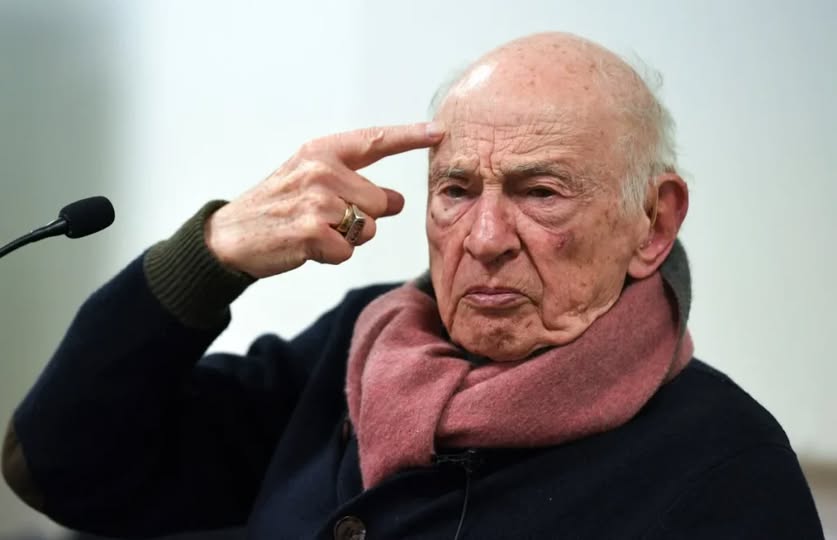
Renowned French philosopher, sociologist and filmmaker, Edgar Morin, has died at the age of 104, bringing to an end a remarkable intellectual journey that shaped debates on humanity, modern civilisation and critical thinking for more than seven decades.
His death was confirmed on Saturday by his wife, triggering tributes from political leaders, scholars, journalists and admirers across France and beyond who described him as one of the greatest intellectual voices of the modern era.
Often referred to as France’s favourite intellectual, Morin was celebrated for his relentless advocacy for tolerance, humanism and interdisciplinary thinking. He was also remembered as one of the last surviving members of the French Resistance during World War II, a movement that fought against Nazi occupation and fascism.
Paying tribute to the philosopher in a profile published in 2021, the left-wing French newspaper Liberation described him as “the grandfather of all French people and the memory of the last century,” reflecting the immense cultural and moral influence he wielded in French society.
Born to secular Jewish immigrant parents, Morin experienced firsthand the turmoil and persecution that shaped Europe during the 20th century. Those experiences would later influence his lifelong opposition to intolerance, authoritarianism and social division.
Throughout his career, Morin refused to limit himself to a single academic discipline. Though formally trained as a sociologist, he preferred the term “humanologist,” insisting that understanding humanity required drawing knowledge from multiple fields including philosophy, psychology, biology, history and ethnography.
His approach challenged conventional academic boundaries and inspired generations of thinkers seeking broader and more interconnected ways of understanding society and human behaviour.
Morin became internationally known for co-creating the groundbreaking 1961 documentary, “Chronique d’un ete” (“Chronicle of a Summer”), alongside acclaimed filmmaker Jean Rouch. The film pioneered what later became known as “cinema verite,” a documentary style built around spontaneous and unscripted interactions with ordinary people.
The documentary explored the lives, emotions and daily struggles of young Parisians through candid conversations about work, race, colonialism, relationships and happiness. Participants were repeatedly asked the deceptively simple question: “Are you happy?”
The authenticity and openness of the responses transformed documentary filmmaking and influenced generations of filmmakers around the world. Critics hailed the work as revolutionary because it blurred the line between observer and participant while capturing real human experiences in a deeply personal way.
Beyond cinema, Morin became a towering intellectual figure in France, frequently contributing to public debates on politics, culture, education, science and globalisation. His writings often focused on the interconnected crises facing humanity, including war, environmental degradation, inequality and the fragmentation of knowledge.
He consistently argued that modern society’s problems could not be solved through isolated academic disciplines alone. Instead, he advocated what he called “complex thought,” a method aimed at connecting different forms of knowledge in order to better understand reality.
In a 2020 interview with TV5 Monde, Morin explained his philosophy by asking a series of profound questions.
“What does it mean to be human? What is globalisation? What is life?” he said, adding that such questions demanded an approach capable of linking together knowledge scattered across different fields of research.
His ideas resonated strongly during periods of global uncertainty, especially during the COVID-19 pandemic when he urged societies to rethink their values, priorities and relationship with nature.
Despite his advanced age, Morin remained intellectually active well into his later years, publishing books, granting interviews and participating in public discussions. Admirers often marvelled at his sharp memory, curiosity and ability to engage younger generations in conversations about democracy, ethics and the future of humanity.
Known for his elegant dress sense, including his trademark hats and silk cravats, Morin became a recognizable cultural icon in France. Yet beyond his public image was a thinker deeply committed to dialogue, reflection and social justice.
French politicians, academics and cultural institutions on Saturday praised his enduring legacy, describing him as a rare bridge between history, philosophy and everyday human experience.
Many noted that his death symbolises the passing of one of the final intellectual witnesses to the tragedies and transformations of the 20th century, from World War II and the Holocaust to decolonisation, globalisation and the digital age.
Though he is gone, admirers say Morin’s ideas will continue to influence scholars, filmmakers and critical thinkers around the world for generations to come.
His life, marked by resistance, curiosity and a profound belief in human interconnectedness, leaves behind a lasting intellectual inheritance in a world still grappling with many of the questions he spent a lifetime trying to answer.