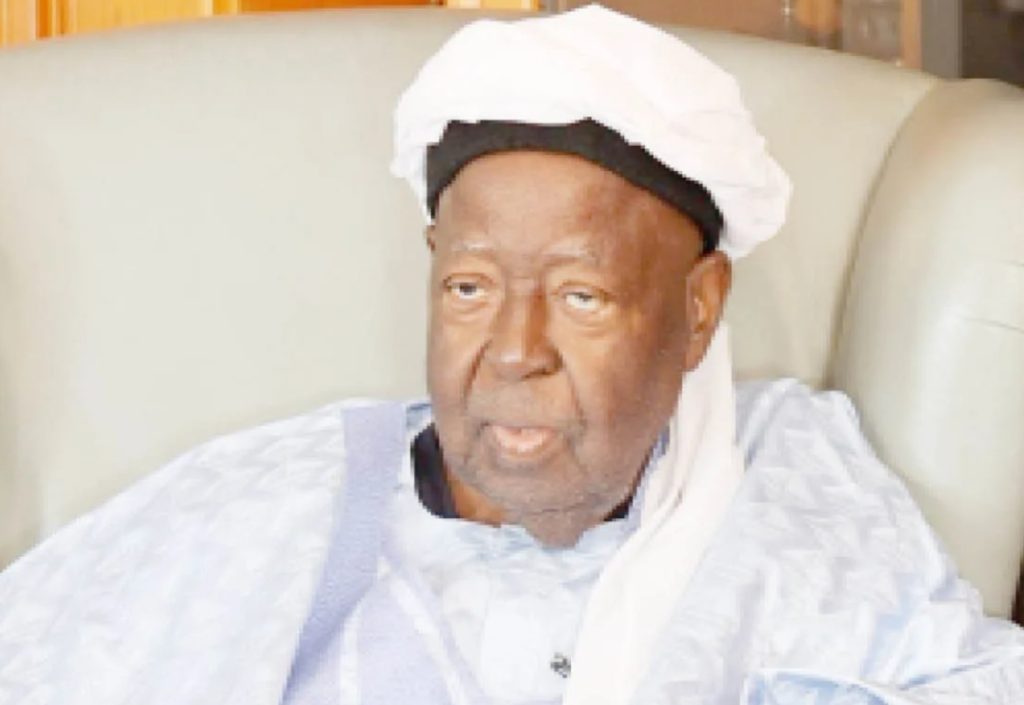
Nigeria has lost one of its most distinguished public servants following the death of former Minister of Finance and Sardaunan Sokoto, Alhaji Abubakar Alhaji.
His family confirmed the elder statesman’s passing on Thursday in Abuja, bringing to an end a remarkable career that spanned decades of public service, diplomacy and traditional leadership.
Alhaji Abubakar Alhaji was widely regarded as one of Nigeria’s finest administrators, having occupied several strategic positions in government and the civil service.
He served as Minister of Finance between 1990 and 1991 during the military administration of former President General Ibrahim Babangida, where he played a key role in shaping the country’s economic policies during a challenging period.
Before his appointment as Finance Minister, he served as Minister of State for Budget and Planning in 1988, contributing to national development planning and fiscal policy formulation.
Beyond his ministerial responsibilities, Alhaji also served as Secretary to the Government of the Federation (SGF), one of the highest offices in the country’s public service, where he coordinated government activities and advised the presidency on key national matters.
His career also extended to diplomacy, serving as Nigeria’s High Commissioner to the United Kingdom, where he represented the country’s interests and strengthened bilateral relations with Britain.
Throughout his decades in public service, Alhaji earned a reputation as a disciplined administrator, respected for his experience, professionalism and commitment to national development. He also held several influential positions within both the public and private sectors, leaving a lasting impact across multiple institutions.
Outside government, he occupied one of the most prestigious traditional titles in Northern Nigeria as the Sardaunan Sokoto, a revered position within the Sokoto Caliphate.
He was turbaned as Sardaunan Sokoto in 1990, succeeding the late Premier of Northern Nigeria, Sir Ahmadu Bello. In that role, he served as a respected bridge between government, the traditional institution and the people, earning admiration for his efforts to promote unity, leadership and public service.
His death marks the end of an era for many who regarded him as one of the last generation of seasoned administrators whose contributions helped shape modern Nigeria.
Tributes are expected to pour in from political leaders, traditional rulers, diplomats and associates across the country as Nigerians reflect on the life and legacy of a statesman who dedicated decades to serving his nation.