By Tiamiyu Prudence Arobani
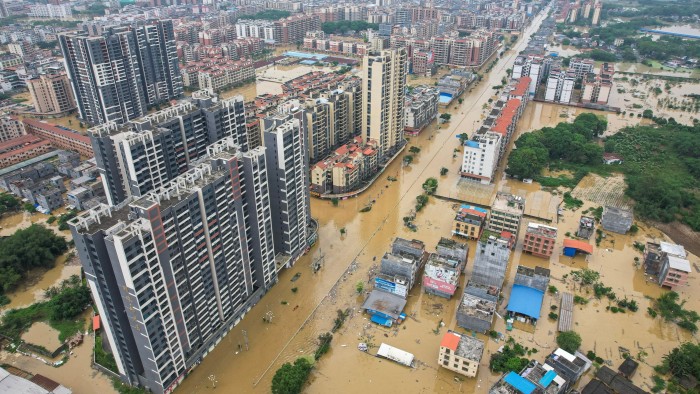
The UN World Meteorological Organisation (WMO) says there is no end in sight for floods and storms as global warming continues.
According to it, the world’s water resources face growing pressure from climate change while emergencies involving the life-giving resource are increasingly impacting lives and livelihoods,
“Water-related hazards continue to cause major devastation this year,” Celeste Saulo, WMO Secretary-General said on Thursday.
“The latest examples are the devastating monsoon flooding in Pakistan, floods in South Sudan and the deadly flash floods in the Indonesian island of Bali.
“And unfortunately, we see no end to this trend.”
Saulo said “2024 was the third straight year with widespread glacial loss across all regions.
“Glaciers lost 450 gigatonnes, this is the equivalent of a huge block of ice seven kilometres in height, seven kilometres wide and seven kilometres deep.
“Or 180 million Olympic swimming pools, enough to add about 1.2 millimetres to global sea level, increasing the risk of floods for hundreds of millions of people on the coasts.”
The report also highlights the critical need for improved data-sharing on streamflow, groundwater, soil moisture and water quality, which remain heavily under-monitored.
Saulo noted that the emergencies had been happening amid increasingly warm air temperatures, which allowed more water to be held in the atmosphere leading to heavier rainfall.
Her comments coincided with the publication of a new WMO report on the state of the world’s waterways, snow and ice.
The report notes that 2024 was the hottest in 175 years of observation, with the annual mean surface temperature reaching 1.55 °C above the pre-industrial baseline from 1850 to 1900.
Against this backdrop in September 2024, central and eastern Europe experienced devastating flash-floods caused by deadly Storm Boris which uprooted tens of thousands of people.
Similar disasters are likely to happen more often, even though they should, in theory, be extremely rare.
In the Czech Republic, several rivers flooded in an extreme fashion “that actually statistically should only occur every 100 years,” Stefan Uhlenbrook, WMO Director of Hydrology, Water and Cryosphere Division said.
“A ‘century event’ happened, unfortunately, statistics show that these extreme events might become even more frequent.”
The WMO report findings confirmed wetter-than-normal conditions over central-western Africa, Lake Victoria in Africa, Kazakhstan and southern Russia, central Europe, Pakistan and northern India, southern Iran and north-eastern China in 2024.
One of the key messages of the UN agency report was that what happened to the water cycle in one part of the world had a direct bearing on another.
Melting glaciers continue to be a major concern for meteorologists because of the speed at which they are disappearing and their existential threat to communities downstream and in coastal areas.
Follow us on all social media platforms @dailyquery for news and analyses around the globe.