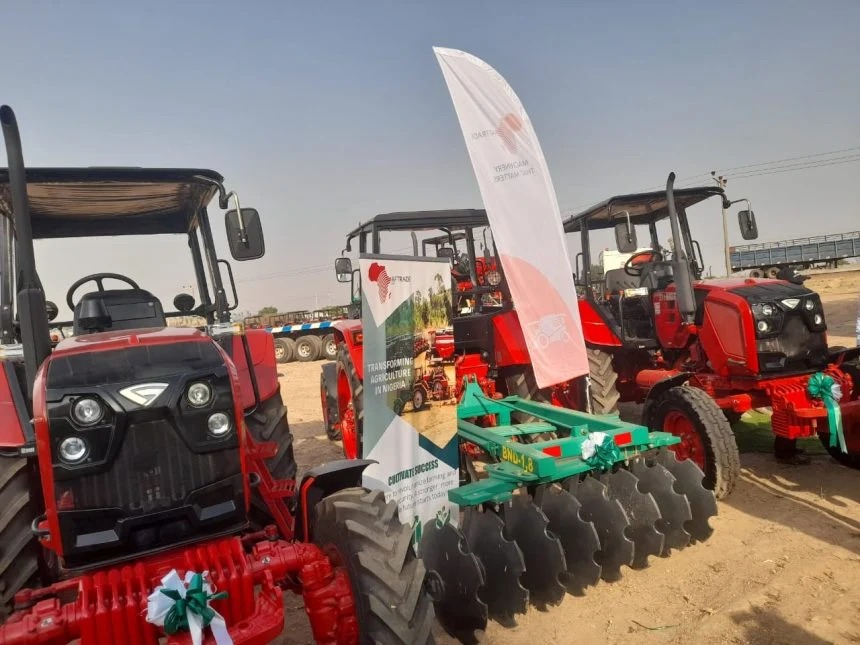
The Federal Government has rolled out 2,000 tractors and more than 9,000 precision farming implements in a bold move to ignite what it described as a national agricultural productivity revolution.
The equipment, aimed at boosting food production and strengthening national food security, will be distributed in phases across the country. The first batch of 600 tractors is set for immediate deployment, to be followed by 750 and 650 tractors in subsequent phases.
Minister of Agriculture and Food Security, Abubakar Kyari, disclosed this in Abuja yesterday, describing the Renewed Hope National Agricultural Mechanisation Initiative as the largest mechanisation drive ever undertaken on the African continent.
Kyari said the initiative was designed to tackle Nigeria’s long-standing mechanisation deficit, which has hindered optimal productivity and limited the capacity of farmers to cultivate large expanses of land efficiently.
According to him, the programme is expected to support over 1.2 million farmers annually and cover more than 1.5 million hectares of farmland, significantly improving yields and reducing post-harvest losses.
Beyond equipment distribution, the minister revealed that the Federal Government is also working on plans to establish a tractor assembly plant in Nigeria. The proposed facility, he said, would have the capacity to produce between 2,000 and 4,000 tractors annually, ensuring sustainability of the mechanisation programme and reducing reliance on imports.
Kyari noted that local assembly would not only guarantee steady supply of tractors and spare parts but also create jobs, promote skills transfer, and stimulate industrial growth within the agricultural value chain.
He emphasised that the mechanisation initiative aligns with the administration’s broader agenda to enhance food security, reduce food inflation, and reposition agriculture as a major driver of economic growth.
Stakeholders in the sector have long argued that Nigeria’s low tractor-to-hectare ratio remains a major obstacle to achieving self-sufficiency in food production. With the new rollout, government officials say the country is poised to narrow that gap and usher in a new era of modernised farming.
As implementation begins with the first batch of 600 tractors, expectations are high that the initiative will translate into tangible gains for farmers and contribute significantly to national food security.