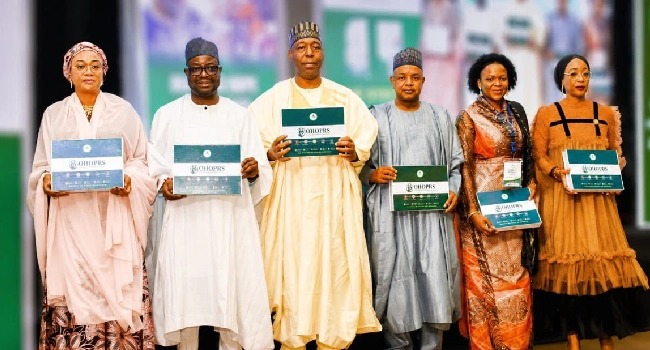
The Federal Government officially unveiled a $1 billion social protection scheme on Wednesday, August 26, 2026, designed to transition vulnerable citizens from short-term emergency relief to sustainable self-reliance.
The flagship initiative, named the Household Prosperity and Empowerment Social Protection Project (HOPE-SP), was launched during a high-level ceremony themed “From Palliatives to Pathways” at the State House Banquet Hall in Abuja.
Household Prosperity and Empowerment (HOPE-SP); Combines targeted immediate stabilization aid with long-term recovery models designed to lift 7.6 million vulnerable households across the nation out of economic dependency.
One-Humanitarian-One Poverty Response System (OHOPRS); A centralized national data mechanism built to eliminate overlapping interventions, streamline single-source registries, and monitor families along a digital “poverty graduation pathway”.
An Emergency Shock-Responsive Cash Transfer that Deploys rapid financial assistance directly to registered households affected by natural disasters, conflict, or economic shocks. Ministerial Blueprint & Humanity First Magazine: Formalizes strategic performance metrics for federal humanitarian agencies while establishing an official communication platform to track social impact.
Senator Oluremi Tinubu, First Lady of Nigeria who was a Keynote Speaker disclosed; “The Household Prosperity and Empowerment Social Protection Project is an important step toward strengthening how to identify and respond to vulnerable households facing various challenges by listening to their specific needs before taking action.
It is designed to provide immediate stabilization assistance while placing the households on a pathway to recovery, empowerment, and self-reliance.”
Dr. Bernard M. Doro, Minister of Humanitarian Affairs and Poverty Reduction declared in his speech that; “Nigeria cannot continue with a system where one vulnerable household receives interventions from several institutions while another equally vulnerable household remains unseen.
Our objective is not to keep Nigerians permanently dependent on assistance. We are moving from reactive relief to anticipatory social protection and from merely managing poverty to actively reducing it through measurable, data-driven poverty graduation pathways.”
Senator Atiku Bagudu, Minister of Budget and Economic Planning said “The administration’s ambition to build a $1 trillion economy by 2030 must be accompanied by deliberate efforts to ensure that economic opportunities reach Nigerians at the grassroots level across all 8,809 political wards.”
Professor Babagana Zulum, Governor of Borno State said “Directly addressing social inequality and vulnerability is vital to dismantling the root drivers of insecurity and building lasting economic stability across our regions.”
The project aggregates existing registries, including the National Social Register of roughly 20 million households into a unified, NIN-verified platform. Federal authorities will use this digital infrastructure to monitor individual household growth from initial relief entry through full economic integration into the national growth register.