By Odimegwu Onwumere
Nigeria waited four years for a substantive High Commissioner in South Africa. It got Femi Fani-Kayode.
He arrived in Johannesburg on Sunday, 25 October 2026, was received at O. R. Tambo International Airport by officials of the Nigerian High Commission and members of the Nigerian community, and told journalists his priority was to rebuild the bridge of friendship and cooperation between Nigeria and South Africa while protecting Nigerians living there.
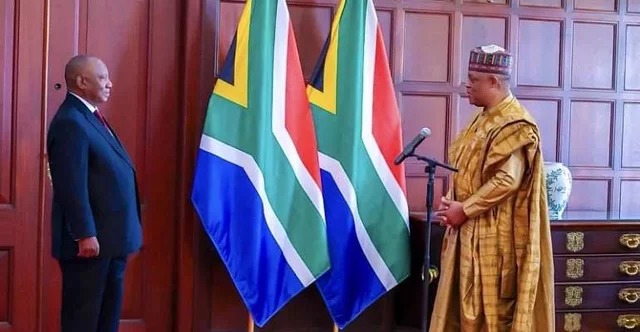
He was also concurrently accredited to Lesotho and Eswatini. On 30 October 2026 he presented copies of his letters of credence to Clayson Monyela at DIRCO and formally assumed duties. Then came Friday, 13 November 2026. At the Sefako Makgatho Presidential Guest House in Pretoria, President Cyril Ramaphosa received letters of credence from 15 envoys.
The event was livestreamed. Fani-Kayode claimed that of all 15 introductions and speeches, only Nigeria’s was cut out, that the feed died on his turn and returned only after he finished. He refused an SABC interview in protest. He posted a long public complaint on X. He claimed he took the matter to Ramaphosa himself. Within hours the South African Presidency uploaded a separate video of his speech. That should have closed the matter. It did not, because Fani-Kayode and his mission kept insisting that Ramaphosa intervened, and Ramaphosa’s spokesman, Vincent Magwenya, kept answering back in public.
Magwenya said the President does not intervene in operational matters at the public broadcaster and did not intervene for him, that Ramaphosa had only pointed him to Sophie Mokoena, the SABC editor who could clear the misunderstanding, that Fani-Kayode refused to speak to her, and that his approach on a minor operational issue he misunderstood was grossly inappropriate.
Then Magwenya went further: “Even when it’s institutionalised a lie remains a lie. There was no such intervention from the president or the presidency, and there will never be.
“Read our constitution and laws and familiarise yourself with the SABC editorial code. Stop disgracing yourself and your country.”
The Nigerian High Commission replied that Magwenya was the disgrace, that Fani-Kayode was treated with contempt and disdain and by extension so was Nigeria, and that they got the result they wanted. So on his first ceremonial day, after four years without a substantive envoy, Nigeria was not talking about trade, visas, xenophobia, or the safety of its citizens. It was trading insults with its host on X over a livestream.
That is not diplomacy. That is the same performance Fani-Kayode has been staging in Nigeria for years, only now the stage is bigger and the damage is international. A diplomat gets the video restored, shakes hands, files a quiet protest, and moves on to the real work. A man addicted to the crowd wants the clip, the outrage, the war of words. He got the clip.
He also got Nigeria labelled as a country whose envoy does not understand how South Africa works, does not know the SABC editorial code, and does not know when to stop talking. And the worst part is that the facts were never as clean as he made them sound.
Reports at the time noted that the livestream appeared to suffer a glitch while the French ambassador, Antoine Michon, was speaking, and Fani-Kayode was scheduled to speak after him. It was never established that SABC even operated the Presidency’s YouTube livestream.
But Fani-Kayode did not wait for facts. He went straight to accusation, straight to “some elements do not want to hear what we have to say,” straight to public confrontation. That is his method. Shout first, check later, and if you are corrected, shout louder.
Pretoria did not invent this man. Nigeria has watched him rehearse the same method on Ndigbo, in print, in public, and on social media, for more than a decade. The record is not rumour. It is dated, published, and quoted.
Start with 8 August 2013. Premium Times published his article, “The Bitter Truth About The Igbos.” It came after Lagos State under Governor Babatunde Fashola removed a group of destitute people, most of them said to be from Anambra, and dumped them at Iweka Bridge, Onitsha in the night. Former Abia Governor had called Lagos a no-man’s-land. Fani-Kayode answered not with a defence of the deportees’ constitutional right to live anywhere in Nigeria, but with a full attack on Ndigbo.
In that article he wrote: “Lagos and the south west are the land and the patrimony of the Yoruba and we will not allow anyone, no matter how fond of them we may be, to take it away from us or share it with us in the name of ‘being nice,’ ‘patriotism,’ ‘one Nigeria’ or anything else.”
He wrote that Lagos belongs to the Yoruba and to the Yoruba alone, that all others who reside there are guests, and that “the Igbos are the least close, the most distant and the least familiar with our customs and our ways.”
He wrote that Igbos have a domineering tendency and are not accommodating because they never had any history, monarchs or structured societies. He wrote that the Igbo introduced tribalism into southern politics. He wrote that unlike the Yoruba, the Igbo were not major industrialists but mere traders, and that the Yoruba were producing university graduates at least three generations before them.
Premium Times itself, in its 2013 review of Lagos newsmakers, quoted that line about no history, monarchs or structured societies and noted that the outrage was such that Nelson Okoli, National Legal Adviser of the Eastern Professionals Forum then, called reading it an ugly experience.
Vanguard, in a direct summary of the same article, listed the same claims verbatim: Lagos belongs exclusively to the Yoruba, the Yoruba were generous to allow Igbo back after the civil war, Igbo have a domineering tendency because they never had history, monarchs or structured societies, and the Igbo introduced tribalism. That is not a misquote. That is the article.
He went further, and this is the part his defenders always try to skip. In the same 2013 article he blamed the victims of the northern pogroms for their own slaughter. He wrote that it was the same attitude of “we own everything,” “we must have everything” and “we must control everything” that Igbo settlers manifested in the northern region in the late 50s and early and mid-60s that got them into so much trouble up there with the Hausa-Fulani and that eventually led to the terrible pogroms “where almost one hundred thousand of them were killed in just a few days.” Read that again.
A former minister of the Federal Republic, a man who once sat in the Federal Executive Council under Olusegun Obasanjo, wrote that nearly 100,000 Igbo people were killed in a few days because of their attitude. He did not call it a crime against humanity. He called it a consequence. He did not mourn the dead. He used them as a warning. That single paragraph tells you everything about how Fani-Kayode thinks about Ndigbo when he is not begging for their votes or praising Nnamdi Kanu for applause.
He has never withdrawn it. He has never apologised for it. Instead, he repeated the same logic in 2025, this time about the 1966 coup. On 24 February 2025, after former Head of State Ibrahim Babangida launched his autobiography, A Journey in Service, on 20 February 2025, Fani-Kayode posted on X and later published a piece titled “A Book That Stirred A Nation.”
Babangida had written that after the murder of Sir Ahmadu Bello and his wife Hafsatu, the putsch was infiltrated by outsiders to its supposed original intention and took on an unmistakable ethnic coloration, compounded by the fact that there were no related coup activities in the Eastern Region. That is what Babangida wrote. Ethnic coloration. Not Igbo coup. Not 99 percent. Fani-Kayode twisted it.
He wrote: “There is NOWHERE in IBB’s book where he said that the coup of January 15, 1966, was NOT an Igbo coup. In fact, he alluded to the contrary when he said the coup had taken on an ‘unmistakable ethnic coloration.’ That is what he wrote, and that is the reality. The coup was an ethnic one, and that ethnicity was Igbo!”
Then he invented the numbers: “99% of the officers who planned and executed the Jan. 15, 1966, coup and were involved in the mutiny were Igbo, and 99% of those murdered by them were non-Igbo military officers and political leaders, in some cases including their wives.”
He concluded: “The coup was UNMISTAKABLY an Igbo one, and IBB made this very clear.” That 99 percent claim is false on its face, and it was challenged at the time.
The coup plotters included Major Adewale Ademoyega, a Yoruba officer, among others. Major John Obienu, an Igbo officer, helped crush the coup. Babangida himself, who was on the ground, never wrote 99 percent. Fani-Kayode wrote it, because 99 percent sounds like proof, and because a lie told with confidence travels faster than history. He wanted to pin a military coup on an entire people, more than 40 million Nigerians, most of them not yet born in 1966, and he wanted Babangida’s name on it. Babangida never gave him that.
Then came 2022, and the same mouth turned on Peter Obi. On 7 October 2022, as Director of Special Media Projects and Operations and New Media for the Tinubu/Shettima Presidential Campaign Council, Fani-Kayode reacted to Obi saying he would only respond to presidential candidates, not their spokespersons.
His answer, published by TheCable, Leadership, and others, was: “You don’t respond to comments of presidential spokespersons because you are a mannerless dunce with low self-esteem and you have no answers.”
He added: “The insufferable arrogance and deceit of this shady character and strange-sounding little man called Peter Obi are such that it nauseates and confounds even the most restrained and tolerant amongst us. Simply put he is a charlatan and a modern-day walking disaster.”
He also said Obi was far too low down the ladder for any real candidate to debate, and that he would come a distant fourth. You can oppose a candidate. You can attack his record in Anambra. You do not need to call a former governor, a man who built businesses and governed a state, a mannerless dunce, a strange-sounding little man, a charlatan, a walking disaster, unless you enjoy the insult.
Fani-Kayode enjoyed it. He posted it, repeated it, and built his campaign relevance on it. The Sun, in May 2026, when his redeployment to South Africa was announced, asked the obvious question: will this man defend the Igbo in South Africa, after he had spewed negative narratives against them, after the Bitter Truth article, after the 2023 insults? That question was not asked by his enemies. It was asked because the record demanded it.
So when Fani-Kayode arrived in Pretoria and said he would protect all Nigerians, Ndigbo had every reason to ask: protect us from whom, and with what credibility? How does an Igbo trader in Johannesburg walk into the High Commission and trust that he will be defended with the same energy as anyone else, when the man behind the desk once wrote that his people have no history, no monarchs, no structured societies, that they are the least close guests in Lagos, that they brought the pogroms on themselves?
How does an Igbo mother whose son is arrested in Durban believe that the man who called Peter Obi a mannerless dunce will fight for her son without first checking his surname? Fani-Kayode’s defenders will say he has Igbo blood in his family, Igbo friends, that he later defended Nnamdi Kanu and spoke about Igbo marginalisation. That only proves the point. A man can praise you on Monday and abuse you on Tuesday, and still expect you to forget Tuesday. Ndigbo have not forgotten. They remember the dates. They remember the quotes. They remember the laughter that followed each insult.
That is why Pretoria is not a small embarrassment. It is a warning. Nigeria and South Africa have real problems to fix. Xenophobic attacks. Trade disputes. Visas. The killing and harassment of foreigners. The bad blood that has built up over years. Those problems need patience, quiet pressure, facts, and dignity. They need a man who can sit with a hostile spokesman, take a note, go back to his office, and get a result without turning the whole thing into a show. Fani-Kayode cannot do that.
He proved it in 2013 when he turned a deportation scandal into an ethnic war. He proved it in 2025 when he turned Babangida’s book into a fake 99 percent statistic. He proved it in 2022 when he turned a campaign disagreement into a string of schoolyard insults. And he proved it again on 13 November 2026, when he turned a livestream glitch, or at worst a protocol error, into a public fight in which a foreign spokesman told Nigeria to stop disgracing itself.
If Fani-Kayode wants to prove he has changed, the test is not a speech in Pretoria. The test is whether he will finally withdraw the Bitter Truth essay, apologise clearly for blaming Igbo victims for the pogroms, withdraw the false 99 percent claim about the 1966 coup, and stop using Ndigbo as a punching bag whenever he needs applause.
Until he does that, nobody should be fooled. The livestream row was not an accident. It was Fani-Kayode being Fani-Kayode, the same loud, reckless, tribal baiting he practised at home, now exported to South Africa at Nigeria’s expense. And Nigeria, and Ndigbo in particular, deserve better than to be represented abroad by a man who spent years talking them down at home.